20 October 2026
Getting Sales Out of the Owner's Head: What to Build First, and in What Order
Sales & Marketing
Frameworks like EOS give MSPs a common language, clear accountability, and structured decision-making — reducing chaos and helping teams stay aligned as the business grows.
Signs such as unclear roles, stalled growth, reactive leadership, or misaligned teams often indicate the need for a formal business framework to support scale and sustainability.
Implementing EOS isn’t just about process — it requires clear communication, leadership commitment, and staff engagement to ensure lasting impact and real business value.
Edited for readability from the episode audio — may contain minor errors.
Hi everyone, thank you for joining us. We will kick off in just a few minutes — we will just wait for a few more attendees to join. Let me get my screen shared.
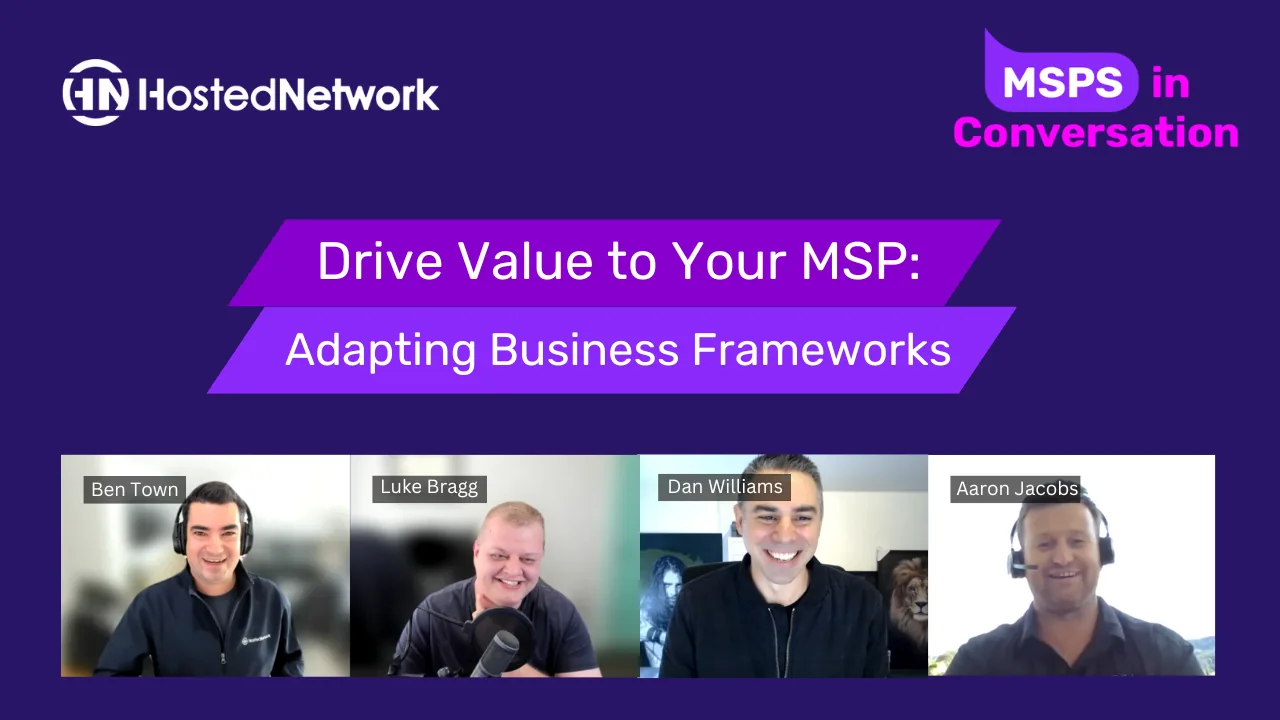
Well, thank you for joining us today, guys. Today's topic is on driving value to your MSP through adapting business frameworks. These last few MSPs in Conversation we've been talking heavily around operational maturity of your business, and business frameworks are a way that we can accelerate that. We've got on the line today Aaron, Dan and Luke. I will get each of them to introduce themselves in a second, but thank you for joining us, guys.
A little bit of housekeeping before we jump into it, though. For qualified MSPs, you will have all received an Uber Eats voucher for lunch — lunch is on us. If you haven't, please drop it into the chat; our team are standing by to answer any questions and sort that out for you if there have been any issues there.
Very quickly, and I won't do the sales pitch — who is Hosted Network? Hosted Network are an Australian wholesale cloud and telco provider for MSPs. Everything we do is about the partner experience. Our services range from desktop as a service, connectivity, infrastructure, and voice, and we serve well over 150 MSPs across Australia. Everything that we do is designed for MSPs. Most of you on the call will have already heard of us, so I won't go into too much detail there and we'll keep it on topic.
So, introduction to today's panelists, starting from left to right. Aaron, can you give us a quick intro to yourself and Rodin?
Yeah, sure, thanks, Ben. So, Aaron Jacobs, general manager, Rodin. We are 26 full-time staff, manage about 4,000 seats, based in Wollongong but operate over New South Wales and the country. I've been in business for 26 years, I think it is, and I've been with the business for about 19. So, yeah, long-time AOS partner, Hosted Network partner, doing it all.
Thanks. And Dan?
Awesome, thank you, thanks for having me. I'm Dan Williams. I recognize a lot of names in the participants list there. Twenty years or so in MSP land — I've earned every gray hair that I have from being in there for 20-odd years. Former owner and director of Powernet IT Solutions, a national MSP, about 80, 90 people. I've been out of that business for a couple of years now, and I've been an EOS implementer — certified EOS implementer — for four years. I also am the community builder, so I'm responsible for building the EOS implementer community, which is the coaching community, and also coaching them, so that's a big responsibility. But yeah, I appreciate you having me here today.
That's great to have you. And Luke, friendly face, give us a quick intro. Who are you?
For those of you who don't know me, my name is Luke Bragg. I have been working in, on and with MSPs for, I think, the better part of 15 years now. I've got the ticket — my birthday was on the weekend, so I can now say officially 15 years I've been doing this for. And I've only just started the gray hairs; when they start coming, they're coming for us. Oh yeah, they're coming. During that time I have worn many, many hats, but I am currently the operations manager here at Hosted Network and have been for what seems like forever — in a positive light, I hope.
All right, well, let's cover today's topic a little bit. I'm going to turn my share off so you can see our beautiful faces in a second. Today's topic is adapting business frameworks. You've already heard EOS mentioned a couple of times. One of the reasons that we're running today's session on this topic is that most of the high-performing MSPs in our partner community run a business framework. So when we were looking at what topics we can provide value to our partner base with, that was one of the ones that stood out most. Again, the high-performing MSPs, the guys that have run-rate sales, they're winning deals but they're also growing — they typically run some form of a business framework.
So today we've got Aaron as our use case of a business framework in an MSP, Dan is our industry expert, and Luke is our representation of how we've adapted it ourselves. Because, as many of you know, we started as an MSP, we had many of the same challenges. Business frameworks don't just touch MSPs — they really benefit all businesses — but we're going to keep the topic to MSPs mostly today.
Remember, today's session will be recorded, so don't worry if you have to drop off. We usually try to keep this to an hour, but we may go over a little bit, so if you do have to drop off, completely understand; we will send out the recording within the next day or so. And if you do have any questions, I really encourage you to drop them in the chat. This isn't a scripted session at all, so we do want to encourage you to jump in and ask any questions that you might have of our panelists today.
All right, let me stop sharing. So, Dan, I'm going to start with you, because you can probably give the most succinct answer given that you're an EOS implementer: what the heck is a business framework and why should a business look at actually implementing one?
Given we have an MSP community, it makes it really easy for me to explain it to you. A business framework is kind of like an operating system for your business. It sounds a little bit cheesy, but you know, we're peddling operating systems in terms of a platform you're running your PC or your Mac on — it's effectively like having a system in your business that is the foundation for everything.
One of the objections that I often get from people is, "I don't have time for something like that." It's actually designed to give you back time. By having a system that gives you a rhythm to run your business, to operate on top of — it's like a foundation — it gives you that control of your business.
Specifically, EOS — I'm not an expert in any other system, and I'm probably still on a path to mastery with EOS, if I'm honest; I don't think you ever really get there, to that mastering — the EOS is a really simple set of tools and systems that is designed to give you that control of your business. We have a promise as an EOS implementer that we'll give you three things: it's vision, traction, and healthy.
Vision is about clarity of vision — so where you're headed, why as well; it's an important aspect. Where you're headed, and we distill it into a really simple format so that you can share that with everyone in the business. I was speaking with a startup today who asked me if they could have half an hour to sort of get an understanding, and I said to them that most businesses don't have a plan. They sort of had a look on their face, then I said, "Do you have one?" and they said, "No, we don't." I said, "That's okay." This is really simple — it's a game changer just getting people on that vision.
The second one is traction, and so that's the tools and the processes. Simple things like how to run an effective meeting, how to plan 90 days at a time — really simple things that most businesses don't do well.
And the last part is healthy, and that's about having a healthy and a cohesive team. We focus on leadership teams through EOS; it's initially designed for leadership teams. We have a saying that as goes a leadership team, so goes the rest of the business. So if you as a leadership team feel like you're in control of the business and the operating system is working, then that perpetuates through the business. EOS is kind of a collection of those tools and processes that is really distilled into something that's easy to consume. It's really tempting for me to give you a longer explanation, but I'll leave it there — hopefully that makes sense.
Yeah, I'd like to think so. Okay, so we've mentioned EOS a few times now already. Aaron, before you adopted EOS — and Luke, in the research that you did for us — are there other models out there? I'm going to start with Aaron: are there, and why did you choose EOS?
Look, I'll be honest, I'll say there probably is, but I actually don't know. And the reason I don't know is — and I suspect it to be like many other MSPs — that you probably think there's not one for MSPs, that maybe it's just not right for you. You may be aware that there are things like that, but you could probably think it's not for us, we're MSPs, we don't really fit into another vertical or something of that nature.
For me it was just really — I had these sort of great ideas and understanding of what I wanted to do, but I was just not quite getting there. Or, like Dan mentioned, not having time and things like that. So yeah, there's other models out there, and when I came across EOS it was more about, "Well, hang on, this sounds very much like my style." That's what resonated with me from the hour or two speech that we had about it. It just sort of really clicked for me, and I kind of thought, "Hang on, this just really fits." So I didn't bother looking at others or comparing. I really just attached to it quite quickly and thought it really fits my style, and just really ran with it. That's where it fit for me, and that was somewhere between two and three years ago now.
Okay, cool. Luke, from your research for Hosted?
Yeah, we kind of went the opposite — the extreme opposite. We almost investigated and tried everything a little bit. Everything from, you know, the Getting Things Done sort of personal aspect, and trying to apply that to different departments. Trying to look at things like OKRs, the Objectives and Key Results sort of method, which almost kind of semi-suits into the EOS model anyway. And then I'd heard of TruMethods, but I hadn't experienced it very much — literally just Googling it, "Okay, that's cool, that's what it is." But yeah, we did a fair bit of research, and we actually ended up on a variation of EOS, believe it or not.
I probably should add there that there's the ConnectWise — Dan, probably help me out, I've forgotten, they've rebranded it a few times — what they call their partner community now.
The Evolve community, yeah.
The Evolve community, yeah. I've definitely heard some of the speakings and sat with a few of those guys, and definitely some approaches are different, I've heard them say, but some things are very similar. And Luke, you just mentioned OKRs — my wife works for a large pharmaceutical company, global, and they do OKRs. I literally sit there and listen to some of the things, 90-day goals, and I'm like, "Okay, cool," and then they say something else and I'm like, "That's an L10 meeting." Yeah, sure. So I think that's kind of the appeal of EOS — that there are lots of other systems out there, and EOS is really simple.
When Gino Wickman, the creator or co-founder of EOS, formed the operating system, he picked bits and pieces of things that he knew worked and that worked really well, and then supplemented gaps where he thought things could be improved. The ConnectWise community is more about planning — they have a model called Four Plans, and so EOS complements that. And then even TruMethods — quite a lot of businesses that are running on EOS, that have the operating system underneath, are using TruMethods on top to optimize their service delivery or the actual managed service component.
Really? Okay, it's interesting. So from that, it sounds like EOS is the OS, and something like TruMethods could be your ERP or your CRM.
Yeah, great analogy.
Yeah, okay, cool. So today we really are going to focus more around the EOS piece of it. If anyone has any questions that are a little bit off topic, in terms of maybe TruMethods or something, if we can answer it we certainly will, but given that we have someone that runs it and an EOS expert, and it's the one that we see in the market space the most, we'll focus there.
Dan — actually, this is probably best for Aaron — at what point did you look at EOS, or a business framework, and go, "Yeah, we need this"? The light-bulb moment.
Yeah, so for me, it was almost like I was trying to build AOS without knowing about EOS. My experience — I've been with the business for so long. We took over as GM eight-ish years ago, and for me, in those first sort of five years, I was really trying to set some frameworks and things like that. My predecessor was very big on — and this is probably very relevant to many MSPs on the line — a flat structure where everyone does everything. And I knew that doesn't work, basically. Or it can work to a point, but then you have to break through that. For me, that was all about breaking through that in those first years, taking over the business and really changing things around.
But then I did almost hit a ceiling. I got to a point where I was trying to do things and our meeting frequency just wasn't there — we were kind of just meeting monthly. And Dan, you know, now looking at EOS you think, "What the hell?" It's crazy. One thing for AOS is it's so obvious when you get into it, and when you're really doing it, everything you do is just so common sense, but it just puts it in a nice framework for you and delivers it. And we say "framework" like it's this big manual that you've got to work through — I guess there is a manual, so to speak, but it's very easy to follow. Dan's going to hold it up, there we go. Mine's on my shelf. It's so easy to follow.
But the light-bulb moment, going back to your question, Ben, was really just continually trying, writing a lot of notes down, coming up with ideas, "Maybe we should do this," trying to suggest to other managers and other people in the business, "Let's do this," not really getting there, maybe not getting buy-in, or maybe just not really being able to sell the vision properly. And then for me, just having an explanation given to me of what EOS is — like I said earlier, it just clicked. I thought, "Hang on, that is exactly my style." It's not over the top, everyone can relate to it, it makes sense. And then we kicked off with the two-day session, and yeah, it was funny, it was just there — it was really, really good basically from the word go. All my other staff were just bought in straight away.
Okay, so trial and error was sort of where you were at, and that was personally?
Yeah, not within the business. I hadn't allowed the business to waste time trialing and erroring. I had been trialing and erroring a lot in my head, and a lot of trying to suggest that people do things. But that was sort of the moment for me — I just knew we needed something a little bit more. We needed to grow, mature — our maturity level. We had the never-ending to-do list, but just never ever ticking anything off. So the concept of this 90-day and rocks and all of these things just fit. I was like, "Wait, that is so obvious, let's just do that." So yeah, absolutely, I drank the Kool-Aid straight away, I did.
And then the two people — I brought my leadership team to the first two-day session, which is the thing you do in EOS at the start. On the way they were like, "We really don't know what this guy's going to get out of us, Aaron." That's literally how the conversation went. And at the end of it it was like, "Oh my god, where did all that come from? That was amazing." So yeah, absolutely, a hundred percent, and I couldn't recommend it more to any other MSP on the call. It's a really great platform.
Okay, this isn't the sales call for EOS!
No, I know it's not, and I don't have to say that either.
And I guess that's a good point. Anyone talking about a business framework, or listening in and thinking about maybe adopting one — do they cost money? Dan, maybe you're better off answering this. Does it cost money to use the EOS framework?
Yeah, so it doesn't — you can self-implement, we call it, which — there's a whole Traction library. We have the main book that started the whole thing, which is called Traction, written by Gino Wickman. A lot of businesses — in fact, I think it's estimated that for every one business that's working with an EOS implementer, there are up to 50 who aren't, just in the US alone, which is kind of the main foothold for EOS. So you can do it on your own, absolutely.
In fact, I love it when I hear of businesses and they say, "Oh, you know, I love EOS, we're running Level 10 meetings, we're not working with an implementer at the moment, but we're running Level 10 meetings," and they're a little bit embarrassed. And I say, "That is awesome, I love that, that is nothing to be ashamed of. It's really cool that you've had the initiative to go out and learn these things and then implement them yourself." I wish I could say the same — Aaron said he didn't do trial and error on the business; there's at least one former team member of mine in the attendees who could attest to the fact that I tried everything before in my MSP.
But yeah, you can work with an implementer. There's an EOS implementer community, which I lead and coach in APAC, so there's 25 of us, and we charge what we call a session fee. If you want to work with an implementer, we'll take you through every step of the journey, and the unique thing about working with an implementer is that there's no contract. We don't say, "Hey, we want you to ink here for a two-year deal." We literally do it session to session. So we'll charge you a session fee, and here's the kicker — and this is something that no other coaching platform or operating system does — if you don't feel like you got value from those sessions, you don't pay. You just say, "I didn't get value today, so, Dan, I'm not paying." So I might cry myself to sleep that night and wonder where I went wrong, but I will learn from it and never make that mistake again, and you will have learnt hopefully something, and potentially continue yourself or continue with an implementer. But there's no reason why you couldn't pick up a copy of Traction today, read it cover to cover, and then start implementing those tools immediately.
You've mentioned the book Traction a couple of times. I'll just throw this out there for any qualified MSPs on the line as well: we are sending out a free copy of that. So that'll give you a good starting point to "what the heck is EOS," and you can go from there.
All right. So we do have a question there, Ben, just quickly on the — I think it's relevant. Brendan asked, his understanding was a minimum 24-month commitment to engage with the coach. I'll let you take that down, Dan, but I know that's not my experience.
Yeah, no, absolutely not. And if someone has said that, then I need to know, because I'm the coach for the community. No, what we do — maybe where it could potentially be a little confused — is when we start the journey together, we say we would like you to consider this to be like a two-year mental commitment, so that this isn't something that we just turn the key and voila, you have results. It's going to be a usually two-year journey of going from learning the tools and then through two years of annual planning. But there's no commitment, there's no minimum term, and like I said, even if you feel like you didn't get value, then you don't pay. So there's definitely no minimum.
And I would say that most of the businesses I'm working with — 23 MSPs right now — most of them have been with me for longer than two years, but at every step of the way I've said to them, "You're in control." There's one MSP that's stuck in my mind that I said to them after the first year, "You guys are rock stars, you've got this, I've never seen anyone implement this so quickly in their business. Just a reminder, you can go on your own at any time; I'm not the ball and chain."
Sorry, I'll let you finish there. And they said to me, "Dan, you're not" — I'll clean it up — "you're not going anywhere," because they liked having an external party to hold them accountable. It's like going to the gym — when you go on your own you can get complacent, "Oh yeah, eight reps is enough, I won't do the 10," or, "I'm not quite feeling it today, I might just call it quits after half an hour." But when you've got a personal trainer who you're paying to be there and they say, "Push, you're going to do 10," and you might not be feeling it, but we're doing the full hour — that's the sort of accountability that you get from an external party. So there's some skin in the game in that regard.
Yeah, absolutely there is. But I can see the potential confusion around the two-year thing, because, Dan, of the two-year plan — the cycles and the annual planning — so there is a two-year cycle there. And we've just finished our first two years, and I can hand on heart say that we've done and achieved more over the past two years than we have over the five years before that. It's been a great growth thing for us, and just the buy-in has been amazing. It probably took us the first year to get our stuff together, and then the second year was really flooding it down properly throughout the rest of the business and the teams.
Even just recently, we found a certain team that were trying to cram their L10 meetings — and I guess for everyone that probably has no idea what we're talking about when we say Level 10 meetings, that's the weekly meetings — we were trying to cram that down into sort of 25, 30 minutes. Ironically, we were having problems with that team, and that's when we found that out. They weren't doing IDS-ing — these are all terms from EOS — but they weren't talking about issues properly, which meant nothing was getting solved. We found the root of the problem was they weren't meeting properly.
It's really funny — at the start we got told, "You will never meet; you'll never have more meetings than you've ever had before." And like every MSP probably on the line, we were like, "No, surely — we don't have time for that many meetings." I think someone said, "You'll meet with your leadership team for an hour and a half every week," and we're like, "How the hell are we going to have any time for that?" And now, if we miss one — I think we've missed one in two years — it's like, "Jesus, what happened? We've got so much to catch up on, we've got all these things we need to sort out." It's just amazing having that pulse and being able to solve dramas just instantly. Weekly is instantly if you were doing things like monthly meetings, like we were before. That's far too long to address things. Nothing turns into a big issue anymore, because it's just brought up, addressed and moved on. It's just part of the process, part of the cycle, part of life, part of your week, and it's an amazing part of your week.
Cool. Okay, so you've been running it for two years, you've already gone through the pain points, the challenges. What are some of the challenges that you faced early on that our audience should be prepared for with any business framework?
Yeah, look, I know this — I'm really spruiking the Kool-Aid on AOS today, but I have to honestly say they weren't challenges, they were good things. I'm sure every business is in a different spot, but for us — the IDS-ing and getting uncomfortable stuff out is probably the biggest challenge, and it's more of a challenge for certain people. But to answer your question, Ben, it's probably documenting all the issues or stuff that you want to get done, or that are a problem, especially at the start. That first two days that you do, you end up with 70 things on the board, and you're like, "Jesus Christ, we've got a lot of crap to sort out." But it's just amazing to see how quick it gets ripped apart and sorted out once you get into this framework and you get into the pulse and you move through it.
So I guess the challenges, while they might seem like challenges, are really just getting everything out there — getting everything out of your head, getting all those things written down, and maybe looking at it going, "Jesus Christ, how am I going to overcome that?" But then the whole point of EOS is just breaking it down into little chunks and working through it, and it's amazing. Really, really good.
Okay, so Luke, in terms of our implementation — I'm going to say that we run EOS, yes, very lightly. We don't run it religiously; it's kind of what suits us, and maybe that's not the best practice. But what are some of the pieces — and maybe we've got more to go, potentially, as well?
Yeah, everyone's at a different stage in their business life cycle. It's a journey — you know, what do they say, sprint not a race? Never mind.
But what are some of the challenges?
That's the one, thank you. It's a sprint not a race, hang on — I'm like, that doesn't make sense.
Look, what are some of the challenges that we faced when we were considering it, and why did we do it? Historically, we've always tried to focus on partner experience, sometimes at the detriment of internal processes and documentation. It's just something that we used to be guilty of. We still keep partner experience up front and center, but we recognized, after reviewing all of these different methods, that different teams were working independently. For example, sales would do something and our service delivery team and our support team — we were effectively working in silos. We were working individually. We would work together, we were working well, but we were hitting that ceiling. I can't remember, I think it was Dan or Aaron that mentioned it before — we were definitely hitting that kind of glass ceiling where we weren't able to break past it unless we changed something. And that's where we kind of went, "Okay, let's make sure that we have all the right people in the right seats on the bus going in the same direction, and if we can't, well then let's see if this framework can help us do that." That's when we really did a lot of research into all those different methods that I mentioned, and that's when we kind of started the journey.
Yeah, and I think, interestingly, Brendan wrote in the chat that the biggest challenge was the People Analyzer. So just to pick up that point that you said there, Luke — that's the thing I see the most. The biggest challenge is having the right people in the right seats to be successful.
That's an incredible topic. We've been talking about that as well, and I think anyone on the line does need to look inwards in that sense and say, "Okay, do we have the right people?"
Yeah, and it's hard to know, like, how do you define "right people, right seat"? That's one of the things that I love. I can remember seven or so years ago starting EOS implementation using an implementer, as the MSP owner, and just thinking — he kept talking about right people, right seat, and I'm like, "Yeah, yeah, cool, everyone knows that, but how do you know those things?" But literally by the end of your second day in the EOS process, not only have you got to find who the right people are, but also what the right seats are, and what the potential future seats are — what are the gaps, what are your blind spots.
Once you have that, that is when the real work starts. Because some of those calls are going to be people who are absolutely the right people — they share your values, they're the heart and soul — but they're just ineffective in their role. And that can be heartbreaking sometimes, to think, "Actually, they're in the wrong seat." So EOS gives you that opportunity to say, "Is there another seat for them? When we look at our structure and the needs of the business, is there another seat for them?" Because if there isn't, as much as you love them, you're probably holding them back, and if you love them, you need to let them go. And same token, you might have a superstar, stellar performer who's absolutely in the right seat, but they're not the right person — they don't share your values — and in another way they're actually going to bring you down as well, because they become the standard. You compromise on your values with that person because they're performing well, and EOS forces you to confront that. You still have to do the work and want to do something about it, but that's absolutely the most common challenge that I see, and I can vividly remember that, being the MSP owner going through that as well.
One of the best things that I found — and god, we are speaking a lot about EOS, but it's just because it's just there — is the way that the framework doesn't break down an organization in a hierarchy like a standard organizational chart. It breaks it down into your actual roles and responsibilities. I remember when Ben and I were doing it, it kind of changed our mindset overnight. It was like, "Oh, everything fits now. We actually understand that that person — maybe we can move them there," etc. It was almost like a flip switch. I think I mentioned that before — it was just like, "Wow, okay, let's do this." And as we went through that journey of changing things, we were able to see the impact — not overnight, but almost immediately we could see people were happier, we had different outcomes, we had a lot more positive outcomes. We definitely went from a couple of people going in the wrong direction to — I always like to use the analogy, instead of a bus we were on a speedboat, everyone in the speedboat going in the same direction. It's a fantastic feeling.
Yeah, I love the speedboat analogy, because they don't have brakes.
Yeah, exactly, that's good. I like that. I think someone said to me at one point — you mentioned before, Dan, it was like, "You may love them, but you may have to let them go because there is no seat." Someone explained to me once, it was a story about, you know, time to get a new pair of shoes. It's that kind of concept, right? If you put the wrong size shoes on someone's feet, all the time it's going to burn, it's going to hurt, and it's just going to wear that person down. Put them into somewhere where they've got the right shoes on, let them go, and then you find someone for those sort of shoes.
We've actually got an upcoming topic, another MSPs in Conversation — I'm going to say this now before Merrill pings me to say that — it'll be on human resources, and finding and how to maintain staff, because it's been a recurring topic throughout this. People are the lifeblood of our organizations, so it's a tough topic.
Oh yeah, that sort of area — I'm yet to find anyone that can do that easily and well. Some people just have a knack for it. I mean, I was talking to a partner today, maybe yesterday, and they were stagnant, realistically, and it wasn't until they actually found someone they could trust to hand off to — and they're a smaller organization — as soon as they found that, their life changed. Previously it was because the wrong people were on the bus.
So with that, let's talk about the size of MSP. Dan, Powernet was a larger MSP really, in our community, and Rodin's are fairly substantial. What size do you need to be? Can you be a one-man band and implement something like an EOS business framework?
Yeah, so I don't necessarily look at it as size of business. For an example, I work with an MSP that is 12 to 15 people, and I also work with one who has several thousand employees — a couple of million in revenue into the hundreds of millions in revenue — and EOS works in all of them, because it's actually about fundamentals. The only difference between the really large business that I work with and the smaller one is the smaller one is more agile and they're able to adapt and respond, but the bigger one has deeper pockets — if they want to do something different, then they can fund it, but sometimes it can be like trying to steer the Titanic. When you've got the smaller business, they're able to be a bit more nimble.
But realistically, to get the best use of EOS, you need to have more than one leader in the business, because you need that duo to hold each other accountable. It's really difficult to maintain that traction on your own. I've worked with lots of startups — I've started two businesses myself this year and used EOS from day one, because I know it, and I've had a business partner in both of them, and it can work there. But what I commonly find in really young businesses is they don't know what they don't know. So when you're saying to them, "You need to have a 10-year target," they're like, "Yeah, I've been in business for like 10 minutes, I don't need a 10-year target." Well, you will one day. Or if they don't have someone to hold them accountable, then they're not able to — they can become complacent, like that personal trainer analogy.
It can be a cost barrier sometimes to justify working with an EOS implementer, but there's no reason why you can't, like I said before, take the book and start. I've worked with an MSP for the last nearly four years, and when they started, they went all in. This guy — I can picture him in my mind right now — he's like, "We're doing this, and we're going to commit 100%." They were around about, I think, 20 people, maybe 15 people, a couple of million revenue, and just three and a bit years later they just broke through eight million in revenue and about 50 people — 45, 50 people. So it's about committing to that process and getting started. I love it when I hear people that are trying things or trying to implement it, because it doesn't really matter.
I've busted that myth as well — people have said to me, "I think when we get to 50 people, that'll probably top us out." And I'm like, "Well, hang on, we were in proximity of 100 people when we were running it and we still had plenty of runway, and I'm working with businesses with a couple of thousand employees." So the limit is only in your mind, I would say.
I would agree. So, asking for a one-man band —
Yeah, I don't think so, Ben. You need a couple there, too.
Okay. And I guess that's good. So there is a minimum, really, if you're going to see the benefits? Would that be true — would that be the visionary-integrator concept?
Yeah, so I run EOS in one of my businesses that is just me and one other person, and it works really well and it makes us efficient. But if I didn't have that other person, I'd just be talking to myself — which I do a lot of, actually. But it's not true accountability. So it doesn't mean you can't leverage some of the tools, but you won't maintain that traction, I don't feel, without you having a co-pilot. And it's quite often the visionary and the integrator — it's kind of like the person looking to the horizon with their head in the clouds, and then the one with the feet on the ground. That's kind of how I look at it.
Does that make sense? "Head in the clouds" defines me quite well — that's why I'm laughing. Shiny coins. It is important to have those two different types of people, though.
Yeah, very true. I know from us, as an organization, that was a big light-bulb moment for us. We've done a lot of that over the last two years. COVID's been really good for it, in the sense of we couldn't go to events and whatnot, so we had this reflective time to be able to make these changes. And that light-bulb moment of going, "Okay, well, me as the business owner, I'm not always the right person for the right job" — for me it was a lot of trusting and actually going, "Okay, I've got to let some stuff go," and letting the right people shine through. That was a mindset change for me, and I think I was my own worst enemy there. Luke's now my best friend, because he helps me make things actually come real — I can think about it, and he can also turn around and go, "No, that's a stupid idea, go back into your box." That helps as well.
I think that's why it works, though, because there's the strengths and weaknesses, and then the things that we cross over with. With business, you're only as good as the mistakes you make and the lessons that you learn. Ben's been doing this for a lot longer than I have, he's skilled in a lot of different things than I am —
But that's why you're my boss, you have to say that, maybe.
No, but my point is that I think that's why the visionary-integrator roles — as far as that role and responsibility thing that I was talking about earlier — work quite well, because it's not just about accountability, it's also recognizing that there are people with different strengths and weaknesses. I won't travel on too much about it, but I really do like the dynamic there.
Yeah. And I guess — oh, sorry, off you go there, Ben. But in case there are any other MSPs on the line that were in my shoes: especially starting EOS, I thought I was the visionary and the integrator all in one. And in all fairness, I was, when I went in there, and I got told that you can't be, and I said, "Well, I am, so too bad." So we actually put myself on both squares. But what it showed me was — and I guess for people that don't really know what we're talking about, visionary and integrator — I got my role because I was the integrator, but I needed to be the visionary, and I was being the visionary at the same time. What it showed me was I needed the people around me, my leadership team, they needed to come up and be the integrators, the ones that do the day-to-day. I still very much do the day-to-day, like you, Ben, but it is about letting go.
What I quickly realized in EOS was that I am sort of over here always looking to the future — "Let's do something else, I'll start it" — but I absolutely need to hand it off to someone to then run with it, because I'm already thinking about the next three things ahead. I'm a little bit like a puppy dog with a ball: "Let's go, all right, I've started it, you guys now do it." Once you get that flow working really well, it's really, really good, because otherwise I'll get something started and then I'm stuck on the integration of it and I get bored and go, "Well, I kind of want to go do that new thing." And so that's what we mean when we're talking about visionary and integrator — you need people around you to do the do and the day-to-day and integrate it into the business and then keep on top of it, measure it, all that stuff, while you need to be thinking about what's next and the measuring and the planning and all the stuff that comes with EOS, all those tweaks.
Yeah. I think for me, being our leader in that regard, the turning point was that I realized other people could do a better job than me at certain things. When you're a smaller MSP you do everything, and you know how to do everything, and it's your way, because you know how you want things done. But once you give people that opportunity — and sometimes they need coaching, and sometimes they aren't the right person — but when you do find that right person and you're like, "Holy crap, you do a way better job of this than I ever could," now from a hiring mindset, that's what I keep in mind. I bring in people that are always going to do a better job than I am, knowing that my capabilities are limited in certain areas. I've got my strengths, but I bring in other people that complement those and deliver extra things.
Cool. Okay, so we've talked a little bit about the size of an MSP they could be, and the limits, which doesn't really sound like much of a limit either — most of our MSPs for the audience are going to be in the SMB space. We've talked a little bit about team, having the right team, and definitely that mindset piece of it. Aaron, was there a mindset change for you when you implemented it?
Yeah, the GWC — the GWC concept is brilliant, Dan, it's so good just to be able to — maybe can we get a bit of a — what is that? Do you want me to explain it, or —
You could do it. It's quite funny when you start throwing EOS acronyms at MSPs, because an MSP is usually thinking, "I've got this, I've got every acronym under the sun, we live on those things," and then EOS introduces a whole new collection. So I'll tee up GWC and then, Aaron, I'm sorry to interrupt, you can continue on. GWC is the right-seat element. We talk about right people, right seat — GWC stands for: they get it, they want it, and they have the capacity to do it. So when you look at the roles and responsibilities for each individual, each seat in the business, we ask ourselves every 90 days — through my coaching, we recommend doing it at least twice a year — does that person still get it, do they still want it, and do they still have capacity to do it? And asking that question of ourselves as leaders first, and it's just a yes or no answer, and then asking that of each person in the business, appraising them against what we're asking them to do — that's super, super powerful. Anyway, Aaron, I couldn't resist, keep going.
Oh no, no, and I couldn't agree more. That exercise, when you put everyone on the board — whatever however large your team is, or however small — you sit there and think, "Jesus, yeah, they don't have capacity to do it." And that's either time or mental capacity, training, whatever it is. But getting it and wanting it is a really interesting thing, because you might think, "Yeah, everyone I employ, they understand it, they get what they have to do, they want it." But when you really sit down, especially if you're starting to have issues with staff, do this exercise, and then suddenly — I don't know if this is a US thing or an EOS thing, Dan, but it's a two-strikes-and-you're-basically-out: if two out of those three letters don't fit, it's, "Okay, well, you've either got to turn it around right now, we're going to fix that, or you're gone." One is still a problem, we still have to fix it, but it's incredibly powerful just to do that.
You talked about people in the right people, right seats before. We've got a technical team of about 15-ish full-time people, and we did this late last year again, and we realized there was someone that had been with us for 22 years and they'd sat in the same seat for 22 years. Yeah, they were awesome at it, but they were also causing other issues. So it was a simple GWC exercise, and we moved them around into a different role, and suddenly now they're great over there and those other issues are gone. So it's truly a very, very powerful tool.
So that's what changed the mindset, Ben, coming back to your original question. That definitely changed the mindset. But just seeing the seats, having that accountability chart, the seats of what everyone does, documenting what they need to do, and then GWC-ing against it — it's an incredible, again, stupidly obvious thing to do, but when you actually do it, it's a great exercise and the outcome is amazing. And defining core values — what's the saying, then, it's hire and fire against them? We use our core values on everything, we use the GWC on everything, we live and breathe EOS now, if you can't already tell. All the feedback in every quarterly check-in and every time we do it — honestly, EOS is working. The best thing, all the tools in AOS, if there's ever one, it's the L10s, just that frequency and that meeting pulse and communication. It's really, really great.
I was going to say one tool — and to be honest, I don't know if this is part of EOS, but we definitely got it implemented and it's worked wonders for us — is a tool that we use called one-on-ones. So on top of the department meetings, on top of the Level Tens or anything else that we run, either Ben or myself will sit with each person of the team for half an hour, an hour, every week or fortnight, just depending. We really try and engage with those staff, to understand if they get it, if they still want it, if there are any issues that we can assist with or try and guide, because sometimes day-to-day things just get in the way. These one-on-ones have really helped us, and I can confidently say have really helped our team grow and become better people, better staff members, more effective. It's also highlighted very quickly the staff members that didn't get it or that were really drifting off on a different course, which of course we had to go through there on that way. I just wanted to highlight that just in case, because I know sometimes trying to look at these frameworks and apply them to a small business can be a little bit scary, but something like one-on-ones can be implemented virtually overnight, and it's very, very easy to start tomorrow, sort of thing.
So my next piece of it was: what are some small key takeaways that someone can implement quickly? Whether it be something like a one-on-one, Aaron, you mentioned the Level 10 meeting — Dan, of EOS, what are the key takeaways for someone to get a taste of what a business framework, in this case EOS, could give them?
There are so many of them that are really simple and unintimidating to start. I would actually look at them and pick the one that either addresses the pain or represents the most gain in the business. We have this thing called the 90-minute meeting, which is like a free sort of consultation for people to learn about EOS, and one of the questions we ask in that is, "How regularly do you meet with your leadership team?" Some people say anything from daily to weekly to monthly, and we'll say, "If you were to rate those meetings out of 10, what would you rate them?" And I've had everything from a solid two out of 10 to, you know, seven, eight. And that's why we call it a Level 10 meeting — because it sounds really clunky, really odd, but that meeting format — there's a really simple one-page agenda that you can download from the EOS website for free, and it's the most downloaded thing from the EOS website, a Level 10 meeting agenda. That is something that you can do if it's just two of you in a smaller MSP — either a GM and the founder, or two business partners, or whatever — you can start Level 10 meetings on a weekly basis. You could start tomorrow; there's a YouTube channel that walks you through how to run them as well. You could do that immediately, and that generally gives people a bit of a taste for how simple some of this stuff is.
And then you'll realize there are some things that you can drop into that format and things become easier, because I always want people to really start to think about things like their scorecard. If you know what your critical numbers are — if people can say, "These are the five numbers that I need to know on a week-to-week basis, that I need to know whether they're on track or not" — only five. If I'd said you could only pick five — and that's a challenge for an MSP, because we completely measure everything, we've got Power BI, we've got BrightGauge, you name it — but if you start with Level 10 and then start thinking about your scorecard, you know, five, maximum 10 numbers that would tell you the finger on the pulse, the health of your business at any point in time. If you can get those two things alone, they will give you control, because you'll have good connection as business leaders, good conversation at least once a week, and you'll know your vitals. It's like your blood pressure, your pulse, oxygen saturation — knowing those sorts of things is what keeps you alive. If you know what the equivalent of those are for your business, that in itself can be a game changer. Even if you don't know them, putting yourself in a position to find them can be a huge benefit, right out of the blocks.
Yeah, cool. Okay, so I was half listening myself then — no, it's incredible, exactly. Our L10s, as part of the agenda, include checking the scorecard. That scorecard is incredible, and we've got scorecards now top level, all the way through, down to every single employee in the business — everyone has a number, as the saying goes. That scorecard, we can see trends now, we can pick them before they're an issue. "Oh, hang on, that number wasn't hit — okay, that number hasn't been hit two weeks in a row, what are we going to do?" Bang, bang, bang. It's not all sales, it's anything — measure phone calls, ticket numbers. As you said, we can measure everything in an MSP, and it's incredible when you have that kind of control.
Having conversations with other business leaders or MSPs, it's funny, sometimes I ask the question, "How many of this do you do a week?" and they're like, "Oh, I don't know, maybe this." And I'm like, "What, you don't measure that?" And then I realize that was me two and a half years ago, not measuring it either. But it's incredible how, when you have that data in front of you, how important it is. And some of it's not that hard to get — you kind of maybe have a mental gauge of how that's flowing along, but put it on a scorecard and suddenly look at the patterns, and you quickly find issues that you didn't even know were there. The second you do that, you start making data-based decisions as well. And it's funny, sometimes you predict it right, your gut feel is right, but many times you're wrong, and you're like, "Oh, that's happening because of that, I had no idea."
Can I give a shout-out — and I don't know, this is probably — but it's definitely not an EOS thing, I don't know, Dan, if you share it like Ben does — but Kolbe. Kolbe's incredible, that was a real eye-opener for me as well.
Yeah, so Kolbe is definitely part of the EOS stable. It's effectively a one-of-a-kind profiling tool — and when I say one-of-a-kind, it's not like your DISC or Myers-Briggs or anything like that. It's a way to assess your people, and it's like 50 US dollars, I think, per person, and it assesses each of your — we start with the leadership team — your natural instincts, what is your natural MO. What that does is it gives you a really good snapshot, a simple way to understand what makes people tick, how they're hardwired. Because most — I don't want to rubbish any other profiling tool, but you can somewhat game a lot of them and think, "Actually, I'd like to have more of a visionary profile," so you can start to be a little outlandish. Well, this Kolbe — Kolbe A in particular, the Kolbe A assessment — it picks up if you're gaming it, and it will say, "Your results are inconsistent, try this again in three months." It doesn't give you the score, it just says no. Especially at a leadership team level. And if you're a visionary and an integrator, Aaron, you would have a fascinating Kolbe profile.
Well, no — again, the Kolbe highlighted that I'm absolutely not an integrator, I'm a visionary. So, again, just to highlight that point of when you go through it, what you think you are, you quickly realize you're not. The Kolbe — you're only doing it to yourself if you're not going to do it to your staff just yet, but highly recommend it. It's a big eye-opener, and reading the report, you sit there and think, "Yeah, that is me, that is why I make those decisions." And then doing it to other people, you're like, "Right, okay, I'm not going to throw —" it's funny, because sometimes you don't get frustrated, you're like, "Right, that's why that person's like that. They're not as quick-start as me and want to move on to stuff; they're more slow, research, integrate, do the stuff." It's an incredible tool, and highly recommend it.
That kind of leads to my next question, because we are coming to the end of the session. What are some of the tips — so we've got Kolbe to take away. Summing up a little bit, is there anything else, for the MSPs on the line?
The thing that is the glue that holds the whole framework together is this thing called the Vision/Traction Organizer. It's effectively a two-page business plan, and you can download that for free on the website as well. In fact, it's in Traction — Traction will show you, and there's a follow-up book to it called Get A Grip that'll show you that, and What The Heck Is EOS takes you through it as well. So that tool — if you printed that out on A3, got yourself a glass of red, or whatever your poison is, a glass of water or a gin and tonic, and then just go through and try and put answers in every box on that: core values, 10-year target, your marketing strategy, who's your target market, your three-year picture, one-year plan, what are you doing the next 90 days — all that sort of stuff. That's a great starting point, and that will tell you what you don't know as well. It gives you a really good way to start thinking about where you could actually take this. All of these tools are freely available to download, and I recommend that you have a crack at almost any of them, but that VTO is the thing that keeps the whole operating system relevant and front of mind.
I've always messed that up with "your plans," this plan — yeah, pretty much, just do this no matter what. Yeah, 100%. And if you don't stick to your goals and the things you set, then the bigger picture will unravel. Your meeting pulses and things might stay the same, but hitting those goals and things like that won't. If you're anything like we were, sitting there not doing any of this stuff properly, and then you get asked, "What's your 10-year goal?" you sit there and go — you can't answer it. And then you just shoot something out there and you're like, "I don't know, 20 million revenue, all right, let's run with that." It's like, "I literally have no clue if that's even achievable, but sure, why not." So it's just funny.
I think — and Dan, I'm sure you've been across this more than I have — if you ask any MSP, well, not any MSP, but most MSPs, they would not have a clue what their 10-year plan is, let alone a five, and sometimes even 12 months.
Yeah, I think that needs to be understood, that that's perfectly okay — to not know those things, because that's the place you start thinking about actually what this looks like. I've had two business owners that have been in business for 15 years, and one says, "Oh, we want to be 100 million in revenue," and the other one says, "Actually, I'm okay with 15." And so then we start to understand what actually is important to people, and it might not actually be revenue at all. That's some of the great conversations that come from just asking yourself those questions.
I think that's really worth noting as well, because — I know, especially from our community, that there's a very diverse range of why people are actually in business. Is it a lifestyle business, are they out to be the next — I don't know, starting a space company, what is his name, Elon Musk, or whatever the case. Is that where you want to be, the next — what is his name, who's that guy with the rockets, they've all got them, you've got the Virgin Galactic — did everything. I think that sometimes actually having something to ask you that, and enable you to reflect, the answer is not quite what you'd expect. And especially even when you deal with other people — I used to have a business partner, and he's no longer a business partner with me, because when we asked ourselves that, we didn't align, we weren't working in the same direction. And that's okay. It's okay to be a lifestyle business, it's okay to want to start a rocket company — if that's where you want to go, that's okay. It sort of enables you to work towards that.
Cool, okay. We've got a quick question — so, for the web address: we will send out a copy of Traction to everyone, like I mentioned before. Traction is probably a good introduction to EOS to get you started, and like Dan mentioned, there are links to a lot of these free resources in there as well. But, Dan, what's the best — if that's going to take a week or so to get to everyone — if it's a hot topic now for the people on the line, where could they go to get a little bit more info?
Yeah — I was just trying to double-check, I promise I wasn't doing anything else. If you go to eosworldwide.com, there's a — the website has just recently been updated, but there's a "Get Started" button, it has a little call to action. If you just fill that out — and you can unsubscribe afterwards if you like — it will send you a link to the tools, and the tools include all the things that I've mentioned, including the business plan, the Vision/Traction Organizer, Level 10 meeting agenda, scorecard template, even an accountability chart template. All of those things are on there. And if you were to chip away at those, Traction will pretty much guide you through — the book will guide you through how to do those things as well. Or, if you're impatient like me, you can just listen to the What The Heck Is EOS audiobook while you wait for Traction, and Traction will become your reference when it arrives.
Yeah, good book, What The Heck Is EOS — it's how I got into it. Traction was a little bit thick for me, so I started with this one and then went into Traction. It was really good.
What The Heck Is EOS was a great innovation that's designed for employees to understand, and now it's actually become an introduction to anyone who wants to know about EOS.
Yeah, I think that Traction book does go into a lot more real-world detail for, I suppose, the people on the call. It's going to have much more of an impact.
Yeah, 100%. And I think you touched on it before as well, Ben, that YouTube — there's heaps of stuff on YouTube. We've been running through the different resources, so if you want to get a bit more of a visual indicator, that's a great way to go as well. Yeah, bite-size.
Cool. All right, well, look, we're at time today, guys, so I'd like to say a huge thank you. If you've got any questions, feel free to pop them on the line, we'll stick around for a few minutes, but that's all we've got, all the questions I've got for today. So thank you, guys, it's been an absolute pleasure having you. Fascinating.
Luckily you put a time limit on it. Aaron and I could probably go all day on this topic.
Yes — the first one we did of these, we just kind of kept on going. We were like, "Oh, you know," and in our catch-up afterwards it was like, "Yeah, people have got things to do." But there's lots of resources that you can continue with, so hopefully this has been enough to get you thinking about how business frameworks can actually improve your business.
All right, well, it looks like we don't have any extra questions today, so we'll leave it there. Again, thank you, guys, thank you for joining us, hopefully you enjoyed your Uber Eats lunch, and until next time. Merrill, what is our next one before I close it off?
Yeah, we have our next MSPs in Conversation in a couple of weeks, on the 16th. It talks about hiring, firing and training staff, and I know that's a very popular topic and seems to be a running theme in all of our MSPs in Conversations, even today. And there's also a technical workshop that is on tomorrow, on our desktop as a service, but we'll send you a link, as always, to our events, as well as a link to the resources that we spoke about today.
Cool. Well, again, thank you, guys, thank you to everyone for attending. It's been wonderful. Beautiful, thanks, guys.