20 October 2026
Getting Sales Out of the Owner's Head: What to Build First, and in What Order
Sales & Marketing
The MSP market is tough in 2025, and new customer acquisition costs between 5-25 times more than customer retention, so you can’t afford to neglect your current client base. Yet many MSPs are so focused on net new logos and the day-to-day that customer experience is an afterthought. Support is reactive. Communication is inconsistent. And that “great service” promise? It’s lost somewhere in the ticket backlog.
Meanwhile, the smart MSPs? They’re turning CX into their secret growth engine, deepening client trust, driving referrals, and turning support into loyalty.
Join us for an unfiltered MSPs in Conversation session as our expert panel dives into what it really takes to deliver outstanding customer experiences and how Aussie MSPs can stand out in a sea of sameness.
Agenda • Why today’s clients expect more than fast response times and what they really value. • How leading MSPs empower frontline staff to drive loyalty, not just close tickets. • Simple shifts in how (and when) you engage clients that can drastically improve retention. • Move beyond SLAs and CSAT and focus on experience-driven KPIs that drive real impact. • Tools, tactics, and automation that let you deliver high-touch service at scale. • Increasing average recurring revenue by understanding your client’s business better
Outstanding MSPs are intentional about the experience they want to deliver. They clearly decide whether they are serving customers, clients, or strategic partners—and design every interaction, process, and decision around that choice instead of defaulting to generic industry habits.
MSPs that win long-term don’t compete on price—they lead with value. By understanding what truly matters to their clients and aligning services to those outcomes, they build trust, charge appropriately, and move from transactional relationships to trusted advisor status.
Customer experience isn’t just a sales or service desk responsibility. High-performing MSPs align every function—sales, support, finance, projects, and leadership—around the client experience, ensuring consistency and reducing friction across the entire business.
The most effective MSPs actively listen. By asking thoughtful questions about client challenges, expectations, and priorities, they uncover deeper insights, strengthen relationships, and create experiences that feel personal, relevant, and memorable.
AI and automation can improve efficiency, but only when used with intent. Successful MSPs adopt tools based on what their clients actually want, tailoring solutions to different industries, generations, and working styles rather than forcing one-size-fits-all systems.
Edited for readability from the episode audio — may contain minor errors.
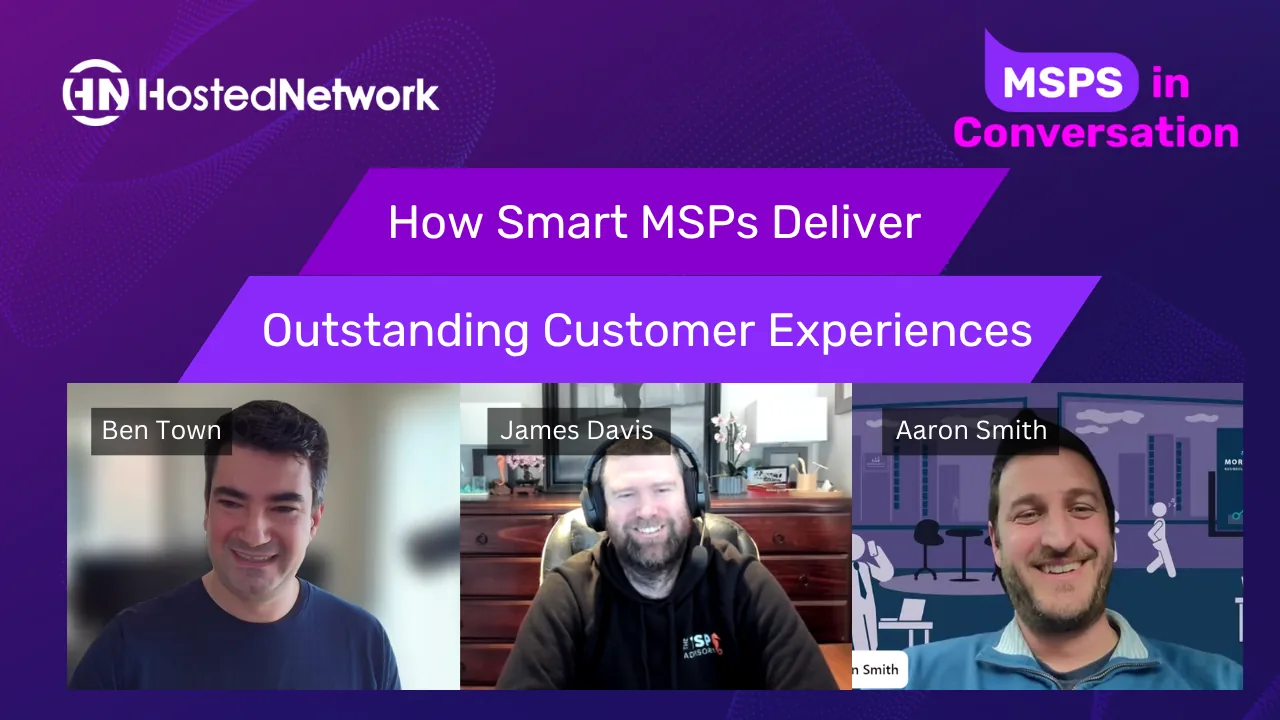
Welcome everyone. Thank you for joining us for this month's MSPs in Conversation. Apologies for rescheduling, and to those that are listening to the recording, thank you for listening to it later, and thank you to James and Aaron for rescheduling as well. Today we are talking about how smart MSPs deliver outstanding customer experiences. We did this topic two or three years ago, and a lot's changed. You know, AI is now a thing, and so we wanted to sort of revisit it and see what's changed, tackle it from an operations but also from a sales perspective.
As always, this is recorded. We encourage questions, so if you've got comments or questions, jump into the chat and be part of the conversation. Once we're done, we will cut this up into a podcast. It will go up onto Spotify, Apple Podcasts, YouTube, Vimeo, everything. So make sure that you check that out. I encourage you to share it with your team. These conversations are a great resource for your upcoming team members and for your management teams, to learn new ideas and learn new concepts. So please feel free to share it. And yeah, let's jump into it.
So, as always, something very quickly about Hosted Network. If you don't know, we are a wholesale cloud and telco provider for Aussie MSPs. We are all about improving your profitability by delivering cloud, voice, connectivity and security the way it should be for an MSP. So if you're not engaged with Hosted Network already, please reach out for a chat. We would love to speak with you. And if you're an existing partner, thank you for being part of the journey.
All right, let's jump into it, guys. So James, Aaron, thank you for joining us today. I will get you guys to introduce yourselves as usual. James, start with you.
I think most people know who I am by now and are sick of seeing me on LinkedIn, but for the rare people that don't know who I am, I'm James Davis. I'm the chief strategy officer at The TSP Advisory, and I spend my days engaging with the leading partners in the region to help them transform for the future. And I share a bunch of thought leadership out there from those sort of bleeding-edge partners I'm working with to help everyone else elevate the industry. Half of my day job is spent talking to a bunch of different people, knowing what's going on in the industry, and just joining the dots between our disjointed ecosystem down in this region.
Well, thank you for joining us. Mr. Smith, would you like to introduce yourself?
Hello again, and similar to James, for those of you who've seen me before, thank you for having me back. Morphability is a business that ultimately works inside TSPs and MSPs, regardless of what you want to call yourself, if you're on the journey through that. We've kind of evolved beyond sales team development into more business growth development. So wherever those roadblocks are, be it sales-centric, be it finance, operations, whatever it might be, that's certainly where we help unstuck wherever you are stuck, and work with you pretty closely in order to keep evolving your business and growing to the points that you want to be. Ultimately, our vision is that you are sitting on a beach with a drink in hand and the business just carries on behind you.
The dream. The dream.
All right. Well, I will stop sharing and we will jump into it. So, why are we talking about customer experience? I'm going to tell a little story. I told this two or three years ago, and it's probably evolved a little bit for us as well. At Hosted Network, one of our core values is to be partner obsessed. It is our measurement of, you know, if we're going to do something, it's our pub test, right? How is it going to impact our customer, our partners? So if we're going to go make a change, how does that impact? And it sort of goes through, so it's very fundamental for our business.
And I see a lot of people in our industry, MSP, IT industry as a whole. Too few people, I think, get it right. And I'm not saying that we certainly get it right all the time, but we try. There's some tips and tricks that we've seen along the way that, you know, James and Aaron have certainly been a part of as well. So if those of you on the call today, if you've seen great examples of customer experience, whether it's in your MSP or that you've seen other businesses do, please shout it out.
I always remember, and again, I think I talked about this a while ago, my wife bought some sheets, right? And it came in this box. They were just sheets that she bought online, but it came in this box and it was beautifully wrapped and it had a handwritten card to say, you know, thanks for ordering. It's just a small online business, but I always remember that. And I've probably told, you know, maybe my wife bought a few more from there, but I've told so many people about that story. And to me, that is why customer experience matters, right? It's that sort of repeating piece of it. It's that feeling, call it the warm and fuzzies, as to why people do business with us and why people are continuing to do business with us.
That's our story and why we wanted to recover this topic. But James, I'm going to start with you from an operational perspective. Why do you feel, and maybe repeat what I just said if needed, but why, or challenge me, why do you feel that customer experience is important in a successful MSP?
A few reasons, and before I go into that, I'll be a little pedantic. What we've got to understand first is, are we talking about customers, clients or partners? The reason why I'm bringing this up in the first place is just to get people to think about and frame their point of reference. Customers are transactional, like the sheets example. You buy a sheet, you're a customer. Typical MSPs are client-based. Clients have ongoing relationships based on your services. And partners, there is a deep strategic alignment that we're doing over a long period of time. And so depending on what you're delivering and who you're delivering it to will determine what sort of experience is actually appropriate and what makes sense. If you're a break-fix shop, you've got customers. If you're an MSP, you're likely to have clients. And the modern TSP is working towards partnerships.
And so when you break that down and you start looking at the operational areas of the business, what you put in place will be very different based on those sort of particular things. And the reason why overall experience is very important, especially in the SMB space more than anything, is this is the value that we create for our clients, and it's reflected in the amount of revenue that we can charge for clients as well. Again, if you're a break-fix transactional operator, you're charging by the hour. It's going to be very different to how we're setting ourselves up as a strategic partner in the way that we charge. And then all the different mechanisms for engagement, what we do in operations, will then be determined by that sort of philosophy in the first place. And the biggest challenge for everyone is we're not deliberate about it, or we don't understand what we're doing at that level. And then we make assumptions at all the other levels, if we're even thinking about the client and the experience, which, brutally honest, the majority of us aren't.
I think you've kind of nailed the brief in terms of the type of engagement. I think the bit that I would throw in there is it still all comes back to value. Even as a break-fix operator, you are still providing a level of value to someone. Now, regardless of whether that value is a high-value, high-revenue, or a low-value, more transactional piece, it just depends on how you choose to run your business.
To James' point around clients versus partners, we actually started segmenting that towards the end of my tenure at Correct Solutions, where we actually worked people through from a basic engagement with us, where they were a low, I guess, or initial engagement with building relationships, all the way through to a trusted advisor sort of relationship where you don't have to sell to those people because you've built the trust, you've taken the time, you've proven your value. You've proven what you can provide to them in alignment, and it should be and is commensurate to the value that you are charging. The more value you provide, the more you can charge, because then you trade off accordingly. But once you get to that point where they are a trusted advisor, selling to those people is actually easy, because there is trust already there and they know that you will operate in the best interest of their business. I think that trust element is very important as well.
All right. So we've talked about, you know, you guys mention, both of you mentioned break-fix as well, larger MSPs and TSPs. What size do you think focusing on customer experience is important? You know, when we're small, we're focused on just getting dollars in the door. But when does that start, or what do you guys think?
I don't think it's a size conversation. I think it's a maturity conversation. You can provide great customer experiences at any type of business. There are multiple different flavours of operating models in this industry. I mean, it's ridiculous how many people are doing things differently. We're all independent humans at the end of the day. If you're clear on the value that you're providing, that's the bit that's important. There's no such thing as where customer experience starts. The clients doing, or the organisations doing client and customer experience the best, find it easier to continue to grow and evolve and change, because they've got an army of people following them, willing to follow them into whatever it is they're going into. They've created that army behind them of people who have had a massively positive experience engaging with them.
Yeah, the sooner you start thinking about experience and putting it as core to the strategy and planning and discussions internally, the better off you're going to be. So if you're starting up now, if you start up and have that experience in mind, then that will drive a lot of decisions. So it's actually easier for that small one-person technology company to actually drive client experience than, say, a 200-plus TSP or MSP that's having to transform and transition and push all of that through an organisation. They might have the resources to do things more deeply and better, but the pace and the focus that you can have as a smaller technology company is dramatic.
I think that whole thought process around "I just need to get revenue in the door," well, that's what we lose automatically in our thinking around experience, because we're not thinking about what level we want to be. Work out customer, client, partner, and then that drives our decisions. We're not driving decisions around how do we make this more consistent, what experience do the clients actually value. We've got no triggers. We're just going, well, it must be price-driven because we need to get revenue, and that pushes us off and gets us off the wrong track from the start. And then the longer you go, the worse you get at this, and the more people you get involved across the client, the less in touch you are and the more internally focused you become. And this is why, especially from an operational perspective, everyone's lost sight of our clients, our customers, our partners, and they focus on what's best for us with no thinking about the external experience.
I think it's one of the first things that, when I started this game almost three years ago, we're coming up on three years in about eight weeks time. When I started this three years ago, I had seen consultants come through our business who landed once a month and they seagulled everything. And for those who haven't heard of the seagull analogy, go and have a look at it. We're not going to talk about it right now. But basically, they'd walk in, tell you everything was absolute rubbish, and then fly out again. And then away they go. And you'd see them again in a month. They might have given you a couple of things to try over the month, and that was it.
The first thing that I decided upfront was I wanted our client experience to be different. We are active. We are hands-on inside the business. We are not your traditional consultants. We want to be involved actively from soup to nuts throughout that entire month. We don't do monthly one-touch engagements. We work all the way through because we wanted that client experience to be different.
Flip that into a sales lens, and the teams that I work with right now, it is very, very easy to just fall back into the old habits of pricing being the main focus point, because price is an easy conversation. But until you can actually start to — the first time a salesperson comes at me and goes, "I need to discount the price," you're having the wrong conversation. You've been having the wrong conversation since you started whatever conversation you're having. You need to be having a conversation around what their needs are, what the client needs are. And that starts with what their expectations are, what they're wanting to see from you, how they feel about what's going on in their current world. And until you start to pull that thread, you don't know what they want. You're not having a value conversation. You're just comparing and competing with people who are doing the same thing you are, which is competing on price, which is the fastest way to lose the game if that's where you start your conversation. Value must be first.
Okay. So James, I'll throw this one to you. If we talk a lot about what good looks like, an MSP that you deal with, you deal with a lot of MSPs, think of one of those, or a few of those that are doing customer experience really well. What are they doing that makes them stand out to you, and why are they winning?
There are two key things at a high level that they're doing. They're thinking about the experience and their clients first. Every decision that they make, they always bring up, how's that going to impact the clients? How are they going to view it? And they can talk to that with authority because they understand their clients. The majority of partners out there don't talk to their clients enough. They don't actually understand, and they're making a whole bunch of assumptions. So that's where a lot of people go wrong in the first place. And on that side, those assumptions are often based by the owner on what was happening 10 to 20 years ago, when they were on the tools in the middle of it, when we were break-fix. They haven't really changed that mindset. They're stuck in those value props of yesteryear. And so that's creating issues in and of itself, which I can extrapolate later.
The second thing is the cross-functionality across the company. So it's not just a sales thing that they're responsible for, all the client experience. It's not just support services and our help desk that's responsible for it. Every single department inside of a company, no matter how big, whether it's a department or just a function, plays a part in the client experience, from our finance, project delivery, support services, centralised services, advisory, account management, marketing, sales, HR, even — it all comes back to what are we actually doing for the client, and how. There's a way that each one of those functional areas actually play their part. And if you've got silos that don't understand the clients and don't think that they're a part of the experience, you start to get very disjointed approaches, especially on top of if we don't have a clear strategy, don't understand our clients, and are making assumptions. This just is what causes lots of friction, lots of different ways of doing things, and that's what causes poor client experiences. And so at a really high level, it's those two core things that they're doing. There's a lot of different approaches under that, but you start there and then you're already on the right track.
Aaron, from a sales perspective, the partners, the MSPs and TSPs that you're working with, what are they doing from a sales perspective, and how are they leveraging customer experience to grow, to win deals, to get traction?
The biggest and most important part for me for client experience is consistency. And James talked about it just before in terms of they're actually talking to their clients. They're actually asking the questions. The most important thing that I coach my teams on is stop talking about yourself. Just stop. The more you start asking questions about what your clients are doing, what their business needs are, what's causing them issues, what's keeping them up at night.
One of the first things I ask, with one of the systems we put in play, is within the first 45 minutes with every and any client, I am having an issues conversation with them, and it comes from two angles. The top angle is what's keeping you up at night as the owner. The bottom angle is what are your people complaining about? Because if the owner doesn't understand what their people are complaining about, they should go and find that out. That's part of the conversation that needs to be had. And we, as MSPs and TSPs, we could be going, "Well, have you actually found that out? Have you actually put your ear to the ground and gone, what are your people complaining about when they're standing around the water cooler and having a chat? What do you think they're saying?" And then you start to become that trusted advisor piece. You differentiate yourself from every other person in the market who's going, "I'm the greatest MSP out there and I can solve all your technical problems." Well, that's what the same guy next door said. You stop having technical conversations, and from a sales perspective, they're doing that consistently.
The other end of that scale is when you've done something good for them, leave it in your notes. And I think I've spoken about this before, but we had a thing called reminders of brilliance. We left any items that we'd completed in our tactical notes. And so for the next 12 months, you just had a building list of all the things that we'd done and finished doing in our summary notes that went back. And speaking of summary notes, within 24 hours they have to go back. They have to be summarising what the key issues were, the next actions, and all the rest of it. Do not underestimate the value of engaging back into that team very quickly and making them feel like you've listened and heard what they've said with a good quality summary of what's going on. Whether you use AI to do that or not is a whole other ball game. But consistency is critical from a sales perspective. And stop talking about yourself. What's the old saying? You've got two ears, one mouth, to use it in that ratio sort of thing.
I want to sort of really draw attention to that consistency, because both of you, but also many other panelists, have really been talking about that sort of thing in our MSPs in Conversation, and really going deep and understanding the client. We have a term for it within our team, and it's a little bit crude. We just say to our team, ask the effing question, go deep. Ask them about their question, right? And we had to make a bit of a joke to build up muscle memory. Paul actually, in the chat, threw out that it's crazy that some people are scared of talking to clients. And you're right, Paul. What I often see is that bad habits develop though, and that if you think of it like driving, for example, I wonder if many of us would actually pass our driving test, you know, because we've developed bad habits over the years and we haven't course-corrected, right? Looking at you, Aaron, right now. Aaron is joining us from his car, I should point out, so thank you, in between meetings, to join us today, hence the joke.
But it's one of those things that if you're not talking to your clients, you've almost got an excuse. I'm busy with this, or I'm running around with this, or we haven't delivered that. There's always a reason. There's always a reason.
It's kind of like that. It is hard to break that. And it can be scary. It can be scary. And it is quite often that I have that conversation with you, even if it's, "Hey, how's this going?" "I haven't spoken to them yet." "When's the last time you spoke to them?" "Oh, it was a year ago," right? And so the only thing that they're dealing with you in that sense is support tickets and maybe your monthly invoice, right?
So you've got a couple of benefits from being a TSP generally, and I came out of a very tactical industry where we were selling a thing and that was on contract, and I didn't really need to talk to you again post that, or until the next one came up. But in an MSP world or a TSP world, you're not. Every part of your business makes you more and more sticky, from service to finance to everywhere. The biggest challenge though is that as you guys start to grow, an owner who is not traditionally sales-led thinks, "Holy yes, I can stop being in sales now," when in actual fact the opposite is actually true. You cannot forget about the executive sponsor relationship. And that is where, if you bring in an account manager to take on the day-to-day and do all the things that you're expecting them to do day-to-day in terms of keeping the ship running and provide that conversation piece, you still need to be touching base at least infrequently. And I say infrequently, it doesn't have to be every week or month. It could be once every three to six months, but you must stay in touch. You're the original person that brought these clients on in most cases. You can't disappear entirely. You are still an executive sponsor, and you will hear things that they won't, because you've got a different level. You've got a gravitas and a power piece, particularly when it comes to owner-to-owner conversations, that your sales team will never ever have.
I'll tell a painful story, right? And it's not one I often talk about too often. Back when I ran my MSP many, many years ago, 10-odd years ago, we bought an MSP and we hired an account manager to look after all of those accounts. The painful lesson was, in two years I didn't go and see those customers, and I think we lost nearly every single one of them. Painful lesson for me right there. That's life, right? We kind of learn these things as we go, but that's one that certainly stuck with me.
But I think you're right there, Aaron. We've talked about what good kind of looks like, but what are some of the common pitfalls? And James, I'll sort of throw this to you from a day-to-day perspective, and Aaron, chime in from your side as well. What are some of the common pitfalls that you see, the mistakes that MSPs are often making that might be low-hanging fruit that they can fix, that the audience on the call might resonate with?
I'll be brief, because there's heaps. We've already touched upon the interactions with clients. What we've just spoken about, most of us are still acting like they're customers and transacting and being order-takers reactively from a sales side. From there, what that floats into is the way our quoting is done is often very slow and fudgy, and it causes a lot more issues, and the clients often have to follow it up. So I hear partners all the time complain that clients are going to, you know, JB Hi-Fi and stuff because it's price. Most often it's not price, it's convenience. We're forgetting the experience factor. We're making it more difficult for a client to get something from us, who are the experts that they trust, for them to go down the road or jump online for stuff they don't actually know what they're buying. That's a trigger point and a really good example of how we're missing the mark on understanding our clients and the experience.
From there, it's that default to thinking about it like it's 2010 and we need to service clients the way that we did. Most people think our biggest value in our support services is how fast we answer the phone and have a tech responding. It's often not the case. And again, we're coming at it from the wrong perspective, from a break-fix mentality, but also understanding that that doesn't often deliver a great experience because our processes and stuff aren't working. So if the guys on the phone don't deal with it right there and then, it goes into a black hole causing more issues. It also doesn't take into account the demographic changes. As a millennial and younger people, we don't want to pick up the phone if we don't have to. We don't want to use email. But for most, probably 99% of technology businesses out there, that's the only way to get support.
You go to finance and the way that we invoice and the way that we package some stuff. For a lot of clients, the old-school way of having the vague bundles that just come onto the invoice with no detail are long gone. We're trying to make decisions on what's going on in our budget, where the money's going, and all of that kind of stuff. Lack of transparency. You go to project delivery and the methodology that we use is often very poor. The way that we engage clients with communication and structure and transparency is often missing. You bring it into the business technology review and reporting to clients. We structure it very much our way, and basically, if we do anything at all, we're often spitting out all this random technical stuff that means nothing to the client. The list goes on and on and on. But those are probably the real highest-level examples that nearly everyone does and keeps falling into the same trap, because that's been the generic advice for years. That's the common wisdom, yet we're missing the mark because that's not what clients need or want anymore, and it keeps shifting.
I think the other bit that I see a hell of a lot of MSPs hang their hat on is CSAT scores. And I'll be honest, if your CSAT score is fantastic, you can still lose the client, because if you're not dealing with the executive level of that business on a consistent manner, as much as the people with their nose to the grind think you're doing a phenomenal job, they're not the ones being checked for the decision at the end of the day. The CFO, or whoever you're directly reporting to, is the one who actually signs your paycheck. And unless you're actually checking in with them on a quarterly basis — how are we doing, what's working, tell me what's working inside the business — you're not having the right conversation if you're just banking on CSAT.
My marketing piece in here around the influencers as well. I've seen time and time again that, oh, the office manager, and I've said this on this many times, the office manager is being a pain, you know, but they often throw a lot of weight around.
Oh god, yes.
So think of it not just from the decision maker, but who's the loudest voice in that organisation as well, right? They've got to have a good experience. We've all seen time and time again where maybe the office manager or the CFO has changed jobs, and all of a sudden they've brought in a new MSP, and I've certainly lost clients back in our MSP in that very case. Sorry, James, I cut you off.
No, it's a really good call-out for CSAT, Aaron. Because nearly every partner I see, it's always great CSAT. It's always 90% plus. The thing that no one actually ever talks about is what's your response rate? The average sort of partner out there is getting like 5 to 7% response rate. So we're talking like seven responses on 100 tickets. That's not well done. You've made seven people happy, and it's probably the same four people that have responded multiple times. So without actually having that depth of satisfaction rating, NPS, client sentiment, you're creating yourself a very false narrative. I'll back you up, Aaron. I've seen so many partners lose clients even though they had this awesome CSAT. It's really detached. CSAT's a great transactional measure on a particular ticket. It's not a sentiment.
One of the things that we talked about gathering, and I've mentioned it to multiple people and it's been executed once in my experience, we started — and I'll be honest, we did a poor job of implementing it — but we started talking about gathering data on who you were, what are your hobbies, what do your kids do, from an individual people perspective, you as the account manager. One of the best experiences I had, I had a cold call that I made while I was working for a rather large entity, and I had a chat with him and his son was playing for Melbourne Victory against Manchester United, and I just put a note in the system. And three months later, or whenever we'd agreed to catch up again because he wasn't moving anytime soon, I called him back. I said, "How'd your son go?" "Oh god, you just, you remembered that?" I went, "Well, yeah, that's kind of the basics. I need to put down the things that matter to my clients, not the things that matter to me."
And so we started, and one of our clients has now actually started utilising ConnectWise to put down coffee orders, information about their family, their birthday, their details, just random little bits of data. Could be, you know, for some of us it's an alcohol preference, for others it's just a drink preference, whatever it might be, along with things like who's your lawyer, who's your finance, who's your accountant, all that supplemental information, because you've actually asked a question to get to know them better at a personal level. Particularly from a marketing perspective now, personal engagement wins clients. You could be the best business in the world. The personal engagement is what makes you memorable and helps you get clients over the line and helps you keep them.
I've seen a number of MSPs that have actually been shifting their whole brand around that piece of it, and, you know, talking again from a marketing perspective, sitting down with a number of our partners over the years, just going through and understanding what their buying persona would look like. And I always say, just look at your existing customers and start mapping it out, and it's a gap analysis of what you know. It is scary by the end of those calls how little you actually know, in many cases that I've seen. It's like, you know, I often say, if you're a local MSP, you've got to be involved in the local community, but it's like, do you know if their kids go to the local soccer club? What do they do? And so it's just that human element, and I think that is very, very important.
I'll be honest, on that point, the regional players are beating the city players hands down.
Yes.
Because they are 100% community-centric, and I've watched it time and time and time again. They do community so much better than the big city players do, and they win business faster, and they win bigger business faster, because they're part of their community. They're actively involved and they just shake hands, kiss babies, and get to know the people in their world.
Do you think that is something that is — I mean, shifting from a customer experience, do you think that is something that is a different experience that is expected from the city versus a more regional player, for those that might be more regional versus the city?
I don't think it needs to be, but it is.
James?
Yeah, 100%. It's different by default. There's different market dynamics. That community-minded spirit is genuine. It's not false. That's why it's successful. In what you were talking about, Aaron, with the personal details and stuff, but a lot of this comes back to what type of clients are your ideal clients. There's industries and stuff that don't want to talk like that. Like for me, I'm generally all business when I talk to people. I don't really care. Like I don't care what their favourite drink and stuff is. That's not how I work.
You don't drink though.
Well, that's right. So I don't care. But what's important, and what I think Aaron's really sharing with the insights, is knowing what your clients actually care about. And then focusing on that. And that mapping exercise that you just spoke about, Ben, that's what we need to do internally, is go, what are all these touch points? What do our clients need from us in those? And then shaping and shifting it in the right direction. Because what always happens in our industry is we'll go, "Oh, there's this new shiny tool out. How do we plunk that into our stack?" and then force the clients onto it, rather than starting from a client perspective and going, here's all our interaction points, what are they actually expecting from us and what are we putting out?
Again, going back to that customer, client, partner mindset. If we're only going after transactional customers, you don't need to know them in that deeper detail. So to your point, Aaron, it's transactional. You just need to work on delivering a commodity, making it as frictionless as possible so people can get their transaction done. A client is, how do we build in that relationship piece, and how do we provide information over time to keep it sticky, keep it transparent, keep the relationship fresh and dynamic. And a partnership perspective is, how are we tying into their business and their objectives, and how are we implementing stuff in our business that are going to drive their business forward and not cause friction and drag them back? Whether that's maturity, whether that's self-service, all these different things, we need to think about it more than just tools. Because I know people listening and watching this, their mind goes straight to, what technology can I roll out? What generic things can we do? Like the QBR always comes up as a thing of, "We need to do QBRs." Well, do your clients actually need that? Do they want that? Do you charge for it? All of these kinds of things. There's no right answer, but everyone's going for the generic right answer. And I know I say it a lot, but I'll say it again. The average MSP runs at 6% EBITDA. I'm not sure I want to copy the industry. They're the ones that aren't performing. So why would you copy them? It's the ones that are doing unique and different things in their own way that are the high performers.
So part of the thing that, in my experience, and I know this from when I first started out in MSP land, was that I just thought I could do it better than the guy next to me, right? But it came from a place of, I felt like what was happening where I was wasn't serving the customer enough, and I thought I could do it better, right? But then, if I think back, I got distracted by all the hiring of techs and trying to get them to blow that through, and what I originally started out as didn't end up in what was actually happening day-to-day. And call it growing pains, call it, you know, webinars weren't really a thing back then at all. But if I look back, I often had a lot of struggles with my technical-minded people, because they thought so technically, right? So for those people on the call that are technical, or if they've got their technical teams, you know, the responses that their techs are there solving a technical problem — what is your advice to them where it's not natural, I guess, is what I'm asking. Aaron, what would you do? I know you're more from the sales side, right, and sales guys often have this big, bubbly personality, it's natural to them. But for those of us that have to actually put effort into this, what's your advice?
With anybody new into my team, or who gets a new portfolio, who gets a new whatever, and even post-acquisition, to your point, Ben, the reason we didn't lose all the clients was we literally forced ourselves down the throats of the new clients to just go and meet them. That was it. It was literally no pressure, no nothing. And we just — where were you 10 years ago? — ask them two questions. In all of those cases I've just talked about, ask two questions. What do you like about working with us? And what do we do that makes it difficult to work with us? That's it. And they're two simple questions, but what they tell you very quickly is what people like. Please do more of that. Carry on. Rinse, repeat. Do more. And where can you improve, and where are your gaps? And whatever structure, however you want to address those, that's great, be it a big team, small team, or otherwise. Some of those things you can summarily dismiss. But some of those things will be the little nuggets that come to a client experience piece about how you make them feel, that if you can tweak something like that, that will make a measurable difference.
How do we get our technical teams to sing that song? James, same situation.
Yeah, go on. Having not been technical and being more the operations guy, I struggled with this with the techs initially. I wasn't clever enough to realise that, hey, different people have different personalities, and didn't appreciate that. But what I learned, and what I've helped tech teams over time really understand, it's really simple. It's a culture from above that's driving client-first attitude, and then actually pragmatically teaching them what that means. So any opportunity I got with my techs to talk to them about the client experience and play the part of what the client was feeling on the other side, it would be explaining to them, this is why the payroll person was panicking, because it's payroll day, and if they don't actually put this through there's financial penalties, and this issue happens, and that issue happens. And every time talking about what that role does as a function, how they operate, because the techs, apart from being technical, they're used to working from ticket to ticket to ticket. Most jobs aren't like that. Most jobs aren't structured in the way that a lot of techs are working. So they don't understand that there's all these different roles, these different personalities, these different responsibilities. So the more that they actually get educated and get their hand held through what's going on through a process, why a client's doing what they're doing, and how we aren't delivering a client experience, they get it, because they're logical problem-solving people. They can see that, well, if I just actually pick up the phone, talk to the client, then it'll remove all this other work for me. They will do it. But if you just give them blank statements with no context around it, there's nothing to buy into. There's nothing tangible there. And for the great majority, there's not enough experiential knowledge to fill in those gaps. So they're literally running blind.
Yeah. Or time taken to actually educate them. James, I liked what you said before with regards to the payroll person's drivers. And I reckon — I've had an aha moment, because we did something similar to it. We talk about who your customer ultimately is and what's important to them. And if you can get a documented list together, or some of that in a service desk where it just says payroll cares about this, CFO cares about this, sales will care about this, this team will care about this — what is it that is their driver? I was on a one-on-one call with one of my team last week and she put a comment out there, and I said, "Do you understand why that person is the centre of it?" It was an accountant for a bunch of clients of theirs. I said, "Do you understand the why for this conversation?" And we unpacked that whole conversation. I said, "Well, actually, they go to their accountant because they see everything. They see absolutely everything. The accountant sees the numbers, sees how they're used, sees how they're moving. Of course a company is going to them for the final sign-off. So rather than going to 74 different companies, go to the accountant and talk to them first. Have them pre-sell it all for you. If you know that they work with everybody, there's a faster way to go about this." Understanding the why of the people you're talking to is critical to making sure that you provide customer experience at their level, be it customer, client, or partner.
Okay. David Vidos in the chat has just mentioned that, with tech teams, take them out for the meetings. You know, that's not always possible, but let them see it in action, that techs learn by doing. And I know that's true. I didn't go to university. I went to TAFE, because that's how I learn. I learned by doing.
Me too.
And I found that, and a lot of the techs that I've hired over the years are very — that's very true. You know, it's all good for theory, but actually doing it and guiding them through. James, you mentioned culture. In our experience, we'll sit down — you know, we run EOS, so when we have our Level 10s, we'll sit down and go, "Hey, this is what a good ticket reply might look like," and then it'll be a coaching and a mentoring, because it's not always right, and there's different personalities. And I have this saying with my team, someone said it to me once and it's always stuck. "I didn't say you were pretty," right? And everyone's like, "Wait, what are you talking about?" Yeah, see your face there. But when you put it in an email, when you put the emphasis on each word, it means something very different, all right? And that's often been quite powerful for our techs to kind of go, "I didn't say you were pretty," you know, that means different things as you put the emphasis on different words. And that can often avoid a lot of frustration over the years as well. Little examples like that, that's something that I've found quite powerful as well.
James, I'm going to talk systems. I'm going to talk tools, shiny things, just because I am a typical tech and I do love my shiny things. Only because it is so relevant at the moment. But I want to touch a little bit around AI. And I'm not talking about specific tools, but more about the change that we're going through. AI is being used everywhere. Aaron, you and I have had multiple conversations around AI tools and this and that. We built — for those of you that don't know, and I think a lot of our partners already do — we've just built and launched our own internal ticketing system so that we can pass sentiment and things like that. I was talking to a partner the other day about a voice solution, and they wanted to, via their 3CX environment, have their techs, for tone and sentiment, so that they could get escalations faster. All these things are moving at a very, very rapid pace. We don't all have the answers, but what are you guys seeing that's working? And if the listeners on the call are going to put their efforts, their eggs in a basket, where should they be focusing? So James, I'll start with you.
There's a lot of things you can do. So before I give some recommendations, like you already mentioned, like sentiment, there's automation, there's self-service, there's client portals, there's all this different technology. And I want to reiterate, there's no single right answer. So just because it's working for one partner doesn't mean it's going to work for you, because your clients are different. What you're delivering is different. If you keep racing towards being generic and following everyone else, all you're doing is driving commoditisation. And that might be what you want to do, and that's okay. Again, there's no right or wrong in this. It's just being very deliberate.
And so with that in mind, what I'm seeing the most successful people do is not focus on rolling this technology out for what's better for us. It's knowing what's going to help the client get a better experience. So a few examples. Let's say triage automation and driving people to more client portals and being able to utilise chatbots and stuff. For young, up-and-coming companies that are more Gen X and millennial, that's actually a very good thing, because I don't want to pick up the phone, I'm not going to email you. If you give me a chatbot or something, I'll use it, and then as long as I can get — if I need to escalate it, I can get hold of someone — that's great. But for more traditional businesses that have baby boomer and Gen X employees, a lot of them don't like that. If you've got hospitality clients and things like that that have people on the floor that can't jump onto their technology, they need to just pick up the phone and lodge something. Well, that kills that experience. So the tools are there. It's more understanding what's best for your particular clients. And this is the challenge for partners, is not just that they don't understand their clients well enough, they're so horizontal they can't actually niche down and have the good solid experiences, because they're trying to please everyone with everything. And when you're trying to do that, all you can do is be generic and a commodity. So irrelevant of the solutions, because there's more than ever, there's so much available for us around chat automation, AI across a lot of different sort of tools, it's a bit irrelevant to me. It's more knowing the client side and then being able to bring the right solutions that are going to deliver what you require, and set your level of expectation with the clients again with what value they're expecting, what we're providing, to be at the level that we want to work at.
We just — out of our strategic business reviews and tactical conversations, we just ran a monthly summary of what we called the voice of the client, with one of my clients. What had we heard and taken down as notes and summarised it up into core items for discussion? And everyone is talking about productivity and efficiency improvements around that. That was the summary piece that came out from a "where can we possibly utilise either development, AI, or something else like that." The biggest piece of information that probably came after that is, I think we're trying to almost do too much. And I think if you treated AI and automation instead as a "how am I going to improve this one thing," and deal with that as a singular body of work, that makes a massive move to the needle of your efficiencies. That is a way better place to start having an intelligent conversation with your clients than trying to boil the ocean.
Yeah, guys, I'd agree with you. And James, I actually made a note of that sort of generational change that you mentioned, understanding the industry that they're in. My marketing hat flagged straight away, and that's when we start segmenting our customer list, right? So I'm going to throw out some advice around EOS, right? Start with the end in mind. What are we trying to — what's our revenue target, our net profit that we're actually aiming for, and work backwards, looking at what are our customers that are driving that value, and then starting with that customer segment versus trying to do everything. Look at where it is going to move the needle the most. Because James, I actually think you were bang on, that, you know, this is my experience, we didn't have a lot of young companies that we dealt with back in the day. They were all manufacturing, they were lawyers, they were real estate agents that had been doing it for donkey's years. We had one client where the owner didn't even have a computer, you know. And so I think that is some really sound advice, that looking at your customers and thinking about how it impacts them, and what both of you have said, and I'm going to term it like what I say to our team, is ask the effing question of them. What do they want? I think that that's a very powerful piece of advice.
That's the one.
Aaron, I know that you have to run, because I so rudely had to reschedule this, and Aaron has to run to his parent-teacher interview. So hopefully it's all A's for your child. But I do just want to wrap up. We will wrap up a little bit early today. Final advice, Aaron, I'll let you go first in case you have to drop off. For those on the call, what is your top tip for encouraging a sound customer experience?
I think you've nailed the brief, and I'm going to put mine in with yours. Ask the effing question to understand their why is what I would put that into as a single sentence. Just ask. Most people are happy to talk. I appreciate James' position on not everyone wants to talk to you. I do appreciate also the customer understanding of who you're working with. But yeah, ask the question to understand the why. Even if you get a basic answer out of them, it's one step forwards from where you are currently.
Yeah, very true. James, what's your final imparting bits of wisdom?
Got to act like how you want to be treated. So if you act like a commodity, that's how people are going to treat you. If you act like a strategic partner, that's how people are going to treat you. And so that mindset needs to drive a lot of things. And this is the main issue for most partners, is they're not deliberate. They're just floating about doing everything for everyone, doing generic things. And I think as partners are starting to see the need to transform their experiences, especially to what their modern client needs are, a lot of partners aren't going to have the energy, the resources, to do this. And it might sound a little brutal, but this is probably the time, if you're sitting there going, "I don't think I can do this," well, don't. Be more deliberate about exiting. This is the best time to sell out of your business while you've still got all of your anchor clients. They're not going to be around forever. Clients are needing much different things. I'm seeing higher client churn than ever in the industry. If you're not elevating your experience and delivering that more holistically, you are going to see more and more client churn. It's as simple as that. So transform or exit is the decision, and just be deliberate about it.
Big challenge.
I love that. That's a good way to end the call. Paul and Lexi have both thrown in some advice in the channel. Lexi says, "Be a partner." And Paul says, "People always like to talk about themselves. Once you get your clients talking, they will tell you a lot without even realising it." I think that's some very sound advice.
Guys, we will be wrapping up a little bit early today, like I said, to accommodate Mr. Smith. But James and Aaron, I really appreciate you guys joining us today. For the rest, our next one coming up is tentatively on the 6th of August. We will be talking about meeting the demand and the evolution of the MSP offering, and that is bang on what James is talking about, right? The industry is changing. How do you change? How do you adapt? As always, these are recorded. We put them up on our dedicated website, mspsinconversation.com, but they're everywhere. Like I said before, thank you for listening. Thank you for joining. James, Aaron, thank you so much for imparting your amazing wisdom. And Aaron, I hope your kids get straight A's.
Thank you. Cheers all. Thanks, guys. See you. Thanks.