20 October 2026
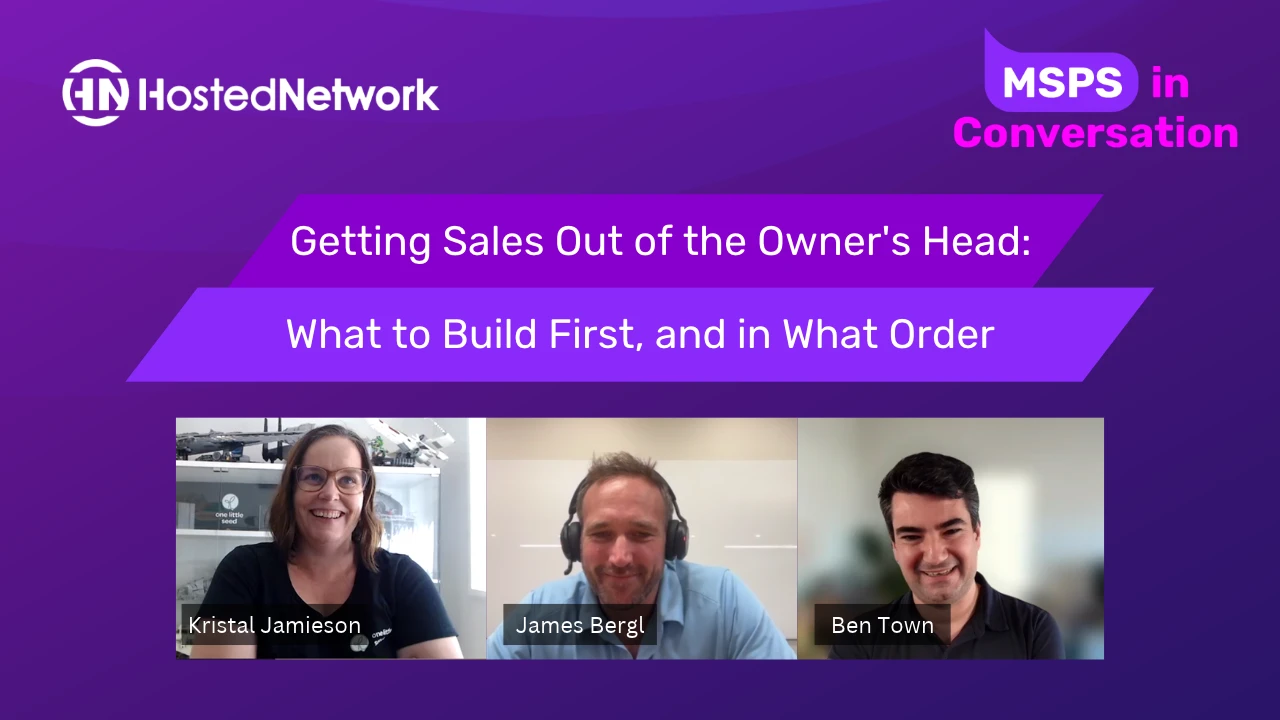
Getting Sales Out of the Owner's Head: What to Build First, and in What Order
Sales & Marketing
Successful MSPs approach recruitment with long-term thinking, hiring for attitude, values, and potential — not just technical skills — to build stronger, more resilient teams.
A clear, well-communicated company culture sets expectations, drives behaviour, and significantly improves staff engagement and long-term retention across the business.
Building a strong team doesn’t stop at recruitment. Continuous coaching, clear direction, and supportive leadership are essential to developing high-performing teams over time.
Edited for readability from the episode audio — may contain minor errors.
Hi guys, and welcome to today's MSPs in Conversation. This is part two of How to Build a Great Team. I think we had "perfect" in there originally; we may have just changed that to "great." Today we are joined by the same guests as our last session. We've got James from Sea Level Operations, now Pax8; we've got Ryan from 360 Consulting; and Matt Smart from JEM. Guys, thank you for joining us today. I won't get you to reintroduce yourselves yet again, so we'll jump right into it today, so we have as much time as possible.
For those on the call, if you are an MSP in Australia you should already have your $25 Uber Eats voucher. If you haven't, lunch is on us — feel free to hit us up in the chat and our team will help you get that, and we'll get that sent over to you.
So very quickly, Hosted Network: if you don't know who we are, we are a wholesale cloud and telco provider for Australian MSPs. We started as a managed service provider ourselves, and now we support — we're 100% channel. And that's all I'm going to say, because today is not about us. We do have a slide for the intro for the panelists, but we will jump straight into it today.
So, how to build a great team, part two. Last time, guys, we covered a range of different topics, and we won't recap entirely — feel free, if you haven't, the last recording is on our Vimeo and our YouTube page, so you can see those for free at any time. Unfortunately it doesn't come with the $25 Uber Eats voucher if you missed that, but here we are today.
So the first thing: we talked a little bit about recruitment, and one of the topics that we didn't really get to dive into was, you know, what is everyone doing to find talent at the moment? In Australia we have a big talent shortage. The new Labor government has a new policy specifically for the ICT industry to try and train up level ones and whatnot and build people into our industry, but that doesn't help us when we're all poaching staff off each other and everyone wants more and more. So guys, what do you see as some other alternatives? James, I'll throw this one to you — what do you see as alternatives to the staff availability issues that we're facing today?
At the moment I'm seeing very, very good success with offshoring and doing it well. And I caveat that as doing it well, because we seem to think just offshoring and hiring people in the Philippines means we can get more cost-effective resources and they'll do more than the people that would do it here — like it's this magic bullet, isn't it? It just happens, right? You just hire someone and all your business problems go away.
So have you guys offshored before? I am currently offshoring. Matt, Ryan, what about you guys? Yeah, I think we've been doing it for four or five years now. Have done it in the past, but as part of the sale of that business no longer have it. But yes, we'll be doing it again in the future.
Okay, all right. So tell me, when did you guys start offshoring, and what are some of the lessons that you potentially — when would you want to come back to the offshoring bit and finish off the recruitment question you just asked? Yes, I do. I'm going to make you the host in a second. So James, the question was posed to you about the recruiting piece at the moment — how are you finding that? Does offshore work, or what other things work, looking for outside of industry?
We're still very stuck at: we just need MSP experience, we need MSP experience. So whether that's hiring for roles outside of the industry — account management's a good example. People want this unicorn who's super technical but has business savvy, and they can work with everyone and make it all work. Often I find the best account managers aren't technical but can leverage the technical resources to get better relationships with the clients. There are a lot of industries out there that have good structured account management as part of their day-to-day jobs, so looking at business-to-business industries — one of my clients just recently hired someone from Toyota, a fleet manager, and they're already killing it in like two to three months, just because they know how to do account management, and then build the structure around that.
The other part that I'm seeing a lot of success with, and I think we touched on this last time, is hiring more junior people and training them up and elevating the people internally. We touched on sort of TAFE programs and those sort of things last time. On that note, are there any other areas that we should be looking at?
I think there are plenty. I think this is the problem for most people: there are too many options, too many things to look at. And I think where we go the most wrong — and to jump in after this — is we don't actually know who and what we're looking for, and we don't document and write it down. So we don't actually know where to look and what that can actually get us. We just look for basically a unicorn that we've got this random idea of in our head, and we wonder why we can't find them, because we're not targeted. "Unicorn" is something that definitely comes up a lot in our recruitment — like, where's the unicorn?
But yeah, look, I think it's hard. We have to consider here that we put out a job, we know what function we want them to fill. A line I use fairly regularly in the office is, it'd be nice just to run down to Staff R Us, pick up a couple of extra level twos, and problem solved. But everyone's an individual, so there's this stigma around — we've got a role out for a level two at the moment, all these people apply, because where they've come from they're classified as level two, but in our eyes, because of what we do, which is slightly different to someone else, they don't quite hit what we deem as a level two and what we define in our checklist that level two meets. So it's hard.
You look at other industries — use nursing for example. You're either a registered nurse or an enrolled nurse. You either have the qualifications or you don't, so when you're applying for the job you meet the criteria. So I do find it's a little bit more difficult in that sense. And that makes James's point that it's therefore hard going out to market, because you know what you're looking for, you know what works for you, but you have to cut through that information, the resumes, the interviews, to actually find out what a person's like, and then hope when you hire them and they accept that they actually fulfill it as they move forward through their probation, and then hopefully on for a long career.
So James, you mentioned different roles from different industries — you mentioned the Toyota example. It's a bit hard to do that with tech roles. Sorry, my wife has just brought me a lovely glass of water, because I forgot — thank you. So what are some of the other areas? Tech's going to be a bit hard, but — and Ryan, feel free to jump in here as well — what are some of the other areas or the roles within our businesses that we can look to tap other industries for?
Service coordination, project coordination, sales, administration, account management, finance — obviously finance is usually the one thing that MSPs default to getting someone out of the industry, because we've never had any other choice. Team leaders, managers — there's that whole gamut of just people management, HR, all these components where we don't actually need industry experience to be able to lead and run people and undertake a lot of the functions in the business.
And I think, sort of following on from what Matt was saying, to attract the right people as well — what are we projecting out from our company? It's something that we don't think of with our brand, with attracting talent: things like our website and our LinkedIn. They're often fairly neglected, and they all look the same compared to every other MSP. So, why would I want to come with you? What's the culture at the business? That's what everyone's looking at — not just what the role is and how much I'm getting paid, but what's the culture of the business, am I going to fit in, do I have any type of growth in this? And if we've got a website from like 20 years ago, we'll almost guarantee most people are going to look at that and go, "Yeah, nah," straight away and not even apply. In today's market it is very much about positioning yourself. You have to stand out from the crowd.
And that also helps you get other people from other industries, like James was saying earlier. Some of the best service coordinators out there have come from the plumbing industry or the electrical industry. You think you're dealing with a bunch of techs? Go and deal with the 20 plumbers. Those people that manage those types of people and those service environments, they're fantastic. Yes, they don't know the difference between an Exchange server and a 365 email account, but given three to six months they'll know that, because they didn't know what a brass turn-something-or-other was two years earlier or whatever. They're fantastic — they're just managing people. One of the strangest, best account managers I ever heard of was someone that actually got out of banking and transitioned from being in a bank to being an account manager in an IT firm. That's not what you would think.
Yes, the general technical people have to come and can be developed, like we talked about in part one of this. But the other thing I think is a real big piece of this: everyone hires when they need them. What about hiring permanently? What about constantly hiring and never stopping — having roles on your website, having roles that you talk about on LinkedIn or Facebook, maybe not on Seek or Indeed or any of those things, but what's wrong with having a rolling one of those that sits there all the time or goes up once a quarter?
We've always had a rule, and I've personally had a rule for years, that if I find the right candidate I'll find a role for them. It's nothing to do with that — finding the work was always the easy part. Finding the staff and the really good team members, that was the difficult bit. So for me I was always recruiting. And what's wrong with having that? That always seems to have been a challenge for recruiters. I can't tell you the same — we've told recruiters, just keep bringing people to us. But what are you looking for? I'm looking for everyone. The right person comes, as you said, we'll find a role, we'll make it work. Because when you need them, you need them weeks, months in advance, so you can train them up so they can actually work. If you hire them today because you need them today, you've still got the better part of six to eight weeks before they're really kind of moving by themselves with your processes and your systems and your customers. And even then they've still got time to really ramp up that pace, so six to 12 months is often what it takes to get them really effective within this.
Yeah, that's right. And that rolling thing — I agree with it — recruiters don't seem to like it. I don't know why. I mean, they want a specific job to hire for, so you've got to keep going to them every month and basically say, I'm looking for this role, I'm looking for this role. Well, I think that's just their cycle of how they work, right? They place, they get paid. It's like when we're in the time-and-materials game — it was all about just what's in front of us right there and then, and we did it and we moved on to the next.
So I think this is where a lot of people go wrong with recruiters: looking at it transactionally as well. Not necessarily your example, Matt, but when I've spoken to a lot of people in the past, there are very few people that have good things to say about recruiters, and I don't actually think it's a recruiter's fault — I think it's more our fault. We treat it as a transaction ourselves. We don't like it when our clients treat us as transactional, when we're relationship-based and we're a long-term management thing. We don't actually go and look for an HR advisor that does recruitment; we go straight to a recruiter that needs to recruit somebody on the spot. They don't know what our company is like, they can only go off the one role that we're looking at, they can't provide much other advice because we're not really letting them and bringing them into that. The people I see that engage with the HR advisory that does recruitment as a project service get way better results, because they're much more likely to not do what Matt was saying — they're a lot more open to constantly looking for what's good for the company, because we've got that ongoing relationship, and that's how they're built to run. It's that break-fix versus the MSP model, right, that we touched on last time. And you think about how we want to be treated and how we engage with our customers — it's the same sort of approach.
Interesting. So from what I'm hearing from partners — and we had an event down in Melbourne the other day — everyone's struggling, it's constant. We've touched on sources of talent outside of tech, but what else can we do for the tech piece? Because I think that is often what we're hiring the most, it's the most repeating thing, and that's what we're competing against. Would you guys agree?
Yeah, I mean, we are competing against each other in the sense that we're all trying to find good staff. And I think every MSP out there, especially in Sydney, is struggling to find those right people. I think that's a national issue we're facing at the moment. It's certainly not based to Sydney — it's international. As you're seeing with offshoring, I know people in New Zealand having the same problem. A lot of places around the world are having that same challenge.
So let's go back to that offshoring piece of it. The reason I want to talk about that is that when I speak to partners, finding tech is hard. We've got a comment: "Try finding techs in Cairns, far north Queensland." And that's kind of where I want to go with the offshoring piece of this. Do techs always need to be in the office? When I say offshoring, it could be working remotely — it could be the US, not necessarily somewhere like the Philippines or India. But at what point, within your own businesses, did you make that step of going, "Okay, I need to look at alternatives"?
For us it was when, years ago, we were struggling to find good candidates. It was like, we need to expand that horizon. More recently we've expanded interstate, but prior to that we were trying to find somewhere that could help us manage staff. It's hard when you start growing interstate and you start putting one, two, three people on and trying to manage them remotely. We looked at an offshoring solution that helps deliver the HR side of it but also helps manage the staff locally, until you get to a point where you've grown and you start promoting some of the guys that you've hired through that offshoring piece to be your team leaders, who are then interacting with the local management, things like that. So that's where we started, and that was about four or five years ago for us. We've grown that team originally from three — I think we're at seven now — and currently still recruiting for more people in that space.
But how many people don't get that first role right, Matt? And how many people have a very bad experience to start with, generally because they don't have their house in order to start with? I think that's a really good point. From our perspective, there were a few things that we identified before going in. We need to make sure that things like documentation are as good as we can get them. And yes, there's always going to be things — I mean, you say documentation and I can hear everyone in the attendee list just go "ugh, documentation" — we all struggle with it. But get it to a point where you can have these people work and access the documentation and effectively be able to do their jobs with the appropriate training. We went in there as well making sure that we treated them the same as if they were here, so that while geographically distant they felt like they were part of our family, and they weren't just another offshore team, as you hear a lot of them get treated. So there were a few key criteria that we had for doing it. Now, we went with a plan to hire two people, we found three that we thought were perfect; from those three, one of them didn't quite make it more than three or four months, the other two went on for some time. One of our very first hires out of that three is still with us today.
Right, okay. So Ryan, I'm going to throw your question back to you — what were your first pitfalls when you first started looking at hiring remotely? Look, we tried it differently. We didn't go technical first, we actually went sales admin first overseas. Again, I've got Irish heritage, so I like to take a very different path, or the much harder path, than everyone else, as it often happens to be. We tried sales admin first and we actually hired two, and overall it wasn't far from a success — it wasn't an outstanding success, but it did work quite well. I think the issue for us was training. Training people remotely, in that first piece, because this was well before COVID — this is four or five years ago, so four years ago — and I was just getting used to training those people, and not having a lot of our processes in that area as good as they could be compared to where they would have been now, or a year ago before we sold that piece. But I think it comes down to, again, good process, good documentation.
We already had multiple offices in Sydney, so we were used to dealing with multiple offices — that helped. I think for a lot of people this is kind of a second office away from home, and that's where there's a lot of challenge. We also had, I think, the right attitude — and everyone said it was, but for us it was one company no matter which office you're in. So we actually had the same technical stack, we actually shipped up the same webcams, the same headphones that our support people had. We made it so it didn't matter where you are, you had access to the same toolset and the same equipment. Yes, that cost us more to do that, but it meant that if they didn't have problems, they had a lot less problems, a lot less issues, and from what they knew — and it was true — they were using the same equipment as the people in Sydney, or in Australia, or didn't matter where they were.
We had the same with staff like eight, nine years ago. We had staff that actually moved from Sydney to Brisbane, so we kept them on, we set them up properly from home, all those types of things, many years ago. So that offshoring, or remote work 10 years ago, was not — we'd already started, we'd already given it a go, we already knew what — I don't know if we're experts at it, so I definitely don't agree with that, but we'd already gone through some of those initial pitfalls. I think the only thing that's different now, post-COVID, is everyone's used to possibly starting remotely now, versus a lot of times with new staff we would actually start them in our office for a couple of weeks. Even that staff member, Mel, who was up in Brisbane — every quarter we used to bring her down for at least a week, and a lot of times it was three days a month or four days a month, but failing that it was at least a week a quarter. We used to bring her down into Sydney just to spend time in the office, to have those water cooler chats and be part of the culture and part of the company still. That's an important piece.
And that's one thing I think that JEM, with Matt, has done very, very well: they now have a team in the Philippines and they do similar things as what they do in Sydney. They have get-togethers, they actually have time — other than COVID, they spent time in the office and had their own little area and whatnot. That to me was a great outcome and a great picture of it, and that's what I was trying to replicate as well: build a team there, not just one or two or three people. I wanted to have a team of 15, 20 people there eventually.
But some of those ideas that we often get told about through the offshoring and BPO process — of when you need one, hire two — there's nothing stopping you doing that in Australia either. I know people that have done that. One of the phone calls I was on earlier today was someone who hired four. They hired four level ones, and right now there's two that are really looking good, and there's two that are going — they'll survive, they'll stay, but there's two that'll go through their process. They're training really quickly and will come out the other side and be very, very good at what they're doing very quickly. Yes, it costs, but how much does it cost not having that staff? What is the opportunity cost of not being able to deliver those services to those clients? So sometimes you've got to spend money to make money. What's wrong with hiring a second or an extra person, and the best survives? As Matt said, with their first lot, they had three that were really good, so they gave them all a go.
Interesting. And then one didn't work out. If you're only hiring one and going, "No, he's the one," and it doesn't work out, you're back at square one — not to mention the work that they were doing, maybe not as effectively as you'd like it to be, is now no longer being done at all, so someone else has to pick up that slack. So we take that same kind of approach: if you find a couple of candidates that are good, then don't just stop at one. That's a bit easier to do when you're offshoring versus Australia, but if you've got the budget here in Australia, by all means. I think last time we touched on, with salespeople, it's always best to hire a couple of salespeople at once and get some competition going.
But James, I want to throw this back to you. You mentioned roles before. I know offshoring is part of what you use — but when you advise MSPs, and Ryan, you said you started with sales support, if it's not tech, what roles do you think are worthwhile that an MSP should start at?
There's probably a handful. Support is one of my go-to ones. But, as I've mentioned before, if you're an owner-led salesperson and you're not doing a whole lot of routine quotes, it's pretty easy to get a sales support person up and running offshore for a reasonable price, and that will pay for themselves and more, and free you up. It becomes not even a financial conversation then; it's an opportunity cost at that point. But dispatching, service coordination, project coordination, even account management — I've seen some people do really successful account management over in the Philippines. It's not the high-level stuff that a lot of people think of, the vCIO, but if you've got 100 clients and you as the owner are working with the top 30 or 40 because they're all the managed service clients they're engaging, you've got all these other people that you need to sell with — perfect opportunity to put someone else in charge of that and run with it. There's plenty of people with experience over there doing that.
What else did I mention? Service coordination, project coordination — you don't physically need to be here to do that, it's just coordinating people and systems and talking with clients, there's no reason they need to be in the office. Marketing, marketing, marketing — if you've got a strategy, rather than trying to outsource it and think that that's a magic bullet. Either way you have to manage marketing and contribute to the marketing content, but having someone internally full-time to work with you might actually get you some better results, if you're focused and hire the right person. I've got a client that's hired software trainers over in the Philippines, so they're cost-effective, and basically every onboarding and anytime there's a new system rollout, they're responsible for going and training the client base on how it all works to engage with it. So there's value added there.
So there are so many different opportunities. But I think, going back to the essence of this, we need to know what we're hiring for — what sort of qualities and personality we're hiring — and then actually setting them up for success. So I completely agree with all the documentation and processes, but it doesn't actually need to be as perfect as we think if we hire the right people and actually work with them. The problem with outsourcing is everyone treats it as a dump-and-run: "We're hiring this person in the Philippines, they must know what they're doing, we're just going to give them this role and they'll be fine," and it's sink or swim, and most often they sink because we haven't set them up. But if we're treating them and working with them, like what Matt and Fuzz said, as a part of the team, and we're investing in their future as an employee of ours, they're going to be successful.
And I think what offshoring, more than anything, does is show how poor our business maturity is a lot of the time. You can get away with being a bit by-feel with the Filipino resources if you've got time to make sure there are meeting rhythms and you're providing them with training — you don't need to have everything documented and perfect by the time you bring them on. But if we don't even have those meetings internally and have an onboarding process for people in Australia, often it's just a hidden thing because they're just not here — it's easy for people to sort of skirt by and work things out a bit more. But offshoring has pulled back the veil of how poorly we manage people in general in our industry, and forced a bit of change, with having to do a lot more recruitment because of this churn.
There's also training that we miss out on, if you think about it. Most tech businesses will send people on a Microsoft certification, a security certification, a whatever certification. How many people — and I think a lot more people are doing it now, to be clear — but historically, how many people would send people on project management training, or time management, or sales process management, or leadership and development and leadership management type training, things like that? It was very rare in the past. We would take a good tech and turn them into a manager and often break them, because they didn't have the management skill set. They knew their team and they were good with the team and they were friends with the team, and then they often had a challenge to transition into a manager of that team, rather than just a friend of the team or a team member, and how often did people actually help with that? That's where I see now more businesses are sending people on those types of training, but it's still, I'd say, a small percentage of people. I think that might be the difference between those that are keeping people longer term — it's soft-skilling people, not necessarily just technical or hard-skilling people.
It's funny you say that. One of the most successful things I've done internally is Excel training — just enabling people to be able to answer their own questions. That did wonders for our marketing department, sales as well.
So yeah, anyway, Ryan — just adding my little piece in there and then I'll move back on — you touched on culture, and you mentioned that your team and your remote team, you tried to keep that like one company. So what were some of the things that you did, whether they be remote staff working in Brisbane or offshore in the Philippines? What are some of those things that you've done to keep that consistent level? Because we touched on last time, culture is not a ping pong table — it's greater than that. So what are some of those things that you've done?
Yeah, look, any team-building exercises. On Melbourne Cup days we used to get everyone dressed up, almost suits and nice dresses and things like that, and we used to always do a Melbourne Cup thing in the office. Any of those things — if we were putting on a tech note with pizza, we actually had pizza delivered in the Philippines and into the remote offices. There are pizza places in the Philippines that will serve pizza at nine o'clock in the morning, trust me, they've been found — because if you're having lunch with your team in Australia, you don't want your team overseas to be having lunch three hours later; they want to be part of it. It doesn't matter if you're doing something somewhere — it happens everywhere. Little things like that. We had birthday cakes for people, all of those, and we did that overseas, we always do that. It was never us and them. And that can never ever be in your vacuum at all, even before you start. It is one team, and that's — I was pretty harsh on that, it was one team regardless. If I found anyone treating it — use an example, if anyone ever tried to decide, just let the overseas team do that ticket or whatnot, it's like, no, you're going to do that ticket. No, that's you — you've just now volunteered yourself for that ticket. Because it was not giving them rubbish work; we wanted to challenge them no differently than we were challenging anyone else in our team. And that was the big piece: everyone got treated the same regardless. I think that's critical.
Too many times people see this — "Oh, hang on, we'll just get a cheap offshore resource and we'll just give them all the stuff that we can't do, or it's too expensive to do in Australia." Yes, a little bit of that happens, but it's not what should happen. For us it was not a case of getting a cheaper resource; it was, wherever we could find a resource, we hired them. And our technical team got a little bit worried when we first did it — they're like, "Oh, they're going to offshore all of our roles." It's like, it didn't matter how many times we told them, but when they saw that we're hiring the same role irrespective of the location, they soon started realizing that no, we weren't getting rid of anyone, that we were actually increasing the headcount at both locations, and whoever and wherever we could find someone capable of doing the job, that's where we did. If we could find one in Australia, we would do it. It's no different even with the sales admins — that's where it started out: we couldn't find a good sales admin in Australia at the time, for a reasonable price that is, and at that point in time we found some good ones overseas, so we went with it. Then longer term we then had one in Australia and one overseas, and in the end, to be honest with you, it actually ended up being two in Australia. It was not to do with location; it was to do with where could we find the resource and where could we find the person capable of doing what we needed.
Okay. Matt, what about you, in thoughts? Yeah, look, I mean, we call our team family, so it's a little bit different, but 100% the same thought that Fuzzy's got going there: we're one and the same. We don't want to send the rubbish jobs over there. We evenly distribute — there are monitoring tickets, there are backup tickets that need to be actioned, but we make sure that that cycles right the way through all of the locations that we're in. It's not just, "They're boring, no one wants to do it here, we'll send them over there." I've come across other parties that have gone, "Oh, overseas didn't work for us." "What did you have them do?" "Oh, they just did whatever we didn't want to do over here." And it's not going to work — you can see the writing on the wall before you've even put the people on, if that's how you're going to treat them. So we treat ours the same as we treat our Sydney guys and the guys that we've now got in Melbourne and Queensland. It's about us all working together to achieve the common goal, and enjoying it at the same time.
It's harder at the moment, everyone's working from home still over there, but they're safe for doing it. And to be honest, I actually feel like we get more out of them without asking, because the two hours they'd spend on public transport in and the two hours they'd spend getting home, they've actually been studying, and sometimes just doing an extra 10 minutes of work here to get that job out of the way. They are maybe more appreciative as well, because they've just saved themselves four hours a day in travel, and that's given them a bit more of that home-life balance as well. And that's where the culture is very visible, isn't it, because they're happy to do that. Yeah, I think that pays off wherever you're dealing with, right? We're all human at the end of the day, and we just want to be treated with respect.
All right, so what have we got? I want to touch a little bit on mindset. We talked about this a little bit before, and James, you had a good quote when we talked about this last week, in that all small businesses are a reflection of the business owner. And unfortunately, unless anyone else knows otherwise, I don't think we can really clone ourselves yet, because often we try and hire people that think exactly like us, right? And this is a lesson that over time I had to learn. So I thought that's an interesting piece to talk about. If I look at all of our clients, they often look like the business owner themselves. So how do we break away from trying to clone ourselves, whether it be here or offshore in general?
Yes — sorry, I was going to say, every business has a personality, and yes, that personality often mimics the owner or the founder. I would definitely say I don't necessarily know if we're trying to clone ourselves. I would hate to see two Ryans, or two Jameses, or two Matts, and there's definitely only one Ben, that's enough here. But yeah, sometimes you dream about cloning because of the knowledge you've got, or the skill set and things like that, but the reality is that's not going to ever work. I think it's just having that personality in the culture of the business, so that is what's different. It's no different than — most marketing companies hate IT companies, why? Because what is our USP, our unique selling proposition? We don't have one. We do 99% of the same bloody thing at the end of the day. And it's like, what's the difference? Well, it's the personality and it's the culture that is really the big difference. But how do you quantify that, and how can you actually explain that in a piece of marketing literature? You can't.
So it's important, going back to an earlier point — we're all individuals, and I think that's important, that we stay as individuals. And I can't remember where, but Ryan's made this point before — I know I've heard him say it — you know, we need to empower the people that work within the business to do their job. We also need to empower them to learn from the mistakes that they might — not necessarily drop a ton of bricks on them, but make a mistake, let's learn from it, let's make sure it doesn't happen again. But sometimes you can't predict the mistakes that are going to come. So I think it's more about the empowerment rather than cloning the Ryans, the Jameses, the Matts. We don't want multiples of us; we want that individual personality, because that's what makes the culture.
I think where it comes to — "cloning" is probably not the right word, but especially this is why we don't need two Bens. I've held off changing my background, I was waiting for it. I think, yeah, at the start of our business journey we naturally hire people who think like us and have a certain cultural alignment, and as we grow, unless we get some self-awareness around it, we keep making those mistakes. And that's where a lot of the people hit their leadership-level talents and their plateaus in their business, because they don't bring people with complementary skills and personalities to broaden the team. And I think a lot of it — from what Matt and Fuzz have been talking about with offshore teams and how the integration works and it's one team — relevant to where it comes from, what it boils down to is deliberate culture. It's not just letting a culture create itself; it's actually being aware of, well, this is how I want it to be, this is what's right for me, this is what I'm comfortable with, this is what I want, and then actually deliberately creating and — like farming and cultivating, cultivating is the word — cultivating that inside the company. So that's where the empowerment comes, because we've already got that base trust, because we're all aligned culturally. If we don't have the cultural alignment, even if we trust the person in their role, there's always going to be that psychological component of, I don't really fully trust you because you're not fully aligned with the culture of where we're heading.
So if we're just more deliberate about actually trying to document out what the culture is and what I want — it can be a bit difficult and awkward sometimes, but it makes a big difference to actually write that stuff out and get the team involved as well. Do the exercise with them, like, what do they think the culture is, and get that sort of 360 perspective, then you've got that base foundation — this is my starting point and where are we trying to get to. Then you know what you need to do to develop them and cultivate the culture. And not enough of us do that in small business. We just let it settle itself, and it's undefined, and if we don't define it, someone's going to define it for us.
You're right. And I think if I look at Hosted Network, we were kind of lucky, we kind of fell into our own culture, and then we realized, oh wait, we've got a good culture. But in hindsight, as the leader, I should have turned around and painted a clearer picture of where we wanted to go, so that we could actually work our way there. That's what I see if I look at a lot of our partners. It's a tough industry, there's a lot of stress, a lot, from day in, day out — we're fixing people's problems, and having more than just doing our — we're fixing tickets — is important, and making sure people are aligned to that really gets that buy-in, which helps with retention and all of that.
We've got a comment here from Aaron that onboarding a staff member is always — I'll let everyone else read the comment — but we touched on this last time as well, the onboarding piece of it. It sets the tone, right? So when we forget things — "Oh crap, your computer's not ready, or your email address isn't set up" — but remember, we're not all perfect. I had a sales meeting today, and one of my sales guys is like, "Um, I actually haven't got my business cards yet." So it's always a work in progress, but I think our approach is just, improve a little bit by a little bit by a little bit.
So onboarding is really important, more than ever at the moment, like we've spoken about in previous stuff, but people don't have the tolerance to push through crap at the moment. That's a good way of putting it. So if we don't have a good experience, and we don't see a longer-term purpose, people just go and get another job. The amount of stories I'm hearing from clients and people out in the industry around, "Oh, we just hired this guy, lasted seven days." "Oh, did you give him an onboarding process? Did you outline what's going to happen, what he needs to know?" "No." Well, no wonder he's pulled the pin within seven days. Because let's be honest, I reckon the younger generation is a lot cleverer than what all of us were, where we just sat it out and that's all we knew. They already know, well, it's not a fit, why bother, I'll go somewhere else, right? Are we more tolerant? Gratification — I didn't get the gratification, I'm going. Yeah, that's an awesome point of view on that one.
James, you're right though, that first experience counts, right? And that's why — let's say you use a recruiter, you're paying however much you've just paid a recruiter to then stuff up the onboarding, and then for them to — Ryan, your point earlier — that's kind of why you want to hire multiple people at once, so that you don't have that cycle of, "Oh wait, I've got no one, I'm now having to recruit again, I'm now having to onboard again." So you do want to have that workflow at least down pat — well, maybe not down pat, but you need to have a foundational piece there. That amortizes your costs as well, if you think about it: training two people simultaneously isn't double the amount of time and effort to train two people individually. Training two people could be only 30% or 50% more work than training just one. So there are some efficiencies. Everything we try to do in our industry and whatnot is automate, or try and become as efficient as possible — there's a perfect way of doing it. So definitely.
So we're talking about this workflow, and I know I love shiny toys — I joke about that every single time — this time, systems. So I want to, because we've only got 10 minutes left, let's talk a little bit about systems and how that can help, but most importantly, when should we look at systems, at what point in our business? Because the one-man band, or one or two, it doesn't make as much sense. So James, when do you think an MSP should start to consider HR tools within their business to help them scale, at what point?
I'm always very — that's the right way to say it — there's a bit of creative conflict around this, because I think we chase the shiny tools and we grab tools way too early and we spend way too much on it, and none more so than employee engagement. We're trying to automate a social problem away, where actually all we need to do for a lot of this stuff is just jump on a video call, have a conversation. We just need to start with engaging with the people and go from there. So I don't think a full-on system like Employment Hero or things like that to really do the onboarding and employee engagement matters until you've got that process and you've got other people actually delivering it, so you create consistency. While you're an owner, like even probably to 10, 15 people, you can do it from Excel spreadsheets, OneNote, and just by having conversations, and it's more valuable than it is to have a system behind it. I only consider it important when you need to make it structured and consistent across multiple people delivering the employee engagement, so that you can scale.
Yeah, I'd definitely agree. I would say a process is far more important than a system, every day of the week. Onboarding, doing reviews with people — the yearly review, the catch-ups each month or each week or whatever you do — having that documented and you following that, even in a manual system, even being bits of paper or phone cards or whatever, even going back old school, before you even have OneNote and Excel and things like that, that's far more important. If you are consistent with that, getting a piece of software or a system to do it, because you can prove that you're doing it, it will have a massive and profound impact on your business by doing it. A system should just take a process and help you do it better, or help you scale it. Importing and putting a piece of software in to solve an HR problem, or solve the fact that you don't consistently catch up with your staff or don't onboard people properly — a piece of software or a system is not going to help solve that, because if you're lazy enough to not do it properly, it doesn't matter whether there's a system in there or not. You can just click "ignore," or don't log into the system, and you still can just not do it anyway. So I think procedure kills system every day of the week. A bit like "culture eats whatever," whatever the other statement is. But yeah, I think having a good procedure is far more important in my mind than having a system.
Don't get me wrong, systems are important too. As you scale you do need systems, you do need those team leads, you do need the other managers to be following that process and procedure consistently, and you need a way of that actually being done. So that's where Employment Hero, Connex — there are hundreds of bits of software out there that can help you with HR and make sure you're doing those types of things. But it really should be ingrained in the business before you go and put a piece of software in. You should have a way of doing it, just maybe not the most efficient, and the piece of software or system coming in just makes that procedure efficient for you, complements the existing procedure that's there.
I always like to think of those sort of things, that you need to have the internal foundation first. The system is only going to help you scale, right? But it's not going to do it for you at the end of the day. So how do you get started with these sort of bits and pieces if you don't have any processes? Talking to the teams, the people here on the call, especially with HR — are there some resources that you guys would recommend for those foundational HR processes? We touched on a couple last time, but I thought it might be worth recapping.
I think even in the webinar we did outside of this one — there are other people out there, there are support groups, peer groups and whatnot in this industry, there's some of those guys. We've got this thing called the internet, where if you know what you're doing you can google something or search for something. But as in our industry, it's actually understanding what's real and what's not out there that's more important — anyone can search, it's no longer that, it's knowing what's crap and what's not. But yeah, industry groups; ask people, ask your customers. Ask customers that have employees — most of us will have customers that are bigger, that are not five or 10 people, they're 20, 30, 50 people staff. Even one-man bands look after 100-seat customers. Ask the HR person, if you can grab half an hour or an hour with them. Or you, as the owner, go and replace that person's computer instead of one of your techs — it's amazing how much time you get.
That's what I did for years. Anytime a management-level or CEO person — I used to go and replace their computer, because it used to be funny, they used to sit on the other side of the desk and I used to sit in their seat while I replaced their computer. How else would you get one, two, or even three hours of a managing director's or a customer's time? We're just chewing the fat. It's a great way of doing it, and they don't realize how much time they've given you, because they're just chatting, and it's different for them to actually sit on the other side of their desk. All of those things — that was always one of the best ideas I ever did, and it just got you so much time with customers. And just ask them those types of questions. Ask the HR person, ask recruiters, ask other people that are doing this. How many people will come and speak to three or four IT companies — they don't just go and pick the first one out of the Yellow Pages and say, "Hey, that's my IT company now." No, they go and speak to people. You can speak to different HR people, speak to HR software or whatnot, talk to multiple places, and just learn as you go. As you learn you start getting a bit smarter, you start understanding a bit of the language and whatnot, and then you'll end up getting more information again because people realize, "Oh, you know the basics, how about I give you a bit more."
I like that. All right, I think as well, just to add to that — there's definitely the customers, and I find, and I have for a very long time, that a lot of the people I talk to on a regular basis — the competition, as most markets would call them, but we don't compete against each other, we're all running IT businesses — you bump into them in conversations like this, or ConnectWise, Kaseya, they all have massive events. I swear most of the time I go to those events just to catch up with all these people that I know that are like-minded, and you have these conversations, and it's always interesting even talking to other people going, "Oh, I'm having this problem," and you expect them to be well in front of you, and they're like, "Yeah, we're having it too, there's no one out there to hire, we're all struggling for the same thing." Sometimes at the same time, or sometimes "I had that problem a couple of years ago." So building those peer groups — without it being a peer group — through collaboration of like-minded people that you enjoy having a good beer, coffee, lunch with, or any of those things.
Not failing that, call 360 Consulting. But in all seriousness, HR — there's a whole profession around this, and there are lots of professionals running around that can help businesses every day do these sort of things better. And it's funny, being a service industry, we're so reluctant to get services from other places, when we can utilize the same sort of mentality: if we're engaging with our clients at managed service, we're providing this advice, why don't we do that for our businesses? That's right.
Timing on the mute there. We're nearly at time. We've got a question here from Don: can you suggest any criteria for selecting a BPO provider? What should you look for in a good BPO provider? Guys, thoughts?
If I was to sum it up, outside of anything, if they're not showing you how much the people actually matter — run. The good ones are very worried about their reputation with the staff and how the staff are being looked after, and if they're not talking about that part, they're not going to do very well at all, from my experience. So irrelevant of anything else, if it's not a people-focused business, then there's something wrong.
I think something we did before we selected where we were was actually travel over there, met with management, met with the staff that were already working there, and found out from them: how do you like it, what do you enjoy about it here, what's keeping people in this company? Understand that, and as James said, you'll quickly find out whether they're treated well — people aren't going to hang around if they're not being treated well. There are plenty of jobs in the IT world, so they're just not going to hang around. So if staff aren't being treated at that same kind of level as you would treat your own staff, then that's probably not the right fit for you.
And also, how much they're willing to help you. A lot of them will be just trying to fill a seat and sell another body, versus, "Hey, this is your first one, okay, let's slow down, let's try — what are you trying to achieve, how are you going to do that, let's sit down and actually spend an hour with you, or 90 minutes, or two half-hours, or two one-hours, whatever, and let's talk through what you're trying to achieve here." That's just providing value. How many of us provide advice in our first engagements with clients? That's how you win customers — you provide them advice and show them exactly how you're going to work in that initial sales call, and they like it, and it's different to everyone else. It's no different than that with these guys: they should be spending time with you to help you through that process, and not just to get the sale. What's the first year look like? What is the first 30 days, the 90 days? What are they going to do, and how are they going to help you bring on the second or the third or the 10th person? Ask those types of questions.
I think part of it, again, looking at where we are, is what initiatives are coming up — what new initiatives, what were they doing when COVID hit, how did they react to COVID, and how did they continue through COVID? What are we doing now post-COVID to look at the problems that nationally, globally, we're having, in that staff are hard to find? What steps have they taken to try and fill that gap as best they can? It's out of everyone's control, but what steps can they be doing to also help? So I think those are things, and where we're seeing that kind of outcome, we're happy with where we are. So I'm happy, you know, if people want to get some more information, have an offline conversation, because I'm sure the others are as well.
I think most of us actually met through the same BPO, so I think that's the thing, right? And James, whether it's HR, or whether you're sitting across from the MD, or whether it's a peer in our industry, ask a question. They can always ignore you and say no. It doesn't hurt to ask.
And for anyone that is wondering which BPO — Matt, do you want to give them a shout-out? Yeah, if I can — Techno Global. I saw Darren on there before, so Darren from Techno Global can answer all of your questions. And that's how we met, Ben, it was through Techno. I know Ryan had staff over there, I met Ben's team through Techno. They hilariously took one of our old clients when they were still an MSP — it was hilarious, I was never about to meet them, we just had emails, and then we're over in the Philippines and it's like, "Hey, you guys took this client, how's that going?" And they're like, "Oh, crap." It's like, we didn't have a problem with it, go for it, but they were the greatest of clients — and then we just ended up having a bit of a rake on the client, because they weren't a great client. It was quite funny actually. I'm curious — behind the scenes, when we debrief this call, I'm going to ask if they're still a client. They're no longer an MSP, exactly. But that just ticks off, I think, and rounds off our industry in general.
But hey, on that note, we are at time, we're a little bit over. So I would like to say, like always, thank you for joining us. And for those of you that got the Uber Eats, I hope you enjoyed that. And panelists, your invisible T-bone steak — one day, next time we negotiate. Next MSP in Conversation will be on enhancing your MSP's customer experience, so very excited for that topic. We've got a couple of great panelists on there — we've got Bradley, who runs a very successful MSP; Jamie Warner, the eNerds out of Sydney, if anyone knows them; and this guy called James from Sea Level, he's on here again, so we'll see you all there. Thanks for your time, guys, it was great having you. Hopefully you took away a few interesting tips. Thanks everybody, good afternoon everyone. Cheers.