20 October 2026
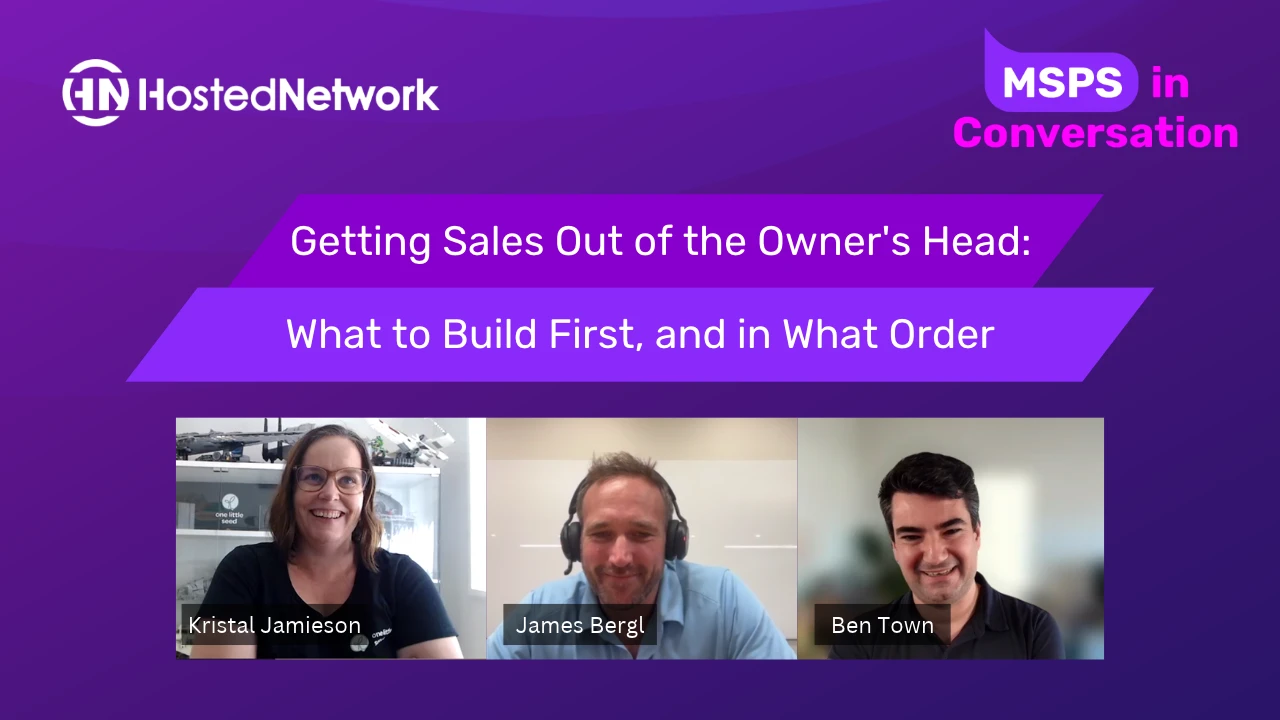
Getting Sales Out of the Owner's Head: What to Build First, and in What Order
Sales & Marketing
Successful MSPs don’t try to do everything in-house. Knowing which functions to outsource — and which to keep internal — allows teams to scale efficiently without burning out staff or inflating costs.
Hiring too fast, hiring the wrong role first, or hiring without clear expectations are common MSP pitfalls. Strong teams are built intentionally, with roles defined by outcomes rather than job titles.
High-performing MSPs are clear on their values and protect them. Culture influences hiring, retention, accountability, and customer experience — and poor cultural fit can undo even the best technical talent.
The most successful MSPs prioritise training and development, even knowing staff may eventually move on. Well-trained people deliver better service, create happier customers, and build a stronger business in the meantime.
There’s no perfect org chart or instant solution. Building a strong MSP team is an ongoing process of learning, refining, and adapting as the business grows and customer needs evolve.
Edited for readability from the episode audio — may contain minor errors.
Thanks for joining, guys. We'll just wait a few minutes to let a few others join. All right, beautiful people. I've hit the wrong one — a sec, technical difficulties on my end. I had to reach out to an IT department. It's funny, when you're in IT but you don't do it, often you lose that basic desktop troubleshooting skill. Thank you — or maybe I'll speak for myself. I know Meryl's come in with — is it technical difficulties or user error? Thanks, I appreciate the support there. Thanks, Stu, we try. I actually shaved today, unlike everyone else on this call. I'm delighted, because we couldn't all match.
Guys, thank you for joining us today. This is our second MSPs in Conversation for this year: how to build a perfect team. I am joined by James, Ryan and Matt, and I'll get you guys to introduce yourself in one second. But most importantly, there is an UberEats voucher for all of you that are on the call if you're a qualified MSP. If you haven't received it yet, please reach out to us in the chat — our team is standing by to make sure you get your lunch sorted out for you. So enjoy that while we ramble on, and hopefully you have a couple of light-bulb moments while you're having your lunch.
I'm going to start today with a little bit of a quote, and I don't normally do this in these, but I always like this one. If you haven't read Jim Collins' book — what is it? — from Good to Great: if you get the right people on the bus, the right people in the right seats, and the wrong people off the bus, then you'll figure out how to take it somewhere great. At the end of the day, that always resonates with me — having the right people on the bus and in the right seats is kind of like my little mantra. It gets me through all the HR difficulties and things like that, and it really does resonate with me. It's always a bit of a saying internally for us when we talk about our team. When I look back at how our team at Hosted Network has grown over the years — as people have come and gone and how we've shifted people around — that's always resonated. So I just thought I wanted to start off with that today.
Hosted Network, if you don't know who we are: we were an MSP ourselves, we started as an MSP before we went entirely channel. Today we are an Australian wholesale cloud and telco provider purely for Australian MSPs. So we only deal with channel, only deal with you guys, and with our range of services — which I won't go into each and every one, because you're not here to hear entirely about Hosted Network today. You're here to hear about how to build a great team.
So with that, I'd like to get each of you to introduce yourselves. James, over to you.
Thanks, Ben, thanks for having me again, and hello everyone. I'm James Davis, Managing Director of Sea-Level Operations down here in APAC. For those that don't know who we are, we're a coaching firm that specializes in MSPs — to help them mature their business operations and develop their teams and leadership inside them. So, exciting to share and talk about building a team today. It's one of my favorite topics to talk about.
Fantastic. Ryan, welcome.
Thank you. Ryan Spillane, I'm the CEO of 360 Consulting. We were an MSP, a bit like Ben, and decided a few years ago — and maybe my other roles — but yes, we've transitioned from an MSP into 360. What I like to do is actually help a lot of other IT companies in mergers and acquisitions, and valuations, etc. So we've done a lot of M&A over the years and are well known for it. That's kind of what I'll be focusing on this year, starting to do full time. So we've got a few tricks about hiring and building a team, I hope — over plenty of years.
Good day. And Matt?
Hi guys, I'm Matt from JEM. We're an MSP, about 54 staff as of earlier this week, and I guess just constantly working on growing. I've met both Ryan and James before, and certainly leverage some of Ryan's experience in learning the best ways to kind of move forward.
Fantastic. All right, well, I will stop sharing now and let's get into it.
So today, guys, I wanted to start right at the beginning of growing a team. Keep in mind, we've got partners on here, MSPs on here of all shapes and sizes. We're going to have some one-man bands, we've got some guys who are much more established, so hopefully everyone has a little bit of information or a light-bulb moment. Guys on the call, though, if you do have any questions for the panel, please drop them in. This will be recorded, so you can send it round afterwards as well, or revisit it if that's what you want to do, and we will send that around after it, the next day or so.
But, panelists, where to start? Let's start right at the recruitment side of it. You're looking for someone — what do you look for if you're going to actually hire someone? What is the key thing that you actually look for? Ryan, I'm going to throw that to you.
Oh, thank you. Well, on that note, your title slide was "how to build a perfect team." I've got a great team; your slide says something different. Let's be honest here — I don't think there's such a thing as an absolute perfect team. I think there's great teams, I think there's highly performing teams, but I don't know if perfect is such a thing. It might be perfect for a second or a minute or something like that, so it changes over time. I think you've had to build great teams would be a great title. "A perfect one" — I think that's pretty darn difficult.
But I think, look, what are you looking for with someone? It depends on the role, let's be honest about it — whether it's technical, whether it's in sales and marketing, whether it's a management or exec level or team leader, etc. Obviously you need to find the right skills for that role, but the biggest piece I would say is always hire on culture. You've got to find people that fit your culture. If you don't know what your culture is, you need to spend some time building what your culture actually looks like. How can you define it? Which is never easy, but how can you actually define your culture — be it through values, be it through whatever, and all of the above, let's be honest about it. I think you need to spend time there.
And then for us, through our recruitment process — we had 59 people in our previous MSP, and I would say it's all about speaking to people about the culture, the values, making sure they're aligned to that, ask them which of your values actually resounds well with them and resonates best with them, and then talk about those things. If they're not the right fit during that whole interview process or your onboarding process, then they're not going to be a good fit for your longer term, unfortunately. So I think culture is by far the biggest piece for us.
It's a very good point. At Hosted Network, we actually do a cultural round dedicated to interviewing, where we actually get different team members to basically sanity-check it, and they get the final say. Even if — I can't overrule it, they get the final say. We found that's been a very successful thing for us because it rules people in. Those of us that are doing interviewing, you can see someone, and you might have external pressures — you've got projects coming up, you've got those sort of different pressures, so sometimes you want to get a seat filled. But you shouldn't always do that for the sake of it. Getting the right fit is very important.
James, from your side — I mean, you talk a lot about the operational side of it — how do you feel it from your side?
As a starting point, I completely agree with Fuzz around it: there's no perfect team. And I think that's why we make the mistakes as well — we try and really define exactly that box of who we need to hire, and we miss a lot of other opportunities there of creating diversity and getting people in there with different points of view and different skill sets. A lot of the time it's not deliberate that we're doing it that way, it's just how we work, how we do it, because we just hire people that are aligned to us, and we don't have a well-defined culture, like I was just saying.
If you don't have a well-defined culture, always start with self-awareness from an owner perspective, because at the end of the day, small business — it all revolves around us. However we frame it up anyway, we're the main leader with the main authority, which is how clients are buying from us. It will be a long time until we get out of that sort of position, no matter how we build it; it still revolves around us. So let's embrace it, and that's where the uniqueness starts. Everyone that's attending now, we're all different. We've all got sort of the same objectives, but we'd all go about it differently. We've got a different way of speaking, we've got different values that we value personally. That's where we start — like, why? What sort of people do you want? What do we want to achieve for our clients? And start building it out that way, to have a deliberate culture.
And like what Fuzz was saying, that process of hiring becomes a lot easier at that point, because we're looking for the right fitted person, and then we can build out the jobs and the specificity in tandem with that. Whereas we tend to start with "this is the job role, we need that 100% exact fit for it to work," and it just doesn't line up.
I think for a lot of us, we don't really go and get the help to do this either, especially on the smaller side of things. Like Fuzz was talking about building up to 59, and Matt's built his team up to like 54 — when you're that size, you've done a lot more recruitment over time and you learn the mistakes. I've got plenty of them. For us smaller MSPs, you generally don't get the volume to learn the mistakes enough for it to be turned into a process and understand how to go through this recruitment. So my biggest piece of advice when we're starting and looking at recruitment is actually get a partnership with someone outside as a recruiter — more importantly, as an HR person — to actually engage in a managed-services type arrangement of helping develop the culture, helping to develop that sort of people management and leadership and all of that internally. And then they will be able to be more effective in recruiting.
We typically use a recruiter as a project, once-off basis, and we all know in our managed-services companies how well a once-off project works with a random client that contacts you out of the blue — it's always an absolute mess. It never works, we never get the results. Whereas we know if we've got an existing client that we work with and know inside and out, we get great results for them. So that's how we should treat recruitment.
Interesting, I like that angle. We've got a comment from Brendan in the chat: does that work in today's world? Staff are hard to get at the moment, it's an employee's market, and often time is of the essence. We've got those projects — how do we get around prioritizing those aspects of it, and not just hiring the first person that can fill the position? Matt, over to you.
Yeah, look, it's hard, because I 100% agree with that. It's hard finding staff at the moment, it has been for a couple of years, and I think we're going through those same pain points at the moment. We're trying to grow the team, there's demand for more people, but the right people aren't out there. So we will typically continue our recruitment process. We won't just hire the person that's the best of a bad bunch, because, as Ryan said, if they don't fit the culture — which is a key concern for us as well — they're not going to be long-term for us. We don't want to just hire someone in, go through the training (the training costs us time and, I guess, money to do that; there might not be a bill for it at the end of the day), but you go through all of that pain, customers start engaging with this person, and they don't stay. It has a flow-back effect. So we'll continue, and I guess we've got a really good culture, a great team of people who will help pick up the slack while the positions are outstanding. It's tough, but everyone in the business seems to agree that culture is a very important part of who we are.
Okay. Brendan's just expanded on that there for his question, and I think it's quite a good point that in a recruitment process you can't necessarily draw that out either in today's market. We've recruited a few people recently, and one of them made the comment that he'd done like eight different rounds of interviews. Process, I think, is an important part of that as well. Ryan — in a quick answer, how many stages do you think is acceptable? And James, you're very process-driven in what you do as a business — what would you suggest in that sense?
I don't think there is one; it really depends on what you're hiring and the job role. I know that's not what people want to hear. I agree, in today's market, long, drawn-out processes aren't necessarily beneficial — but actually they can be, if it's transparent. The main reason why potential employees don't like to stuff around and wait to go through the process is that it's not laid out in front of them; they don't know what the whole process is to go through, so that they can appreciate "what am I getting myself into?" If you lay that out in front of them in the first place, and they see that transparency and they see the opportunity of getting to see if they're a fit for the company, and if you're a fit for them as well, actually it's the reverse effect, because you're showing your maturity and your transparency and how you're working with someone to get the right fit.
That's one of the most important things that the general younger people are actually looking for. They want to be working somewhere for a cultural fit; they're not just looking for a job for a job's sake. I'm probably in the last generation — on the older side of the millennial, where I'm a bit old school — but in general most millennials and Gen Zeds are actually looking for that cultural alignment, and being able to see there's a path. If you've got that well-thought-out recruitment process, you already set yourself apart compared to most people, that are a complete shambles and non-transparent. So yeah, I'd counter it and go: actually it's a unique thing that you can leverage as a huge opportunity.
I like that. In today's market, employees do have choice; there's a lot of positions available. I dare say that most people on this call will be recruiting at the moment and trying to find people, and have been for some time. I say regularly on my LinkedIn posts, partners, it's just around and around — even people swapping between partners. In Australia it's a very small world; we've all had an account manager that has been to multiple different vendors that we've dealt with. They just bounce around. That's the world we live in, in a way.
So the thing that I do see the most in terms of recruitment is around tech, right? It's finding junior — your day-to-day desktop support, level one, level two. So where should the guys on the call look for those? James, you said recruiters. Matt, where do you look for staff — is it just recruiters?
We do a mix, and I guess part of it depends on the role, the timing. Previously we used recruiters all the time for all of the roles, and with, I guess, a gap in the market that seemed to come a couple of years ago, with the number of quality people out there, we also started advertising on SEEK, using multiple recruiters to try and work out where the right place was, because that one method didn't seem to be working. So maybe it was the recruiter, maybe it was just there's not the right people out there. So we started doing both.
I've recently just hired a role in our business for HR, and where we're taking that is to do more of the SEEK-style advertising and go through the process of those initial stages of "is this the right candidate?" — have a conversation with them, see whether they progress through — and I guess effectively take that role of the recruiter. It's hard when you use recruiters, in my mind, because you can't see everyone, and there might be someone that does fit that doesn't meet the criteria that you gave your recruiter. So it comes in the other way: you can see all of them, but that's then met with the time-poor problem. A good job ad will potentially get you 100, 200 people — that's a lot of time to go through those resumes. So we've filled a role in our business to try and accommodate that. But we have seen success in the last year or so using both methods, so I don't think there's a right or a wrong way. It really depends what attracts the right candidate, and whether they see the ad through a recruiter or they see it through SEEK — what jumped out at them could be different in every scenario.
Back in the day, I used to hire a bunch of techs through Whirlpool, back in the day. It always worked out really well. I think Dylan, our infrastructure manager, actually came from Whirlpool as well. But it changes.
Sorry, I don't think you stop recruiting. Good, mature MSPs — doesn't matter the size, and to be clear this is not a big-MSP thing — you don't stop recruiting. I think everyone would openly agree on this call that if they found a great engineer, you'll take them on regardless. You'll easily find the work; it's not a case of finding the work, it's always been the case to find good staff. And I don't think there's any one way of doing it anymore. I think you need to be using recruiters, you need to be doing SEEK, you need to be doing even a newspaper from time to time, because you never know who's reading it. It's not something you do every single time, but likewise, that's right.
And the recruiters have their place — I'm not anti-recruiters, to be clear. I've used plenty of them over the years, but I think they're just another way of doing it. I do like the SEEK method, and any of the replacements of those from nowadays — there's new ones out there and whatnot. You do find those diamonds in the rough that way. A recruiter, if they don't fit in the box of what they think you're looking for, won't ever show them to you, or rarely are they able to show them to you, because they don't want to waste their time, and vice versa. But you find some really good diamonds in the rough through random conversations, through other people. I've had other IT companies refer their staff to us, and they've had a change of business, or a chat through COVID had to downsize a little bit, and they actually said, "are you looking for more staff?" and we said yes, and they referred good staff to us. They didn't give us their rubbish, they gave us good ones, because they had to contract a little bit, and then now they're looking for staff again. It's just what happens. It's keeping your eye out in the marketplace and look creatively.
I think it's worth noting as well that, using the various avenues, you might have a really good candidate — you don't know yet — that has experiences in the past with using recruiters. I've heard a lot of recruit stories from candidates where they've been involved through a recruiter before and haven't found that process to be great, or found it more difficult. So I do know of people out there — I've met some that I've hired who had a bad experience in the past with a recruiter, so just avoid responding to ads where a recruiter is involved. So if you're all focused on recruiters, there could be a bigger portion of people that you're just missing out on.
It's a very competitive talent pool in that sense, right? So you want to have as many options as you can. We've just had a comment from Steve that planning at the right time of year can also be very good in terms of graduates and things like that. I've personally found great success in those areas, or aligning myself to the local TAFEs, those sort of things. One of the things that I've often tried to develop and maintain is a level-one program to make sure that we've always got — like Ryan mentioned — that constant, not just recruitment, but that constant developing of more senior resources internally. Because I think we've all been in a position where we've hired a senior resource, especially from the enterprise space, and they don't get the MSP mindset. Whereas training up often yields better results.
With that in mind, graduates and whatnot — use that as a bit of a transition. I always like to ask this question for techs specifically: what do you care about from that education perspective? Is there a university degree? Matt?
I think it depends, again. If we look at trainees and graduates and all that kind of thing — everyone's mentioning it's hard to find quality applicants, and I think it's a burden that we've created ourselves in the industry. We'll talk a lot more about retention and that kind of thing, but in general, probably about 2014, I noticed the great majority of the industry stopped accepting trainees. It was like we could only hire experienced people. And it's only started back up in probably the last two years that trainees are an option. So we've basically wiped out a generation. So when we're talking about "we can't find any experienced people," it's because us, as an industry, didn't develop them and didn't keep the people in the industry. So it's really worth keeping that in mind.
And I think a lot that are starting to buy into that as an option now won't want to do it — they're not set up to train and develop those people, not enough processes and not enough focus on what we need to learn and what skills we need to know. Like, take a step back: in just Tech roles, you talk to everyone on this call and they'll have a different opinion of what a level one, level two, level three tech actually is and what skill sets they should have. So we don't even have standards in the industry to base it off. Each business is hiring something different, and when we talk about it and compare salaries, it's different, and when employees are going to search on SEEK or whatever, we don't know — the employees don't know what they're getting into either. So there's a lot of disjointedness and lack of clarity as an industry that we could get better at.
And I think having that framework to start with — what are we trying to fill, and what culture are we aiming for — that's a lot easier to find the skills and what's right, and then feed in that training program from the graduates. If we don't have that, all we're going to do is hire one graduate, and it's a single swim moment: they're either going to be super-awesome and fantastic and do, or they're going to flounder — either because they're not the right person, or we haven't set them up for success. So it's very important to be mindful around that, and how to make that work properly.
Especially for the smaller MSPs, typically they're only going to hire one. All the good trainee programs that I see, even in smaller MSPs, are hiring more than one at one time, because it's more efficient to train two or three people on the same things at a time, with the potential that one or two out of that cohort is going to fail, but we get one good person. So we have to think about that sort of recruitment at that level a lot differently as well.
Just to grow on that, and on Steve's comments — I know JEM, Steve has a team that is basically those trainee, those graduate-style positions. I think — and Steve might correct me — I think we've been running that for about four or five years. It's basically people that want to get into it. The idea actually came from another MSP, but looked at what the market was looking for, and it's like, oh, we want junior people because we've got a smaller budget, but we want five years' experience. You can't have both. They said in a job story, "I want someone young that's cheap, but I need 10 years' experience." It doesn't happen.
So we developed internally, and took the part of the idea to build that up, and we've had a lot of success with a lot of people that have come in at that very junior level — not even level one — have been trained by us, learned our bad habits (which is sometimes better than someone else's bad habits), and a number of them have actually progressed up and are now sitting in level two within a year and a half, two years. So they're motivated, we've got goal posts, they have to meet certain marks as they go through, they have to sit certain certifications — not university, but like vendor-style certifications or CompTIA certifications — before they can progress through. So from that initial start with us, the transparency is there, they can see what they need to do to continue to grow, whilst at the same time we're giving them the experience that a lot of places back four years ago just weren't in a position to give.
I think that's an important point. On our own Cadet program — yeah, we ran a Cadet program, and every six months we'd hire a new one, and there was a two-year Cadet program, and every six months we kept adding one. So it basically meant we had a continual flow. And look, to be honest with you, it's not cheaper, let's be honest about it. It's the amount of resources you need to put in to train them — level two, level three mentoring, etc. It's nothing to do with being cheap, because yes, they might cost you a little bit less on your books, but in reality the effort you put into them, they're actually quite expensive.
But someone's got to do it. No different than what Matt said — we get to train them our bad habits, and don't have to break other people's bad habits, or the best way of doing it. But on the other hand, someone's got to give back in this industry. It's all good and well saying we give back to the industry, but how many people actually do it? So for us, we did build our own Cadet program. We put a number of people — I think probably six or seven people in the end — through the program, and multiple of them are still in the industry. Some started out — again, for us, they had a passion about technology, they had no idea how a help desk worked, what practice management software or any of those types of things. Yeah.
But back to your original question, Ben: does a uni degree or any of those things matter? I don't think so, from what I've seen — unless you're going for a business consultant, or a VA-type role, or senior roles where it helps a bit. But I would much rather see someone that's been passionate about technology, passionate about learning, and over three, four, five or however many years they've actually continued their education — they've done Azure, they've done network skills, they've done this, they've done that, whatever it happens to be. They've actually engaged with vendors, or even just online training, and actually certified themselves over a period of time. That, to me, is a lot better than someone with a uni degree who's been able to do it basically full-time for three years and then doesn't learn or doesn't train afterwards. I'd much rather have someone — maybe they've got a TAFE diploma or whatnot — who has a passion for technology and the industry and is willing to learn. They're going to soak things up, they're going to be a sponge, and, as we call it for the first couple of weeks — what was correct? — Solutions, it was like drinking from a fire hose. You can learn as much as you want, as much as you can handle, and it can keep going. That, for me, was always the better outcome.
Yeah, I've always enjoyed that part — passing on my knowledge and watching people grow within the team as well. I like your example of being a sponge. I often said to a few people, "Just be a sponge, absorb as much as you can, but it's okay, because you're not going to absorb everything. There's a point in every day."
But we've had a few questions here — well, comments — around people having success with graduates. A few comments here: where have you guys found your graduates? We've mentioned TAFE, and we've mentioned trainee programs, but is there something that the guys on the call could potentially look at to actually kick off their own training program, or something like that, that you guys have had success in?
Because sometimes it's the neighbor's son. It could be someone that's come and done the work experience from school. That, to be honest with you, is often a good way of getting them, because they've come from school out of year 10 or 11 or 12 or whatnot, and they've come and done some work experience — find out whether they like it or not. It's a good couple of weeks for you to see whether they've got any passion or not. Yes, they're extremely green, because they're 17 or 15 or whatnot, so everyone's green, and it's just the way it is. But yeah, look, I think any of those — if you openly talk that you have a Cadet program or whatnot, you'll get so many people responding to it. People are looking for people to get back into this industry.
I can see there was another question there as well: what size did we do it at? I think we would have been 40, 45, but don't get me wrong, we were thinking about it for years before — even at 20, 25 we were thinking about it, we just didn't have the process down on how to do it. It wasn't a science thing for us. I think you could do it at eight or ten people without a problem, to be clear — even five, I think you could do it. The catch is just having some process around it. Be it, let's say, they have to go and do some TAFE certificates as well — if they're coming in younger than that, get them to do that part-time as well as some work with you for three or four days a week or whatnot.
The biggest thing is realistic expectations, I'd have to say. You can't expect these guys who are level zero — they're not even level one, they're level zero — to not mess things up, to not make mistakes. This is life. And the biggest thing you've got to have as well is a culture that says, for them to be able to make mistakes, but also understand when they're out of their depth, or out of their comfort zone, to take a breath, stop, and ask someone near them — even a level one or a level two — "hey, what I'm doing, is that okay? Is it going to cause a problem?" And having that culture where even level threes will talk to each other and bounce ideas off each other. We had level threes who would ask even a level one, "hey, what do you think of this?" It's a training for them as well, but it makes them feel great — hang on, an L3 has actually asked me a question. There's nothing wrong with that. It removes some of the ego; it's not a problem with doing that.
So I wouldn't say it's a size thing. I think it's more a maturity piece of whether you're willing to really invest the time, because someone like that, if you invest a few years in, yes, they become L1, and then from L1 to L2. How many people in some of the businesses that have been around for quite some time have people that have worked with them for 10, 15, 20 years? And the ones that have generally grown through the ranks over a long period of time.
I completely agree with that. I've got, you know, our coaching program — we've got some smaller lifestyle businesses that, 10 staff, they're successfully doing the training program with cadets. It really is just the maturity and "I want to do it" and having the processes in place, and it's very successful. There's a lot of advantages for everyone.
I think, taking a point that you made a bit before around trying to find people that have got a passion for technology — what I'm seeing, being fortunate enough to view a lot of MSPs across the industry, is a lot of owners are struggling to look at the younger kids. Like, you mentioned 15, 17, even 20-year-olds — for most owners now, that's a 20-, 30-year gap, and they think back to when they started in the industry, and how they got their start, and what qualities they have. That's not who's coming into the industry anymore at all. We still get young kids that are still that nerdy, play around, create a gaming machine, and they have potential fit because they're fiddlers, and that's where I see most of the owners get excited, of how they do this stuff at home. But we're missing out on some opportunities. The industry has shifted a lot. It's a lot more process-based, it's a lot more customer-focused, it's a lot more about technology and productivity and how we actually use the tools, not just fix the back end.
A lot of the people that are looking to come into the industry at the moment are not from a technical background. They're looking at: well, I've got some customer-service skills, technology actually looks like a good, stable career with long-term prospects, so we want to come in. It's not the best and brightest young kids that are coming in, like it was 20, 30 years ago when it was a cowboy industry, because all of those people are going to AI and all the more shiny technology parts of the industry. So we're getting more stable, process-driven and customer-friendly type people, and I see a lot of owners write those types of people off. So it's really worth understanding what we actually deliver — going back to our culture, going back to what our clients are doing and what we're actually delivering — so we've got that frame of reference. And looking to the future: they're not useful now, they're green, but what are they going to provide in five years' time if I retain them and invest in them? Where are we going to be with that technology? We can mold and shape them so that we've got that experienced workforce in the changed environment. So there's a long-term play there too.
Okay, well, I think that's a good transition, because this is a big topic — I've got to remember we've only got an hour today, and recruitment is a big piece of it. But please do ask questions, guys, if you have them. I'd like to shift a little bit. We've found this great level one, level two, level three, whatever it might be, level zero — how do we retain them in this competitive landscape? Because everyone is recruiting at the moment, and we tie back to this idea of culture, of having a great company. It's not a ping-pong table — I've seen that, and sure, maybe that was attractive once upon a time, but the world has changed, especially in the last two years. So I'd really be keen to hear from you guys. This all ties back into the recruitment piece of it, right? Culture — a lot of these, since COVID, people can work from home now, they are moving further out. What are you guys doing as part of your businesses, and what do you see in the industry that is working to help businesses retain their staff? Matt, I'm going to throw this one to you.
Yeah, look, it's an interesting question. As a business, we look for the right culture in people, and — I made this comment earlier — I think those people also look for the right culture fit for them. So it's looking for that win-win situation. We've had a few guys in the last couple of weeks been headhunted by another MSP out there, and the offer on the table was amazing. They've been very open and honest with us, and I guess we try and replicate that: we're open and honest with them, they're open and honest with us. "I've been approached, this is what's on the table." And a lot of the time — oh, sorry, all of these cases of late — they've declined the offer and stayed with us. I think part of that comes down to the people they work with, that culture, the business. I think part of it comes down to the level of tech they get to play with, so our customers are running some very complicated networks, enterprise-grade equipment, that might be, for the right person, part of it. But I don't think there's any one thing that makes someone want to stay long-term. If we look back through our business, we've got guys that are coming up to 13, 15 years, things like that, and it's a good majority of them. The ones that don't have that time with us are the ones that are coming in, but they're staying with us.
That's a big testament to your business — if you've had guys stay with you for 13 years, you must be doing some things to help maintain that. Ryan, in your previous businesses, what have you done?
Culture is key, yeah, culture is critical. But as Matt said, it's not just one thing anymore. Yes, culture is a big piece of it. People need to be challenged, people need to have some flexibility. And now, flexibility — it used to be to be able to take the kids to school or go and do a school thing, or go to the doctor's, or get a haircut in the middle of the day. Those things were easy. Now flexibility has changed. Flexibility is working from home for a couple of days a week, or all those types of things, or even permanently working from home if you're hiring staff in other states or in remote locations, because that might be the only place you can get the staff.
They want to be excited about where the business is going, through transparency. Are you putting a good vision out? Are you explaining where the business is going? Are you explaining how they can actually help? That's the biggest thing — anyone can go out and put a great strategy out, "hey, this is where we're going to take the company," but if people have no way of how they can help bring the company forward or help get to that goal, there's a disconnect, and it doesn't actually help. So you've got to make sure there's alignment, and that each person knows how they can help the company achieve what you want and where you're going. That again builds on the culture.
They want to play, every now and again, with some cool tech, something interesting. They don't want to have customers that are — yes, we are in an industry that can be, but — negative customers are only ringing us generally when they've got a problem. There's not that many customers that ring us and say, "hey, the network's working great today," or "hey, the computers are working fantastic today, I'm glad I didn't need to ring you, but I did anyway." You do get the odd customer like that, it's extremely rare, but they are out there from time to time. But normally most people are ringing you when they're having a really bad day, excuse the French — I know this is getting recorded — but something's just broken, they've just lost a file, they're having an absolute crap day, and sometimes they unfortunately take it out on our team. If it's a continual thing — if a customer is just not a good fit for you — it's really powerful firing some of those customers as well, and letting the team know that they weren't treating you right, and you'll take the team's side and we're supporting our team. There's plenty of customers out there, there's not a problem generally in going and finding other ones — unless you're extremely regional and there's not many people or companies in the town at all. But normally you can often find a replacement for that customer.
So again, staff want to know that they're being looked after, that you're thinking about them, how they can help, play with stuff, have a bit of flexibility. All of those pieces do it a bit. But don't get me wrong, you're not going to retain everyone. People need changes sometimes, and we're seeing it right now with the — what is it in America — the great resignation, and even in Australia it's happening. People are just moving to new roles at different companies, hoping or thinking that it's different, when in reality it's not. They know it's not, but they just need a change. It's just the grass is greener on the other side of the fence.
That's right. There's an interesting one a South African once said to me: the grass covers a lot of... and I've loved that ever since he told me that. It's so true, though, because you don't know until you get across there. How many people have been on an overseas trip over the last couple of years? How many people have had a good break? They haven't. Most, they've staycationed at home, really all they've been in is ISO or something like that. They've not really had a break. So people are looking for something different, and that might be it — right now people are just changing roles. I know so many people that have contacted me — even last night, I had someone message me at 10:30 last night. He's only been in a new role for like five months, doesn't have a big problem with the company, pretty happy, but it's not what he was looking for. So he's ready to jump again.
If people are just moving elsewhere to try and find something, they generally won't find it. So you've got to give them that base. Sometimes you've got to let them go out and have a bit of a chat. We've had someone that's just hitting 15 years with my own company, and he went and interviewed three or four times, and he came back. As Matt said, have a culture that people will come back and tell you where they're at and what they're doing and talk it through. We did that plenty of times with people, and they realized it wasn't actually going to solve what the underlying issue was for them.
So I'm going to say — we actually had a staff member rejoin us yesterday. I'm going to say Luke actually rejoined us at one point as well. And I think life is a journey, right? Not just for ourselves, but for our teammates as well — our employees, our colleagues. You don't know what they've got going on in their own life, you don't know what other pressures they've got as well. Steven's made a comment here that some people will leave for money no matter what, and that's just life. In that sense, well — maybe if you're paying competitively — and sometimes it is harder to pay extremely competitively, especially at the moment, when you've got the big enterprises just upping and upping and upping what they pay, because there's no IT staff in Australia, sort of thing. It is difficult. But I think the majority of people aren't money-driven in that sense. I think most people won't change for five or ten grand. Yes, if it's 30, 50 or 80,000 more, it's harder to say no to that — which I have seen, a lot of people will take that. That's just life, something someone can't refuse.
Okay. Stephen makes a good point: if they're going to leave for five or ten grand, then they're probably not the right culture fit for you anyway. Right person on the bus in the right seat.
I'd agree with that. I think all the points are awesome, and I think you can distill it down to a couple of things. I think we often forget there's a lot of advantages to being in a small business, and we keep trying to take lessons from corporate and trying to stuff it into our small businesses, and we fail. HR and retainment, I think, is a really — there's a lot of good lessons that we can learn from corporate, like training. Let's actually provide our people training, because if we're not — who has a distinguishing feature? If I'm looking somewhere else and Fuzz tells me that he provides training, and Matt doesn't really convince me that he provides it well, I'm going to go the one where there's training, because at least I get something, and I know I'm going to get something out of that.
A lot of what we've got to remember is we're generally working with people that are 20 to 35 in the industry — that's the majority of the workforce. There's obviously still some older people around, and they're usually the more settled, and most of them at this point are like managers or owners kind of level, and we've still got that one senior tech that's been around forever kind of thing. But we're talking about people that are in certain life stages, and the taking money is because of life circumstances a lot of the time. It's not actually driven by money, it's like the partner at home is saying "we need more money" — there's the driver, the motivator.
And I think more than anything is the connection. Even at a 50-person business, like Matt and Ryan, you can still have a personal connection with all your employees of that size, and that's what most people want. If we've got a purpose, and what we're aiming for with the company — like Fuzz said, if we've got a plan for them, and we work with them, and we actually take the time, whether it's an owner or managers and leaders, to provide consistent feedback and adjust the plans as we're going — people want to actually stay the majority of the time. We give them reasons not to stay, whether we know it or not, and whether they are better off moving somewhere else or not.
Like, there's advantages in people going and coming back and learning different skills and growing, but there's also a danger here. We pride ourselves on longevity of employees — that's great, as long as those employees are actually training and staying relevant. My experience is the majority of people that have been in the industry, that are our senior techs for 10, 15 years, are becoming static, they're not training in these new things. In general — like, you guys might be lucky and have that culture that keeps promoting the training — but in general, in the wider industry, the experienced techs' skill sets are becoming more and more limited. They're not really understanding the cloud, and more scarily for me, what I'm seeing is they're very resistant to security. They don't understand best practices, they flat-out refuse to implement some of the best practices when they're challenged, because it's too hard to do our job now. And they're the ones that the business owners — that are becoming less tech-savvy — are relying on to make all these risk decisions about technical standards in their environments. So, on the flip side, there's dangers for retention as well if we're not doing the right things.
So training is super-important, connection and regular feedback and that relationship building is super-important, having an overall purpose — and that will drive most people. Most people are joining small business for all the things that Matt and Fuzz have said, because they get to play with a lot more things. Go to Matt and JEM and get to play with these complex networks and all this enterprise-grade stuff — they don't know what corporate looks like, they're young. And unless you're transparent, have those conversations — even these 40-, 50-, 60,000 increases, they don't understand what job they're actually walking into. Most of the time I'm not seeing owners have the conversation transparently, to lay it out in front of them to say "here's what the role looks like, this is what you're going to have to do to succeed at it, good luck, go and do it." We're not even setting up the people for success to move into these next roles.
So it's a basic thing of communication, right? Like any relationship, relationships fail without communication. Setting clear expectations, and not just saying it once in that sense — reinforcing it. If you're going to set KPIs, it's all well and good to set them, but reviewing them regularly. And that's hard when you're a small company as well, you know, we're all time-poor in that sense. So maybe, James, that's where — what are some of your tricks, and are there ways that we can?
Yeah, we have time, it's what we choose to spend it on, like, especially with our employees. It's much easier to go solve XYZ problem when it's on fire than it is to sit, prioritize, and sit down with our employees to talk. To me, that's an excuse. If we're too busy to talk and communicate and work with our employees, we're too busy to have employees — like, we should just go to our perfect team of one. It sounds very brutal, but our people are the most important part of our business, and we've got to actually treat them and show them that.
Especially with the flexibility of work from home and in COVID, the generational gap between owners and employees really showed. The amount of people I've spoken to that, as soon as everyone started going remote, there was no team meetings, there was no tech huddles, there was no one-on-ones. If I was a tech on the front line, doing a super-stressful, hard job day-to-day, would I want to stay there doing that work? No, I'd go look for the higher pay, I'd go look for a place that engages with that culture. And work from home is not going to go away, so we need to set up the meeting rhythms, whether it's in person or whether it's via Zoom or Teams, and actually talk to our people. We start with planning your week out of what meetings you have to do with your people, and then fill the gaps with the other stuff, and that will show you what to delegate. That's the simplest place to start, because without that discipline, we don't default to it, and that's what causes the disconnect with communication and relationships. And with work from home, you just drift faster and faster and faster.
It's a really interesting point. During COVID — it's a great example of this — we actually went the other direction and made sure that we had pre-booked-in regular catch-ups. Where teams were large, we'd break them into smaller groups. The thing we noticed — and part of, I guess, the fun part of our culture — is that banter, that family feel. So smaller groups meant that we could continue to have that banter. So it wasn't that every meeting was a serious meeting, "this is what's going on, this is what's changing." There was obviously the highlights of those kinds of things, but it was more about just that employee engagement, making sure they felt the same as they would if they were in the office, with obviously more of a virtual touch to it than that face-to-face.
You needed to look at — literally when we went home, you had to up it. We already had a lot of that in place, we were already doing it, but to be honest, I think you needed to increase it, like we did. The social things, we had social drinks, we did all of those types of things, all those things happened and needed to happen, and you needed to double down on that. And don't get me wrong, it was tiring as well, but it was the difference between keeping a team and doing well, versus a bunch of people that are now, probably at the end of it, who've already moved or starting to move and things like that. So to me, it was a critical piece.
It's funny — I mean, back in the day, we all work remotely, Hosted Network is entirely remote now. Most people haven't been able to do that, but we've done it for a long time, close to, well, 15 years, we've had staff that are remote and whatnot. So we're a bit more used to it. But one of the things that I used to complain about, as, you know, the boss in the office, is the water cooler — it used to drive me insane. I tell you what, COVID really taught me how important that was, letting people have that little break, that sort of mental break of bits and pieces, and how to actually do that virtually is hard. So now we've got this kind of hybrid workforce — some people are in person, some people aren't. It's a tough world in the last two years. I'd hope that it has taught a lot of us lessons that would have taken us a lot longer to learn, whereas with COVID we were forced to start learning them virtually overnight.
So, guys, I guess we're nearly at time, we're nearly at an hour, but I just want to cover off the last little bits and pieces. A couple of, I guess, very quick ones in terms of systems, from an HR, managing-a-team perspective. Are there any things that you guys, or systems or companies that you might use, that the guys on the line can actually look at to do some extra offline reading that you've found useful? I'll give you an example: we use the New South Wales Business Chamber. They're great whenever we have any issues, when we're not sure — they make sure we cross our T's and dot our I's, and they provide insurance as well for fair-work issues and things like that, to make sure that we go through that. That's something that I've found really valuable, that HR guidance piece.
So, we're members of Ai Group, which provides that employment — kind of like the Business Chamber — but we've also got an external HR consultant that we lean on relatively heavily. At least once a week we have a conversation with her about various different things, and planning, as well as things that need to be actioned.
Does that help — does she work just with you, or does it work with your employees as well?
Oh, both, yeah. So we've had her in recently to work with a couple of employees that we were struggling with in different areas, and so she'll work with them. So it's not just us that's engaged with her. She comes in, and when we're trying to do group things she might come in and run those, get feedback — sometimes get feedback without managers sitting in there — so we can go through that continuous improvement to allow us to grow.
Okay. James, from a process, operational side of things, do you see many systems or tools out there?
There's a lot, and to be honest, I'm reluctant to say go get tools, because it's a people thing. Tools should be once you understand how to manage the people, have the process.
And what about blogs, then — are there any good reading resources that you might know of?
There's lots of people on LinkedIn that just do this content, and there's heaps of content around there. There's Next Gen HR, there's Alchemy 2.0, there's Axia HR, and they all work in the MSP space and have really good content. Backing up again what I said before, and what Matt said, the HR consultancy is really important. It's that ongoing relationship, it's being involved, understanding the business. It's basically managed services for people management, is what we need to look at. There's services like EmployShore and HR Assured that are out there that are cheap and reasonable, but they're very generic, they're not based on getting to know your company. They'll just tick off a lot of items, which can be good for people — can be a good first step to make sure we're HR-compliant with our work and all that sort of thing — but if you're really engaged with this and want to learn, you'll quickly outgrow those types of services and get more mature, and that's where these HR consultants are a lot more important.
Okay, anything from you, Ryan, to finish this off?
No, look, just on the back of what James said there — it's important to have someone helping you with those areas, there's no doubt about it. But I don't think you can abdicate it. You can delegate — and whatnot — delegate and verify, but don't abdicate the responsibility at the end of the day. These people are your team. You should be getting close to them, you should be understanding if there's problems. If you're not a people person, look, it's not going to be the easiest thing, but you're going to have to get through it, because it's the best way of managing and actually maintaining your staff and actually having a culture, as if you're right there with us. Just delegating that out to a third-party company and whatnot — it'll work for a period of time, but you'll find that as people go on for longer and longer, they just won't be as connected to the business.
And as to that final question — no, look, off the top of my head, the guys have mentioned some good resources: peer groups, community groups, all of those things, local chambers, all of those things. Other soft skills, any of those things, will definitely help and improve this. There wouldn't be one particular place, and again, as James said, you don't need to add another system. You're dealing with humans here, you're dealing with carbon-based life forms. Look after them, and I think that's your easiest way of doing it. Don't just try and ignore it.
Fantastic. Well, guys, thank you so much for today. It's been absolutely great going through this, and hopefully everyone on the call took a few tidbits away, a few light-bulb moments. And hopefully you enjoyed your lunch, whatever that may have been — UberEats and all.
So, our next upcoming events: we've got a couple of technical workshops coming up on the screen there, we also have some marketing workshops. Our next MSPs in Conversation — and James, I believe that you'll love this topic — MSP mindset: avoiding the noise and the stress. And then we'll have another one for finding qualified prospects. So check out our events page, you can register and find out all the details on there. If you joined late, or if you want to recap anything that we spoke about today, this will be recorded and we will be sending it out in the next couple of days.
But again, thank you for joining us, everyone, and the panelists, thank you so much, guys. It's always a pleasure.