20 October 2026
Getting Sales Out of the Owner's Head: What to Build First, and in What Order
Sales & Marketing

MSPs face constant alerts, client demands, and internal pressures. Identifying what truly requires attention versus what can be deprioritised is critical to reducing overwhelm and improving decision-making.
High stress over long periods leads to burnout and mistakes. MSP leaders must build systems, routines, and boundaries that support mental resilience for themselves and their teams.
Well-defined workflows, escalation paths, and communication standards help teams stay focused, minimise unnecessary interruptions, and operate calmly even during high-pressure situations.
Edited for readability from the episode audio — may contain minor errors.
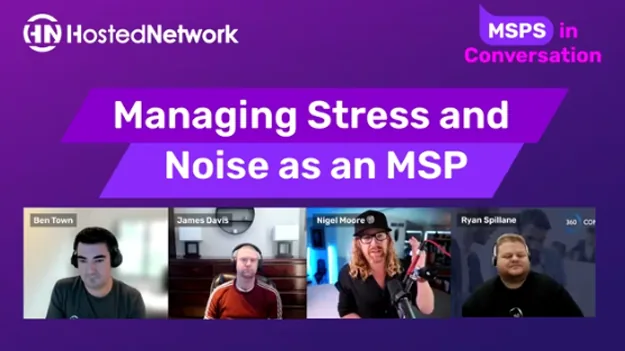
Thank you everyone for joining us today. So today's MSPs in Conversation is on managing stress and noise as an MSP. We've all been there before, and some of us are probably going through some stressful moments right now. Our panelists today have all been there, and this is about talking about some of the causes of burnout and some of the things that you can do to avoid it. Some of the bad habits that we all have developed over the years, and hopefully identifying some of those for you so you can get more out of your business or your work-life balance.
Most importantly though, most importantly, if today you are an Aussie MSP, whether you're a partner or not of Hosted Network, hit us up for an UberEats voucher. 25 bucks, lunch on us. I think everyone should already have one by now, but hit us up in the chat. We've got the team on standby that can hook you up with that if you haven't got it already. And if you like one, can you pay for us hosts? Yeah, pay for our lunch as well please. They got invisible steaks.
So, a little bit of a Venn diagram. I thought this was kind of funny. We've all been here before, so I was sharing this around yesterday and we were like, let's throw that in at the beginning of the slides.
So anyway, a little bit about Hosted Network quickly. Hosted Network is a wholesale cloud and telco provider for Aussie MSPs. We deal with MSPs across the country. We started as an MSP ourselves, which is why we do these series of MSPs in Conversation, because we've all been there. Everyone's got things to share, and we've got a great community, a Hosted Network of partners. So yeah, that's enough about us. You can sort of see that there.
But on to the fun stuff: introduction of our panelists. You've met all of these guys before, but starting with Nigel. Give us a low down.
Me, started an MSP, sold an MSP, built a community of MSPs, and made every mistake that you could possibly make along the way. And now teach others how to avoid all those stupid mistakes that I made along the way.
That's what we're here for.
That's it in a nutshell. Thank you. On the topic of our topic today, had a bunch of burnout, had a bunch of mental health challenges I went through when I was doing all of that. And happy to try and share and help others avoid going through those horrible situations if we can.
Yeah, that's what we're here for. Ryan.
I've been in MSP from '98 through to 2022, so I finished up being an MSP a few months ago. Sold my MSP, which was Correct Solutions, into what is now Orro. Still have some shares there, but now I spend most of my time helping MSPs either buy and sell their businesses, or prepare their business for sale, or actually just help them inside their business to kind of have a bit of a life as well. So yeah, still very much MSP at heart and don't want to leave the industry, because I love it and I love this community.
Thank you. And James.
Well, small MSP, Pax8. I'm going to get used to the whole thing now, my new title of Director of Academy for Pax8. Now I'm in the big boys, so it's a bit different. But I've come from the small business background as well. I think about 50 percent of my working life I've been a small business owner so far, so I've lived the burnout, with the dream of the stress every day of that freedom that we supposedly get as small business owners. I get to share my wisdom every day with clients and people in the community of what not to do, from all my mistakes over the past 10 years in the MSP world as well. So look forward to talking about this topic.
Awesome. Well, thank you guys for joining us today. We're here for an hour today, so it will fly by. We're already like seven minutes in, so let's kick on. I'll stop sharing, because there are no more slides for this. It is just looking at our beautiful faces, as I make that joke every time we do this.
So first thing, avoiding burnout. Everyone's gone through this, like we've sort of touched on. Today we're going to be covering some stories, and hopefully you can relate to some of those. So I'll start with the cause of burnout. James, I'm going to throw that to you. What do you see as the most common reasons for burnout within an MSP? And then guys, jump in afterwards if you think of anything else as well.
I'll start with my experience of where I got my massive burnout in my small business. I had a trade services business back in 2012. We grew to over a million dollars in 14 months worth of revenue. I had 14 staff, and it was super busy. It's exciting, but I learned a lot from that period of what a lot of the causes of burnout and our bad habits for ongoing stress are, in a very short period of time.
So by the time I was exiting the business at that point, I was working 100 plus hour weeks, and that was like 10 weeks in a row over 100 hours, and I just completely wiped myself out. A lot of that stemmed from the stress of making payroll, because we grew so quick. I went from basically two of us to start with to 14 in so many months, and that pressure of making payroll every week was just exponentially growing. We hadn't got a lot of the core operations of our business in place to make sure all the processes were right, were collecting cash correctly, were making sure we're hitting the numbers on sales to keep that repetition up.
And I found I grew a lot of bad habits as the stress built, because I would just take more and more onto my own shoulders to make it work, because I needed to make payroll the next week. And because you were so busy and so chaotic, all I did was think about the next payroll. Not a lot of that forward thinking, because you were so stressed. And at a certain point you get it so ingrained in you. I know I did it at a real hyper scale compared to a lot of us that start businesses, but it reinforced a lot of habits for me. It was like, I just need to be busy so that I can make payroll. If I'm busy, things will fall out and we'll have cash in the bank. And I've seen that time and time again from a lot of MSP owners who have done this for 10, 20 years. A lot of the bad habits stem back to those early days of just making payroll, and we don't know what activities we do that actually drive the business and drive the cash and our profitability. So we just get addicted to being busy, and that just keeps building and building and building, and it eventually becomes our identity and it's really hard to crack.
I think a lot of people, James, off the back of that, actually wear that as a badge, that they're always busy, or trying to do 100 hour weeks and things like that. And I think, look, I probably was a bit guilty of that in the very early days 20 years ago, but it's not the right thing. There's busy good and there's busy bad, and unfortunately most people are busy bad rather than doing the things that are really good for their business or whatnot. So I think too many times people take that as a moniker. And the other thing I think people don't realize is that not every dollar is a good dollar. Too many times we chase any sale or anything, just to make, what you were saying there, of those early days of making payroll.
Web development projects. That's all I'm going to say.
Being an MSP doing web development. No deal, no deal. You know the biggest thing that I saw, I see, and I had this problem as well, is that when you get into those modes of just hating your world and hating your business, is that you start the business for the reasons of, typically most MSPs started because we love technology and we love helping people and we love playing with the latest kit. And then six, 12, 18 months into it, we realize we're not doing any of that stuff anymore. We're not helping people, we're trying to manage stuff and we're fighting fires all day every day, we're not getting to play with all the tech like we used to anymore. And that lack of doing the stuff that we loved absolutely just piles the burnout on, because we're waking up every day and there's a treasury of stuff that we didn't want to do, we didn't sign up to do. All of that managing the books and dealing with having to do sales or marketing or all these things that were foreign to us at that particular point in time. And when you don't have a way to work on the stuff that you really love and that really lights you up, you get burnt pretty damn quick in the grand scheme.
You do indeed. Throwback to James, I've had many nights, when we were small, business starting out, laying in bed freaking out over payroll. And you really do just do anything, right? And then you get that bad habit of getting rewarded by it, and you make payroll. Okay, cool, I've got another month for whatever, payroll.
So, Ryan, can you give me an example of when you failed? You've been in business in the MSP land, so I mean way back when you first started, or even more recently, of when you've faced burnout and what you did to tackle that.
Yeah, look, I think probably the early days, and I think burnout happens, or I think challenges happen — not necessarily burnout all the time, but I think challenges happen at different sizes, and those challenges change. I think from the one and two man days back in the late '90s, to just shy of 60 people, or 59 people, through the middle of COVID. So that's a totally different type of size difference. And then thinking about payroll, a couple hundred thousand a month all the way through COVID, that was a different type of thing. Luckily we had a good war chest, which we didn't have to worry about, which we did say to staff, you didn't have to worry about your jobs or whatnot.
But yeah, look, back in the early days, I think probably the biggest challenge I would say is finding the right people. A lot of times you don't have the budget or you don't have the dollars, or you don't think you can afford the right people. So a lot of times you employ people that are necessarily cheaper, or people you know, and they do the job, don't get me wrong, but often you're covering for them, or you're spending all of your time solving problems that they can't, or doing things that they don't get to. I think you set a bit of a rod down your own back as well, if when they finish at 5:30 and there's 10 things still to be done for the day, that as a business owner you often jumped in and did them all, just to get them done, because you didn't want customers to be unhappy next morning, or you didn't want everyone to come in with a big list. And I think you then start creating those problems and those issues for yourself, and that can lead to burnout or lead to other issues.
And I think that's something, especially when you're small. I think the best way of dealing with that, again, we had the old back in the small business server days, we had the old SBS user groups which then turned into SMBiT Professionals. I think anything like that, having communities around you — and we'll talk more about that later I'm sure — but I think that kind of helps, being able to speak to other people in a similar industry and similar pain points. And there's plenty of programs like that nowadays, which we'll talk about later in the call.
So speaking of communities then, Nigel, you obviously run a wonderful one here in Australia. What do you see in MSPs, being an external party for those in the community? What do you see as the most common?
Our industry is unfortunately rife with mental health challenges and all sorts of stuff, because we're a really, really, really tough industry to work in. Technology changes faster than we change our underwear. Trying to keep up with the business model and trying to attract new clients and all that sort of stuff is just very, very wearing down. And I see a big majority of MSPs in our industry have had mental health challenges or are struggling with them right now, and it's horrible. I think it's probably fair to say most of us on this call have had our fair share of them, and we know what it's like when you're sitting down in those bloody trenches and you're not wanting to get out of bed in the morning for weeks and months on end, and it's horrific.
And I see it, and it's a byproduct of all those things you just talked about: trying to make payroll and trying to focus on the right things and not getting to do all the stuff that you liked. And then what happens is you stop focusing on things like your health. And when you stop focusing on things like your health, everything else suffers, and not only your physical health but your mental health as well. And everything else suffers on top of it. You then go to work every day and there's working and working and working, and you're not getting any exercise, you're not getting any movement. I'm seeing it as kind of a pandemic or an endemic in our industry, that people are really struggling. COVID probably sped it up a little bit in there, but I'm seeing lots of people in that state of just not knowing where to go next, not working on the things that they love working on, but not knowing how to pull themselves out of that situation that they're currently in. And not having, like Ryan mentioned, that peer support network of people around you that you can share the journey with.
That was one of the main things that got me through my MSP journey. I met Ryan through SMBiT Professionals out here in Australia. If I didn't have that in my world when I was running my MSP, I don't think I would have been able to do it, sharing that journey with a group of other people. And I think that MSPs need to cling to their peer groups, and if they're not in one, find one and get in one, and whatever it happens to be, get in and hang around those people sharing the journey with you. Because it's going to be hard no matter what. It's a hard industry to run a business, and it's also incredibly rewarding and exciting when it's running well, but it is hard. There's no two ways about it. And if you can have a team of mates and friends that you're running it with that are sharing similar journeys, and you can talk about all the crap, it absolutely makes the load a thousand times lighter as you go through it.
You have a strange thing, and I'll start with Nigel on this, and that this industry is almost like none other, in that for everyone here, we're willing to share with our competitors. We're willing to build best practices and send each other how we deploy technology, how we do things. And it's one of those very strange industries. When we've spoken to clients over the years about the peer groups and the Evolve groups and SMBiT Pro and Tech Tribe, all those types of things, it's amazing that they look at you almost strangely, like you'll share all that with someone that's almost a competitor. We had five, I think, or six IT companies in the complex where our company was. I went out to lunch with at least two of them, if not three of them, every quarter. And we didn't see each other as competition. I think we came up head to head maybe twice over 15 years and nine times. Like every time, we'd just ring up the phone and say, hey, what's going on, is this your customer or whatnot? And if we knew it was their customer, first thing we did was pick up the phone after we walked out of the client: hey, are your customers looking? Do you want to keep them or do you want us to go and engage with them? And then let us know what you want to do. It's just a very strange industry. It's a great industry because of that, to be clear, but it's a very strange one.
In the coaching world that I've been in, some of the coaching programs I've talked to people about exactly that in our industry, and they're like, man, if I brought all of my clients together in one room in our industry, someone would kill another person. They were talking about the hairdressing industry. And our industry just supports each other, often more than they'll support themselves out there. They will go out and help a competitor, and that can be even detrimental to themselves, and they'll go and do it. And that's what I love about this industry. As Ryan said, it is weird, but it's awesome, it's amazing. And it comes back to that fact that most MSPs start the business because they love helping people. It's not about making tons of money or whatever it happens to be, it's just they love helping people, whether that's a client or a competitor kind of is a bit of a grey area to most of them. And it's awesome. We're there to help and serve first, versus making money first.
Which I think, in the time I've been able to reflect on the industry and see a lot of different businesses and stuff, I back what you're saying, Nigel. We start from the fact that we want to help people, and I've come to realize we're probably as close to emergency services as you can get as an industry, without the life and death — that's obviously a huge difference — but there's a lot of similarities in the way that we have to respond. It's high stress environments, it's never ending, and the types of personalities that we have obviously suit that type of environment. But that's where we get those mental health issues, because we just keep going and going and going and don't actually stop and get help. And yeah, that's where we get trapped as owners and leaders a lot of the time, is we don't reach out and get help from others, from the community, from coaches, from outside perspectives, or even mental health professionals. We don't take that time to take that step back and review and reflect on what we're doing. It's always, we've always got a long list that we've got to get done. And honestly, a lot of the time it's like, this client has an out of date server that keeps causing issues that keeps us up at night. Things like that, it never ends. But we don't take that time to reflect on all the good things that we do either. We don't actually celebrate, look at all the people we've helped, actually helped. We just move on to the next one.
And I think we often worry about our clients' networks and our clients' systems more than they do. We take it personal when a client's server's down at three o'clock on a Saturday morning, or when we notice at seven o'clock on a Sunday morning, we're in there fixing it. They're not even aware of it, nine times, or 99 times out of 100, they're not aware of it. So they don't realize it's happened, and we look after that, and I think we take that burden on. And don't get me wrong, there's contractual liabilities depending on your support agreements and whatnot, but I think we go well and truly above and beyond those. And then the biggest thing is we forget to tell clients what we did, and that's probably the biggest piece. And then, as James and Nigel both said, we never celebrate the wins. We're always on to the next challenge or the next biggest thing or the next whatever we need to deal with, and forget to actually slow down and take a breath for a minute. And I think that's definitely systemic in our industry, is just off to the next thing, rather than, hey, how do we celebrate this and actually, as a team, we've done something really good here, and make sure that we back that into our teams.
So I mean, over the years, I certainly have had my moments where I wanted to throw in the towel, walk away, that's it, I'm going to go get a job somewhere else, I'm just going to work for someone, I'm done. And being where I am in my career now, and where Hosted Network is, it's very easy to look back, and sometimes it's painful trying to think about those stresses. But once you acknowledge and identify those bad habits, they're easy to avoid.
So let's talk a little bit about those specific bad habits. James, given your operational coaching that you do with your MSP partners, what do you see are the key bad habits that MSPs can avoid, or start to think about and write it down and prioritize fixing those?
I think to start with, one of the biggest things that we don't do, going back to not reflecting, is we mash everything that we do up together. So that busyness, we're busy, but we don't actually know what we do. And we very rarely take that opportunity to step back and actually create a functional list, a functional chart, of who does what, what are the functions inside our business. That in itself is a bit freeing, and gives some clarity on what's actually next, because otherwise, if we're just going from day to day to day, all we're doing is swimming in chaos, and we're just busy for the sake of being busy at that point.
The other mistake we make is we don't look at the data. We run off emotions. So COVID, I agree with Nigel, COVID sped a lot of things up in this industry, but it was already happening and it was always going to happen. But we don't look at the data of our businesses. So when everyone all of a sudden was working from home, and you're used to being the owner there and you could keep your finger on the pulse because you heard phone calls and things like that, since that disappeared, the amount of owners that lost all knowledge of what was happening in the business was shocking to me. It's not really a surprise, but the lack of visibility on our data — financials, our service data, our project data, etc. — is so important to actually bring it back to reality and know what to focus on. Because otherwise, if we're relying on our gut, if we've developed all those bad habits over time, then as the business changes and the business model shifts, your gut's not actually up to speed anymore. What might have been right 10 years ago with SBS servers and stuff compared to maybe what's happening now, or what type of work we're working on, completely changed. So relying on that gut alone is dangerous, and that's what feeds that emotional need to keep doing it over and over again.
Coupled with the fact that we don't know our functional areas, which prevents us from properly delegating, going to Fuzz, being able to bring people on. A lot of the time we might bring good people on, but we can't set them up for success because we don't actually know what we do. So we just have to feed them micro decisions all the time, and that feeds our stress as well. So those sort of three components, I think, all slide in together, as the most common mistakes that everyone makes.
Part of that, James, is that they don't have a good communication mechanism. Not just the accountability chart or the role descriptions and very clear definitions, there's a lot of it that there's no good communication in the business up and down or left and right. Because it was all relying on people to be there in person, for the owner to walk around and get that sense of what's happening, that sense that everyone's busy. And then when they were detached from that from COVID, they didn't realize everyone was still working, because there was a lot less communication.
Yeah, I'd definitely back that up. That's the next level as well, is having those communication rhythms and actually being able to leverage the data in that to hold people accountable. The way that we discussed, because we're so busy, right, we're running around, we do ad-hoc conversations in the hallway because we just get a chance. Whereas when we went to remote, the amount of people that didn't bother to have daily tech huddles with video on — and a lot of people still don't, even when they went back into lockdown and stuff, there's a lot to it — but I think starting from that foundation and building out starts to give you that step by step of what to do next. Because otherwise we're just going to throw a whole big list of things for everyone to do onto their already big long list of things that they need to do and improve.
And to Ryan's point though, I've got a little saying internally, I say expectations fail without communication. That's one of my lessons looking back, that the frustrations that I would face with my team, because I've told them something and then I've festered on it, and it's just an extra layer, rather than, maybe I've only brought it up once, I haven't brought it up multiple times, I haven't reinforced it, I haven't made it, as I also like to say, super effing clear. And that for me was a big one. Once I realized that, and realized that humans are humans as well, they don't necessarily know, and you've got to work with people. I think that for me was a big stress thing.
What about you, Nigel? What have you seen in your community that builds bad habits, or that are bad habits that people on the call might be able to recognize?
I'm going to change to the opposite and say, what I see a lot of in our industry is a lack of good habits, not a ton of bad habits. It's a lack of good habits. And good habits around — I'm going to harp on a little bit — but good habits around your health, right? Those sort of things that should become habits, like exercise or eating healthy or all those sorts of things. But also mindfulness and looking after your mental health in there needs to become a habit. And those good habits are really, to me, what help us through these challenges, not focusing or worrying too much about the bad habits. Sure, we've probably got to get rid of a bunch, and I've got a bunch in there that I've got to get rid of, including eating ice cream too much. But to me, focus on the positive and find what are the good habits that we need to put in. And those good habits can be simple things, like James just said, like our daily tech huddles. That's a good habit to put in place to keep that communication rhythm happening.
And habits for us as an industry are inherently really hard to get a hold of, because we all love chasing that shiny red object somewhere else. We'll bring in a good habit and we'll do it for a week or two or three or whatever it happens to be, and then we'll see another red squirrel over there and we'll go, ah, let's go and look at this thing over here now, and we jump over there, and then we go, let's go and have a look over here. And those good habits that started off with the best intentions turn to junk and they don't get anywhere. And so to me, the biggest wins that I see people have is committing to good habits, committing to the long term to good habits, and making it a part of their culture, and pushing past those distraction points where they're going to go, oh, this daily huddle or whatever it happened to be only lasted a couple of weeks before I thought I'm going to try something else. Pushing past those barriers of resistance and getting those habits locked into place so that they become part of embedded culture. And to me, that's where you get the biggest ROI, is just finding the good habits and getting them locked in and getting them consistent, and getting them consistent with the team as well. And that happens from the top down. You've got to be the leader that comes in and gets these consistent habits in, so that everybody else dives in with them. But that to me, it's that focusing on the positive habits out there that's going to really get you the bang for buck. And sure, wiping away the bad ones when and when you find them — and there's always going to be them, and they're hard to get rid of — but the good ones are the ones where you're going to really get the benefit from them.
Yeah, I like that. It's definitely more of a glass-half-full approach. So that's going to be Nigel's motivational t-shirt that we're going to get him.
So I reckon, going off from what Nigel just said, what I've seen help owners a lot crack into that awareness, self-awareness component to really buy into changing habits and going for the good and being more focused, it's often been when they've done like a life planning exercise, and to take the business side out of it, and take that out of your identity, so you can get back to, what are my strengths, what are my weaknesses, what am I trying to do and achieve for me, my family, and that sort of stuff. And then how does the business fit into that? Because we're so used to self-sacrificing for the business all the time, it's so ingrained in our identity that we know nothing else. But when I've seen people go through — I've been through it myself with the life plan from Paterson Center — it was eye opening, and it gets you focused on what's important in your life, rather than what's important in the business today. And that just feeds into exactly what Nigel was saying.
And so empowering at that point, and that zooming up and down is such a healthy habit, to spend time up at the 20,000 foot view. Where a lot of us, like I went for years and years and years in my business where I just lived in the weeds, just lived in the day-to-day, solve a ticket, solve a problem, that kind of thing. And I never ever zoomed up to the not only the 20,000 foot view in my business where I was kind of business planning, but I never zoomed up to the 40,000 foot view where I was caring about my life and whatnot. And that's where, if you're not doing that, that lack of doing that is what really leads to your burnouts and your everything, because you're stuck down in this myopic tunnel vision view of just the day-to-day drudgery of what's happening, without seeing a bigger picture, and feeling into a bigger picture, and getting excited and inspired by this bigger picture, and thinking about all the things that you can and want to do out in the world, and then tying a business back into that in some way, shape or form. And when you do do that — and I'm sure you went through this, James, as you were doing that — is once you get that kind of 40,000 foot personal vision in place, and you get excited about all the things you can and want to do in the world, it makes the business side a little bit easier then, because you're connecting it to a why, and you're connecting it to a vision, to something that actually concrete makes sense to you and you're excited about, and it makes getting through those tough days, which are always going to happen, so much easier.
I'm always a fan of starting with the end in mind. Right, so where do you want to be, and just working backwards. You started a business for personal reasons typically — what are they? What do you want to be? And just gradually work backwards. And that works even from a sales point of view. You work back and you get to that point, you're like, okay, well, if I want to be here, I want to have these things in life, what does that look like? You're working backwards, okay, cool, we need this much turnover because I want to pay myself X or whatever the case may be, we need to do XYZ. And so if you start with the end in mind being you, what do you want to get out of your business? Because what do we say, we work to live, not the other way around. Did I get that right? I always say it the wrong way around every time.
That's right, you work to live, not you live to work.
Right. But let's be honest, Ben, though, when you started Hosted Network years ago, did you think of the end in mind? Because I'm guilty, I never did that initially.
We don't, but stopping, and it changes, and that's okay. I think, you know what, where we're at, you know. As I remember when I had a kid, I was so against kids, and when I had a kid my whole world changed overnight, and it really, really surprised me. My team still get after me today about how bad I was with kids before and what I am like now. Life changes, and that's okay. But just having that in your mind, because some people — I mean, I used to say, for me personally it was, I want a fancy boat. Okay, I don't want a fancy boat anymore. And so back in the day it was kind of like a running joke. But looking at that as where you want to be, and just trying to keep that positivity of where you're actually going, or why you're doing it, I think helps as well, to get out of those weeds, as Nigel said.
It does, but it changes over time as well. And like Ryan said, when you first start out, my why was to put food on my own table and pay my 50 grand credit card debt, and that was it, without having to work for a madman that I was working for before. And that was it. I didn't connect to anything higher than that, I literally just wanted to survive. And it's like, we always hear about Maslow's hierarchy of needs. We've got kind of our baseline level of things that we need in life, and a lot of us, when we first start out, that's it, we just need to survive, and we need to personally survive, and we need the business to survive. Then we get to points a little bit further along in our journey, when we are surviving and we're making a little bit of money, we're having a little bit of impact or whatever it is, and that's when we can start to think, okay, well, now let me step up a little bit now and think a bit more about me or the business at a bigger vision or whatever.
But the more you hear conversations like this — I wish I heard conversations like this in those first couple of years when I started, because it would have forced me to think about this stuff. But I wasn't. I was not connected to any groups, I was not in anything, I was kind of flying silo with those blinkers on, not exposed to any of this type of thinking. And it was, in hindsight, the most alone, scary, horrific part of my journey, because I had no frame of reference. I had no people out there that I was inspired by, I had no bigger vision to connect to, I just wanted to survive. I just wanted to eat and pay off my debt before the bank came knocking on my door. But the earlier people get exposed to this type of thing, the better. I'd spend that time, even if you're in that mode right now where you are just doing it to survive, try and find 15 minutes here and there just to spend time on, what are you doing it for? Like what the guys have just talked about, what are you really doing it for, what's endgame for you, what do you really want out of this? And the more you can spend time on that, the easier the game becomes. And then the more you can connect it back, as we said before.
Great, we've got a question, please. Sorry, we've got a question from Edwin: how do you manage the expectations when you want to allow people to be themselves as they take stuff off your plate? So I'm guessing we're talking about staff in that sense, like how do you — is it a reframe of that question even, is it how do you let them do it their way, rather than — I think that's how I'm reading it, and throw the comment back into the chat or the Q&A if it's wrong.
And look, that's hard, that's difficult, after you've done it a certain way for a lot of years. But there comes a point that you've got to realize, if it's getting done, if it's getting done still, well maybe not the way you want it, but as long as there's not a major step missed in how you did it versus how they did it, it doesn't matter that it's getting done. And that's a really hard step for most entrepreneurs and most business owners to start with, but then it's also an empowering step. Because if you get to the point where you can actually say, hey, this and this needs to get done, and someone then goes and owns that for you, that's fantastic. And that's that transition. The initial part is really hard, and I can tell you now, it sometimes takes years just to get used to that idea that someone's doing it a different way. But yes, I think it's critical that you need to do that.
And yes, look, part of it, I had a great exec team towards the end, but part of it was I had to let them do things and make mistakes. And as much as it wasn't — as long as the customer's network wasn't going to go down, as long as we weren't going to lose an A-level or a major customer — yes, we would have lost a couple small customers over the years from letting our team learn and make mistakes, but sometimes they have to learn that way. It's no different than kids, you can't save them all the time, sometimes they've got to learn their own mistakes and learn their own lessons. And yes, that's really hard as an entrepreneur and as a business owner, to just let someone make a mistake that impacts your business. But it's some of the best training, the most powerful training there can be.
Fail fast, and I hope they learn from it. And I'll be the first to admit that that is a forever journey, I think. I'm still going through it, and I'm sure I'll still be going through it at different levels for the next couple of decades. It is tough. It is very hard to turn around and just stop yourself and go, you know what, it actually doesn't need my advice or my feedback on that. They say — we use the RACI model internally for that piece of it: if I need to be informed, like, great. So Responsible, Accountable, etc. And for me, I swear back in the day it was like I was all of those, it's just everything. And you need to hand that — I mean I've talked about this before, Luke's on the call, Luke's our ops manager, and giving him control over things, and my greater team from a technical point of view, it is a very rewarding feeling.
And to talk on what Nigel said, I think it is important to celebrate those small wins, right, as you get to each — Nigel, you had your initial pay the bills, you got there, celebrate that when you can. Because I often, you're going to get to the next player, and that's just business in a lot of cases.
But yeah, I'd add to that, just to go back to what Nigel was saying earlier around the owner's mindset. One of the biggest things to remember is employees don't think like owners. If we start in that survivability mode of, we need to do this, we need to make it work, because otherwise we're not going to feed the family, employees don't have that. They'll just go to the next job. If they're not getting paid, they'll just move on. Yes, it'll be traumatic, but it is a lot different. So we've got to take the emotions out of how we're delegating as well. Our employees are never going to think the same way as us, and that's a fantastic thing, because if we had a team of 10 entrepreneurs running around, utter chaos with no consistency. Okay, but that's what we all sort of expect of our employees when we're less mature, is just run it like you're a business owner, will be fine.
So one of the simple concepts I like to go back to is a concept called Judd's Box. Basically, I got taught it from Arlin Sorensen in the US from old HTG. Basically he got a job in a bank fresh out of university, and the first thing the boss did was got him in the office, drew a square on a piece of paper, and basically said, anything in this box you're allowed to make the decisions on, because I trust you, I know you understand the risks involved, I know you know the processes, etc. If it's in this box, you're autonomous, go for your life. If it's outside of it, we need to collaborate together. So first day was, you could choose when you go to the toilet, everything else you need to come to if you don't know anything. But that's a good framework to work on, is, until people understand the risks, don't just dump everything on your employees and expect them to make all these great decisions. Going to Ryan's point, he's like, people need to make mistakes, but you also need to hold the rope so they don't get too much rope that will actually kill the business. So it's this constant dynamic, agile way of working with each other. It's not just like dump them on once and move on, or talk to them once a year and give them their next goals. It's actually consistent feedback. And a lot of the time you just break it down, talk about a concept, understand where their knowledge is at, and then you know the gaps from there, and basically can give them direction of, all you need to go learn XYZ, go document this process, come back to me, and you can work through it step by step. And then you've got a guide, and it's a lot less ethereal, it's a lot more practical, and you start to see the benefits more and more. Then you just expand that box and keep adding things in as they learn.
And context is critical to that, and that's exactly what it is. It's like, if you explain — and having the time, or giving the employees or your team time, is the critical piece with that — telling them why you do it a certain way, or why you did it a certain way because it broke something else. If they know that, and if you give them those couple minutes or whatnot to explain that, they'll take that on board really quickly. And that fits perfectly in what you said about Judd's Box, which I've heard of as well. It's exactly that, it's like, you explain the context of why you do something a certain way, not just to just do it that way. That's not what works.
Interesting, yeah. We, Luke and I, were talking about this earlier today actually, and I think that from that ownership, you don't want it — like James said, you don't want to give them enough rope that they can hang themselves — but I also think that when you've got a team like that, any team, you need to have enough of an open door. Sometimes as a — I mean, if I look back, I remember I had a senior manager tell me that I needed to stop micromanaging, and I freaked out over it. I was really like, oh, I'm micromanaging, oh no, that's the worst thing in the world. And it wasn't till years down the line that I realized I actually wasn't micromanaging at all. It was that I was guiding, I was self-correcting, and the mistake that I was making is I wasn't doing what Ryan was saying, is giving them enough opportunity to ask why. Context, right. And so the solution for me was simply — I mean, now we do one-on-ones, we do all this — and we say, okay, and I explained that sometimes I need to make a decision because I've got so many things going on, if I see something, if it doesn't matter, I need to let it go. And that's something that is hard. But always having that door that, if you do make a decision and you do correct it, that you have enough of a relationship with your employee, that culture, that they're actually comfortable enough to turn around and go, hey, why? And if they don't know, then that's a red flag right there.
Cool. So we talked a little bit about leaders as well, and I think leaders internally are a very important thing for burnout, right? If you're just on your own, that's hard, and we've all been there, right? Eventually you'll hire someone and you go through this. But identifying leaders and handing over some of that —
Sorry, can I take you one step further before that? That's probably relevant for those companies that don't yet have two, three, four, ten staff, or 40, 50 staff. I think the leaders are 100 percent important, but I think you need to look at something else, and that is something that even Nigel and I did in the past. If you are only a one or two man band, what do you do when you want to have leave, when you want to go on holidays, or you don't get to those things? So one thing we actually had back in Correct days, we actually supported — hilariously, we actually had our own kind of unofficial partner program, but we had nearly 60 IT companies as clients as well, let alone end customers. But it was no different than a lot of people, SMBiT Pro or whatever in other groups, they would actually, if you needed to go on holidays, someone could actually answer your phone, or could actually help do the on-sites, or would have an idea about the setup of your clients. So let's come to leaders in a second if that's possible.
Yeah, 100 percent. I think the next step is critical.
Yeah, I think it's all just — again, it may not be community, maybe just two IT companies starting to get together as a discussion, if they're not used to or not ready for a community or whatnot, or don't think they're introverted or extroverted enough or whatever. It doesn't matter, trust me, just go and sit in the corner and someone's quiet will come and talk to you anyway. But yes, it can start as simple as two IT companies working together, two one-man bands deciding that, hey, when you're on holidays, or, hey, one of us needs a holiday, why don't you go on holiday and I'll actually help support your customers for the week that you're away. And if something really is urgent, or something's going to burn down, then I'll ring you, and if it's coming from me, if I'm ringing you, then answer it, if it's not, don't. It can be that simple. And it has, for so long, that we were the actual holiday coverage for quite a few other IT companies. They told their customers that, yep, we're going on holidays, call these guys, they know enough to be dangerous about your network, they know who the key people are, they've got some documentation, so we can cover it. And that's the first part that I'd say is, that will help give you a break from your business, that will help give you the context, that will help you do the 40,000 foot view rather than the 50,000 foot juvenile, to actually get out of your business and start thinking about where does your business fit in your life. And I think that's a critical piece before — and yes, let's feed that into Ben, into leadership for those businesses that are bigger that do actually have management, leadership.
I'd add to that, Fuzz, too, one of the things a lot of the small businesses neglect as well is often the finance and admin activities. So we're so busy during the day that we do whatever service delivery we're doing, and then we get back at night and then we spend all these extra hours on top of that trying to get the books done, that we've actually got no idea about, and that just adds to our stress and our backlog as well. So looking at it like an outsourced bookkeeper, like Rosey's business, that actually knows MSPs, can also help a lot of these smaller ones as well, lighten that load before we need to start getting heaps of employees on. And it sets yourself up, going back to what I said before around financial visibility and things as well, starting to have some more visible data that we can make decisions on, instead of gut feel, emotional things, a lot sooner in the piece. So I think that's quite important.
You know what, sorry I dropped out there, I was just going to say, in my history, I think I had every big realization and big shift in my company when I was away from my company. When I had that time, like Ryan said, just passing it off to another MSP — I worked with Ryan for a bit, we had another MSP that subleased office space from us — and those times that I got away from my MSP is where I had my big realizations, where I had that time and space to think about the next big moves and whatnot. I think it is such an important piece to have.
Well, I like what David's put in the chat, that one of the early things you need to understand, and much like this call today, is that the MSP down the road is not necessarily a competitor. I think that's very powerful.
But it's scary first time for sure.
Yeah, very, very scary, about, you know, am I opening up too much, am I giving away my trade secrets? There's typically not a lot of IP in that sense of it in MSP land, right. But it is hard, and it does get easier over time to collaborate, I think, is that piece of it.
I think I'm happy to say anywhere publicly, I'll give away 80 percent of the way that we did stuff, and even in smaller groups or whatever, I'd give 100 away, because — sorry, 99 — because realistically there's not a huge amount of magic sauce in this industry. Realistically I could give you our playbook, and the way you're going to execute it with a different personality is different from how we do. So even if I gave you the playbook with every single step, you're going to skip steps thinking you don't have to do it, or your personality says, no, I'm going to go from step 1 to step 30 or whatever. Something's always going to be different. So we really aren't competitive and whatnot, and yes, you can share, and there's not a problem in doing that.
So I think that's a very big, powerful — if we're taking notes here — of that community, or finding other people to lean on. Going back to what James is saying as well, of finding other areas, not just overflow, that can help within your business. So James, what are some of the areas that you recommend the MSPs in the early, to keep in Ryan's area of being at the smaller end of town, where do they start?
I definitely think the right outsourced bookkeeper makes a huge difference, because that decision making affects you many, many years into your future of business. Like the amount of MSPs that come across that still run how they ran in the early days — or often what I see is the poor wife gets dragged into the business, because the owner's not managing it properly, so they have to step in to make sure they're collecting cash so they can actually put food on the table, and it just impacts the marriage and the relationships way too much.
Because he's talking about me here, poor Clem, which for everyone else that's listening, that's Nigel's wife.
I see it so many times happen, and a lot of the time the wife doesn't actually want to be there, and it stunts the career and all of that sort of stuff as well. And it's just purely because they're coming in to save the day to get food on the table. That one stands out to me as the most impactful of anything else. You can obviously farm out things like marketing, you can look at outsourced NOC services and things like that as well. There's plenty of well-defined outsourced help desks these days, compared to probably when, oh yeah, when I started, let alone when Fuzz and Nigel started their businesses. There's so many more options in support and that financial side, just to start out and start building off that foundation. Outside of that, outside of any of those, I think you start getting into the point of, you're creating all this business around sales and marketing and things like that, and until you really know what you're doing, you're going to spend more money on those services and not necessarily get the results a lot of the time, just because you don't have a clear strategy. And you'll go, going back to Ryan's point as well, at a certain point you'll go for cheap, so you'll get those kind of results as well.
Okay, so we've got a question for any specific recommendations for specific MSP bookkeepers.
I'm going to suggest that that might depend on your local area. But James mentioned one a bit earlier on, that's Rosey, I'll check the link in the chat for, thank you.
And we got another question from David. Thank you David for keeping us on our toes today, I'm going to get you on here next time. What tools, programs have you used to help map out the right person in the right seat challenge? And we've talked about right person on the bus and the right seat a lot of times. Or is it just a matter of using Visio and mapping out accountabilities? So is there a framework or something you guys can recommend for identifying the right person in the right seat?
EOS has the accountability chart. You can start there, or Google that or search for that, that'll be the starting point I'd recommend. That actually works very well. But look, it can be as simple as Visio, or it could simply be a text, or on a bit of butcher's paper.
OneNote.
That's right, exactly. Start a document, and start putting down all the roles that need to be done in the business, and then start assigning them. And then do the opposite, so start building the roles within the business and what those things will be responsible for, and then, is that person doing that role, and if not, that's the things they should be doing.
It was a lesson that I learned, you need to review that reasonably regularly as well, because individuals, their interests change over time, and things like that. So what you put someone in there one day, you think they might pursue, they may not always. So thinking and communicating that, and actually having that discussion with them where they want to go, really helps with that alignment as well.
We've only got five more minutes so we will — did you want to, Ben, repeat that question?
Yes I do, thank you Ryan, you're circling back around. Okay, so leaders. You know, we've sort of covered being a little bit at the smaller end of town. Identifying leaders for me was a very important lesson, and I think that there's, knowing a lot of partners on the call, identifying leaders within their organization potentially that you didn't even think that you had. How do you identify them, what are the first steps? Ryan, I'm going to throw it to you because you shut me down before.
Look, I think the biggest piece is communicating, again, with your team, and that's, start in your one-on-ones, in your quarterlies, or go out and have lunch with someone or whatnot. Any of those things, go and sit down and find out where someone wants to go, where do they think they want to go in their career, or with your business. That's a good start. I would also say, those you'll find quiet ones, or people that won't have an idea, you can actually give them a taste of a bit of leadership or whatnot, and see if they're interested. Because some of the ones that don't ever think that they wanted leadership are some of the best ones there are, because they just have the skill set, they have the right personality, they have the interest, and you've just got to wet their appetite, and then show them what they can do.
And then, as soon as you've got those, either ones that want it or ones that are not sure and you've helped along, the biggest thing is constantly training, or constantly developing them, giving them soft skills, giving them, to industry events or training, podcasts, giving them some time to help develop those leadership skills as well. Because there's nothing worse than the leader that has zero time to develop themselves, because they'll then have very little time to actually develop the team around them. So they actually need the time. That's the other thing I'd say as well, not just necessarily about the leader, but also team leads, managers or whatnot, you've got to be careful, you can't expect them to kind of have a 50 billable or 75 billable time still doing technical tickets while trying to lead a team. It might work for a while when you've only got two people or whatnot, but as time goes on, you'll find they'll do a lot less and less technical work, and that's okay too, because they should be working with your team, helping the team do better, and building procedures and processes and whatnot. So you've got to consider that sometimes they're going to be doing less billable work, and that's okay, you just need to be aware of that and build that into both your budgets and into your processes.
Thanks. Nigel?
Agreed, 100 percent. I think the more I go in my journey of business, the more I've built a spidey sense around spotting untapped potential in people out there. And I think Ryan talked to that a bit as well, that you can spot people often before they realize that they're a leader. And that is such an amazing thing, to be able to go and help people see something bigger, see themselves as something bigger, and then help them grow into that particular role. And I've seen a number of people that I've worked with over the years where they've joined as whatever, a level two engineer or whatever it happens to be, or even an admin person, and then you see that they've got loads of potential, because you can see them from this outside perspective that they don't see themselves with. And you start just pushing them a little bit, you start getting confident. For me, it was a little bit scary pushing people initially, to go and say, hey, I think you should do this, I know it's outside of your comfort zone, but I'm going to push you. The first few times I did that scared the crap out of me, because I thought, oh, they're gonna bite back at me and whatever. But I pushed people a little bit, and they started to respond, and to show up, and to respond positively, and actually step up to the plate. And to me, that's one of the most awesome things being a leader to people, is seeing them become their own leaders, and become pushed out of their own comfort zone into something that they never knew that they'd be able to do. And that people did it to me — I had mentors that did it to me — and I love being able to see it on the opposite end, of spotting that innate talent in people, or that innate leadership in people. And as Ryan said, it's often the quieter people, the people that are completely unassuming and don't believe in themselves at all, that have got the skills to be able to do it — sorry, that don't have the skills to do it just yet, that you teach them — that they're the ones that often do it the best, and they're the ones that often grow up into these amazing leaders that they never ever in a million years would have thought it, until you saw that in them and pushed them for it.
I mean, I always say hire for attitude above all else, in that sense, regardless.
James, you're going to throw up. We've got another question, just because I'm conscious of time. So James, I'll throw this to you. What would you say the greatest challenge is in removing yourself as the tech? I think a lot of people on the call would relate to that, often the owner is the most competent tech in the business.
I would say it comes with the stack more than anything. Firstly, owners tend to create a really random stack of things that they've wanted to play with inside their client base, and have made it often overly complicated. I'm talking from personal experience here. So starting with the stack, and then simplifying it, and actually understanding what the clients need, then the training and all that becomes super easy. If it's the same setup across the whole environment of your clients, it's not that complicated anymore, everything can start being repeated. And then it's coupled with mindset as well. You've got to not want to be the highest competent player, because it won't change otherwise. So you do what I do, and you get to the point of barely even being able to support Windows — what are we at, 11 now? My team just tell me I'm not allowed. It's only doing it so that — that's often the way. Because you're going to have to do that as a business owner, because it's highly unlikely you're going to hire someone off the street that can manage your business and make all the business decisions for you. It's very rare that I've ever seen that successfully done, especially when we're small and we don't have the budgets to hire someone and pay the big money. And often the people that would fit into that capability of doing it wouldn't come work for a small MSP in the first place. So you've got to become that real business owner for you to have a business. So it's definitely that mindset change.
So I'm going to guess, try and interpret that as, standardize as much as possible, make it as easy and repeatable as possible, so that you can train, and basically piecemeal it, right, so that you can gradually hand over those responsibilities.
We're at time, guys. Is there anything else, any last tips that you would like to throw out to the audience today?
I want to just back up what Nige and Ryan have said around the leaders, it's the reluctant leader concept very much so, that the people that are screaming out that, I want to be a manager, I want to be a leader, are probably often the worst ones, because it's about title and ego, it's not about actually being a servant leader. And just look out for little signs as you're identifying people, look out for the people who are taking the time to educate clients, or educate other staff, that are taking the time to write out process more deeply. Just little things to start with, those are the attributes that you're looking for, that they're looking above just the tasks that they're doing, and that they're impacting others, and they're taking that into consideration. And then just grow up from there.
Great. All right, well, we are at time. So I'd like to say a huge thank you, guys. Our next MSPs in Conversation — we've got a couple of technical workshops coming up — our next topic will be on, no, that's the same one.
That's really good, go to the events page on our website to find out what the next topic is.
It's a good recovery, Ben. It's a part two of our how to build a great team. We have lots of feedback for that one, so that'll be great. So we've decided to do a part two, because one hour was not enough. And then following that, the next MSPs in Conversation will be around enhancing customer experience, or enhancing your MSP's customer experience, so that is also a very popular topic. So we've already covered the questions.
Last but not least, if you are in Melbourne, feel free to join us for drinks and nibbles on the Thursday the 26th, so that's this Thursday. I know most of you are not in those states on the panels, but all welcome, so hopefully we can see you there. Again, panelists, thank you so much. To our audience, I hope that you enjoyed your UberEats lunch, and panelists, your invisible t-bone steak. With that, we will wrap up. Thanks everyone.
Thank you, have a great afternoon everyone. Bye.