20 October 2026
Getting Sales Out of the Owner's Head: What to Build First, and in What Order
Sales & Marketing

Hear from successful MSPs who have thrived by focusing on specific sectors and learn if this path aligns with your business goals. Gain insights on how standardisation in verticals can simplify your operations and sharpen your competitive edge.
What we’re talking about: • Why Consider Vertical Markets?: Explore the compelling reasons MSPs should consider specialising in vertical markets and how it can drive business growth. • Real-World Success Stories: Hear from MSPs who have effectively navigated and thrived in vertical markets, sharing their journeys and key takeaways. • Sales and Marketing Strategies: Learn how focusing on verticals can help refine your messaging and create targeted, effective sales and marketing campaigns. • Operational Benefits of Standardisation: Discover how standardising processes and environments in vertical markets can streamline your operations and enhance efficiency. • Leveraging Industry Partnerships: Insights on building strong alliances and networks within targeted sectors.
Targeting a specific vertical allows MSPs to deeply understand industry workflows, software, and pressures. This expertise leads to faster resolution, stronger trust, and a clear competitive advantage over generalist providers.
Specialisation sharpens messaging. When MSPs know their ideal customer profile, marketing shifts from “spray and pray” to targeted conversations, repeatable sales messaging, and stronger word-of-mouth referrals.
Highly regulated industries — like healthcare — create complexity that many MSPs avoid. Those who lean into compliance, security, and governance can deliver higher-value services and command stronger margins.
Specialising often means saying no to misaligned customers. Letting go of “good but not right” clients creates space to scale efficiently, improve service quality, and build long-term business health.
The best verticals often emerge organically from an MSP’s existing customer base. By analysing current clients, referral patterns, and team strengths, MSPs can validate a vertical before fully committing.
Edited for readability from the episode audio — may contain minor errors.
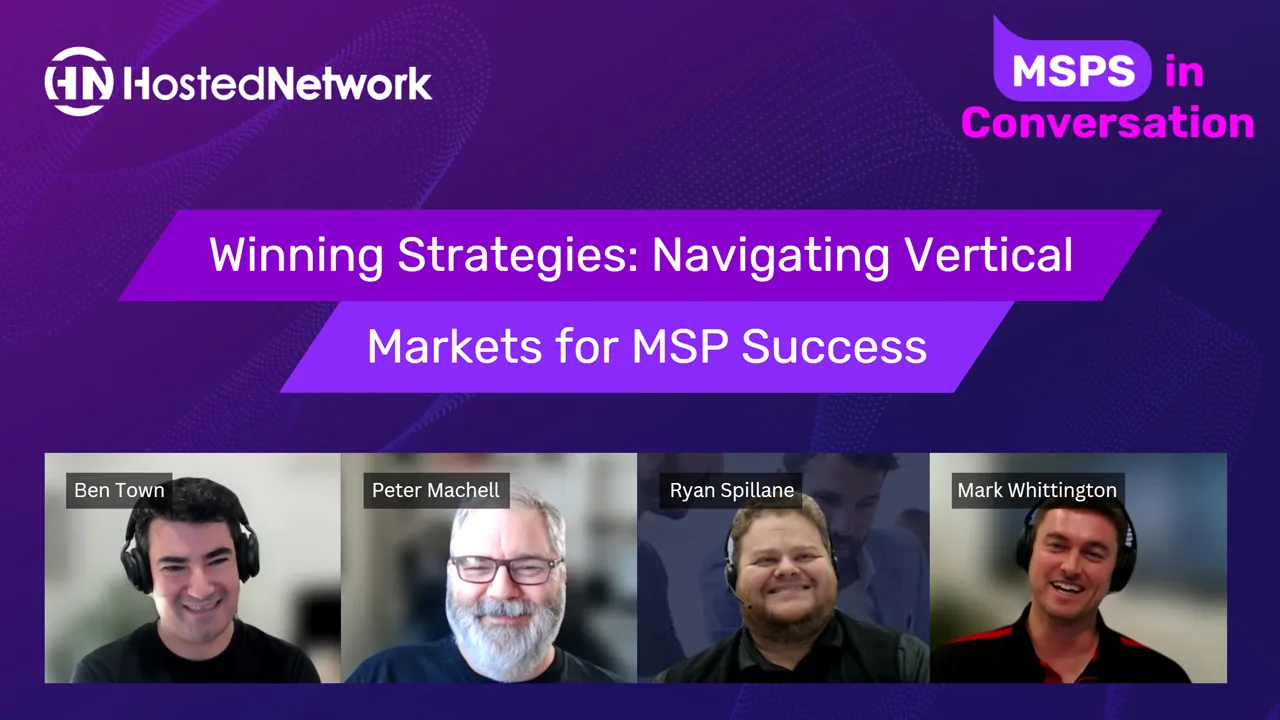
Hey everyone, thank you for joining us in today's MSPs in Conversation. We are going to be covering winning strategies around navigating vertical markets for MSP success. We are joined by Fuzzy, Ryan, Peter and Mark today, so thank you guys for joining us.
A little bit of housekeeping as always. This is recorded. We do cut this up as a podcast, so please share it round. It's a great resource for your would-be leaders in your organization as well. We will be covering a bunch of different topics today, but if you do have questions please chuck them in the chat and we will try and answer them as we go.
So with that in mind, a quick little introduction to Hosted Network if you don't know who we are. Hosted Network is a wholesale and cloud provider for Aussie MSPs. We were an MSP, and our value prop to you guys is that we think differently. We think like an MSP. So we are 100% wholesale. We will never compete with you. We're an entirely feedback-driven organization. Everything that we provide to you as our partners comes from partners' feedback, and we like to get stuff done. You know, we make things happen.
So enough about us though. Let us hear some introductions from our panelists. So guys, thank you very much for joining us today. It's a pleasure to have you all here. I'm going to ask you guys to do a quick introduction to yourselves. So let's start with Ryan. Thanks for joining us, or Fuzzy as you're commonly called.
I take both. Yeah, hey everybody, Ryan Spillane. I was an MSP for 25 years. We had 59 staff, so I've done a lot of these types of things. And nowadays in 360 Consulting we actually work with MSPs on valuations, mergers and acquisitions, consulting, and how to improve your business. So I get to come on these things and have a bit of fun.
Cool, well thank you for joining us. And Pete, welcome for your first time.
Yeah, thanks for having me, Ben. My name's Peter Machell. My company is Health IT. We're 100% focused on looking after basically your local doctor. I've been in the industry for about as long as Fuzzy, about 25 years coming up now. We've been Health IT for eight years, and today we have 22 staff.
Thank you. And Mark, welcome.
Yes, thanks for having me as well, Ben. First timer as well. Obviously technical director at OzDoc. I've been in the industry since sort of mid-90s. Switched to medical vertical early 2000s, would have been around 2005 to 2007. Three partners in the business, 28 staff now, and pretty much 98% medical. We do have some outliers outside of our vertical, but they all have medical divisions.
Cool, well guys, thank you very much. Let me stop sharing and we will get into it. And again, I'd love for those that are on the call today, if you do have any questions please drop them in the chat and we will challenge our panelists.
So let's start with the basics, and Fuzzy, I'm going to throw this one to you. Can you, in your mind, define for us what you believe is the concept behind targeting a vertical?
Good question. I think it makes marketing easier. I think it does a lot of things for you, so let's go through those. Obviously you get to know the software, the systems, everything that happens in a particular market. You get to then speak the language of your customers because you know the inside of their systems, their processes. Construction, like, again we'll talk through a lot of different verticals throughout the call or the webinar, but yes, you get to know those. You get to have almost an intimate knowledge of that information and those systems.
So if you're competing, and this is where it then becomes a really good thing for you, one, you can solve things quicker than any other normal MSP that services one of these industries or verticals. If you then, again, marketing, you can then say, hey, we look after all of these customers or all of these names, these logos, we know the inside of these particular products. For medical, these guys will talk about Medical Director and Best Practice and whatnot. They know the products, those products, almost better than the service desks from these companies that actually manufacture the product or that build the product, because they're dealing with the problems with these, the issues that the doctors have. And again, these guys will talk about it. But again, in other industries, construction, professional services, you pick accountants. Okay, accountants are going to use four or five major bits of software, and if you know how to make those bits of software sing and dance or get the most out of them, you're providing more than just IT support. You're providing more. You're almost becoming a bit of a consultant about those pieces as well. And that's where it helps.
I think, again, having a vertical, or having multiple verticals which we'll debate later in the call, I think it's really worthwhile. It's nice having a broad and a good breadth of customers, to be clear, but you don't get any, you don't get scale, you don't get efficiencies. Your support team have to think about 40, 50, 100 different bits of software that customers use, rather than getting to know four or five extremely well, or maybe 10 or 15 if you're across multiple verticals. So I think that's probably a good summary to start with.
Cool, no, that was great, appreciate it.
Peter, I'm going to start with you. Could you tell us a little bit about your story? What was your journey like, and did you start off targeting health as a particular vertical, or did you pivot through the journey?
Thanks Ben. I absolutely didn't intentionally end up in health. I came through the ISP world. I was a Unix guy building ISPs back before the turn of the century, when they still operated on the humble little phone line. We were probably a little bit late to that. We weren't making a great deal of money, we're a little business, so we were doing tech support to augment that income, and our biggest customer was a group of medical centers. A group of 24-hour medical centers which we no longer have anymore. They were a challenge to work on. They were very intolerant of downtime, as you can imagine. And they took off. They went from three sites to 30 in 12 months, and across a lot of different, you know, they were obviously acquiring those sites, so there was a lot of non-standardization and, in those days, a lot of different software packages.
And look, they ended up imploding, and I thought, you know, somebody has to look after these people. I can actually remember a time in the early days working in a treatment room and there were babies crying in the treatment room because the computers weren't working. Right now, nobody's going to die on the table because the office computer's not working, but there was a deal of pain there, and I thought, you know what, we can help with this. We can get to know this. The service from the software vendors back then was absolutely woeful. You know, doctors wrote this software, not technicians. You would be lucky to get a call back the same week on an urgent call. So basically I saw a need and thought that we could help and fill that. And even today our customers pay their software vendors for support, but they ring us because we're faster, better and more consistent.
Yeah, cool. Okay, and Mark, what was your story like? Did you start off from word go as OzDoc?
Well, we have a bit of a mixed story, so no, I'm not the founder of OzDoc. The founder of OzDoc is a doctor named Jack Ashwin, and it's interesting that, you know, Pete references that a lot of these products were written by doctors, because back when OzDoc first started in, sorry, 1992, Jack was sitting at his desk seeing patients, giving support to other doctors. Essentially that's what started the OzDoc name. He couldn't get any decent IT support, so he's a bit techy, and that was essentially the foundation of the name.
Myself, my story, I actually started in distribution and solution design, and I've got two business partners. Obviously Jack's still involved in the business, and I've got Adam Castany, who also ran an IT company, so we all merged over the time. I used to actually design at first and do the distribution for them, so it seemed like a natural fit for us all to blend together over time.
Yeah, cool. Okay, so you sort of landed both in a vertical target but sort of came at it from different directions, right?
So on that journey, were there any particular challenges along the way to starting to specialize that you found? Pete, I might start with you.
Look, I don't know that there were challenges starting to specialize. There did come a time when we had to let go of a lot of customers because they weren't health-aligned and we weren't wanting to focus on them. You know, something I've learned in business is to get something done, you actually need to focus on it. So there was that point when we rebranded as Health IT and decided to go in 100%, that we actually did let some customers go that were otherwise good customers, and that wasn't an easy decision.
I can imagine that kept you up at night a little bit.
Yeah, yeah. But I saw the plus side as much bigger, so we made the call. And the plus side for us is, like you said in your introduction, it's mostly around expertise. When we interview techs for jobs, and we're very good now at bringing in junior techs and training them up and turning them into experts, I tell them that our vertical doesn't limit the amount of work we do, it actually broadens it, because we're not just working on the hardware and the office and the MYOB and the printers. We are developing expertise across a suite of software, and about half of our calls are actually that medical software support. So that's a real challenge, to learn that software. We need a relationship with each of those software companies where we can essentially do their level one work for them but still be able to quickly escalate to them.
Something that's been a real challenge for me, and I'm not sure it's exactly the same for OzDoc, is our customers are generally very small. Our average seat count is between seven and eight seats, because we're literally looking after your local doctor, and I do believe that they deserve to be looked after well. But that presents its own real challenges, especially around suppliers and things. If something is billed per customer on a multi-tenant model, you know, I'm the same size as an MSP that might have 30 customers, but I have 300 customers. So a supplier will be wanting to charge me 10 times the price for the same thing. That's really tricky. We won't be able to be a partner with Microsoft next year because they don't recognize growth unless that growth starts with 11 seats, not fewer. So whilst we're growing really well, Microsoft don't see that. We're not going to be winning any MSP awards anytime soon because we're just, you know, limited by that.
And having a group of really small customers brings its own challenges around support. We take 200 phone calls on a busy day. We have been very unsuccessful at trying to get our customers to do something other than phone us, because the phone is what they're used to using, right. We're also predominantly still on-prem, believe it or not. There is no great cloud solution for GPs in this country. There are a couple for specialists now, but, you know, the medical industry in particular is a little bit behind on the office space, and there's pros and cons of that too. We see problems coming, we can learn from the experience of our peers, we can look to America who are a couple of years ahead of us, but yeah, we're still managing 200-plus servers on-prem.
Wow, okay. Mark, what about the challenges from your side? What do you face as part of your journey?
Look, in the early days, our challenges were very much based around lack of standards, especially through the medical industry. Now that's greatly improved over the last 20 years, and it's come leaps and bounds, especially since COVID. But prior to, you know, back in the early 2000s, there was not much in the way of standards. Obviously they had their privacy bits and pieces and so forth, but because the majority of the medical space was still very much paper-based, the standards to get across saturation in that vertical were very difficult. Now accreditation and insurance requirements have driven that massively, and the need to be able to be more flexible, especially through COVID, drove that through the roof. So that's been good from that perspective. But yeah, in the early days it was very difficult to standardize across all clients.
And as Pete mentioned earlier, there was a lot more software vendors out there because everybody was writing their own little packages and that sort of thing, so that was also a challenge. Now we probably deal with up to 15 medical vendors as core, whereas when we first were coming into that vertical there was quadruple that, and they were very basic, terrible packages. So from that perspective it's come a long way as well. So they were probably our initial challenges.
I mean, we still have challenges today based around people not understanding what they require from a security perspective and that side of things, and that uplift and that growth. But I think that challenge is there in all verticals. It's not just the health space.
I'm glad you said that. I was going to challenge you on that.
Well please, please, no, I think it's, most industries have that problem.
When it's, unfortunately, security is a, we all know they all have to do it, but unless there's someone else, or compliance, or an insurance broker or a government department saying you have to do something, too often not. We are the ones having to tell the clients all the time, and having to deliver the, it's not bad news, but the fact that they've got to spend more.
When Notifiable Data Breach came out, we had to tell them they had to have an NDB plan, and Pete had a fantastic way of doing that. When the privacy policies change, when everything that comes out like Essential Eight came out, it's like, the fact, and look, I'll go on a high horse for 30 seconds, the fact that right now Australia, like the Australian government has finally put out an ad on television about why you need multifactor, it's great, and I applaud them for doing it, but it's three years too late. Like this stuff should have been happening back then. The fact that we're only talking about this publicly now, like, why are we always the ones having to tell our customers about this stuff? And again, bring it back to the verticals, you would see it quite heavily for both of you in the medical scene. It's like, okay, customers know they need to do some of this stuff, but they don't want to slow down what they do. I would hazard a guess that you might have an aging customer base who don't want to deal with the latest things with technology, and don't want to have to deal with two-factor. They just want to turn the thing on and it work. So that brings its own challenges. And I'd actually throw it back to you, how do you deal with some of those things?
Yeah, it's the challenge of going from in some cases essentially nothing to everything, to meet these standards. And you're right, having that conversation on behalf of, I mean, essentially Essential Eight is a perfect example, right. We now have, well, it's not an official standard, it's a recommendation, but you've got eight lines that you need to address when a lot of these places have not been addressing any of them, and the communication has to be done by the MSP, and that is a real challenge.
Now I thank insurance companies for this, because they make that conversation a lot easier. They do the uplift, based on, you know, now you require decent cyber insurance because it's come out of your standard regular insurance, and these are the tick boxes that you need to meet. It actually starts those conversations and makes them a lot easier. So I do thank insurers for that, even though they can be a pain in the ass sometimes. They're probably one of our best marketing tools.
So it sounds like, guys, that older industries can have a little bit of disorganization potentially, you know, legacy issues, maybe not disorganization, but regulated industries can also be an opportunity to specialize. While it might be a challenge, I always love the saying that where there's complexity, there's margin. Would you find that statement to be true when you look at particular industries, even if it is outside of health?
I think, like Mark said, the compliance that we've had in health, we've had GP accreditation for, what, 10 years now, and that's actually money-driven. The GPs receive a payment if they accredit, and really they can't afford not to anymore. Now only a slice of that is around technology, but the security uplift has been significant. And yeah, look, we're really challenged by, you know, we don't tend to compete too much with other IT companies. We're competing with small companies who are trying to do stuff themselves, or, you know, my nephew works for an IT company so he'll look after me, and he spent time, and that's where we see really poor standards. And companies like OzDoc and ourselves and a number of others have been really trying to drive these standards up over the years, but we still see really immature, um, we saw a company last week with RDP open to the world. Right, it's 2024.
I'm glad I haven't seen one of those for about three years, and horrified.
That's because a doctor was doing his own IT and thought that he knew better. So yeah, we really need to educate them. But when there's a gap that big between where you are now and where you need to be, I actually think that's why the Essential Eight is great. It's not the be-all and end-all of security, it's, hey, if we can get you to just maturity level one of this little standard, you're going to be 10 times more secure than you were yesterday. So it's a place to start that conversation.
So the compliance piece of it, even though it might be a challenge to have that conversation, it sounds like a bit of an opportunity. So, you know, I challenge the audience to think about verticals that they're already working with, whether they consider or realize their verticals or not, that might have those that you can start to specialize in and that you can start to think about. That's my takeaway, and I've taken down quite a few notes already about what you guys have said, but I think that definitely is an opportunity, and being that specialized expert definitely provides you a step above the competition.
Do you find, flipping it on its head a little bit, but staying on the challenge topic, do you find that because you are so specialized that it means that you miss out on business, or do you intentionally say no to business that falls outside of that criteria? Mark, what does OzDoc do?
Look, one of our core values is growth. So independent of whether it's a small or large company, if they align with us on our values, and especially the growth and wanting to improve what they're doing on a day-to-day, whether it be, you know, security workflows, anything, then they're our sort of client. I don't see it so much as a challenge. It's more a synergy between ourselves and our clients. That being said, we have definitely had some clients over the years that they're not interested in growth, they're not interested in improving things, and they take the stance of, I don't need to worry about that because it's never going to happen to me, which is very sad, because, you know, we all know that it's not going to happen to me, it's when it's going to happen to you, and you need to be prepared for that. So a lot of things that people perceive as challenges, I don't see them as challenges, if that makes sense.
Okay, that's great.
They are opportunities. And look, we're invested in growing the operational maturity of our clients, so if they align with that, then we don't have to go from nothing to everything. We prepare and plan a staged approach. It's about improving. It's like what Pete said, you don't have to be right at, you know, level five, which is almost impossible for almost every business in the country. It's, you know, getting everybody to level one, they're a hundred times better off than where they were.
So I think knocking back customers for any MSP is a maturity piece that they need to get to. Okay, so how we do that is we have a standardized measurement for customers. You're either a good fit, a fit, or not a fit. Okay, and if you're not a fit, we're going to be recommending another MSP for you. If you are a fit but not a best fit, then we will give you the opportunity to engage with us and lift you up. But where we find that we do the best work is with customers that are engaged with us and aligned with us, as Mark said.
Yeah, we definitely have our set of bare minimums, and if you don't want to meet those bare minimums, then you're essentially not a client, even if they are outside of your chosen vertical. Look, we focus on our primary vertical, like I said, we do look after some organizations that have entities outside, but they tend to be not-for-profit, child protection agencies, things like this, and like 99% of those have a medical division. They just are larger organizations such as a not-for-profit that have multiple divisions, and we look after those. We do have one or two clients that we do look after that don't fit the medical, but they are head office local to us, have come from referrals from people that they know in the medical space, and they want to make sure that they're essentially meeting what would be classified as high-end medical requirements for their business. So that aligns with us.
So let me put this to you. If an MSP on the line is considering specializing, would you think they go hard and fast, or is it okay to have more than one vertical?
I think it's okay to have more than one vertical, but the more that you keep your vertical in tight and close, the more specialized you're going to be, and the more specialized you're going to be, the better service that you're going to deliver to that vertical. I think the problem with people doing general IT and not specializing in a vertical is they, you can't be an expert in everything. Nobody can. So to give that higher level of service, I think specializing in a vertical is a great way to do that.
Yeah, we haven't even touched on the marketing advantages, right? I mean, we're about to get there. It's much easier to get to expertise if you narrow your market, and we're not talking about narrowing a market to the point where you're not going to have customers coming through the door. In fact, the opposite is true. And maybe we're lucky, we're in the biggest industry in Australia, healthcare, right. But from my point of view, us getting to expertise and getting a reputation in that protocol was a hell of a lot easier than trying to do that for all business.
Cool, so with that in mind, let's shift to sales and marketing. Where do you see, and Fuzzy, feel free to jump in here from your experience, where do you see the benefits from a sales and marketing perspective? Just rattle them off for me. Peter, establishing expertise, setting yourself up as an expert?
Yeah, knowing who your next clients are. I have a list of all the doctors in the country who's next.
Okay, I like that. I like that. Mark, what about you?
Look, we have been very strongly focused as a services company, so the marketing aspect for us has always been brand awareness, and to be known as the experts in this vertical. Just like Pete said, if I'm operating a medical center, I'm not going to want to go to Joe Blogs down the street when I can have a professional in that space looking after me, understanding what we do and what our little differences are, because there are differences in this sort of market. You could have a market that's not medical-related, that, you know, they operate with devices and things like that that aren't as critical. We know that if a nurse is trying to do an ECG on a bed and the equipment's not working, or there's a modality out there trying to do testing, that it is a higher priority to fix than in a non-medical market. So there's a few little gotchas around that.
From the marketing side of things and the real sales side of things, we're only just starting to build a sales engine. I mean, we're over 30 years old as a company, and we've always been word of mouth and driven by reputation. So watch this space and ask me again in a couple of years, because it is a difficult thing for us. We've never been sales-focused. That's not what we do. I mean, if you want to talk about those sort of things, we're in a services vertical, not a sales vertical. There's different companies out there that are very, very good at sales, and their service delivery lacks. We're the opposite. We're still learning how to present ourselves and do that sort of thing. Obviously we go and we do the conferences, and we've got the face-to-face stuff, but traditionally a lot of our new business has come from word-of-mouth referrals.
Okay, and that's another advantage, right?
That's right, yeah, correct. We go to peer groups with MSPs who don't specialize, and the number one thing they ask for is, how do you get more leads? We've never had that problem because we're known in the industry. You know, we're not great at marketing either, but we haven't had to be, because customers walk through the door every month.
Cool. So word of mouth. I mean, I think when I first started Hosted Network it was, you know, having that sort of focus, and even for us, I mean obviously we target a vertical, right, we target you guys, but knowing what the value proposition is, being able to have a targeted conversation, even if, so that when you do get that referral you're having a consistent conversation. I think that even if it is at the very base level of marketing, and as you grow you can only get more and more mature, and just being able to have those relationships, right, because you are putting some boundaries around where you're going, whether it's not-for-profit or architects or whatever, you're going to be going to their trade shows, you're going to be getting to know them, and that's where organic growth comes, I think.
And trade shows is a great example, right? When I first started business many, many, many years ago, I did the shotgun approach, right, versus the laser. And you know, if you think of trade shows as a great example, a generic trade show, like, I don't know, is CeBIT still around, is that the thing, I don't know, versus the industry-specific ones, you're having a repetitive conversation over and over and over again, which means you get better and better and better. You can hone that skill, you know, and it sounds like you guys are doing that naturally, which is fantastic.
So I'll throw a couple of, I've got kind of almost a story and a counter question, and they're not aligned but they're kind of, well, I'll see if I can tie them together. We were an MSP, and I used to jokingly laugh about the fact that we were horizontal, we weren't vertical. We had customers across everywhere, and that was really, really good. And in certain cases I think it is good. I think in health I think you're pretty well protected from the economy, and everyone needs health, everyone needs those types of things. But if you were handling a vertical of retail or mining, they are very cyclical, and they're very big ups and downs. Now we did a bunch of mining services and we had retail, but we actually had a bunch of different verticals in time, and we'll talk through that in a second. But as I said, we were very horizontal to start with, but each one of those things, a lot of times when mining was doing really well, retail was down, and then vice versa. So for us it actually wasn't too bad, but I think if you were in just a single vertical, I think that could be a risk to you, if it's the wrong vertical or it's very cyclical.
So we then decided, like, how do you change a business? Again, we were 20 years in business. How do you actually turn that into running after a vertical, or going after a vertical? So the way we did it, and it's probably relevant for the people listening, is we then looked at, hang on, where are all of our customers? And then we had people in construction, we had people in professional services, so lawyers, accountants, finance people, all those types of things, and then we had some medical. So we said, okay, well, why don't we just start moving a little bit in those directions? So we started producing content and producing sections on our website that talks about those verticals. So then we started getting access to more people because we started talking about those things. So that's how we moved from being horizontal, and don't get me wrong, we still, if a customer was in a good fit and a maturity for us, it was about maturity and whether the customer wanted to grow, that was kind of our requirement, not so specific industry, but we did focus on some industries and started winning more business in there.
But the counter question that I have for you, and Ben, this might be on your list and I might be kind of stepping on your toes here, but it's okay, how would you go and do that again today? Like, I've got two questions. One, how would you go and do that again today, and go up against, like, if I wanted to start a health-focused MSP business in Brisbane or in southeast Queensland, I'd be up against both of you guys. That's not going to be easy. That's going to take a lot of effort. So that's really good for you guys, but it's really hard to actually get into that vertical to start with. So how would you do that again, and would you do it again? That's probably the first question.
You're right, you are asking my questions, but that's okay.
No, I thought you were asking Ben that question.
No, it's to you, to you, Pete mate.
Look, for myself, if I was horizontal and I had no vertical specialty, I would be looking at my current client base, see what I'm actually doing really well, as a potential for bringing in a vertical. Like, I know many IT companies that don't have just one vertical, they might have two or three. Some of them, I think they're crazy, just for the verticals, but it works for them. If I was going to actually build that from scratch, I would identify my customer base, see where I'm addressing things really well, and probably start with a form of a referral program, so that those clients are actually referring to other people in that vertical, so trying to bring business in that way, because that way I'm going to be able to grow those verticals sort of naturally. Because I think it happens quite naturally, if you do it really well, what you focus on is what happens, especially if you're good at it.
I would make the point that a vertical doesn't have to be an industry. What we're talking about is having a really tight target customer profile. And I've seen some, for example, regional MSPs doing that really well, right. It might just be, I'm going to be the MSP of choice for business in this area, and it throws up the same advantages and disadvantages. You know, it tightens down your marketing, it gives you some scope to develop some expertise that other people don't have.
Yeah, I often joke with one of our members in a peer group that his vertical is regional. Or it might be servicing industries with 50 to 70 seats, you know, forget the 20 to 200, it's too broad, bring it down to something that you can do really well. Find out what you're really good at, and then find out the bits and pieces that will integrate you into that market.
So it sounds like, particularly from a marketing and I guess a sales perspective, even if you are doing it naturally, is the fact that you can talk their language. It's a common language, be it regional, or if you are specializing in a vertical, you're able to have a more tailored, targeted conversation. And Mark, I'd agree with you, when I've sat down with a few of our different partners going through your list of customers, I've actually said in previous MSPs in Conversation as well that every time I've done it there's often been a particular grouping of existing customers that you've steered to, because if you do a good job you get referrals, you do well and you speak their language, and if you take a step back and actually assess what you're doing, then quite often that becomes apparent. And it is very much, like you say, that whole tailored conversation.
We do a lot of radiology, and we are the conduit of communication between radiologists and modality vendors, because they quite often talk the same language but talk a completely different language at the same time.
Do you find that you get referrals through being aligned to these software vendors or these other industry players that are targeting the same market?
Look, we've made a conscious decision over the years to not align ourselves with any specific software vendors. We treat them all equally, that way we haven't alienated ourselves through that process. Okay, so I actually joke about, we go to a radiology conference, and the delegates that actually come to the conference, they're from larger organizations that essentially have their own internal IT, so big enterprise companies, so they're not our clients at this present point in time. But I go there because, one, brand awareness, because sooner or later they do, they get the shits with working within these large organizations, they go out on their own, so I want to be the first company that they think of from that perspective. But at the same time, all of the vendors that are there, their clients are our clients, so we align with them, so when you're having a conversation with them and they're saying, oh yeah, you know, I was dealing with backyard Bob that's doing the IT for this company and it's just terrible, they'll be the first to put your name forward. So it comes back to that referral.
Okay, great. I'm going to jump beyond sales and marketing and actually jump back to something that, Peter, you touched on earlier around the technical piece of it. So particularly in the current climate, finding techs and whatnot, do you find it difficult to find techs with specialized experience?
Yeah, we find it really difficult. In fact, I went through a process last year where we did the whole LinkedIn recruitment thing, and we found a level three who on paper was perfect. He'd worked at someone in the supply chain that we know, he looked fantastic, he interviewed really, really well. He lasted about three weeks. He wasn't our kind of people, and he did some damage on the way out the door because he was a senior-level guy. So yeah, I think, whilst it would be lovely to be able to find people who had done it in our vertical, that would mean I'd be poaching off Mark and a handful of others, so we tend not to do that. We've really focused on hiring at level one, hiring for attitude and aptitude rather than existing skill set, and we basically turned into a teaching practice. Which, you know, we've chosen not to offshore, which may be madness, but we are really good at growing our own local talent now, and touch wood, I haven't hired, apart from that guy, a level two or three in many years. We've just built them.
Mark, what about you guys?
Look, we're very much the same, so we hire our graduates and we train them up, because they need to understand workflow as well. We have had success in hiring more technically advanced, so we haven't had those struggles that Pete's had. However, we've had to invest just as much time in those staff to make them understand the little differences for being in the vertical, because they come in and they're like, oh yep, that's, you know, just a everyday little problem, but to a medical center it's quite a big issue. So that side of things is a challenge in itself.
Now for us, our biggest impact around the whole hiring market was COVID. And people say that it was just the done thing, and everybody struggled. For us, we lost some really good high-end talent because they closed the borders. Where obviously southeast Queensland, we're very close to the border, we had some of our senior engineers that were based out of northern New South Wales, so when they closed the borders down, we lost quite a few staff that we couldn't replace easily, that didn't want to come across the border. They relocated to Sydney to work out of Sydney because they just didn't want the hustle. So we've had different hiring challenges over and around that side of things. So COVID was challenging and it was an impact, especially with a lot of people's visas getting cancelled.
Now that didn't affect us directly, however it did affect, I think, the market space where people that were not highly experienced were just being thrown into seats that they were underqualified for, because there was a need for bums on seats. So we lost a few like that, really growing talent, they weren't there yet but we'd invested a lot into them, because they were just getting offered ridiculous money to go and sit in their seats. Unfortunately for them, none of them are in those seats anymore, because when things started to open up again they didn't require them because they were bringing people in.
We don't outsource overseas, we never will, we're going to keep jobs in Australia. That's something that we're very proud of. You know, I've got five kids as well, I don't want to see, once they get to working age, I don't want the country to be in a situation of there's no jobs there, so we want to do a little bit for the community as well from that perspective. So we'll pay more for staff to make sure that they stay local and jobs stay local.
I definitely think that approach of training techs up from when they're young, I know that over the years, even when I ran an MSP many, many years ago, we struggled with the same things of bringing in senior guys. Sometimes we won, sometimes we didn't, I don't think our hit rate was that great, but we definitely had a much bigger hit rate, and to your point, Mark, of looking at some of the guys that we did train and they've gone through our ranks over the years, to see the companies that they've gone on to, you know, to see their career trajectory, it's definitely a non-business piece, but I guess it's kind of the warm and fuzzies, hey.
Look, if a staff member trains with us and they go on to something great and better, that's fantastic, that means we've done our job right. I can relate to all of these stuff that are coming out of university and not being able to get a foot in the door anywhere, because it's difficult. I mean, I had challenges when I very first came into the IT industry, to the point where I went and retrained and did something else, because I couldn't get a foot in the door. I had to come back to IT to do what I do and what I love.
Yeah, I think, you know, we've got a comment from Daniel in the chat that everyone wants to sit in their work-from-home bubble as well, which makes hiring additionally, whether you're in a vertical or not, a little bit extra, you know, more difficult. I certainly know that at Hosted, a lot of our team work remotely from home, and trying to get people, we've got a family barbecue coming up in the next couple of weeks, trying to get everyone out together, and there's challenges. You've got to think, you've got to put extra effort in.
But anyway, guys, some advice for those of us that are thinking about targeting a vertical, what would, number one, we'll start with the first question, what would your advice be on where to start? If there's one thing, I know we've covered this a little bit, but just to sort of, as we conclude, what would that one piece of advice be?
Find out what you're good at.
Yep, I like it. Mark?
Take a step back and actually assess that, because a lot of people think that they're good at something and it's not what they're best at. So you've got to take a helicopter view. So take a step back and see what you're actually good at.
Fuzzy?
I'd build on to what Pete said. Find things that you actually enjoy as well. Like, you're good at it, but you've got to enjoy it as well. If you're good at an industry but you really don't like the industry, it's going to grate on you, and you don't want to then just live and breathe that vertical for years on end. Pete is very passionate about helping GPs and small doctors and surgeries and whatnot to be the best they can, and to empower that technology so they can actually provide great service to their customers, to their patients. That's what he's passionate about. So again, if you can align that passion, what you're good at, all those types of pieces into that vertical, then yeah, it's going to be a lot easier doing that work every single day.
So basically, when you think about targeting a vertical, don't go after the guys that everyone bitches and moans about internally, because I remember when, in our MSP, we had some verticals that we hated, and I can still remember the pain, the guys that never pay their bills, all those things. Don't go after them. There might be a lot of them, but don't go after them. Yeah, you've got to get something out of it as well. If you're not loving what you're doing, then you're slowly dying inside, right.
Got a comment here from David as well.
Yeah, you need to love what you do, right. You need to actually be able to get out of bed, be motivated. And I think that, you know, talking about that team and mentoring people internally, the team around you need to be, if they're going to see your passion, I think that whole piece of it shines through when you do have that passion. If you hate what you do, everyone else is going to feel the same kind of thing.
We've had a, actually our partner development manager just put it, David Vidos, he used to run a, no, David, I think you worked in dental, right, targeting verticals. His comment is that, look for underserviced markets so that you can be the prominent one in that industry. So that's a really good comment there as well.
Guys, is there any closing remarks that you would like to include for the audience today, any little light bulb bits and pieces that you feel that someone that is thinking about adding a new vertical, starting to target verticals, beyond what we've already covered, that you'd like to add?
I'd throw one, I'm trying not to throw a negative spin on it, but I think, and I'll counter these guys a little bit here, that if you target one vertical only, is there a limit to how much you can grow? Like, okay, there's lots of doctors for these guys, but just be aware that you could be limited, and that's why we wanted multiple verticals, so we could grow, and again different cycles around the economic cycles. So that's why we went more than one. But I'm just countering the point that, just don't, yeah, if you are in a single vertical, you're basically hitching your wagon to whatever happens in that industry, that vertical. If there's a really big disruption that comes through, then that can impact your business. You've got to be aware of that and not just have the blinders on.
Yeah, I'd counter that a little bit, and it's, as I said, it's easy from the biggest industry in the country, and you know, we have a good mate who was almost 100% pubs and clubs, and 70% of his customers shut down when COVID happened, right. Yes, there's a risk there, but you know what, I think the upside is such that my advice to you would be, do not be afraid. Don't be afraid to niche, whether it's a vertical or anything. What we're talking about is getting better and specializing in something. I would encourage you to specialize in something, and niche your niche, become the best at something. Make it something that you're passionate about, and it's all upside.
Cool. Mark?
Yeah, you definitely have to be passionate about it. Look, my advice would be, yeah, dive in, but dive in eyes wide open. Yeah, you really want to assess the market and understand the market as well, as much as you can, and ensure that there's not something coming in five or 10 years' time that's going to decimate the market. I mean, they talk now about, you know, in another 10, 15 years' time, jobs will be very different to what they are today. So just take into account all factors.
I really agree with that, Mark. We've got another partner, obviously, and they were going after a particular vertical, it was a new vertical for them, and they were only going after two verticals, and what they did to validate was pretty simple, but they did their market research on their existing customers, people that they knew. So rather than having to start from scratch about where's the market going, where should I be, where should I be targeting, it was, hey, look, they knew where they wanted to go, and they just asked the question of their existing customers, where would I find more people like you, what issues am I going to face? And there was a wealth of knowledge, and they built their business plan based off that, really, and it started with starting a conversation with their existing customer. You know, the fact that you guys are here willing to help, is your customers typically the same, right? If you ask them for that sort of level, they're going to give you their insights or their opinion, you know, whether good or bad.
Well, this is the thing, hopefully they're looking to their future, so you can learn a lot from that.
We also have another comment from David Vidos that targets, from a marketing perspective, then tackle the next one, focus your marketing spend. And being a marketer, I would agree with that, that it certainly does, if you are doing marketing, it does allow you to target your marketing spend. You know, you do get a greater return on investment, rather than, I always love the saying of the laser versus the shotgun, right, pray and spray versus know what you're going after.
Yeah, make sure you're measuring that return on investment as well.
Yeah, 100%, yeah, make sure that you are.
Guys, with that in mind, I would like to say we'll conclude. I'd like to say a big thank you to all three of you. It has been an absolute delight having you guys on the call today. For everyone on the call, as always, this is recorded, so if you want to refer back to it or share it around, please do. I'll just quickly share our next upcoming MSPs in Conversation. So the next one, talking around marketing, and hopefully this is a great launchpad for that, is driving business growth through simple yet effective marketing techniques. So we're going to be talking about verticals, and we actually wanted to run the vertical conversation today in a lead-up to that. Talking marketing has always been a very popular topic, and we've done a number of series over the years on that, but we've got some great experts and some MSPs that have done really well, some that target verticals as well. So please join us on August the 7th.
Ryan, Peter, Mark, thank you so much, and everyone for joining us today, appreciate your time.
Thanks guys. Thanks guys. Thanks everybody.