20 October 2026
Getting Sales Out of the Owner's Head: What to Build First, and in What Order
Sales & Marketing

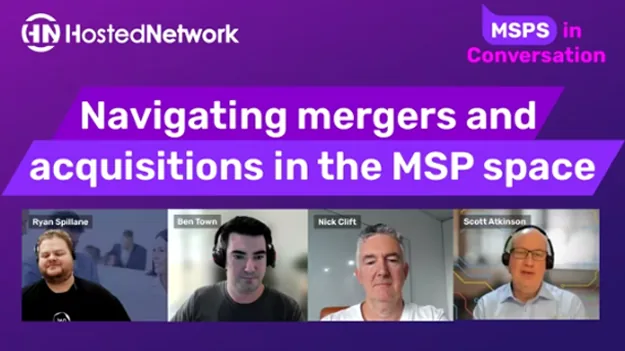
In this episode of MSPs in Conversation, you’ll get insights from your industry peers on the key reasons to consider M&As and how to get ready for M&As.
For MSPs, mergers and acquisitions are a powerful way to accelerate growth, enter new markets, acquire specialist skills (like cybersecurity), or scale faster than organic growth alone allows.
The most successful M&A outcomes come from long-term planning. Building systems, recurring revenue, leadership depth, and financial discipline from day one dramatically improves future valuation and deal success.
Many owners overestimate their business value. Australian MSP valuations are typically lower than US benchmarks, and true value is driven by adjusted EBITDA, recurring revenue, margins, and how well the business runs without the owner.
Managed services and high-margin recurring income are the biggest contributors to MSP valuations. One-off projects and product sales may boost cash flow, but they add little long-term value compared to predictable, recurring revenue.
Signing the agreement is only the beginning. The real work is integrating people, processes, culture, and customers so that “one plus one” genuinely creates more value — not disruption or client churn.
Many MSP acquisitions are funded through vendor finance, where the seller is paid over time using the business’s future cash flow. This approach reduces risk, aligns incentives, and often enables deals that wouldn’t work through bank funding alone.
M&A success depends heavily on shared values, leadership alignment, and clear expectations. Without cultural fit and a common vision, even financially sound deals can fail.
Edited for readability from the episode audio — may contain minor errors.
Thanks for joining, everyone. Welcome to this month's MSPs in Conversation: Navigating Mergers and Acquisitions in the MSP Space. This has been quite a requested topic, so we thought we'd get some people on the call, panelists who have lived and breathed it. I've certainly learned a couple of things from these guys over the years, and hopefully you guys will as well.
Remember, today's session is always interactive, so if you've got questions, feel free to drop them in the chat and we will see if we can answer them as we go. As always, we will be recording this session, so if you have to drop off or you want to share it around, we do syndicate this on YouTube and Vimeo, and it's available as a podcast now as well, which is pretty cool, on Spotify and all those other podcast platforms.
I'm going to talk a little bit about Hosted Network and then I'll get the guys to introduce themselves. If you don't know already, Hosted Network is a wholesale cloud and telco provider. We started as a managed service provider and we only now sell to managed service providers, so we offer a full range of offerings, from your cloud to your telco needs. I won't go into any more; if you want to know more, check out our website, reach out to us. But what we're here for is not to talk about us; it's to listen to the panelists.
So guys, I'll get you each to introduce yourselves as normal, but today can I get you to give me an elevator speech, your 30-second snippet on your background and experience with M&A. Nick, I'll get you to kick us off.
Sure. I suppose, 30 seconds: I started my first company in '96, we bought two businesses along the way, merged in 2020, and we exited this year. So that's a pretty high-level 30 seconds.
Thank you, and well, thank you for joining us. Scott, you've done some exciting things over the years.
A few things here and there. Look, I've been around a while. We started our first company, Netlink, in '94, and we acquired two companies in that time and then sold it to Commander Data in 2010. That was quite fun. A little bit after that I became involved with BigAir, and we acquired two more companies in there, and that's actually an interesting sort of way to look at it, because they're public and the rules sort of apply a little bit differently there. But it was all good. And now we've created TribeTech. We've already done one acquisition in TribeTech, and that's actually been very beneficial to us, and we're looking forward to two more going forward.
Great, thanks. And Fuzzy.
G'day everyone, I'm Ryan Spillane, AKA Fuzzy, as most people know me. Look, we started an MSP, or I actually joined an MSP through an M&A process. We did 10 other M&As in that MSP. I've done three other M&As in other industries for myself, and helped — I think it's just over 30 out of 35 other IT companies complete sort of M&A activity. Along the way I sold out of my MSP in 2021 and then finished the 12-month handover of that at the start of this year, and that was Correct Solutions. And now, 360 Consulting was one of the businesses we acquired along the way, that happens to turn 20 — I think it's about 13 days, actually. We've pivoted that from being an MSP about five years in into a consulting business. So nowadays my focus is on helping other people complete M&A, and helping coach and mentor other MSPs in driving profitability and getting their business ready for sale, or helping other people buy other MSPs.
Cool. All right, so you guys have got some good tidbits for us today. I'm going to stop sharing and then we will jump into it. Remember, guys, if you've got any questions, drop them in the chat and we'll see if we can answer them as we go.
All right, so let's start really high level today. Ryan, I'll start with you with this one, but in your experience dealing with the other MSPs that you coach, and maybe even within your own business: why do you think MSPs look at mergers and acquisitions, really high level?
Well, at a high-level perspective it's actually another form of growth. There's obviously natural growth, which you really need in your business, but it's just another form of growth. If you can pick up — let's say you're doing five million dollars — if you can pick up a half-million-dollar or a three-quarter-million-dollar MSP, or even a million-dollar MSP, every two years or whatnot, it's just another great way of clipping on another bunch of revenue outside of your natural growth. So from a high level, I think that's probably the easiest way of putting it.
Nowadays I'd also say you could be doing it for finding skills that you don't have, going into a new geographical area that you don't look after now, or bolstering an existing one. So if you're in Sydney, you might want to look for one in Sydney, or if you've got a small branch somewhere else, you could actually buy and add that into that branch. Or it could be in a totally different area that you're not looking after now. A good way that a lot of people have been doing for the last few years has been buying early-stage cyber practices, cybersecurity practices. So you would have seen that — haven't seen many this year, but go back over the last three years and I would say there's quite a few cybersecurity practices that were purchased by MSPs to basically bolt in and save them building it.
Cool, that's a good little overview, thank you.
Sorry, was that okay for you?
Yeah, that was perfect, bang on. So I guess a follow-on question for you there then: that's from an acquisition, but what are maybe some of the reasons that MSPs look to either merge or be acquired?
Well, that's two totally different questions.
That's right, yeah.
Look, for merging, it could be a case of someone might be really great at sales and not great on technical, and one could be really great at technical and not great at sales. Bringing those together can actually be really, really powerful, and having that kind of partnership, that company with multiple owners behind it and multiple disciplines — so that's a very big thing. It could be a case of, again, someone may not be from a sales perspective, but an account management perspective, or someone might be a bit tighter. The other thing we see a lot of nowadays is actually — I'll try and say this politely, which I'm not going to get out nicely — but let's say middle-aged, older grey males that are looking to exit in the next couple of years. So they might merge with a younger company, someone young, which means that they can come in and then build the company a bit together, and that could be a good exit strategy for someone a bit older who's been in the industry for a while and is looking for an exit in the coming years. So that's probably from a merge perspective.
And what was the other one? From why would you sell? Well, hey, at the same token, why are we in business? At the end of the day we've got to make money along the way, but you don't want to do it forever, so at some point there's got to be a sales strategy in there, other than leaving it to someone else to clean up after you die. Realistically you're probably going to get the most benefit from selling it when you're making a good amount of money and on a good growth trajectory, or can show that the business can run without you. That's where you're going to get the highest valuations, which we'll talk about much later in this panel. Most people say you've got to have the end in mind when you start a business, and most people — let's be honest about it, in MSP and technical businesses — they were techies that started out that have built their own business and never had a plan on exiting or a strategy on exiting. So I will admit that I spend quite a few hours each week speaking to people about starting to plan an exit, which takes time.
Okay. Leading on from that then, going back to the beginning — and feel free to jump in — I'll throw this one to Scott actually, just to balance it out a little bit. Scott, when do you think an MSP, or any business, should really start planning for M&A?
I'll say you start planning for anything when you start your business, actually. You've really got to get a feel for what you're trying to achieve. It's all very well to say, hey, we're going to go and buy someone, yeah, it's fun, but it's not as easy as it sounds, and certainly not as easy as it looks in most cases. There is a lot involved. There are good reasons to do it. You may be trying to get market growth in your current market, you may want to double in size, something like that.
I mean, today, going and finding a client that doesn't know what an MSP is is pretty hard. Most small-to-medium-sized businesses out there are already working with somebody, so you really want to be having that unique value proposition. If you're just doing, "Hey, we can do MSP stuff, that's great, let's see who can use our services," you're going to have a hard time knocking on doors of all these people and finding out that, oh look, out of the 10 people I just saw, 10 of them have already got an MSP they're working with and they seem to be doing a decent sort of job. Therefore, what's their real reason to move to us? There may not be one. You've either got to have that really value differentiation — you're very skilled in a certain area — or maybe you're a generalist MSP and you're looking to acquire a specialist business, like maybe it's a Dynamics practice, or maybe it's a security practice, for example. I'm not sure that's always the best approach from a security point of view, because you can very quickly just lose it to the banks that'll pay twice as much anyway, so what have you really bought? But it's difficult.
So you're either after market share, or you are after a geographical base, like, "Hey, we're in Sydney, how do we get into the Melbourne market? Let's acquire an MSP in Melbourne or merge with an MSP in Melbourne." Great, now we've actually got some things to share. But you're really just buying customers, and you've got to be careful that if that's your objective, there's a lot of ways to do it wrong.
Okay, so one plus one doesn't always equal two. We can get into the math of these a bit later, because —
Yeah, I was going to say, I was waiting for someone to say just that. You don't need more than about two fingers to work out where your value proposition is going to be.
So let's touch on the high-level process of what M&A is. Obviously it's different in every single one, but let's just talk about — let's call it a 25-seat MSP looking to acquire someone of equivalent size. Scott, I know you've got public experience; I imagine your experiences are going to be a little bit different at the public size. So run me through, high level, what you see that process like.
Similarly, the easy bit is just finding another MSP that you think will be the right fit and going over to chat with them. But that's simple — who doesn't want to catch up for a beer, or a glass of red wine in my case, and just have a chat about their business: "Hey, where are you going? Have you ever thought about selling? We're looking for this, is that a fit with what you're trying to do, and is there any general interest or any vague familiarity with what we're talking about here?" You can then start to get into the raw commercials, where you start to look at, "Hey, we sort of see your business worth about this much because of this, this and this. Is there anything we've missed? Is there some special sauce that you can put value in? Is there something else?" And you can sort of get a feel for, "Look, maybe this is the sort of value you're looking around." And if there is a target that is saying yes, we want to sell, "Oh, we thought we were worth a lot more," you've got a problem. There's probably about 95 percent of the people you're running into who all think their business is worth, you know, 10 gold bricks, when in reality it could be worth five.
But having that conversation is actually the easy bit. And even, to some degree, working on, "Hey look, conceptually, yes, we pay X for you, you come and join" — yeah, okay, good, that sounds good in theory — the hard bit starts after that. Aside from the legals and the accountants and the bits and pieces that do proper due diligence, and assuming everything's lined up, the harder bits actually start at that point. You've probably achieved maybe 20 percent of the puzzle at that point.
Once you've actually got the legal signed, "Hey great, this is good," next comes the one-plus-one-equals-two bit. You need to be doing more than one plus one equals two, and does that actually happen? That's the problem. How do you actually integrate your processes? How do you integrate your people? How do you actually make sure that you're going to acquire a whole group of customers that are going to stay with you and not just run away? If the theory is that, oh, we're going to go and buy a Dynamics practice and we're just a general MSP, and you say, "Great, there's a Dynamics practice, let's bring them in, of course we'll take Dynamics to all of our clients, easy to sell" — you go around all of your clients and find out no one wants to buy it. Well, what happens? And you take all your MSP services to all those Dynamics customers and you find out, you know what, they're actually doing it in-house, or they've got some other thing that plays, or they're working with a different MSP and they don't want to change. Okay, so you've spent a lot of money to say one plus one equals two, and you haven't actually achieved anything at that point. You've really got to get that going forward.
And it's not just from cost reduction. You can't just say, "We'll have less admin costs." Yeah, that's a small percentage of it at the end of the day. You've really got to demonstrate where your leverage is going to come from. How are we going to extract more value out of the team doing this, this and this? And it's hard. It's actually quite hard.
Okay, all right. And I think we'll just put up an overlay that it's different for every business as well, right? The outcomes — there's so many factors, and this is where you really should be getting professional advice. In my experience of M&A, removing the emotion out of it is very, very important.
But we've got the first person asking: how do we value a business? So Nick, I'll throw this one over to you. With your own business, how have you valued acquisitions?
So early on in the piece — I think it was 1999 or '98 — we had an opportunity to purchase a business that was in a very remote regional area in Victoria, and I was very naive at the time. We engaged our accountants to check out the books, and they said, "Oh yeah, this all stacks up really good." At that time we had some partners in business in the US, and I had no idea, so they checked it: "Yeah, it's great, it's great." And I kind of got this funny vibe from one of the ex-employees who said, "Well, I don't know, you want to check those books out." So we did the deal. It wasn't a whole heap of money, but it was based purely off the reported accounting system. I didn't know the customers too well, I knew a couple of the staff, and it was a complete waste of money, to be honest. I bought an office, I got one staff member, and I got three customers. So that's probably the way not to do it. My point here is not to just take one method.
The second one we did was more of — I suppose it was an accidental success. My wife Jenny's a business coach, and she was at a coaching event talking about some stuff, and she talked about how she had an IT company. This other guy called her at the break and said, "Well, actually, one of my clients I'm coaching is an IT company, he's having real troubles, I think he wants to sell." So that was on a Wednesday, we had a conversation on a Thursday, we met the family and the accountant on the Sunday, and we took over on the Monday. And that was super successful, because they were literally going to shut the doors within two weeks, because one of their key engineers had resigned and left. So that one worked really well, and the deal we did there — we had, I think it was, if more than 10 percent of the clients left in a quarter period, we didn't make the next payment, and we'd arranged terms over a year.
Okay, how did you fund that acquisition?
That was just funded from cash. We basically made a 20 percent deposit when we signed and every quarter another 20 percent, to pay it off in 12 months. And that worked really well. The staff stayed on, the clients stayed on, and yeah, that worked really, really well.
For my own business then, we started on the journey to look for another, because we were originally based in Victoria, and at that time we wanted to have a presence in Melbourne. So we were actively seeking to merge with another, or purchase another MSP, and there were probably three deals that got really close. Our methodology was to find someone we liked, who shared our values, engage in some work together — maybe subcontracting or some joint projects — really get to know them, like going on the first date, the second date, then you get engaged. So we had three relationships that didn't go anywhere. And the funny part of that was, in the middle of all that process, someone heard that we were looking, and they came and made us an offer, and that completely threw me. I don't know if you want to go into that now or later, but that's a really interesting story on how that went.
Boy, we'll hold that one, we'll come back to it, only because I want to kind of circle back around the valuation pieces.
Yeah, so when we decided we wanted to do a merger, we found a compatible partner. So I had DWM in the regional area, Milnsbridge was in Melbourne — different demographic, different psychographic type of customer, and even different lead technology stack. There was a lot of white space, so we had no redundancy. We worked really hard on our valuation process; it was pretty much based on, because we were both in it and going forward together, recurring revenue models, as simple as that. And then when we did that deal, we had a five-year exit plan, and a situation and an opportunity came for me to get out a bit early, which we did. And the valuation process there was more a multiple of EBITDA, because it's different. Merging, coming together with no cash transaction, is a different process, by my experience, than it is if you're going to buy someone or sell to somebody. So that's kind of how we got to that.
Okay, that's good. So, Ryan, what do you advise people, or other MSPs, in terms of how to remove the emotion to get to a true valuation? Because I think, like Scott touched on before, everyone thinks their business is worth a thousand gold bars when actually it's only worth one, and that hurts to hear. So how do you navigate that to get to a true valuation that someone's actually going to pay?
Carefully. I was known for quite some time within the HTG and the Evolve programs as the sledgehammer that you went to to find out how little your business is worth. If anyone was ever looking to do an M&A or anything like that, they'd send it to me first to find out what the business is worth, and that would often set the expectation before they went into the discussions. And look, it was serious — I was not doing the wrong thing, it was just what the models were and what the clarity of the businesses were. It's just, they're not worth anything near what people think they are.
And there's obviously a question, which I'll answer in this next point: everyone's used to the US valuations, which are very different to the Australian valuations. And to be honest with you, I've said it for probably 13 or 14 years now, the US valuations are basically double what the Australian valuations are, and it is scary. It's quite funny that I work across Australia, New Zealand and up into Asia a little bit now, and every country actually has a different multiple factor. So if you look at the same business in Australia, let's say it's worth a million dollars, in New Zealand that same business is probably worth about 1.4 to 1.5 million, and in the US that business is probably worth two million dollars. And that's just — it's scarily the same business, just in the different markets. That's what it looks like. We'll go through multiples and whatnot later, but it's just amazing the differences in those locations. When I'm doing deals and helping people and prepping people for sale, or doing the actual sale process, you've got to look at which location you're in, so make sure you're giving them the right valuation and the right advice, because it's very, very different.
Okay, that's great. So we've touched on EBITDA — were you going to jump in there?
Oh yeah, if I could just toss one thing in. It also depends on the size of your business, what you're generating. If I said to you, "Hey, I'll give you X times your earnings or your EBITDA," I could easily — and you would generate maybe a million dollars to your bottom line on EBITDA a year — if you were generating 10 mil, I could quite easily put a lot more onto that multiplier. It's really hard getting larger businesses that are consistently generating solid EBITDA, and therefore they're worth more. But also, being larger, they've either got some solid product offerings that are out in a thousand places rather than in 100 places, so if one or two clients leave, okay, that's annoying, but it's one or two out of a thousand. And you've got some fairly good practices, you've got structures and systems in place and so forth that are fairly robust. That's a lot more valuable a business.
For a lot of the aging business owners who are looking to retire — the silver-haired foxes, is that the thing? — who are looking to retire, and they've got their 10 people in there in what has been a lifestyle business for the last 20 or 30 years: you've got to be realistic about what your business is going to look like without you in it, and also how much is really on that bottom line when you're not paying yourself that healthy payment that is probably more than you would generally pay someone to run a company. In a lifestyle business, if you're paying yourself in excess above market rates because you can, that's fine, that's what the lifestyle is.
That's actually a really good thing, Scott, paying yourself more than what someone comparable would be in that job. But it's rare to see that, though. The mature businesses do that. Unfortunately there's so many businesses out there that, again, they're paying themselves as if they almost had a job.
So that becomes a problem at the valuation stage, because to put a professional manager into that business would cost more, so it actually hurts their number.
That's very true. You've got to value whatever you're paying yourself at a market rate. There's fluctuation here, and I get that, so if you're paying yourself 10 grand a year and you're trying to live off dividends, or if you're paying yourself 500 grand a year, that's not realistic for valuation purposes.
All right, guys, any of the business owners on the call, if you needed a reason to give yourself a pay rise, you just got one. There you go.
But don't get me wrong, though — yes, that's about it, 100 percent — but likewise, if you're actually not making any money at the bottom line, it doesn't matter then at that point what you're paying yourself. Unless it's true, unless you're paying 100 percent of your profit out, which some people do — there's no problems with that, and that's just an add-back at that point in time. But what we often call it is the adjusted EBITDA. Everyone looks at EBITDA and all those types of pieces — if people aren't sure what that means, just throw it in the questions or the comments and we can explain some of that. Everyone's used to EBITDA, and I hate the term anyway, because it's so old, but we use adjusted EBITDA, and that's basically working out what you were paying yourself and whether that was below or above market rate for that type of business, in that type of country, in that type of location. If it's above, if you're paying yourself higher, that's great, it actually adds, so your adjusted is actually better. If you're paying low and below, it actually brings it down a little bit.
So, just again, rough numbers for people: let's say you're running a five-million MSP, I'd expect you to be taking at least 150,000 as an owner, as a salary. Yes, there's other benefits — your partner's car, the holiday house, all of that stuff — that's great, you can throw all that through your business, it's one of the little wonders of the world, and hopefully this isn't being recorded and the tax office listens. But so, if you throw all those through, we will then work out what those are and they become add-backs. In that example, if you're only paying yourself a hundred thousand a year, then realistically I think that's low, your actual adjustable EBIT is going to be lower. If you're paying yourself 200 or 250 or 300,000, I would think that's great, especially if you are still putting a good 10, 12, 15 percent to your bottom line and you're paying yourself above normal figures or above salary. That's a great outcome, you have a strong business. And that also means when you go and sell, you've probably got an extra one, one and a half times on the multiple, because of that. And then if you can even prove that the business can run without you, yeah, then you go again, that's great, because the business doesn't rely upon you. That's even better again.
Some good advice there, I like that.
So I'm going to go back to you, Scott. You mentioned before that a 10-million-dollar business is going to be worth more than a one-million-dollar business. Now, is there a sweet spot? Like, if you're planning to sell on your timeline and whatnot, is there a sweet spot that you should consider, where I dare say it's not worthwhile, where you're not going to get the return?
Yeah. Oh, sorry, Scott, I know this is —
Yeah, you're right. So I'd say a sweet spot at the moment would be about 130, 140 million, with about 70 to 75, if you could 80, percent reoccurring. You might be sitting on a very nice outcome there. But that's probably not what this particular webinar is about.
Correct. But there is a sweet spot, you are right.
I'd agree with that, actually, because there's global buyers at the moment looking for large businesses, and these could be billion-dollar businesses overseas — billion with a B. When you look at the amount of work involved in M&A, it's very similar whether I'm buying a two-person company versus buying a 100-person company, for example, if done properly. So the overseas buyers, they can't stuff around with, "Oh great, we spend all this time and effort, we managed to buy a one-million-dollar company." That's not even going to touch their expense line back where they come from. So they're looking for those 100-million-dollar type investments to go and roll up into the billion-dollar investment, and they'll pay more for that, absolutely.
Your sweet spot for you is really to attract the largest realistic bottom-line return that you can, on a consistent basis, and be looked at as, "This is a real business, we're generating whatever we can and we're doing it consistently." And if you can grow, great. But I'd also say, if you can grow, why haven't you been doing that? This is where the change in business comes from — that lifestyle-oriented business, to all of a sudden, "Oh, we're now an investment business, what does that look like?" And that can be hard, because it's a very different type of business to run, a different type of business to manage.
I might jump in on that, Scott. I think I am that grey guy — well, I'm in the mid-50s — and we definitely had a very successful lifestyle business. We ran that for 15, 16 years and had a country family lifestyle. Our boys worked in the business, we had a great life, fantastic. And at the end of that, the kids finished school and we thought, oh, what are we going to do now? Well, maybe we should start to make some money now. So we thought we need to move out of the regional area and move into the cities, or something like that. So we started that journey, and we really struggled, and that was about changing your mindset, going from this lifestyle business to an actual growth or investment business.
And exactly right — and for us, the reason I'm now an EOS implementer is that that was the thing that changed it for us: figuring out how to actually get your business set up and running on some form of system, then employ and empower staff to run it on your behalf. Because, you know, businesses I go and look at to purchase — and I'm sure Fuzzy is the same thing — if the key man in that is the owner and they want to exit and they're not going to hang around, then I'm not going to be paying a premium for that business, because all the knowledge is going out, they've got no systems. So we've implemented EOS in four of our own businesses, and now I'm working with a number of MSPs around Australia, and everybody has M&A on the agenda, absolutely.
So it was systemizing, and whether it's EOS or whether it's something else, it doesn't matter, as long as you have a system. And I thought it was a really interesting change in mindset between lifestyle versus business. In the end we had to make a whole new company and restructure our books and start with that five-year plan in mind, rather than just doing what we always did.
Yeah, and you both actually answered what I wanted to get out of that question, so thank you, that was bang on where I wanted you guys to go.
We've got another question in the chat, from Drew. Beyond multipliers on EBITDA, what other performance metrics do you consider in your valuations when you're looking for businesses?
It's actually interesting. Your multipliers are all very well. If, let's say, you're an MSP and you've just got a standard bunch of MSP offerings, and I'm an MSP, I've got a standard bunch of MSP offerings, great, so you can sort of say your multipliers are going to be whatever they're worth. But if I know that I've got a client base eagerly looking for a certain type of service offering that I can go and sell 500 times, into each one of them, and you've got that offering and I can't easily develop it for some reason — like you've got some unique value-add that we know we can really get value out of in our client base, but it may take us a couple of years or three years to get on board — that sort of unique offering really pushes the value up.
And this is actually, I'll tell you, what you'll see with the consulting firms at the moment, the KPMGs, the EYs and various things. They're out there buying the Salesforce consulting shops and the Dynamics consulting shops and various things, and in general they're paying about three times revenue, firms' revenue, on consulting now. And — I don't want to get anyone's expectations up — your businesses are not worth three times revenue, okay. But let me explain why they're doing this. When they've got massive global clients and they cannot get Salesforce consulting resources, they cannot get Dynamics resources, they cannot get SAP resources, and they could charge, for example, six hundred dollars an hour in a project for these resources into these companies, commercially for them that makes sense, because the value they'll provide is significant. They could quite easily come and get a consulting firm where they're charging their resources out maybe at 200 an hour, and it's like, "Great, we'll pay you three times your revenue," and the owners are looking at that going, "Yeah, I'll take that on board." Next day, those same resources are being charged out at 600 an hour in a different client base. So really they're paying one time revenue for them.
And this is where you get the advantage, because you've got this unique offering that is of significant value to somebody else, to the acquirer. That's really where you can ramp up the multiplier, ramp up what it is you're going to get. But don't have any expectations that if you've just got the same services that everybody else has, you're not productized — you've got a group of 10 people, yeah, you sort of run it okay, but there's no real processes in place — honestly, you're not going to have the strength in the bottom-line valuations that I think you're sort of hoping for.
Okay. Can I add just onto that? There is definitely, in the MSP space, a time — once you go past, realistically, about 10 million dollars worth of reoccurring revenue — you can start looking at multiples of reoccurring. So in that 25-to-50-million-dollar business, and definitely that 50-to-150-million-dollar business, look, sometimes it'll come back to EBITDA, but realistically it's on a multiple of reoccurring revenue, is how it ends up going. So for the majority of people at this sub-10-million business, even sub-20-million, 25-million businesses, yes, that's generally an EBITDA or multiple of EBITDA, and then, as I said, yes, it can then move into a multiple of reoccurring.
So one of the other questions there from Drew was around the performance metrics, and that is: what is the reoccurring revenue in that as well? So the higher the reoccurring — I would say mid-60s, minimum 60 percent. When we sold, I think we were at 68 to 70, and the average at the time was 63, so we were a bit better than that. I do know some businesses that are at, like, 85 to 90 percent reoccurring, and they are definitely getting probably an extra one on the EBITDA multiple, just because of that, because they're so high. They know, coming into the start of the month, once they do all their billing, that all their costs are covered, and as long as the customers pay and don't go bust and they still provide the same level of service, they're making profit every month just by opening the doors. So yes, having a good reoccurring above 60 — look, if you can get it above 65, that's a good starting point, especially for someone like me looking to help sell. The higher the percentage the better, so that's definitely one of the performance metrics I'd look for, is what the recurring revenue is.
There's also, in that, what the breakdown of that reoccurring revenue is. What is managed services, or what is services reoccurring, what is cloud reoccurring, what is data and telco and voice recurring, what is then kind of like 365 and those types of reoccurrings? Because obviously each one of them has a very big difference in margin. Your managed services should be at 50 percent at minimum of margin on it. Again, your cloud, voice, data, I'd say most people should be putting 30 points there. Your private cloud could be around that. Your Azure, there's probably 20. Your 365 and some of the other product you resell could be anywhere between 10 to 15, maybe 20 if you like it. So each of those does have a factor, and when we do value businesses, we will actually look at what that breakdown of that revenue is. Because what is break-fix revenue, or one-off technical services, what is project revenue, what is your revenue on product, hardware and software — you'd find that in product. So each one of those has a multiple to it as well. But by far your reoccurring is where the majority of the value for your business is.
I'd add to that, Ryan — when I went through my process, I was a sales guy, account manager, and we focused on big projects and government space and sold lots of product, and the revenue was this thrill of chasing the big revenue. Then I realized, through the valuation process, that every dollar of project or product I sold is zero dollars value to my business.
Okay, it changed my mindset.
Yeah, exactly that. It changed my mindset to focus on selling recurring revenue, and it made a huge difference.
Yeah, I'll give you just a high-level view on some of the numbers we've looked at in the past. The margin based on product sales, it's either zero or one times, depending on how strong those product sales are. If it's like PCs or something like that, it's just, who cares? If it's some obscure product, you know, you're going to get some more value-add off that, that's got some value in it. Professional services, though, potentially up to about two times, depending on the strength of the services and how likely they are to keep occurring. And the managed services stuff, anywhere from, yeah, three to five times, but it depends on the strength of the services and what they are. Again, no one wants to pay three times recurring revenue for an Office 365 contract that's worth about ten percent, that's just a recurring product sale. So this is why you strip all these sort of things out. It's really, where is the high-value stuff, the 50 percent margin, the 70 percent margin stuff — that's really where you're going to get your value.
I guess, to summarize, there's a couple of things that I'm taking away from what you guys are saying. Scott, you said earlier that if you can differentiate, then you're creating, in my words, value in the eye of the beholder, and that's kind of what you really want to do. And I think all of you have sort of summarized that focusing on recurring revenue, particularly in managed services, in terms of your valuations is where you're going to get your biggest bang for buck. So I think that that's very valuable.
So moving along a little bit, let's talk about funding, because — I mean, the first time I did an acquisition, I had no idea about how to go to the bank. Do you borrow it from your parents? How do you fund these things? So maybe let's tell some stories, and Scott, I kind of want to hear some of your big ones as well, about how that plays out very differently in the public space. All right, so Nick, run us through how some of these — you said cash earlier for one of them.
Yeah, no, all of the acquisitions we completed were relatively small, and we funded them out of cash flow, doing basically what you call vendor terms. So you agree on a price, and sometimes there was a performance variable in that, but most of the time it wasn't, it was just money over time. And we would always make sure the deal we did had the cash flow to pay for that acquisition.
Okay, so — because I remember way back when, when I first learned about vendor finance, effectively, it was a lesson for me. And I know that when I've talked about it to various people, it's always been, "Oh wait, hang on, explain how that works." How does it work in terms of actually having it funded out of its available cash flow?
Yeah, well, basically for me it was like, we'd agree on a price and I would get the right terms around —
Here, who's the vendor, me or the other guy?
You're the vendor if you're buying.
Yeah, that's right. So I finance it myself. I'm not going to a bank or a third party, so we finance it out of our own cash flow.
And you're effectively borrowing money from the seller on terms, so you're just paying him off over time. So you're effectively, as the purchaser, borrowing money off the seller.
It's fine. That's been the funding at that point in time.
Yeah, you're buying someone with their money. It does sound crazy, but actually — if you're the seller and say, "Hang on, why would I give someone the money that they're going to give back to me? That's dumb, what am I doing here?" — it's actually quite valuable. One thing is, over time you may have some great boosts in your business that you otherwise would not have captured, in which case, great, you can show that you're worth more. In another respect, a vendor-funded, a seller-funded business, when you're actually funding it out of the cash flow in the future, it's probably worth more, because it's less of a hurdle for someone to get into.
In the past, I've done this three times, purchasing businesses using the free cash flow out of those businesses to essentially fund the acquisition. Now there's more to it, because you're still paying taxes, you're still doing all sorts of other stuff, there's other costs involved. And look, don't underestimate this one statement when all cash flow is what you're looking at: don't forget to leave working capital in the business, otherwise on day one after the acquisition you may all of a sudden find you're broke. You've got to leave sufficient cash in the business to be able to support that business, generally one times revenue. If you find a company out there that's got, say, 10 million dollars in the bank and you're looking at, you know, it's a million dollars a year in earnings, okay, so you've got excess cash in the business, take that away, but leave enough to let the business be a viable going concern. You can't take it all out, it just doesn't make sense, it's not a business. Leave the normal level of working capital.
Yes, yes, you've got to do it. It's not a viable business if the cash is not left in the business to support it, otherwise you've just got to find more cash to do it. But it is a very strong way to be able to protect both the buyer and the seller. For the seller side, they can see where the cash flows are coming from, and in theory they're going to get a bit more doing it this way, but they're actually comfortable, because it's their business, they know how strong that cash flow is to be able to support that. From the buyer's point of view, they don't have to go and find other funding sources — or maybe they could offer more — but it's not a risk to them, because they don't have to go and find that cash or put up assets in a bank or put their house on the line in some cases, depending on how big the acquisition is. And it works both ways, and it works really well, because both parties tend to have the same goal. The buyer wants to maximize profitability, so they're really working on that, and the seller wants to maximize profitability, because they're going to get measured on that as well. So you've got two parties working together, singing to the same hymn tune —
To the same hymn — that's it, that's not the expression, is it? Anyway, singing from the same hymn book.
Yeah, that's right, exactly. And sometimes it might be — it's often a mixture, so having funding come from multiple places, or a blended funding, is actually quite good as well. You might be able to get access to 500,000 or whatnot from a bank or through a finance institution, you could then potentially put that down as an initial payment for the business, and then you might vendor-fund — so that's the seller allowing you to pay off another million dollars. So you might actually do a 1.5-million-dollar acquisition with only half a million dollars worth of cash. You could even do a bigger acquisition with only half a million dollars of cash as well, but just pay more on the vendor side.
So, look, the original question was how, and Scott answered a lot of it, but just a recap: how can you fund these? A lot of the time, people two or three years ago and five, ten years ago, you would go to the bank, and the bank would say, especially at our size, these smaller businesses, "So how much equity do you have in your house? How much bricks and mortar do you own?" And let's say, okay, you own this house or you own part of this house, you've got a mortgage on it, you've got 300,000 worth of equity in it, "So we'll happily lend you up to 300,000 worth of money for this acquisition." And it might be a million-dollar acquisition, so it'd never compute, it wouldn't work. It was rare, or the only way to do it was to basically buy small businesses, that was the only real option. So, unless you had a lot of equity somewhere, there were some tier-two lenders that might do a little bit historically, but things have changed now.
And that's why historically there was a lot of vendor funding of deals, because they would actually get more money. Yes, it was their own business paying for it, but they weren't running it anymore, they weren't involved in it anymore, and they often got a higher payout for allowing and helping fund that, and sometimes an interest payment on it. But there are new finance options out there nowadays. There's a couple of the banks now — not your tier ones, your big four — but they're actually doing M&A-type deals and M&A-type funding now. I've actually met one, I've met the same man, same company, twice in the last two weeks, and I've got a meeting with them next week to potentially help people that are buying MSPs that I'm working with, to actually be able to afford more M&A or quicker M&A, because they'll actually help fund some of that M&A activity, and at reasonable rates, like sub-five-percent rates at the moment, which is amazing. So things have changed in the last five years, to where it can be a lot easier, and a smaller business can actually acquire bigger businesses now than what you could historically.
Interesting, very.
We've got another question, this one from Joel, and this is always an interesting one when it comes to emotion with acquisition. So it's shifting gears a little bit, but I think it is a valid one, because there's emotion on both sides of the fence, particularly on your smaller deals, right? When you're bigger, there's a little less emotion. Joel asks: how do you navigate around smaller one-man-band operations and navigating their expectations? Or, when do you walk away from the conversation? Do you let it drag on for two years, or do you just get to the point — who wants to take that one?
I'm not sure if Joel's the buyer or the seller, so it's a little bit harder.
Yeah, knowing Joel, I'm going to assume he is the buyer.
Okay, look, it's not easy, to be honest with you. I was well noted at an SMB IT professionals conference many years ago to say that most one-man bands actually have jobs, they don't actually have businesses, because they don't run it as a business. They run it very lifestyle-related, make 60 or 80,000 a year, just a slave to the business, don't take holidays, don't have lots of money left over, doing what the accountant says and running it as a loss or as little profit as possible. They have a job at the end of the day, and I'll stand by that till the cows come home. But it's very difficult for those guys. A lot of the time, if it's a one-man band, a lot of the easiest ways of doing them is just offer them a job, bring their customers in, and give them a percentage of the margin or a percentage of the revenue — I would say margin every day of the week, a percentage of the margin on those clients for one, two, three years if you're really generous — and just give them a job and bring them into the mothership, and get them to take on your culture. That's the easiest way of doing the small one-man bands, is just bring them in. Unless they want to exit, and if they want to exit, to be honest with you, you might give them a percentage of the customers that retain over 12 and 24 months, because they really need to be involved in helping that transition, otherwise, unfortunately, a high proportion of those clients will churn.
Okay, that's good. Guys, Nick or Scott?
I'll just say quickly that a transaction takes place when you've got a willing buyer and a willing seller coming together on agreement. If there's too much emotion in it, and the seller's always, "No, I've worked on this for 25 years, I'm worth double that or triple that or whatever" — are you really a willing seller? Are you being realistic about the valuations that you've got there, or do you just want to see a whole bunch of gold bars turn up because you've worked all your life and you think therefore it must occur? If you're a true willing seller, you will accept a realistic valuation for your business. If you are really a willing buyer, you will be willing to pay a realistic valuation for a business. And maybe there's a little bit of stuff on either side, some bonuses here and there or whatever, but anything that starts to go excessive, you've really got to ask, why is that happening?
And, yeah, I would add that the emotional side of it is a real thing, that's for sure. And being very, very clear on what the objectives of the buyer and the seller are — or, in the case of a merger, you've got to have a common goal and a really clear path to where you want to get to. I think just spending the time to get to know people — personally, I've never bought a business where the guy wanted to exit, so I haven't gone through that experience myself — but just having a very shared common vision of what you want to achieve is super important to being successful.
How long do you keep persisting, having the conversations?
Mate, three, four years, who knows. Forget about it, it goes cold, and all of a sudden you get a phone call one day and someone says, "You know what we talked about?" I actually had one — a phone call seven years later from a guy, and we got pretty close, we did an NDA and we were talking about how do we bring our businesses together, and it just wasn't the right time for both of us. And seven years later he rang me and said, "Yeah, I think I'm ready." So never say never, never burn your bridges, it doesn't hurt to keep something warm in the pipeline.
But, as for any — not just buying businesses, but if you're selling stuff to a corporate client — as for any project, what are they trying to achieve? What is the goal that this sale is going to give them? There's always some KPI or something like that at a corporate level. For your average buyer, it's going to solve a problem for them. What is the problem that you're going to solve? If you are either selling your business, or if you're buying a business of someone — if you're buying, what's the problem that the seller has that you're trying to help them achieve? And that's where the emotion starts to come into sync. The business is actually a secondary thing. Really, if I can help them achieve that goal, that's really going to bring it across the line.
Okay, so, Nick, you mentioned that you haven't really done any acquisitions or mergers where the other party didn't stick around. So how do you manage that? How do you manage bringing another culture into how you've done the deal, moving on, how do you keep everyone on the same page and keep everyone happy? What's your experience around that? Is it easy? I'm sure it's easy.
Yeah, it can be easy. I mean, obviously having the alignment straight up. And I can use the example of Milnsbridge, I suppose, as a really good example. I think Milnsbridge and I met the first time in 2016 or 2017, at a DattoCon in Denver, and then a year later we had another conversation at another DattoCon. So that was a long time building up to actually coming together. And I had a massive checklist, like, I'd say 35 questions, that I would ask any business partner that I wanted to be in business with. This would go from — we, Jenny and I, built this up based on our experience with our own internal staff buying into our business. I suppose we did sell a business earlier — we sold it to our staff internally, two of our team bought 40 percent of our business back in about the mid-2000s — and we kind of developed this process of really understanding and being clearly aligned.
A lot of work went into that, and then you've got to have your must-haves and your non-negotiables from both sides of the discussion, and we worked on that really hard. And yes, you're going to run into trouble and you're going to have challenges along the way, you've just got to have a plan on how you're going to resolve that, and I think that was the key. But the culture side of it, looking for the alignment up front, and getting to know the team and the key managers, and the key managers' or the other business partners' family, or wife or partner or whatever it is — you've got to really understand that, because basically, getting a business partner is like getting married. You spend more time in business than you do at home, so you've really got to make sure that that all works. And does it work perfectly all the time? No, you're going to have your ups and downs, but you've got to have a process around how you're going to handle that.
And from the actual staffing perspective, it's taking one and one and making four or five, making something bigger, better and bolder and more exciting, so that you take away this, "Oh, we used to do it that way," or "We used to do it that way" — no, the new way is this way. Really important to spend a lot of time working on that, to bring people on the journey. And I remember way back when I worked for a big corporate, I worked for a company called Burroughs, and we had 60,000 employees worldwide, and they merged with a company called Sperry Univac, which had another 60,000 employees, and two years later the entire company was only like 50,000 employees. And of that 50,000, only 20,000 were from the original 120,000. So they didn't do it right. The cost of their recruitment bills would have been — it was crazy. It was in the '90s, and it was a horrible experience to live through.
I can imagine.
Yeah, you've got to work hard at it.
Yeah, okay, that's good, I appreciate that.
We've got another question here, this time from Rod, and a very interesting question: using independent brokers to sell. And I might also, if someone wants to add, even buying, finding businesses, because I've seen that as well. Thoughts, good, bad, what do you guys think?
Ryan, I might have to abstain here. Look, I'll be honest, I'm torn, and even though I do this now professionally, and this is all my job is nowadays. I'm torn — back when I was looking for M&A and whatnot, I can tell you some of the people that pitched businesses to me, and how crap they were. They just put rubbish out there. So I'd agree that a lot of the time there's probably not a lot of value in buying through a broker. Sometimes nowadays it's not as bad; some of those cowboys have disappeared, or they've got such a bad name and a bad reputation that no one actually deals with them or looks at what they're offering anymore.
From a sale perspective, I think, look, it definitely helps by virtue of getting your business clean. Are there things you can do in your business now to start cleaning it up or prepping it in a way that you can actually get a bigger multiple? And that's — sorry, it's not a pitch for myself here, but that's exactly what I do. I'm now engaged with a couple of businesses that are three and a half years away from retirement — like, this is a long way away — and there's one for five years, that they want to work out how can they make more money along the way, so they can show what will be some really great financials and sustained growth, so that they're going to get a great exit out of it. So do I think it's worthwhile? Yes. If you've literally got your business ready to sell right now and you're going to sell it in a month's time, a broker will help you get multiple people involved in it, they like to try and get people to bid on it, but they're not going to be able to provide a lot of value. And look, maybe a broker — to be honest, that's probably what brokers do, they try and consult and actually try and help improve your business before you sell it. So, yeah, that's probably my non-pitch, as much as I can. But yeah, Scott, go for it.
Yeah, I've used a broker a couple of times for various reasons. Look, one was — this point was my first experience with a broker, and it was someone I knew who was quite strong with business. Their role is to actually go and do all the groundwork for you, and to come back and say, "Look, here are three or four potentials, we've got NDAs signed with them, we can meet with them, but their numbers roughly look like this." And then it's actually the broker's job to go and clean up all the mess inside and actually present you a consistent view of what those businesses actually look like, so you know what you're really dealing with, at least a fair way down, before you get too involved.
It's interesting, because they sort of work for the seller, in my case. The broker that I used, one person in particular, he took a three percent commission, and he took it when the sale was successful, so he was encouraged to make sure there was a good transaction there. And in that respect he wouldn't go and try to find anything and just, "Look, here, you've got to buy this," and you go, "Well, that's not going to work," or, "That's a bad fit, and these numbers don't add up, what are you doing? It's not going to get anywhere." So they're good at providing a filter for you.
My first experience, though, was — I said, "Okay, great, what are we going to do?" He said, "Well, you give me a list of all the potential companies you'd look at buying." So, "Hang on, isn't this your job? You've got to go and find out." He said, "Yeah, but give me your starting point, throw me a stick." And you realize then that they're actually doing a lot of the groundwork for you, which actually freed up a lot of my time, that I just had to meet, like, a week to a month later and, "Great, where are we, what's happening, blah blah blah." And you get a real estate-type view on the whole thing. They're also very good at taking the emotion out, because you don't have to deal one-on-one, and they can sort of say to a potential seller, "I get it that you want this, but look, there's four other businesses that are valuing themselves using this model, and they're quite happy. Justify why you want this. If you don't want that, great, that's all right, don't worry, thank you for the time, we'll move on to the other four." And it's a very easy approach. So they can actually be quite valuable, just make sure you've got someone who knows what they're doing. So, for the same reason that you might consider engaging a real estate agent rather than trying to sell a house yourself, you set up a broker, that type of thing.
Yeah, okay, so there is value in them, so don't discredit them. They're not the scum of the earth.
Throwing another alternative in: the anonymity of it. If you're trying to buy someone else, a broker can actually go in and do all the negotiations, maybe do all the approach and all of that, and at that point in time — I have done this a few times — the actual buyer behind the scenes is totally anonymous, because you're actually engaging with the company that they want to buy, and they don't know that someone wants to target them. You're just approaching them, "Hey, are you interested in talking about an M&A, or a potential sale in the future?" and you start that process for them, you get all the details about the business. Again, you need to make sure the buyer is serious, otherwise you're doing a disservice. But yes, it's a good way of coming in, doing a bit of due diligence on the potential acquisition, and saying, "Yes, this is worthwhile," or "No, this isn't worthwhile," and then help assist them in that way.
Okay, great. Well, guys, we are at time today, so I would like to say a huge thank you. I think today we've covered some fascinating tidbits and practical takeaways, which is what MSPs in Conversation is all about. So, to our audience, I really hope everyone learned something, that they could take something away. Sorry, we had one more question, but I might take that offline, Anthony, and maybe we can get Ryan to answer that for you offline, because we are at time.
Our next event, for anyone that is at the SMB IT conference: Hosted Network will be a sponsor, and I believe all of our panelists will be talking about M&A up there as well. So if you wanted to ask some more questions in person, they will be up in Queensland on the 21st and 22nd at the SMB IT Pro National Conference. Again, thank you, guys, for joining us, thank you everyone for attending, and until next time.
And one last piece, Ben: if everyone wants to have a second session of this and get deeper and more into it, then let the Hosted Network team or your account manager know. And if there's enough people requesting it, then yes, we can probably do a stage two or a part two of this.
Absolutely. Thanks, guys.
Thanks, have a great day.
Have a good afternoon.
Thanks for joining.