20 October 2026
Getting Sales Out of the Owner's Head: What to Build First, and in What Order
Sales & Marketing
The challenge isn’t that your services aren’t valuable, it’s that the old way of selling them isn’t landing anymore. But despite this issue, some MSPs are still closing deals, winning competitive situations, and even raising prices.
In this episode, we’re hearing from MSP leaders and sales experts dealing with this exact environment. They’ll share the specific pushback they’re encountering, the messages that are still resonating with business owners, and what’s stopped working.
Most clients aren't pushing back because of budget, they're pushing back because they don't understand what they're paying for. Simplifying your agreements and communicating value clearly can eliminate most pricing objections before they even start.
MSPs with a healthy pipeline are more confident holding their price. When you're desperate for a deal, you'll accept any price. Fix your lead generation first, and the pricing conversation becomes a lot easier.
The MSPs winning premium deals aren't talking about speeds, feeds, or uptime. They're talking about business processes, profit leakage, and compliance. Speak your client's language and the price conversation shifts entirely.
A 10% discount on a 40% margin agreement wipes out 25% of your profit. Beyond the financials, discounting also damages your position as a trusted advisor and sets a dangerous precedent for every future conversation.
Prospects are researching you on Google, checking reviews, and increasingly using AI to find providers. MSPs with strong online credibility attract clients who are already pre-sold on value — making price far less of a barrier.
Edited for readability from the episode audio — may contain minor errors.
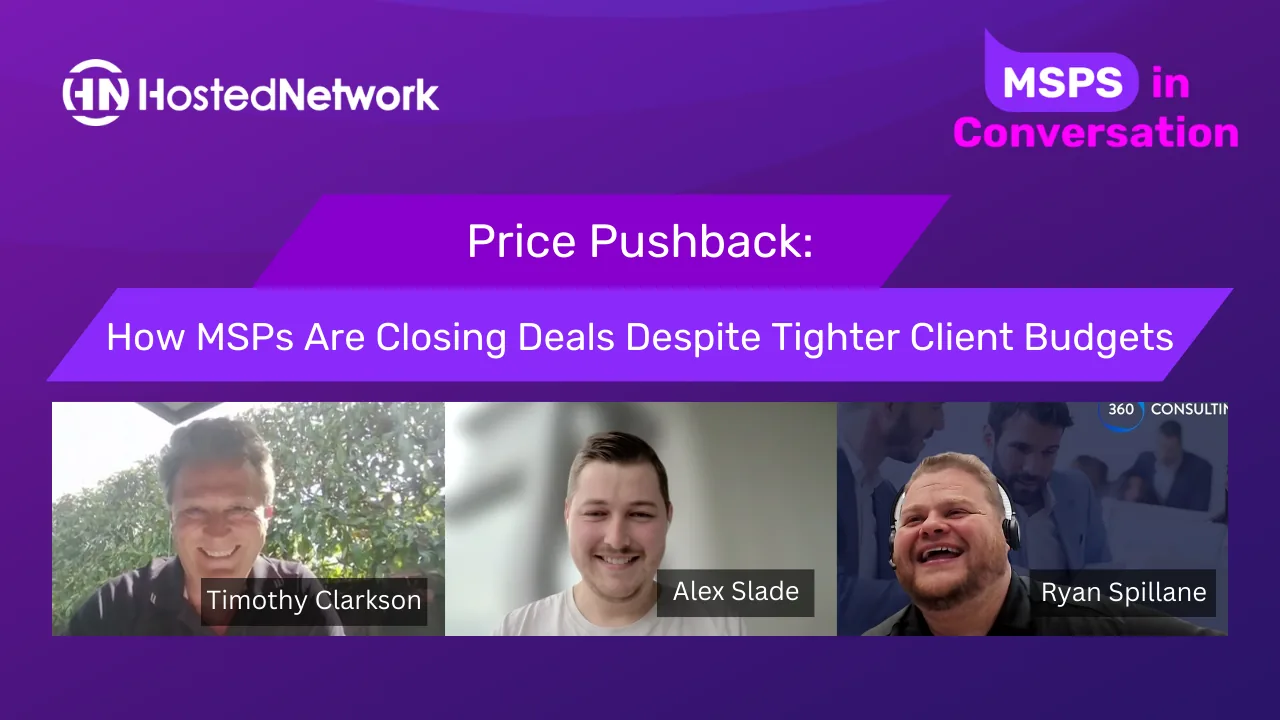
Welcome everyone. Welcome to this month's MSPs in Conversation. Today we are talking about price pushback and how MSPs are closing deals despite tighter client budgets. So we're joined today by Alex, Tim, and our repeating guest Ryan. I'll let you guys introduce yourselves in a second, but first a little bit of housekeeping.
As always, this is a recorded session. So if you do need to drop off or you want to share it around later, please feel free to do so. This will be cut up as a podcast as well, on things like Spotify, Apple Podcasts, and so on, and it'll be available on YouTube, Vimeo, and whatnot. And as always, it is an interactive session. So if you do have questions, or you want to throw some commentary in, please feel free to add it to the chat, use the Q&A, and we will try and answer them and throw your commentary into the conversation as we go.
A little bit about Hosted Network. Hosted Network is our wholesale licensed carrier for MSPs in Australia. We serve over 300 MSPs across Australia for cloud, telco, security and voice. We started as an MSP a long time ago. We've been wholesale for 12, 13 years now. And today we serve those MSPs and help solve problems, delivering cloud and telco solutions the way it should be for MSPs: simple, easy, with no margin burn. Fundamentally, we talk the same language and we're here to get it done. But as I always say, enough about us. We're not here to talk about Hosted Network. We're here to listen to our amazing panelists.
So guys, thank you for joining us. Alex and Tim, welcome to your first time on MSPs in Conversation. Thank you for being here. And Ryan, thank you for being part of the furniture. All right, Alex, I'll get you to introduce yourself if you wouldn't mind.
Yeah, for sure. Alex, CEO at A. Corp Computers. We're a managed services provider. Started up in a town called Muswellbrook in the Hunter Valley, and now we've got two offices, Sydney and Muswellbrook. Pretty stock standard, serving small to medium businesses across the country, all their IT needs. Oh, I'm already getting audio issues. Sorry, I'll have to have a look at that. I'm on a new setup, I apologize. Hopefully I do. Okay, good. Every time — I'm an IT guy that's like a painter that never paints his house. I can never get my audio quite right.
Thank you, Alex. Tim, would you mind introducing yourself as well?
Yeah, I'm the owner of Auction IT. We're a managed service provider out of Christchurch, New Zealand. I've been doing this for 20 years now. Started as a one-man-band engineer, grew the business — and there's other podcasts out there — I went from 200 customers to 20 customers, fired them to become more profitable, and now I focus solely on marketing and lead generation. So that's what we do: I do marketing and lead generation for MSPs, and ourselves, to try and grow the business, because MSPs suck at getting leads in the door. We've had a few different topics on that, that's for sure.
Ryan, welcome back. Give us a spiel.
Good to be back, and thank you for having me back. Look, ran an MSP for 25 years. I jokingly say I'm a recovering MSP owner. But yes, nowadays I help other MSPs in packaging and pricing, mergers and acquisitions, and strategy. So again, I have a lot of experience and I work with probably 30 to 40 MSPs a year quite easily. So yes, we're trying to come from a few different angles with experience, to throw a bit of color into these sessions.
Amazing. Well, thank you, guys. With that in mind — oops, jumping too far forward. Let me turn off my slide deck and we will jump into the fun. Let me get my notes up here.
So today we are talking about price pushback. MSPs, we're closing deals, but it's getting more and more competitive, and how do we focus more on value versus price? How does AI come into it? You threw a great comment out earlier, I'll let you talk to that later. But things are becoming more and more challenging, and this is always the nature of business, right? We always have these different challenges, and this will always be an ongoing thing.
So today, guys, I'd love to hear what you're doing, how you're closing deals despite clients being tighter on their budgets. And Ryan, what you're seeing from the market, what's working and potentially what's not working as well, so the audience and our listeners can avoid some of the same pitfalls. Maybe some mistakes — feel free to share those. And to the audience as well, if you do have experiences of your own, feel free to throw them in.
So my first question, and Alex, I'm going to throw this to you. Very quickly, Alex is actually joining us from Hong Kong today, so thank you for joining us from the hotel room. I want to throw that in. But I'm going to start with you. So with budget pushback, what's the specific budget pushback that you're hearing from clients right now? And is it actually about budget, or do you think it's something else?
Look, for us, I don't think it's really ever about budget. It's the uncertainty. We're often having to have conversations with clients about raising prices because our vendors are raising prices, and it's not necessarily a fun conversation to have. The best example is Microsoft, and then they say, well, why is the price going up? And then you've got to explain to them, well, there's these new features, but you might not use them — but let's try and get you to use them — but there's obviously going to be some consulting hours or some additional cost to help them use them as well.
So for us, it's typically vendor-driven, and we've got to pass those costs on to the business. And they just haven't factored in, in their budgets, that those prices are rising. So it does tend to come as a shock sometimes, because we as partners often find out about price rises the same time as the customers do. An interesting one at the moment was the price rise for Microsoft coming in June this year. I was actually discussing this with another MSP recently. I don't think there's been Australian pricing released for that yet, but they've announced all the US-based pricing. So we know the price rise is coming, but we don't really know what our prices are going to look like yet. So we've got to get those communications out now, but how do we effectively send those out? So yeah, that's some of the discussions we're having at the moment.
Yeah, it doesn't sound great, does it? When you have to send a message out — hey, we're getting a price rise from Microsoft, can't tell you how much. Yeah, that doesn't make us look good, which is a problem.
Yeah, especially because we're the partner, right? They're not dealing with Microsoft directly. We're there for a reason. For us, we are that conduit for our clients. Other MSPs handle things differently and provide access to vendors directly. But for our clients, we're the conduit. They're working with us on a daily basis, and so yeah, it can make a bit of a difficult conversation.
Yeah. Tim, what do you think?
Yeah. Well, the stat I heard last year was 24% of customers leave MSPs because they can't even understand the invoicing. If they can't understand your invoicing, how are they going to understand the value of the package you've put together? So all they can do is look at what their mates are saying down at the pub, or in the boardroom, and go, I think I can get this cheaper. Especially if you're a value provider — like I charge a premium, I charge a price. So that's a constant conversation we have to have, which is: here's what you're getting, here's the value you're getting. And if it truly is a budget issue, it's okay, which feature do you want to take away after our support, triage and advisory service?
But to Alex's point, it's like, if you have a roadmap in front of the customer, the unexpected Microsoft increases, we can't help those, but everything else should be forecast out for them. So is it truly a budget conversation? I think nine times out of ten it's not. They just don't understand, so they think they need to knock some money off pricing. Everyone's got to feel like they have a bit of a win as well, right? Well, that's from an existing company. If it's net new, it's a pipeline problem. The customer says, you know, this price doesn't seem reasonable. It's like, well, what are you comparing against? They can't compare it. We sell MSP services every week. They do it every five years. So they're uneducated. So there's a whole lot of education we have to do in that sales process. And if we haven't got enough leads in the pipeline, we'll sell it at any price to try and get the deal because we haven't done one for six months. So for me, it comes back to pipeline. The bigger your pipeline, the happier you are to hold the line on your price.
Interesting. Interesting take. I like that. Ryan, you work with a lot of MSPs on their business strategy. Are you seeing a pattern with what's driving pushback? We've talked about Microsoft 365, Microsoft pricing. Tim has mentioned pipeline. Are you seeing anything else? Is it the economy, more competition, or potentially buyers getting more sophisticated with things like AI?
Everything except the last one, which I'll go into — and yes, there's an element of that. I think for many, many years we didn't serve ourselves well in the industry by not putting up prices every year. How many people didn't put up their prices for five years, and then had to do a big increase, and then had to explain to the client, hey, we haven't put a price rise in for years, but we've got to do one now? We've just become used to — or sorry, our clients have become used to — I just say "us" as if I still run an MSP — but I think our clients still just don't see us in that same vein as something that's going to go up each year, because historically we haven't. And yes, we may have started to do that in the last couple of years. I know myself and plenty of other people out there kind of gently persuading, and smacking people over the head, to get them to actually raise their rates, because they don't realize what they're offering.
I like what Tim said as well, in that a lot of people — again, most end customers — really don't know what they're buying. So on the invoices or whatnot, simplify your agreements, put it into straight English for them. It can be as technical as you want inside your system, but just make it easy for the client to see. I've said for a number of years that traditional managed services is getting commoditized, and it is a bit of a race down, unfortunately. But if you're adding in cyber, if you're adding in all of the other value-adds and doing good, proper QBRs — and I'm not talking about speeds and feeds, about how good your SLA was and how quickly you responded to a ticket — if you actually have proper and good engagement with those clients, then there should rarely ever be a value discussion or a price discussion at that point in time. So I think they're probably your big ones. Yeah, look, I'll leave it there, otherwise I could talk forever.
No worries. Well, Tim, back to you, I guess. You mentioned pipeline. So when a prospect comes to you and they're clearly price shopping, how do you know that that's what's happening? What are the signs that you're being shopped?
So, relatively few people come to us, because we're quite upfront about our pricing being premium service. And we put the price right at the front. We had somebody phone up yesterday — they're a seven-user shop, they need to get an MSP because of stuff going on, so I can't just go too much. I went, great, you're between three to five thousand dollars a month. How does that sit with you? And we just leave it there. A lot of people choose to walk away at that point. We go, can we find you a provider? Like, I have a lot of peers I work with. Can I find you a provider who I can connect you with who could be more appropriate price-wise? So you qualify them out early on, or in, rather than spending too much time and effort on them.
Yeah. And we did an RFP that we get the signal on Friday. We sat with the key person on the RFP, and on price, he told us, you came number four. We know it's not number four. It'll be number two. But you know, it wasn't their key motivator. It was the additional services. When we went through — like, Ryan's sitting there going on about speeds and feeds — that's operational. We do that on a monthly basis to make sure we're keeping up what we do. When we come into QBR, the QBR is about strategy in the 12 months and 36 months forward, and that's where you add value beyond the other people, because they were going, we don't get that. And that's how you try to get that differentiation: doing the things that I think we should be doing. But it's surprising the number of MSPs who don't. I don't know, they seem to be afraid of the customer, don't want to sit and have those conversations.
It's like what Ryan mentioned — you not doing a price rise is actually doing a disservice to yourself in the long run, and to the customer, right? Because you're setting that sort of bad precedent. Alex, any comments? What do you think in terms of prospects coming to you? How have you seen that they're price shopping?
Well, I think we're similar to Tim now. We've spent the last couple of years — we do have a bit more of a premium offering now. Look, 10 years ago, I was pretty happy to do anything bespoke. The joke was, anything with a heartbeat and a wallet was fine. And now you set yourself up, and the business evolves. We've got a well-defined target customer profile now. We know what our value is. And so we've got to the point where we've basically got — with a few exceptions, because there's always an exception or two — two offerings. The prices of those offerings are pretty set in stone, unless it's quite a large client, or there's some special stuff involved. And so we can very quickly provide a ballpark figure, just like Tim can, which very quickly weeds out the tyre kickers, as you call them.
I've got what's become a running rule now: we're happy to be involved in a tender process or an RFP with multiple MSPs. But if we can very quickly get an inkling that you're calling us as the third quote, for example, because they're coming to you with an agenda — they've already got two people, they're probably renewing with their incumbent, but they need to get a third quote just to see what pricing is like — you can pick up on that pretty quickly, just in the way they communicate with you. And we just sort of say, look, it's not really a process for us to then quote at that point, because there's obviously time and effort in quoting, understanding the customer, and providing a proper proposal forward. So it just comes with experience, I think, part of it. And then you've got to train your staff up on that as well. But yeah, once you simplify your service offering, it actually becomes a bit easier to weed those initial parts out, for sure.
Yeah, I'll just jump onto the back of that about weeding out and knowing if you are third-quoting and whatnot. We used to bluntly ask. We actually trained our sales admins, if a new call came in, or any account managers and whatnot, that we would openly ask the question — we did it politely — and say, are you actually looking to make a change, or do you just need a third quote for compliance reasons? And don't worry, we will still help you with that. That's not an issue, but we just want to make sure how much time and effort we put in. If you just need a third quote, that's fine, give us what you need. If you're just after some pricing of how much your services should be, we have two plans: one is at $85 a user, the other is around $150 a user. There are the differences in those, and what's included and what's not. But there we go. They're the high-level numbers, a bit like Tim said at the start.
And you might get a bunch of people self-select out early, but you've not spent a lot of time really engaging with them. And every now and again, one of those comes back — one of those comes back because you didn't waste their time. You gave them the information they needed to actually complete what they needed to. And at some point, you never know. It's only a small percentage, to be clear, that would come back around. But every now and again, you'd get a phone call another year later, or six months later: oh yeah, the reason they went to start having a chat with someone else has come back up again. And yeah, we're not going to go out and speak to another three new people. Can we just have a chat with you this time?
You have your hand up.
I do. I think you're the first person to ever do that. I didn't even know that was possible. But I referred to Paul Green's podcast last week. The average cost to acquire a new customer is 31,000 dollars. Not just the advertising cost, but sales cost, sales admin cost, failed proposals, because we jump at everything. And that's why I think Alex and me are saying that quick weed-out starts to drop that cost down quite quickly, because you're not chasing everything with a pulse that I have a potential of winning because I don't have enough pipeline. Don't forget the wallet. So when you get the niche down, and you can be upfront about what your pricing is because you're speaking to that niche, that cost will drop from $31,000 quite substantially. But yeah, it's an interesting podcast to go listen to, about what it actually costs to get a client, not just your SDR, your BDM cost.
31,000 — that's a pretty penny, right? So the customer acquisition cost along those lines.
Sorry, just to add — I also feel for the customers in some regards, in these processes too, because our industry is not an easy one to navigate, I guess, because every MSP does pricing differently. It's not just about whether they're pricing cheaply or not, or more expensive, but also how they model their pricing. You could do your own calculations to get down to the same thing, but it's never an apples-to-apples comparison for the most part. So it does make it difficult. So if you can at least make it easier for them and say, look, this is our price — if you don't like the premium price, at least it makes it a bit easier for them as well. So it goes both ways.
Well, we've talked a little bit at cost of sale, we've talked about pipeline. And this is open to all three of you. How much do you think your business's brand and reputation play into being able to position yourself as a premium offering? Can your marketing position do some of the heavy lifting before they even get to the pricing conversation? Do you think that rules people out if you kind of look at the real primo?
I can go first on that one. We had a customer come to us last week, a 25-year law firm, proposal out seven days later. He's like, I came to you because you're trusted. I went to Google, and he went to ChatGPT, and he went, I had that feeling of trust from you. Your website looks good, you've got testimonials, you've got Google ratings. So it wasn't a price conversation, and it happened really, really quickly. One of our points of differentiation is stuff we do with AI, and he's like, well, how is AI going to help me? Well, my sales guy went, how did you find us? And he went, oh yeah — and the conversation stopped. He used AI to find us. And if you think people aren't, you're missing the boat.
Credibility is a big thing, and if you can show that credibility through marketing, referrals, and good case studies, it's worth a hell of a lot. And again, most people — look at when we go and buy something. When you go and want to hire or get a new fridge, you don't go into Harvey Norman, the Good Guys, or any of those and start looking at fridges. You've already had a look online before you even got there. You already know the size of the hole that it has to go in. You're already mentally probably down to two or three options before you even walk in. Even if you do walk in — but how many times do people just buy this stuff online now? Most people are coming in wanting to buy, or have done some background. It's rare. There's still people out there that just call you out of the blue, but let's be honest about it, most people are coming through referral, or coming through a network, and the odd Google, and nowadays AI and ChatGPT and all of those things doing a bit of search for you — search on you, I should say.
Yeah, I'll preface that we don't do marketing the best. We've tried, and we're still doing more improvements this year. Marketing is a tough one to get right. But we've focused on our brand. A lot of our stuff comes through referral still, plenty come through leads. I wish — but the referral process is good. So if you build out your brand and it's seen as a trusted brand through your online presence, you know, we do a lot of sponsorship work in the communities we work in as well, particularly in a regional space, where that's seen as really important, to be part of your local community. So when the referral does come in, it's already warm, and then they're seeing your brand, and they're seeing the feedback across the digital space as well. It just helps you get in a client that will be the right fit for you as well.
Yeah, and then realistically, like I said, those pricing conversations, a bit like Tim has said, they're a bit easier if they're looking for that trusted partner. And that's actually in our TCP verbiage around what we're looking for as a client. Because let's face it, I think MSPs, if you're doing everything right, you shouldn't be having a lot of customer churn. And so our focus is developing long-term customers, which by definition is having them trust you and you trust them.
There was one point I didn't make earlier that I forgot and just remembered. I also think it's a challenge — the longer you have a customer, the longer it is a challenge to show them continual value and continual reason to stay, because they become used to it and become accustomed to it. Now I'm not talking three or five years. I'm talking customers that have been with you 10, 15, 20 years. At some point they're going to test the market if they haven't already, because as much as you've got a great relationship, they just don't know what else is out there. It's not a marriage. They can go and change whenever they'd like. So yes, people will go and do that, and it's hard. And that's one thing we had — again, we ran for 25 years before I exited, and there's still customers still there now that are from day one. But yes, it was really hard trying to show them continual value. We had — I think it was Aaron — what we called continual drivers of value, and continuing to show value. So it's things like compliance reporting, good QBRs, strategy stuff, incident response plans, all of those types of things, to continually level up and just show how good we are. So if they did go somewhere else and test the market, it's like, oh, they'll ask the new provider, or someone they're talking to, what does your monthly report look like? Ah, we don't do one. Or, well, hang on, ours is already x amount of pages. We already know what's happening. Here's a short list of items. Here's the three-year strategy document for that client, and this is what our budget looks like for the next couple of years. If you're writing that — again, premium-level service, as some here are talking about — that includes those things. Not much should be a surprise for a client if you're doing your job well. That's not a price discussion.
We've had a comment from Jamie: you know, everything just works, what do we even pay you for? We hear that quite often, in particular even in these MSPs in Conversation sessions. Something's broke — what do we even pay for? Like, where is that value? Which leads into my next question. And Ryan, as always, you're always one step ahead of my questions. So just let me ask the question.
Well, I've got to do my job too.
I want to shift the conversation a little bit to this value piece of it, because that's what we're talking about. So Tim, I'm going to start with you, about what messages actually land. So when we're in a room with a business owner who's potentially cutting costs, or asking these questions — it could be an existing customer, it could be a prospect — but what messages actually land in your experience?
Well, we get too caught up — and I started this as a fellow engineer — we get too caught up on what we do and what we like, and that's absolutely freaking irrelevant to the customer. So I was in a meeting yesterday and they went, I have an existing incumbent, but we want you to do AI and security for us, because you were the first person to speak to us about business processes. So we highlighted four business processes that were broken. And one of them was fraud detection in accounts payable. And I'm like, I'm not an accountant, but how do you pay your bills? What process do you go through? This is a 30-second fix to stop yourself from being business email compromised. Oh well, why didn't my existing provider speak to me about that? Because they fix your printer. Now, they can stay fixing your printer, but we'll sit across the top of them, because I am sick of coming down to the desk and fixing printers. It's not going to happen.
But that's how you add value and drive the price conversation. Everybody who wants to — if you want to charge a premium rather than commodity, you have to start speaking about business process, you have to start thinking about AI. You don't have to deliver AI, but you should be the source they come to, to have a conversation. Hey, I'm thinking of doing AI — rather than saying, by the way, I've got an AI consultant in, because you're screwed at that point. We need to start speaking to the customer about what they care about. Where's their profit leakage? Where's the optimization of services and the rest of what we do around that? We don't have to actually solve it, but we have to translate it for them. How does technology fit into that business process?
Alex, what do you think? What messages land for your customers?
Yeah. So to give them value, you've got to understand their business and what they actually want out of you. So I think every customer we work with, they all need security, they all need their data backed up, and they all need working emails. But that doesn't necessarily matter, as Tim said. That's sort of the given stuff. They could probably also get it themselves by going online to the various direct vendors that they can buy from and stitch it together. The first thing we're doing — and often I'm running these calls and meetings — we'll have a referral come in, but we've got to understand what they're actually looking for and what their business does. Look, we've got four or five builders on our books, but they all do very different things. They're all builders, but one builds houses that are no cheaper than $10 million, and one does renovations only, but the renovations are no less than $3 million — and that's a renovation, right? So they're all quite bespoke in what they do, and they've all got different people that work for them, different processes. One of our builders is really into AI — they've got a whole heap of automation around safety and compliance that they do, and we've got one that's still doing quite a bit of that manually. And there are different conversations being had with both of them, right?
So that's the first thing: just understanding what your customers actually do. Because you could work in the one industry and only work with builders, for example, but they're not all going to be the same. We're working with financial planners at the moment, and they're big on the AI train as well, as most customers are — they're being exposed to it everywhere. But again, they're all doing it a little bit differently depending on who their lead is and what their guidelines are. So we're having conversations around compliance, that's been an incredible value-add to what we can do. I think our team and us, we're quite specialized and quite good at having compliance discussions based on our experience. We're definitely a little earlier on the AI journey compared to some MSPs, but we're getting up to speed when and where required. So yeah, it's all about having the conversations about what the client actually wants, and then you can define the value. Because yeah, the basic managed services, you're right, it's all, as Ryan said, commoditized quite highly, and you're not going to differentiate yourself if you're going to be a premium offering. Those are just the givens. Yeah, we're going to back up your data if you're a client of ours. What else can we discuss, what else can we do with you, to justify it if we are a premium-priced MSP?
Ryan, this sounds something like we've talked a lot about — focusing on fundamentally having a business conversation, not an IT conversation. We've talked about this in person, on webinars, all sorts of things together many times. You see a lot of different MSPs and how they operate. Can you walk us through what you believe the good conversation actually looks like, in that sense, to focus on that business side of it? What are some tips, in your opinion, that a good MSP is doing, and not necessarily talking about printers?
No, good question. Actually, a really great question. We could spend the rest of the next hour on that alone, but three tips. The biggest thing is, you need to understand it as the MSP owner, or whoever's sitting in front of the customer. You need to start understanding business concepts as well, not just technology and not just IT and fixing things. If you're not confident in the conversation, then it's not going to come across well to the customer.
So we used to sit down with a new prospect and say, okay, Fred from blah blah blah introduced us to you. Can we — are you happy if we work on the fact that we've looked after Fred's IT now for 14 years, that he's pretty happy with us, and that we probably know what we're doing with technology? And they're like, okay, not sure, but okay, I'll go with it. It's like, okay, can we have a discussion around your business? Where has your business come from for the last year or two? What's your business plan for the next couple of years? What are the challenges in your industry? And then, how does technology weave into that? You can also weave in, what are your existing providers not doing right for you? What would you like them to do for you? And these are all great questions that make them talk, and they will do the majority of the talking. And a lot of times that 45-minute or hour meeting often gets extended. As long as they don't have another meeting after it, a lot of times they just always give you a lot more, because they're enjoying the conversation. They probably haven't had a good conversation around their business.
And I'm talking about businesses here that are in that kind of 20-to-100-seat or 20-to-80-seat range, just for context, because it's a very different conversation with a 250- or a 500-seat client, to be clear. But yes, you'd have that conversation. Do you want — would you prefer capex or opex? And you need to be able to understand that, because a lot of times they're not sure, or they have an idea. If they're accountants, and anyone in finance, of course they know. But if it's a manufacturing business, then yes, they probably know the concepts but don't necessarily know it worded that way. Again, what are they trying to achieve in their business? What's their staff retention like, and what's the culture like in the business? All of those things, again, most people don't ever talk about.
And how I know that worked pretty well — obviously you've had Aaron, my old sales manager, on here before. Just before we sold, Aaron went out to see a new client. Again, it was normally an hour meeting to do the intro and whatnot. He was there for just over two, nearly two and a half hours, and they offered him a job. They'd never had a conversation like that. They realized — again, from disarming them to coming through and having a great conversation — that they really wanted to do business with us. And yes, they became a customer, to be very clear. But yes, they tried to offer him a job because they wanted something like that inside their business too.
Now, I can tell you, and Aaron would probably say this as well, when Aaron first tried to do some of those conversations, when he'd only been with us a year or two years, some of the customers shut him down, because it's like, well, hang on, under what authority, or what confidence do you have, talking about business or finance type conversations? But after a while, when he slowed down and actually was able to be very deliberate with the questions he was asking, people — again, not everyone answers them, but a lot of them wanted to have that conversation. Because if you're providing value, if you're giving them some advice and some suggestions even in that first hour, you're building credibility, and at that point in time you're actually giving them a reason to buy from you. You're educating them in a way that they actually want to buy from you, and they want to be in business with you, or want to be a partner with you.
Amazing. Cool. And that actually aligns quite well with what you're all talking about here. Rod's actually put something in there — a very low-cost thing that Rod does is to send out a very quick email with a series of questions before they go too deep in the process as well. So we've got some other good tips in there as well.
We've got a question, though — from Michael, sorry, I'm too far up the chat. Do you publicly share your pricing, or drive a potential lead to a conversation first to discuss their needs before you provide pricing? Tim, have you got a preference? And what do you guys do?
So we don't at the moment, but I'm busy working on that calculator at the moment to give a price range. If I'm prepared to give that price range out in the first 15-minute phone call to close it down, why not make it available publicly? And you just make it a large enough range that you're not paying yourself out. You're not saying we're $120 a seat. You're saying, given what you want, we could be anywhere from — IT support from 100 to 190, and for cyber security we can be anywhere from 80 to 200. Okay. So if they're expecting to get a Costco service at $30 for IT and 20 bucks for cyber security, move on, go to the next person. But if it's the right sort of price range, it invokes a conversation. I remember it came from Robin Robbins, when I was part of her group: it's like, you've got two choices. You need to be the cheapest in the market, or the most expensive. And my choice was, I'd rather be premium than Costco. So, but you do need to have a price range, because we all know we may not discount, but we may change our service offering to reflect what we want. So make that available and just publish it.
Yeah, I think that's a good piece of advice. Alex, what would you guys do?
Yeah, we don't currently, but like I said, we also share it quite early on. So I'm not opposed to it. It's just not something we've done. But I know a lot of people in the market are doing it. I'm in the Evolve program, and a lot of organizations in our group and wider groups, they do it. Because realistically, look, the industry is big enough for everyone. There are no price secrets, right? The price is the price, especially if you're valuing your services correctly. Sharing your pricing early, or sharing it publicly — I don't think you're going to have anyone screenshot it, come to you and say, hey, but I got this price from another company that's cheaper, can you match it? Well, as we've already discussed, if that's coming to me, you're not the client for us, because you're not understanding, you're looking at some numbers, you're not understanding what our service is at that point yet. But I actually quite like the idea of a price calculator. It's one of the things on our very long to-do list. To be honest, it's always a long to-do list of things that are quite cool and you can add in the business. But look, maybe it's going to be moved up the list a little bit, because it seems like it's a good option. I always learn a lot of things from these conversations myself, so I'm always taking notes.
But Tim, I actually think that really aligns to your comment earlier about decreasing the cost of sale — that $31,000 — that quickly rules out those tyre kickers.
Well, if you're doing your lead generation correctly, and you've got the right lead generation, you're starting to get digital leads in, your SDRs are phoning people, people are coming to your website — why waste the time filtering more people out? It comes back, again, to a pipeline problem. If you only have one person in your pipeline, you're too concerned to tell them the price in case they go. So we want to hide it and gatekeep it and explain our value and build the value — but wait, there's more, you get this — but wait, there's more. And we hold it back. We give them the price, and then we wonder why they don't buy, even though we've shown them huge amounts of value. If you fix your pipeline problem at the front end, filter out the people who are never going to buy from you. So there are people who are never going to buy from you no matter what your price, and people who are never going to buy from you at a certain price point, which is not my price point. Get rid of them early, get rid of them quickly, and help them on to somebody else. And then I'm spending my time, which is lead generation, I'm spending my sales guy's time, on qualifying their pain. So we know they fit in the right budget. Do they have urgency? And what pain problem are we solving that made them pick the phone up or fill that form lead in? And we don't get there too often, because they don't know the price. So they don't want to give you the secret sauce of why they have a problem, because they don't know if you're in the right price range yet. And it's all bait and switch: I need to phone you, to have a conversation, for you to tell me how good you are, to eventually get the price.
So I'd love to hear what the rest of the audience thinks. If you share your pricing, or if you keep it later into the process, maybe throw it into the chat. We'd love to hear what you guys think. Ryan, if you want to answer that — I know you were going to add something on there, and then we'll move on to the next piece of it.
I was actually going to give a counter point. My ass probably gets a bit sore from sitting on the fence on this one, but I think it's because there are multiple options and multiple answers to it. Tim's right in that it is a pipeline issue. If you're having enough people come into your pipeline, and you're getting two leads a week or three leads a week, it makes sense to put it up on the website, because you're going to then get some of those out of the pipeline quicker, by them no longer going to tyre-kick for you. But if you're getting one lead in the pipeline a quarter, then I'd probably hesitate having it online, because at that point in time you want to have an engagement with the client. We never did, to be clear. And I felt that because there were plenty of times where a customer came in saying, we're spending X now with our existing provider, and we only want to spend X with you. And then you gently and politely point out that they're getting a certain service because they're only paying X, and if they pay Y, they get all these other bits, which is what they really want. So it's a bit of a balancing act on both of those.
So if we could jump on that — my point of view comes from the fact that I've got 20 people coming to my webinar tomorrow, I've got 19 people coming to my in-person event the following week, I've got another 40 people booked into my events in April. So we're booking out two months in advance for between 40 to 60 people. So I can get away with that, because I'm not having one marketing — I like it.
Yeah. So that's where all of my advice comes from, as I said: pipeline fixes all problems. And you can do something different if you have that pipeline. See our last MSPs in Conversation on marketing.
All right, let's move on a little bit. Thank you. Thank you. I try. So we're going to move on a little bit to handling the objection of "you're too expensive." I'm kind of keen — you've already put your pricing up, but if you have gone down the path, what have you guys done in the past to handle that? So Tim, I'll let you start with this one, but then I'll open up to everyone else. The moment a client says that you're too expensive, what's your first response? Can you — client or prospect?
Prospect.
Sorry, prospect. You know what, we'll start with prospect, and would it be different for a client?
Yeah, 100%. Because a client trusts you and knows you. So it's a different conversation. A prospect, they don't know you from a bar of soap. They have to get to know you, like you, and trust you before they're going to sign up with you. So for a prospect, "you're too expensive," it's like, well, what are you basing that on? That's the first thing: define expensive, and stop, and wait, and be really uncomfortable, and let them answer. Because our preconceived notions as engineers undervalue our services. We want to discount. An inventory MSP, they'll come in, they'll discount: oh, you think I'm too expensive? Oh, we can knock 25% off that, or we can take that out. It's like, just say, expensive compared to what? And what are you basing that on? And stop. Nine times out of ten they go, oh, because somebody at the pub said they were doing it cheaper. Okay, so would you be posted to telling me how they're getting the same service for less money? And stop again. Your quiet pauses, to let the customer answer, is how you get around that objection, as far as I'm concerned.
I like that. Agree. We take a very similar track, because you've got to ask. So again, prospect — we typically have two kinds of prospects. We're taking on businesses and organizations that have never had an MSP, and then we've got others that are changing MSP. So those are two different conversations as well. If we're quoting and we're more expensive than their current MSP, well, I simply ask them, well, why are you looking at moving anyway? And that conversation will typically go down service delivery requirements. They want better cyber? Well, then you have to pay more for those things. And then, if it's coming — similar to what Tim said — from never having an MSP, they're a newer business, they've matured and now acquire one. Cool. So what are your preconceived notions of what an MSP costs? Yeah, they spoke to their business colleague that uses someone, and that was their price, but they could be very different businesses. Coming back again, businesses in the same industry are different. I'll use the builder example: this builder spoke to a financial planner, or their financial planner, and they got told what their IT guy is charging them, and they go, oh well, that should be the price. Well, two very different businesses. And every MSP is going to price things differently. So you've just got to have those conversations.
I usually drive it into a conversation of, you know, we've been operating for what, 15 years now, and we've evolved from just myself to a well-defined and mature team now. I would think that if you compare one of our quotes to an organization at a similar maturity level as us, they're going to be pretty similar. So premium, yes, but they're probably going to be within a decent percentage range anyway. If you're going to compare it to Joe down the road, who's running a business by himself, then it's probably absolutely going to be more expensive. But then it just comes back to that value conversation. So, what is he going to offer you compared to us? What are you actually looking for? Because both answers are correct. He might be best suited for them, he might be what they require. We might be what they require. Just having those conversations, and taking it back from "you're too expensive" to "what is expensive, and what do you value in your IT?" Again, that's in our TCP model: we're looking for businesses that essentially want to mature their IT and work with a mature IT company. Hence why very quickly we can weed out people who want to have discounts and that sort of thing.
Okay, so speaking of discounts, Ryan, I'll ask you this one. Why should an MSP discount their offering? What's the real cost of dropping your price to win a deal, in your experience?
Yeah, look, if you're thinking from a financial perspective, let's say you're making 40% margin on your managed services agreements — which, again, you want to be aiming for 50, but between 40 and 60; a lot of people are making 30 or 40 — let's just say 40% for a second. If you do a discount by 10%, you've just lost 25% of your margin. So that's a very quick commercial prospect there. If you give them a 20% discount, you've just lost half of your margin on that support agreement. So you're going to have a problem with profitability, or maintaining profitability, and servicing that client in time. And then, if that client ends up spending and using a lot of tickets and putting a lot of time in, you're actually probably breaking even at best. So that's the commercial reason why you shouldn't do it.
I get it that, if you haven't won a customer in forever, or you've just lost a big customer, and you want to cover the revenue, I get why some people will do that at that point in time. I don't necessarily agree with it, but sometimes I have openly said to people, discount something by 10%, because you're going to have x amount of staff sitting there, or you're going to have to put someone off, and that might be the difference, if you don't want to do that. Those types of pieces. Bigger businesses, you see it. You saw that in the construction industry through the GFC, where they were actually going in at 0% margin on their deals, and were picking up the profit on the adjustments and the variations, because they just wanted to keep people employed. So I'm using something outside of the industry there, just as a bit of an example, because inside the industry, yes, some people will discount to get something across the line. And don't get me wrong, giving a slightly different price because there's a different size of customer, that's not a discount. That's a volume play, or a volume efficiency. So again, a 10-seat client is going to pay a different price to a 50-, or a 100-, or a 500-seat customer. I actually think it's a reversed bell curve, because you actually start off where it's a high cost, and then you get some efficiencies, and then as the customer actually gets bigger, the actual cost base goes back up — and a lot of people don't realize that, because the amount of account management, and the amount of touch-base and standing meetings and whatnot that you have with a 200-seat or a 500-seat customer, the cost base actually goes back up.
So should they discount? No, I don't think they should. My answer has always been — and Tim mentioned it earlier at the start of the call — it was a case of, if you would like it cheaper, it was no different than if someone ever asked you, can you do this project cheaper? My answer always was, guys, we give you the right price to start with. You've known us for x amount of years. We don't put fat in this deliberately, just to give you a discount to make it sound good. But if you want a discount, tell us which bits you don't want. And a lot of times they don't want to take anything out of your offering. So they don't really want it. They're just challenging you, to see if they can get a discount. And if they can get a discount out of you, then that means you weren't really confident in your product, or you're making too much margin in it, from their perspective.
I think there's a second issue beyond the financial issue, which is a psychological issue, and a demographic issue, which is: if the customer wants a discount, and you're giving them a discount, all those customers are going to start questioning, does it really take an hour to do that job versus half an hour? The bills are going to be — there's so many other factors in the business, that somebody asking for that, and not valuing you as a professional who delivers. The fact that I can get up tomorrow and buy a laptop and call myself an MSP, versus five years of passing the bar — and the thing is just crap. And what that discount mentality says is, you are going to be on the back foot in this relationship. You are not the trusted advisor. Even the quotes you give them to upgrade their network are going to be questioned and nitpicked. It's going to take 10 hours to get across the line. We just don't do it. My price is my price is my price, and for the last three years we've not given a discount. Now, we may go, uplift your cyber security from one plan to another plan for a year — like, hey, if you sign now, we can put you on a premium plan for cyber security rather than a standard plan, you know, but it's only for a year, because after the year you'll see the value; if you don't like it, we'll pull you back down again. So always — yeah, don't discount, give an offering that's of a low cost to you, high value to them, that lets you see the next level of service you're going to give. That's the way I'd handle that.
I like that. I like that.
Guys, we're nearly at time, and I haven't asked anywhere near the number of questions that I had, so I'm going to jump ahead a little bit more. We've talked quite heavily on value, and focusing on that, right? It's definitely the right way to go. If you're a smaller, early-stage MSP, you're still building your reputation, you don't have all those Google reviews — how do you sell on value when you're new to the game? Can you guys think back to when you first started? I mean, when I started our MSP, we were definitely discounting heavily, and it took us a long time to not do that. Any advice for those early-stage MSPs? Alex?
Well, look, personally, I wouldn't be starting an MSP again myself.
I was waiting for someone to say it.
Yeah. That's just me, though. I'd have to start with a team, and that's just a whole different kettle of fish. Look, going back to when I started, I don't know if it's a unique story or not, but my value and my trustedness, if that's a word, was through close family referrals. So it's probably how a lot of people start. Like, you're going to have a network of people. For me, it was my family, my dad, who was in sales and had customers that trusted him, and those were my first customers, because they had IT questions, and he just dropped things into conversations. And for anyone starting now, it's going to be a similar boat. They're going to have a network. Lean on that network. They're going to know that you're good with computers and you're good at IT and you know this AI thing. And I keep using AI, but I think we should still be focused on cyber, to be honest, because no customer has really got their head around that. So just rely on the network, and try early on to define what your value is. You might be able to charge as much as a larger firm if you're providing the service level and the offering. But just don't undersell what you can do, just to win the business. Because whether you're one person or a 50-person MSP, you're going to have your unique value prop, and lowering that price or discounting too early, or too far, is going to be a detriment to that, especially as you grow.
Tim, any comments on that one?
Two things. One, if you are going to go in with a discount, put your price in. It's a lot easier to remove a discount — even though we spoke about not discounting, it's a lot easier to remove a discount than to put your price up. So if you sit there and go, my price is $1,000, and you want to put it up to $1,500, that's a hard conversation. If you go, look, normally it'd be $2,000, but for the first 10 customers this year I'm making it $1,000 — when you go back and you say, by the way, it's going to $1,500, the price hasn't gone up, I've just removed my discount, because I've got busy. So it's a psychological difference, and it works fundamentally easier on the client side.
The second thing is, MSPs go about it the wrong way around. We're engineers, and we go in and we want to be a good engineer, and we think we'll get business, but you have to leave with marketing. If you leave with marketing, you can pick the customers who will pay the price you want. If you leave with engineering, you're left over with those people who come to you after everything else. So I remember learning that lesson — it took me a long time. We used to go in and talk about how fast the speeds and feeds were, and no, it didn't work. Business outcomes.
David Vidos has just mentioned, along those lines of marketing, that a great website that makes you look bigger than you actually are, a high-quality business card, dressing well, potentially a nice car — showing them signs that you're successful, and they'll assume that you are, and then back it up with your knowledge once they give you a chance to talk. I quite like that. It's a lower-cost marketing piece of it, maybe not for the car.
The last thing I was going to say — yeah — is, look, there's an element of, what's his name, "fake it till you make it." You've got to be confident to show it, and it'll come through. That confidence will end up being a little bit haphazard to start with, but it'll then be real. You know what you're doing, just go and do it. And yes, there's an element of that. And again, as time goes on, your rates will go up, etc. But don't ever diminish your own value.
Well, with that, we are pretty much at time, guys. So I wanted to say a huge thank you to all three of you. I had nearly 30 questions, and I think I got through about eight. So, great insights from all three of you. I really appreciate that. The next one coming up — and if I don't put this up on the screen, my marketing team will shoot me — so we're talking about white space, filling the white space, finding the hidden revenue in your client base, on the 22nd of April. So make sure you join us there. And if you've got any questions, or if you'd like to be a panelist, feel free to reach out. We are looking for, I think, one more spot for that one. And if you have missed any of our previous episodes, feel free to check out the MSPs in Conversation website. Everything is on there. You can see all the notes and everything from there, whether it be the podcast or the recordings. So with that, guys, thank you very much. Thank you for joining us, and for your amazing insights.
Thanks all, very much.
Thank you all.