20 October 2026
Getting Sales Out of the Owner's Head: What to Build First, and in What Order
Sales & Marketing
Most MSPs run far more systems, tools, and workflows than they realise. This hidden complexity increases overhead, slows teams down, and erodes margin — often without showing up clearly in reports.
Missed licence billing, unreconciled vendor invoices, owner time spent in the weeds, and manual admin work all contribute to “margin burn.” Individually they seem minor — combined, they can cost thousands per month.
As professional services businesses, MSPs sell time — yet many struggle to track it accurately. Without reliable time data, MSPs can’t understand true contract profitability, identify automation opportunities, or scale sustainably.
Repeatable processes are essential once teams grow, but over-engineering too early can paralyse progress. The goal is simple, evolving standards that remove bottlenecks — not bureaucracy for its own sake.
Revenue alone doesn’t equal success. High-performing MSPs are clear on where they’re going, price based on value (not vendor RRP), retain the right customers, and deliberately design businesses that don’t rely on the owner being the bottleneck.
Edited for readability from the episode audio — may contain minor errors.
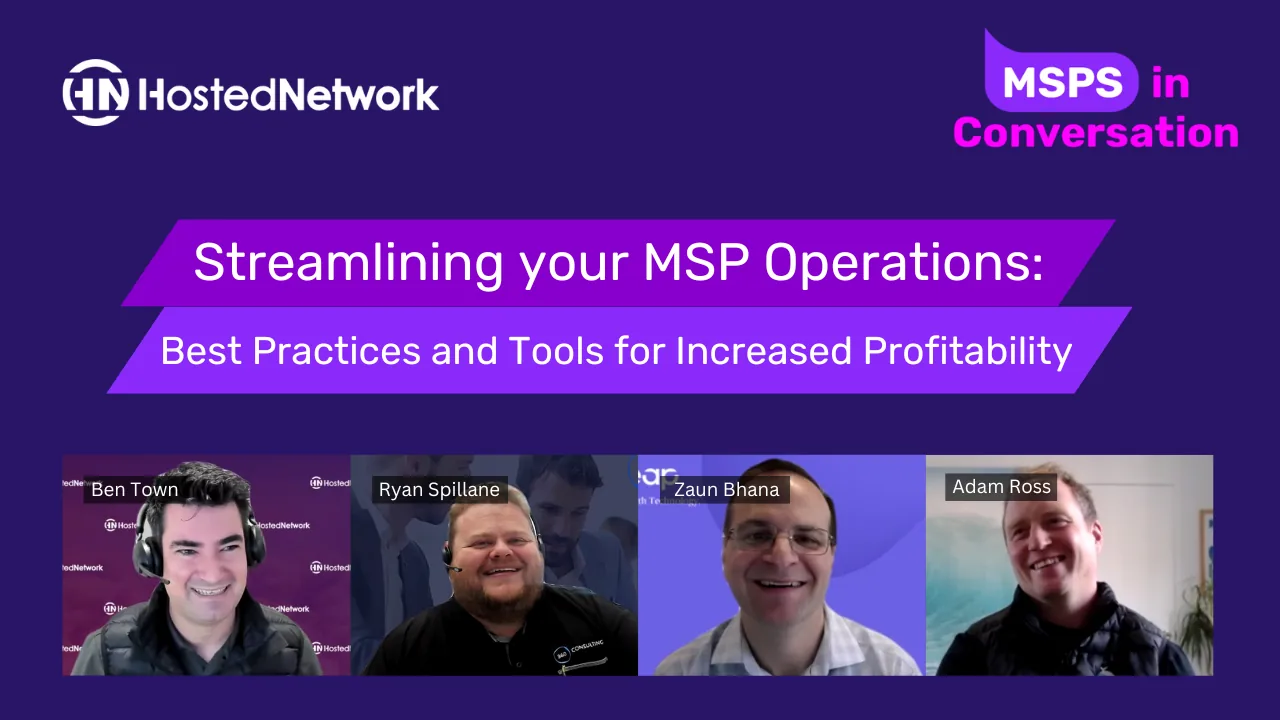
All right, thank you for joining us everyone for this session of MSPs in Conversation. Today's topic is streamlining your MSP operations, and we're going to be talking about best practices and tools for increased profitability. It's a very popular topic. We've got lots of questions that people have submitted already, so hopefully we have time to get through them today.
As always, this session is recorded. We will be sending out the recording afterwards. It's available not just as video but also as a podcast, so check it out on your favourite medium and share it around for anyone that might find useful insights. If you have any questions as we go, please feel free to drop them in the chat and we will try and address them if we have time.
Very quickly, as always, just a quick intro about Hosted Network. Hosted Network is a wholesale cloud and telco provider for MSPs. Twenty years ago we started as an MSP ourselves, and we've now been, for 10 years, servicing over 150 MSPs across Australia, delivering cloud and telco the way it should be for an MSP. So if you'd like to have a chat, feel free to reach out to us afterwards. But today isn't about us, it is about our wonderful panelists.
So today we are joined by Adam, Ryan and Zaun. Left to right — well, that was not left to right, but Ryan, you've joined us before. You're basically a piece of the furniture these days, right? So go ahead and introduce yourself, and then Adam and Zaun likewise.
Might be a big piece of furniture, mate. Yes, I'm Ryan from — don't laugh — 360 Consulting. We were an MSP for many, many years and we've transitioned over to consulting, back to the MSP and CSP community, around profitability, mergers, acquisitions, valuations and accountability.
Wonderful. And my name is Adam Ross. I'm one of the co-founders of a company called CloudOlive. My background started life in an MSP sort of back in 2010, 2011, and then from 2011 onwards I was the first employee for Autotask here in Australia. So I launched that business, and then eight years later Datto came along and merged. And a problem that I noticed over and over again with our MSP partners was that they asked us, "How do all the other MSPs manage all the licence fluctuations across all the vendors they resell?" We never really had an answer, so my co-founder and I set out to solve that problem three years ago. So now if you run Autotask or ConnectWise, we can verify if you underbill or overbill any customer across any service that goes through your business, including Hosted Network.
I'd like that, absolutely. Yeah, absolutely.
Hi, I'm Zaun, managing director of Leap, we're an MSP based in Perth in Western Australia. I've been fortunate to be in that business with my business partner Lee for 19 years — so he's the technical one out of the two of us. I also started the first HTG, now ConnectWise Evolve, peer group in Australia way back in 2010, and was the facilitator for that and then the organiser for that in the country. I spent five years facilitating peer groups as well, and getting to be a fly on the wall for other MSPs. I've had a lot of time to be in it and around it, and probably overloaded with it. So yeah, good to be on with everyone else.
Thanks, guys. I reckon we're going to have a really broad spectrum of answers today to the range of questions that we've got. So without wasting any more time, let's jump into it. I will stop sharing, as I always like to say — we're not here to see slides.
So Ryan, I might start with you if that's okay. From an industry perspective, as a consultant, what are you seeing talking to multiple different MSPs these days in terms of operational things that are getting in the way of profitability?
Look, it's a pile of different things if you think about it, but the main ones are the complexity inside people's environments. We are a technical industry. We love our tools and we love everything we put in, but that comes at a cost as well. If you look at most MSPs, they think they might run on 15, 20, 30 systems, but in reality they're probably running 70 to 80 different systems to try to piece everything together. So it's kind of like — a lot of us used to call it spaghetti — it's a bit of everywhere. So it's quite funny from that perspective. It comes down to, again: are they building the right amounts for their services? Are they efficient enough? Are they using automation where they can? Obviously there's AI nowadays, but we'll worry about that for another time. Are they billing everything that they're actually getting billed from their vendors? Are they billing the right quantities every single month for their clientele, for lots of their clients? There's a myriad of different things that make up all of that.
All right. And Zaun, overall, 19 years, what have you seen within Leap that has driven the industry to where it is at the moment?
I think if I was to play David Attenborough for a moment and pick on the industry as the animal, I think there's probably been a few changes if you look at it. For those that are losing their hair like me, you'll probably remember the Small Business Server days, and networking, and the change — you know, how that shifted the industry, and that drove a lot of businesses really strongly. It was kind of like a tailwind that really pushed them forward. We saw the shift of cloud coming into Australia — we'll pause when it first came in from Telstra, before it was Office 365 — and that drove a huge change as well. It wasn't really focused on managed services then. But I think now what you're seeing is more and more organisations realising the value of recurring revenue and subscriptions, and that's not just in our industry, that's in every industry. I think that's kind of like the third wave that we're seeing. And like Ryan spoke about, probably not the time to talk about AI — maybe that'll be the fourth wave. But there's definitely those three things that seem to have pushed really hard into the industry, and each time it's felt like a bit of a tectonic shift for businesses, because you've seen businesses sell out at each point, and you've seen people get in at each point. That's a big change. So as the market has moved through those cycles — and it's always a cycle — there's that famous saying, "What's old is new again," and I think many people in MSP would say the same thing: "I've seen this all before." So that's a blessing and a curse.
Yeah, it's definitely interesting if you think back in the old days of Exchange hosting and whatnot. I know a few people that ran good businesses back then, and in a way you have to reinvent yourself to stay relevant, right? And some of them didn't.
So, Adam, in terms of what you see from your career — being on the other side of the fence a little bit — you deal with a bunch of different size MSPs, much like Ryan does. What are you seeing in the industry at the moment?
I think I should just mention the word AI all the way through, ever since — that's where we say Bingo, I'm sure. Yeah, definitely. Little red buzzer. Yeah. So the background of eight years of essentially working on understanding and selling and implementing the PSA, the Autotask system — those systems are very big. They demonstrate very well when people buy them, and then when you actually implement them day one — I think when the rubber hits the road and you try to go live in those systems, I reckon only 30, 40 per cent of companies that have deployed them are actually enjoying, like, generating significant value out of them. And that's no different, small, medium or large. I think the small guys really struggle if they're the ones implementing, the ones picking up the phone, the ones working with all the clients. And then when you get to 10, 15, 20 staff, there's more people obviously to take that on. But that's a consistent challenge that I've seen for more than 10 years now.
We're very focused on helping MSPs bill effectively. The core of it is: make sure you bill what you are getting charged for — the raw simplistic version of it. Solving that's extremely difficult though. And what I do notice — it's almost two years into obsessing on this problem in CloudOlive — what dawned on me one night was the complexity lives, and it gets expanded, when MSPs are billing differently to how they're buying things. If you buy — if it's 10 units here and there's going to be 10 units there and it just flows perfectly — that's okay, and it typically is quite simple. But the further you branch away from that, it becomes more and more complex. A lot of MSPs implement these PSAs before they look at the way in which their vendors are going to be billing them, and then all of a sudden there's a mismatch and a complexity.
I think most people look at it from how they bill their customers. They don't consider how they get billed at all for really the first couple of years. They'll throw admin and they'll throw human time at the problem, because they just want to be billing their customers right to start with — like their own labour, that is.
I wonder even if many people actually think about that element as well. Like you think about not thinking about the vendor, thinking about your — it's how I bill my customer.
I would say maybe there's even that decision tree that comes up, which is: is this bright shiny thing — does it look really good, and I haven't really thought about how I'm going to bill my customer or how my vendor bills me? So it's like three problems rolled into one. I've sold the first one, it looks like a great product; I haven't thought really how I'm going to bill for it; and then I haven't really thought how I'm going to reconcile it. So you get all three coming together at once. Yeah, 100 per cent. Depending on the problem that the MSP is trying to solve, we find that if you sign them up and incline to a per-user model, then you want to pick a source of truth — probably a Microsoft count of some description, or multiple, like primary licences — and that's cool, you can bill them 10 units and everyone's happy. The customer will pay that because that's what's been signed up to. The knock-on effect of that though is the admin teams can never reconcile: AV's got 15, what do we do with the extra five? And it just — especially if someone's got OCD in the admin team, which drives them absolutely insane. We like trying to understand why there's that complexity, and there's a trade-off to it, and trying to work out which problem you want to solve, and then just understand why the complexity exists. I think it's something that — it took us, we might have been focused on this for a really long time, and it's just dawned on me about 12 months ago that this is a big part of why CloudOlive — why we've got a job.
It's interesting. I know that back when we ran our MSP, and even talking to our partners today, it's that shiny coin syndrome, and in fact I suffer from it quite — those of you that know Dan Williams, he gave me a book that I'm looking at now, I haven't read it yet. Probably? Yeah. But in terms of that complexity, you start off at that point of setting your pricing and whatnot, and I wonder how many things people add in, and then they deal with that margin burn.
So from your experience of running MSPs, how significant of a problem has that been for both your MSPs and what you guys see? So Ryan, when you ran yours, how often did you have to catch yourself to sort of go, "Oh, we've added more things in but haven't necessarily looked at what our actual profitability is"?
Look, yes or no. In the early days — but in probably the last five to eight years of the business, we were very clearly aware of what was made up into each product. We had kind of a spreadsheet we used to do and build out for every single product or solution, that took up all the costs, understood what that cost was, put a — attributed a time to that, the effort —
Have we lost Ryan? There we go. Sorry, Ryan, we lost you for a second there.
Yes, sorry, Donna. What just happened then? But yes, we would — we had a spreadsheet, we'd pull all those costs into the product within ConnectWise Manage. So we used to make sure that all of those costs were taken up.
Right. And what was the turning point for you — when you were a smaller business — to make that transition? Because we've got quite a wide range of audience members here, some smaller, some larger. What was that pain point that triggered for you?
It probably — I don't know if it was truly a pain point. I think it was more around maturing of the business. Again, we were a part of HTG, the United Nations of Evolve and the old HTG community. For us it was actually making sure all of our line items were right, understanding the true profitability and the gross margin on each one of our products — all of those pieces made that up. And then from there it was a case of okay, how were vendors invoicing us? We had a big spreadsheet that could attract all of that information: what was getting billed to a customer, pulling that data out of ConnectWise, to what a supplier was actually billing us. And yes, sometimes we had differences, like Adam was saying. We deliberately had differences in some instances, where we weren't billing everything to our customer, but at least we identified what those were, and we always knew what it was.
Rather than most people — a perfect example is even data connections, kind of relevant for the call we're on. How many people actually cancel a data connection, or the billing of a connection for a client, because the client cancelled it? They forgot to actually stop the billing from the vendor side, or the vendor keeps billing you and you don't notice and you didn't reconcile it. It's the same for Office 365, it's the same for antivirus, it's the same for backup, it's the same for anything. You don't notice one or two or five — when you've got, what's the name, 1,500, 2,000, 5,000 mailboxes in Office 365, you wouldn't even notice 50 difference in a month. So it's a lot of margin and a lot of cost that you could be still taking up that you're not billing back out.
A lot of money left on the table. When we're speaking with companies, it's just like, "Oh, it's eight bucks here, it's 10 bucks here. It's not that big a deal, we win some, we lose some." I guess it's totally the wrong mindset, because at the end of the day that's an eight dollar or a hundred dollar cost that has been submitted. If you're selling something at 20 points margin or 50 points margin depending on the type of vendor, it's the revenue that you're missing out of the company, which you could then go and do other stuff with. So having the mindset "I've earned a couple of bucks here, eight bucks here, 50 bucks here, we'll win some, we'll lose some" — it's absolutely the wrong mindset that you should be taking. Because at the end of the day, the compound nature of having revenue coming into the company, as well as streamlined operations, is material when you compound that over time. And just letting it slide — slide by — you're not doing it for yourself or your staff, or even your eventual outcome, whatever that may be, will be impeded, because it's typically a small cleanup in understanding where those gaps are.
Well, that's an example off the back of that, Adam, with Office 365. When we were starting to invoice that out — and it's changed a bit now — but the default margin was 10 per cent. So if you missed billing one month of that licence, it was 10 months before you broke even back on that licence. If a customer didn't pay you for one month, there just disappeared 10 months' worth of margin. So it's really, really quick to lose margin that way. If you have hundreds or thousands of them in there, a little bit here, a little bit there — it may not seem like it adds up, but sorry, it does add up in reality. But they might just ignore that. The reality is, why ignore it? It's your profit, it's your money that's not in your bank. What could you be doing with that yourself, for yourself?
Ryan's going to play the part of the person who doesn't make mistakes. I'll play the part of the person who's made lots of mistakes. We've made plenty of mistakes on the way, yeah.
So in that scenario — and you talk about margin burn, Ben, I like that word, margin burn — I think definitely from Adam's perspective there's licences that go into that, and that's a considerable amount of burn that MSPs chew through. I think when you're smaller and you're in that initial phase, it doesn't matter what kind — starting off, margin burn is also time of your team. But when it's just you, let's say you're wearing three or four hats as an owner, you create margin burn any time as an owner you're engaged or doing something that's outside of what you should be doing. That's margin burn, because when you remove yourself from it, you're going to have to have someone else do it. So it's kind of like a false sense of security when you hear people say, "Oh, I've built my own backup solution," and you're like, "Oh, that's amazing," and, "It's fully automated, I don't spend any time, my team doesn't spend any time on it, because I built it and it's so fantastic." I was like, "Oh, how much time do you spend on it?" "Oh, I check it every night." And so when they look at their margin, their margins look great in their profit and loss, but their margin with their spouse or their family doesn't look great, because that burnt that. That's this kind of margin burn that people don't always think about: your time as an owner, even when you're small, has an outsized impact on your take-home and the experience for your staff as well, because eventually you're going to have to hire someone to do that, or employ someone else, or get someone to do that. So that burn really adds up, and I don't think people really see that, because it's kind of like, "Oh, I'm doing five things anyway." So I think margin burn is licensing, it's time spent yourself, it's time spent for your team, and then it's probably the third thing, which — and you're talking about complexity that comes back — is how much time do clients spend understanding it? Because we consider burn internally as MSPs; flip that on the head, what is the burn for clients to understand your product, understand your invoice, understand how you bill? That's another form of burn. Because if you've got a really simple offering, well, it's easily understandable, clients go, "Oh, I get that," unless you have 29 pages of terms and conditions that might be hard on the client. So yeah, good word, margin burn. Good one for everyone to take home and think about.
From continuing that train of thought, margin burn I think also isn't just if we forget to bill things — it's also the time that it costs to bill that, to reconcile all those little bits and pieces that go into it, that admin overhead. I was only having a conversation with one of our partners the other day, and it was the owner that was doing that, despite them having a team. That's right. It is very common, whereas — so I want to sort of shift in terms of a little bit around process and how to get out of that.
With any business, right, mindset is one of the biggest, hardest things to change as you grow a business, because a small business mindset is different every step along the way as you get to medium, bigger, and I'm sure enterprise is just a whole different world. So in terms of changing that mindset, that approach — what advice do you guys have for the owners on this call for getting them out of the hot seat of being, you know, burning that margin? Ryan, what if you were to advise someone on the call?
Well, I'm thinking, going back even to when I was much younger, reading The E-Myth for the first time — the book that doesn't get talked about much anymore. Every system, every process, has to be repeatable, and it shouldn't actually revolve around you. That's the catch. Most small businesses — it's almost a need, especially with technical people that are business owners, and hey, I was guilty of it, I think everyone's guilty of that, or most people are — that it's almost like they build the process around themselves because they need to be needed or want to be needed. And then it comes to a point where they get to almost a burnout, or it's managing burnout, managing stress, managing the fact that their home life isn't great or whatnot, and then they realise, "Hang on, I'm a big bottleneck." Of course that's a problem. And then it's a lot of effort, and it takes quite some time for someone to actually make that transition out of that mindset into, "Okay, I now want to grow this," or, "I'm having growing pains, and how am I going to solve this?" And it is through repeatable process. It is through making sure that things don't really just revolve around you, or wait on you, and again, clear boundaries or clear guidelines to other people, and all the processes within the business, so then people know how to deliver them, how to actually do what's needed, and can actually do the job without it relying on you.
Zaun, how have you handled that? How have you had those processes as you've grown Leap Consulting, so that you're not in that hot seat?
Yeah, look, this has been deliberate — I mean, it's been very deliberate for us. We've focused heavily, that's been Lee, my business partner, and I, that's our kind of North Star. We've always focused on, how do we build a vehicle that can run without us, and then grow without us? I'm a big fan of Jim Collins. He's got the book Good to Great, Great by Choice, that kind of stuff. He has another one which he doesn't talk about, but I actually think it's better for small business owners, called Beyond Entrepreneurship 2.0, and he talks about moving from being the time-teller to the clock-builder. Because if you're the time-teller — kind of to Ryan's point — you've always got to be the one to go, "Here, do this, do that, go here," and it's like you're just telling time to people. Whereas his thing is, build the clock, the clock will tell time without you. And that's this focus on, well, what did you get into business for, what are you trying to achieve, and what is your outcome? So that gave us motivation. And I do think you have to have a reason to start process. I don't think anyone gets excited with processes — if they do, I have a job for you — but not many people. I mean, we're fortunate to have a few people in our team which are superstars, and literally that's what they're great at. But to that point of The E-Myth, or any kind of concept of getting yourself out of being a bottleneck, it's making sure you have a focus on — and this is the way we did it — what was the hat we wanted to take off first. So we started with what was the most annoying role as owners we wanted to remove first, and that became the first kind of role, and underneath that role we needed processes. Because the first mistake you make — and again, I know Ryan's perfect — my first mistake is you hired someone with no process and said, "How about it?" And basically they were just looking at you like a fruit loop, going, "What do you want me to do now that you've hired me?" Because we didn't have any process. So I would say having a person requires a process to follow. KPIs are a separate conversation, but start with a role first and go, "What's the worst role you want to take off, and what is it you would expect to manage them by if they were doing that successfully?" So that would be my kind of key advice. Back when we started, it really helped us kind of stop doing it. Mine was payroll. I just wanted to stop doing payroll, because I was on holidays and I had to do payroll, and I'm like, "No, I need to do this differently." So maybe Adam's in the middle of payroll tonight, who knows.
There's not much other stuff to worry too much about at the moment, and we've outsourced it already. But by the way, just a slightly different angle on that — I think the getting bogged down trying to refine process when you're one or two staff, or even five staff, and you're like, "Right, what if we land this 2,000-seat customer? What if we do this? We have to have all of our back-end systems, we have to have everything aligned" — I think of it as a slightly different angle. I think you won't know the processes to put in place until you find your own seam and you're growing, you've found what would deem your market fit for whatever you're doing and solving, and where your niche is, and where your customers are telling their friends who look like them to come and work with you. Really, under the mindset of, like, great things to start off with, purposely don't worry about patching it all together from day one. But as you're moving forward, then you're almost going to have to, and if you're passionate about what you're doing and the problems you're solving and the people you work with, you will figure it out, you will solve it. But doing it in reverse, I think, especially people whose background is in sales — which is a lot of people in this industry — almost flip it, like, you need to have clients, you need to be growing. And then from there you will naturally make the right decisions or systems to put in place, because you're going to be forced to, you've got no choice, otherwise it's going to be even more stressful. But it's worth going through that pain, and you're probably going to have to re-engineer it every time you triple in size anyway. So just try and win as many clients as you can, and keep pushing, keep trying to speak to people.
Growth covers a lot of sins, that's the reality. But it comes to a point where you actually want to make profit and make money, and that's probably a lot of times where that next shift becomes as well. It's like, "I've got a massive headline number, but I'm making bugger all on the bottom line, why am I doing this?" And then they meet someone that is a quarter of their size or half their size, driving two to three, even four times the amount of profit, a lot less stressed, and they wonder, "Hang on, why can't I do that?" That's often where it starts the question from a lot of people, I'd say. Just because you're a big business doesn't mean you're profitable, right?
So sticking with process, just a question for Zaun: does everything have to be processed? Do you have to have a process for everything?
Well, you've had that argument — because I think there's always more than one way to scale them out, and there's always different pieces of advice. The questions that we have around processes — when we were starting we had no concept of what's an A player, what's a top performer. It was kind of like, we just wanted bums on seats. We didn't know what values or culture were, or topgrading, or interviewing. We didn't have any of those clues. So our version was exactly what Ryan was talking about with The E-Myth, that was like, okay, let's put in processes. But we didn't start that way. We definitely started the way Adam did, Ben. We just kind of — paddle pops and shoelaces and a bit of chewing gum — and that seemed to do the trick, and that was the way it worked. And then eventually we worked out we wanted it done this way. Actually, we started getting angry, or frustrated, or annoyed, or letting people down because it wasn't documented. And the minute you added another person — you doubled your staff, you went from one to two or two to three — suddenly the process wasn't the same, because it was kind of like Chinese whispers, we had a verbal tradition. "I do it this way." The next engineer comes in, he goes, "I had done it this way," and, "I've done it this way." And so we learned very quickly, just by hitting the wall consistently enough at a painful velocity, that we needed some form of a standard — whether you call it a process, whether you call it an SOP, standard operating procedure, whether you call it a checklist, a tech standard, I don't know. But you typically have a way, and it's like, what's your way? EOS — they call it kind of your 80/20 on processes. What's your version of that in your business? So yeah, I would say that's kind of the approach we took: you've got to have some form of standard, because oftentimes you don't actually know what your standard is. If you've been growing, or you've been servicing, or whatever else, you have a version in your head, you probably haven't articulated it, and no one's interrogated it, no one's looked at it and gone, "Well, actually, that doesn't make sense anymore." So yeah, we started there. We just focused where we were bleeding the most and started to put a process around there. That worked well for us, because if we could stem the tide, that's where we started. But to what Adam said, I've definitely gone through the point where we kind of put everyone into a process mode and theme, and then watched the money drain out of our bank account because we were so busy looking at our navel that no one was looking at our customer. And so that is a very real risk of over-processing or over-engineering — you end up going into kind of stagnation. So I think there's a cautionary tale around process: enough to advance, not too much that you sink.
Mike in the chat has a good comment that process can also be problematic and a roadblock — progress over process also has its place. A hundred per cent. Wise words, Mike.
Okay, people have got to be able to — again, I know someone who built a process and a procedure on how to clean the coffee machine. I'm not against it, but at some point people have to be able to think for themselves too. Things need to be really proceduralised and process-based, but people still need to be able to do something and have some free thought and think outside of the box, because that's how you come up with new ways of doing things. I often like to say that I hire people and I trust people to not follow the process, but to know when to break it as well — to think, basically.
So we've been talking about profitability. Shifting gears a little bit — obviously a broad question — what does good profitability look like in an MSP? Ryan, I'm going to start with you, because I think you're doing something right. Well, the survey is more around what people are actually charging, not necessarily their profitability, so I'm not asking you that question yet, at this stage. But I don't know. Well, that's all I'd say.
What's industry-wise? I think the average profitability is what, six per cent across the global industry? Yeah, I think the average is — the lowest I've seen lately is seven. On that number, and it has been rising for managed service providers, but that's kind of been the standard. It's been seven to eight per cent, kind of bumps around that mark, depending on which surveying company you talk to, consistently. And the number one piece of feedback when you talk about that profitability is, in today's market, it's hardly outpacing inflation. And even if it was accurately seven per cent, the majority of owners, not just in IT but in every small business, don't pay themselves the equivalent market salary for the work they're doing. So you can start taking numbers off that seven per cent and drop it down from there. But that's kind of the average, I think, at the moment, what you hear.
What you hear is, you know, best in class. And this is talking — if you took 100 MSPs, the top 25, number 25 MSP should be doing around 21 per cent, give or take, EBIT or profit, if you like. And that's not the top, that's just the bottom of the top 25. So number one. And I know there's people in Australia who run very, very profitable 10-person, 20-person, 50-person MSPs doing 20 per cent. It's not size relevant, it's not market relevant, it's more how they've structured and built their business. I mean, software's a lot better — I'd prefer to be in the software industry, they seem to make a lot more money. But hey, that's what I've seen.
What is it in software, Adam? We should know, because that's where we'll see the Lambos and the Ferraris. Yeah, margins are tricky. You build one thing and the cost has already been sunk, right? And then to provision something there's no additional, or really no additional cost to it. But finding something that people want initially will take a long time. It does take a long time, and most of the time it never actually works and gets out the gates, right? That's why so many don't make it through. But 70, 80 per cent — super. Once you — the whole premise here is to grow as fast as you can and then you can switch off sales and marketing, which is your biggest expense, and then it's extremely profitable. But again, you've got to get out the gates and find terminal velocity and product-market fit with it. But once you do that, you become unstoppable.
But I guess just to come back to it, we've almost got a PhD here in software licensing, MSP billing, PSA setup. You would not believe the lens that we've got on this thing over the obsession for years now. There's a lot of MSPs that just go, "Oh, vendor, you tell us to sell RRP, okay, we'll do that, we'll fall in line, we'll do exactly that." I would really question that. There's a good 15, 20 per cent of MSPs that literally do not listen to anything a vendor tells them to do, and they go and generate value, they solve problems, and then their customers pay way over odds on what the RRP is. And I don't think it's them fleecing them at all, it's just they've got a really good relationship with these customers and they're just recouping the value that they're generating with their customers. So if you are one of the absolute majority on this call that are doing it — just things like new clients coming on, you don't need to follow the RRP. And that's even on Microsoft, you do not need to follow that. Not everybody does that by any means. And there's some good — it's just free money, effectively. It's an easy way to increase margins across certain business lines for certain customers, if it's the right thing to do for what you've built for them.
Interesting. And we say that as well, ironically, with our voice services. We see customers doing very low margins, but also guys that are doing very, very, very high. It's always interesting to see just how much margin people can make off these services, right? So I think that's good advice: just because you've got a standard doesn't mean it has to be applied across the broad board to every single customer. Yeah, without fleecing them, of course, unless that's your business model, for sure.
So Adam, staying with you. I certainly know that when we ran our MSP, we sucked at misbilling. I've talked to heaps of partners over the years as well, who'll buy an internet connection from us and then go, "Holy, I haven't billed it for the last two years," and some of these things are, you know, thousands of dollars a month. I've seen it. And you can't really backdate that — I mean, maybe you can to a degree, but your customer is going to be pretty dirty with you if you're backdating some of these big things, right? So what have you learned over the last couple of years working with MSPs about the most common areas that they can fix to avoid those headaches?
Yeah, I think, similar to what you do with a new client coming on, you almost want to just take a rain check on where you're at with your own business. This one piece of advice probably won't travel for everyone, but if you take a check on what does our PSA now look like — we're deep in all the details of ConnectWise — so what do those two systems look like? If you've had that system, either system, for eight years, and anybody can add stuff to it, there's a really good chance that there's going to be a ton of duplicate products and services in there, and it's just hard for the team. Some of the early ways — just look at, before we start automating all of these things, we just try and deduplicate. There's no point just automating madness. But that's definitely one thing. If you're an owner of a company, I would recommend just going — maybe you're not deep in the admin reconciliation, the on-billing piece of the puzzle in the background — go and ask the people in that team what is the biggest or the hardest vendor to actually do. And what I reckon you'll understand at that point, when you dig one layer deeper, will be the way you buy that stuff, the way they invoice you, is different to what it looks like in the PSA. There's a really good chance that there's a mismatch, so it requires humans to go in there and sort of patch things together, and one person remembers this customer that has this weird nuanced thing that they need to just remember and manipulate every single month. That's definitely one of them. And that can even be as simple as, if you bill on the first and the vendor invoices you on the sixth, that is a mismatch. That's a type of mismatching that the admin and finance team will be struggling with every single month, to try and line those two things up. And the further away you've made decisions to bill your customer, just recognise the pros and cons to that. You don't need to change anything, you don't need to try to understand why the admin team really hates this vendor or that vendor, but there's a really good chance just the way it's being sold is vastly different to how you're buying it.
So with that, I mean, you can name names if you guys want to, but what is the most complex thing that an MSP bills? What should they be aware of that, if they've got it on their books, they might need to be aware of? What is the most complex thing in all of your experiences?
Always Microsoft, because it's so big. Whoever their main distributor is — typically, or some of these guys, like you guys, will put everything on one invoice, that's awesome. You'd be surprised at how few distributors actually do that yet, class themselves as consolidating everything. Like, 10 years ago they sold eight, probably created another one. But if you've got a vendor that is lower margin but big amounts, naturally you're going to have to reconcile that every single month, you need to get that under control. So Microsoft, definitely a big one. And things that move a lot — things that are tied to users, typically, fluctuating left and right all over the place. And you might be billing your customer and saying, "Right, if they come off on the 15th, we're going to take all the costs associated with that human off at that point in time," but if the vendor's billing you for the whole month at the high point, the high-water mark — which a lot are — okay, it's just friction, it's just annoyance that's going to happen for the admin team every single month. And I just ask them what they do with the mismatches, and see where that conversation takes you, especially if you're an owner. There's lots of teams that are struggling with this problem every single month, and realistically you don't need to keep adding people to solve this, you shouldn't keep adding people to solve this problem. There's better ways and smarter ways to actually leverage tech these days.
I think from a revenue and volume perspective, I think you're right, Adam, it's NCE, CSP or Microsoft licensing. From complexity, I would actually say it could be backups, because backups again — it depends if it's volume-based backup. So if you're charging per gig, per terabyte, per whatever, that goes across multiple machines, servers, desktops, whatever — SaaS-based backups, I think that could be the most complex.
Yeah, I would say — Dave put a good comment around visibility: do you have visibility on where your biggest problem is? Do you even know where that challenge is? And then John's put another one in there around telephony. I would say the thing when you're starting that most small MSPs struggle with is time. The complexity of time is what seems to — time seepage, time leakage. I think again the licensing is massive, and I think Azure is a big one at the moment that people try to wrap their head around, consumption billing. But if you look at how people mature through that, a lot of the first challenge most people get hit with is time, and it's probably the first one they think they nail but probably get wrong. They think, "Oh, I've got all my time, it's all sorted," and then you start stripping through their chart of accounts and you're like, "Where's this time going? What's happening over there? Where are you allocating pre-sales? How is that not hitting projects? And where's your owner's time, where's your rate in any of this?" And that complexity of just, where does that time go? We also assume that, "Oh, we've all got PSAs and we're all getting 100 per cent time accuracy." I think there's a ton of tools that do that; I would query why there are so many tools for time, because it's not yet solved. And look, I definitely think there's some new ones. I'm going to do the Bingo word and talk about — I think it was Thread that I've seen — and they're using AI to take notes of tickets. And I'm like, okay, that's a pretty cool initiative, to start to bridge the time gap, because of the complexity from people just, "I haven't put my time in, I've just waited all week, and now I'm entering it." As you scale, you kind of have that under control. And I think one of the guys involved, Brad Schow, talks about skipping the curves: every five people you add to your business — five to seven — you have a curve to jump, and some people slide off the curve, others have to jump it to the next curve. And it's kind of like everything resets: how you use vendors, how you do reconciliation, how you do time tracking, how you do reporting, kind of resets. So to Adam's point, I felt like we had reconciliations nailed six months ago, picked up the covers and went, "No, we don't," because we skipped a curve. And I was like, "Damn, Adam's been in my business, how does he know that?" So that's exactly the truth. Every time you go through that, it's never one and done. So I think complexity with time is kind of this hidden one that we most take for granted, that's probably the biggest win for most businesses when they're starting off. And then I think as you scale and have more customers, like Adam said, you make a huge dent in getting user count right — the number of times we've seen huge swings because user count was wrong.
You should have gone into Adam's business: which would you rather, time or money in it? I don't know what — I just sort of popped it out there, and I guess I thought 50/50. It was like eight per cent were money and then everybody else was time. And naturally my network on LinkedIn is tech and MSP, and all the rest of it, I was like, wow, that's dramatic, I wasn't expecting that. But yeah, the longer we do this, the more time you want to be able to — I mean, we're doing it so we can have free time, right, and be able to do what we want with our time, and that's true wealth creation. But yes, I feel like some days we're a million miles away from that, because we're just spinning the wheels, it feels, and trying to solve a specific problem. You've only got so much mental faculty that you can actually solve problems with in a day, and if you use all that fuel up in the first — before 11am — you've got a tough afternoon fueled by coffee, no doubt.
But Zaun made a really good point there, and I'll probably reiterate it: your time is your biggest — at the end of the day, your time is your biggest margin product, generally. So if you can solve that, that's going to make a big difference, a big lever to pull for your bottom line. And Wayne in the chat just touched on that.
So I'd like to just shift away from services to the human — not just the business owner's time, but in terms of our techs and ensuring profitability. We need time tracking. If people aren't logging — and I've heard this many, many times over the years — so to jump to Wayne's comment, accurate time, who I might add, Wayne was really bad at putting his time in. Is this the pot calling the kettle black? How does this work? I used to track all billable time. I stopped tracking all the non-billable time, but I used to track all the client — all the time — because then it meant that if the tech needed any information or whatnot, it was always there, and I had to set the example. Is there a golden bullet to getting our teams to — has anyone got some tidbits of information to share with the audience? Because in a lot of ways, if you don't know if your staff aren't tracking their time, you don't actually know how profitable your contracts are.
Yeah, I mean, I've asked the question, and full credit to Lee, my business partner, on this one. He always asks the question: do the engineers even know why they need to track time? Has anyone explained to them how this contributes to revenue, how this contributes to our business, and how our business makes money? It was a great insight, that a lot of times we're telling people what to do — like, "Cross the road at 5pm with your arms behind your back, a hat on backwards, and your shoelaces left undone," and everyone's like, "Why would I do that?" And that kind of feels like trying to explain time tracking to engineers if they've never had experience for why it's done. They don't understand where it comes from, and it's like, what does it add value to? For them it's like, "Well, what problem does this solve?" It feels like you're just trying to be my teacher in year 11 telling me to get my homework done. So there was an MSP, Nathan Franks, DP Technology up in Newcastle — he's got a business up in Newcastle — and I remember him saying years ago, he was having this problem, and he went, "Right, everybody in the company gets an extra 20 per cent per week if everybody's done their time tracking on time, to the minute, and a cut-off." And then the first week, they coupled in, and everyone put their eyes on those two, because it was very public. And then he never really had that problem moving forward. This was back in 2012 or something, I remember hearing this, and just hearing that then — yeah, I've said that a few times, not for a while now, but that helped him significantly, for what turned out to be a very small amount of money based on the billable hours that they then picked up.
Yeah, I did a presentation for another client, to their staff, talking about time and time tracking and whatnot. And at the end of the day, in a professional services organisation, which is what we are, time is our product, so we need to track it, we need to understand it, and we need to explain exactly what you said: why is that important? And I'd say 95 per cent of companies don't. Again, it's that bit of tribal knowledge, or it's expected to be kind of mind-melded to everyone in the business. No, you need to actually sit down and explain it, and explain how that actually makes a difference to the business, and that it helps to pay their wages, it helps pay their bills. It's all important.
Ryan and I know, and he's the CEO — they've got over 50 staff kind of thing — and consistently, even in brand new interviews with staff, he's the last person to do the culture interview check, and he always shares with those engineers the importance of time and keeping time, and why that's commercial. And that's a rare thing, to get in there and go, "Look, here's the time that you've got to have tracked," and it's the expectation from the outset, from the very beginning. That's what I was going to add, basically: start it at onboarding, and make sure — but also consistency, right? I found over the years, most of it, you can't just say something once. You need to remind people. It needs to be part of your mantra as to why we're doing this, so that everyone's across that.
And Jono added a good comment here as well in terms of — we're talking margin burn and streamlining systems — you can't identify automation opportunities without accurate time tracking. No. You can't even — I think if you were to go back to, even with Adam, you're talking about reconciling, part of the power of that reconciliation is knowing how much you're losing. If you don't know how much time you're losing, how much will you gain by automating? And is the risk on automating without knowing what you're going to gain — or undertaking that without knowing what the win will be — like, how is this going to help you hit your goals? So I think that's a really important thing: in terms of profitability, where can you make the biggest dent in that? And having that knowledge leans back to having the right information in the system, having it set up right, tracking time, all those kinds of things. Grade A. And look, I think there's realistically — I know I said, tongue-in-cheek, a golden bullet, but there is none, right? It's just that kind of continual improvement. Yeah, that's it.
Guys, we've got eight minutes left, so I want to let you each have a chance to talk about the key things that each of you would recommend for MSPs on the line to implement within their business. Maybe two or three — like, what are those takeaway moments over the years that you, when you're chatting at conferences, you pass on?
I'll go first. I think there's a couple of things I'll do, and Ryan knows this is kind of my thing, so I always talk about it. It's like, why did you get into your business, and understanding the legacy. So spending a lot of time in Evolve Peer, it's by the wider questions, like, you know, if you're in software, you get an exit, you get a sell, but some of that is — it doesn't have to be, you're focused on the end result, sometimes it can be during the journey, what are you crafting on the way to wherever you want to go? And asking people — a mate in Sydney asked me this good question the other day, which was like, "Are you still enjoying what you're doing passionately every Monday morning? And how long do you want to keep doing that?" And so being clear of what you're trying to get from your business and by when. A lot of us, me included, you kind of fall into business. You don't come up with some perfect Harvard business plan, and then suddenly, 10 years later, you look up and you're like, "Oh, where's time going?" So I always think that's a healthy kind of question to ask people, because it comes back to Adam's, like, what problem are you solving in your life? There's a problem to be solved in your life, whether it's your family, your friends, your fitness, whatever else it is that you have — it's that focus on where you're going. And so a lot of people don't ask that question, kind of just keep travelling, and I think it's healthy to ask, "Where are you going? Why are you going there? What's the purpose of it?"
The other side of that coin is, how much time do we spend doing that with our staff? Like, they're the other ones that we're asking to help us get there, and a lot of the successful MSPs you talk about, there's always a group of people that are behind that. It's like, people build businesses, not things, and it's those team members that are often in that. And you get to meet them, and there's some incredibly talented leadership people who never started MSPs but run amazing businesses, because that owner took an interest in where they wanted to go. So yeah, I just think that kind of legacy viewpoint is really good. And it is one of the most viable — almost outside of mining here in Perth — but the highest-paying professions. It should be the most rewarding business. But even as we've seen, we're at 20 per cent, Adam's at 70, there's a big — yeah, maybe the pain for him is more upfront and ours is later on, who knows. But there's some good questions to be asked. So that's the thing I'd always say, is like, "Hey, how are you tracking? How's your team? Where are you going? Are you on track to where you want to go? Is what you're going to do this week going to get you there?" Always good questions to ask people.
And I think from our lens on this, it's literally go and ask the finance or admin team — typically which are the top two trickiest suppliers that they have to deal with on a monthly basis. They will know pretty quick. Write their name on a whiteboard, and then just ask them, like, why is it difficult. And then just try and look at the way you bill out of, and then the way that then the data comes in, and just try and work out the differences between that. That's a huge part as to why this problem exists and the teams have to manipulate it. Second to that, and on the same page, if you bill per user and per device, or some variation of that — again, jot them down, like, how standardised is the selection of how you count those? So if you've got a full user and a cloud user, as an example, you might be premium and above — is that standardised across the board, yes or no? Is it business basic and below as the cloud user, or some other variation you'll have in that? How standardised is that across the board, across the customers? And you think about, like, what we've learned along the way — we've just built software that just sucks all that information and you plug it in, and you don't need to re-engineer your business around it, we just help you understand it. That's why we're so passionate about this specific area, because your problem's not going away anywhere anytime soon. And the last one is, if you run Autotask or ConnectWise connectors, just Google CloudOlive freemium, just self-serve yourself going there, and it will just give you a view of all your recurring billing items, and you can start filtering and searching on them, and you just begin to understand and take that sort of audit of yourself initially. It's not an overnight change, just start learning what's going on underneath the hood and gradually just work your way out of it, whatever your starting point is.
The journey, right? You need to look back in it — it's 20 years later and you're like, "Okay, that's a longer journey than I thought I was on." But because it's — Ryan, doesn't it? It does. I think what the guys have performed is really, really good. I'd probably build on what someone put forward, and that is: how much are you working on the business versus in the business? As well as — in the same vein of that, another way of asking that question is, are you working on what's important? What is important first, versus what is urgent? Often they're not. People are literally running around firefighting. And I love the monkey, the firefighting clown, because you're running around putting out fires while juggling 10 balls up in the air. But how many times are you actually looking at — like, I said this to one of our old staff, our sales manager, I said to him, "You're great at putting out fires, but you forget to look down at the floor and realise that the fuel valve's on. Turn it off, reach down and turn the fuel valve off, so then you don't have to fight the fire anymore, because it'll go out." Like, how much time are you actually spending working on what's important, which is going to move the dial, drive the bottom line, change your business? Any of those things. How much are you working on what's important versus what's urgent, and what's literally someone throwing a monkey on your back for you to solve?
Commenting on that book that I've got, Stop Chasing Squirrels — I often ask myself. And I've actually got a poster, I need a lot of these motivational things that I never look at clearly. But the poster that I don't think I look at often enough — well, you seem to look at them all the time. Well, yeah, I do, I just put it out and read it. But my ops manager, Luke — and those of you who know Luke — he's very organised, and he actually sent me a framed poster that says, "Does it align to our goals?" As a friendly reminder, even as a business owner, that hey, it's very easy to get excited, it's very easy to — but see exactly what you guys are saying: where we're going, is it relevant, are we going through?
Guys, I'd like to say thank you. We are at time. Your insights today were really, really valuable, and I hope our audience has taken a few light-bulb moments away from today. If anyone on the call has any questions or whatnot, always feel free to reach out. We will be sending this out as a recording, and it'll be available as a podcast etc. as well. And we do have a number of upcoming webinars. The next one for our MSPs in Conversation series will be motivating your team for success, right? So we're going to be talking about sales strategies, those sorts of bits and pieces. Ryan will be joining us again — thank you, Ryan — and we'll also have Jim Thrugle from Pax8, and Jordan from Autoit. So very exciting for that. The date of that hasn't been locked in yet, but stay tuned. Check out our events page on our website, which has all the recordings of all of our past and upcoming events as well. Again, guys, thank you so much for joining us. Today's discussion was fantastic. To our audience, I hope you guys found some value in it. Thanks again. I think so. Thank you.