20 October 2026
Getting Sales Out of the Owner's Head: What to Build First, and in What Order
Sales & Marketing
Agenda • Client retention vs. acquisition: Understanding the value of focusing on existing relationships. • Personalising the client experience: Gathering client feedback to align your services with client needs. • Increasing your clients average spend: Identifying additional services for upselling and cross-selling opportunities • Converting clients into brand champions: Strategies to encourage advocacy and referrals. • Long-Term Relationship Management: Sustaining client loyalty through continuous engagement.
Strong retention comes from deeply understanding a customer’s business, priorities, and pressures. MSPs that consistently build trust — by asking the right questions and listening — become long-term advisors rather than replaceable suppliers.
Customers don’t want quarterly discussions about tickets, backups, or patching — they assume those work. High-impact engagement focuses on business outcomes: growth plans, risk, compliance, cost control, and strategic priorities.
There is no universal “QBR cadence.” Some customers want frequent, hands-on engagement; others prefer minimal touchpoints. Successful MSPs tailor communication frequency, format, and depth to each customer’s needs and maturity.
MSPs don’t need to go deep with every customer immediately. The most effective approach is to start with a small group of high-value, well-aligned customers, refine the process, and then scale it across the wider base.
Most MSP growth comes from referrals and expansion within existing customers. By consistently engaging, prioritising the right clients, and aligning solutions to real business pain, MSPs reduce churn, grow recurring revenue, and create a sustainable pipeline.
Edited for readability from the episode audio — may contain minor errors.
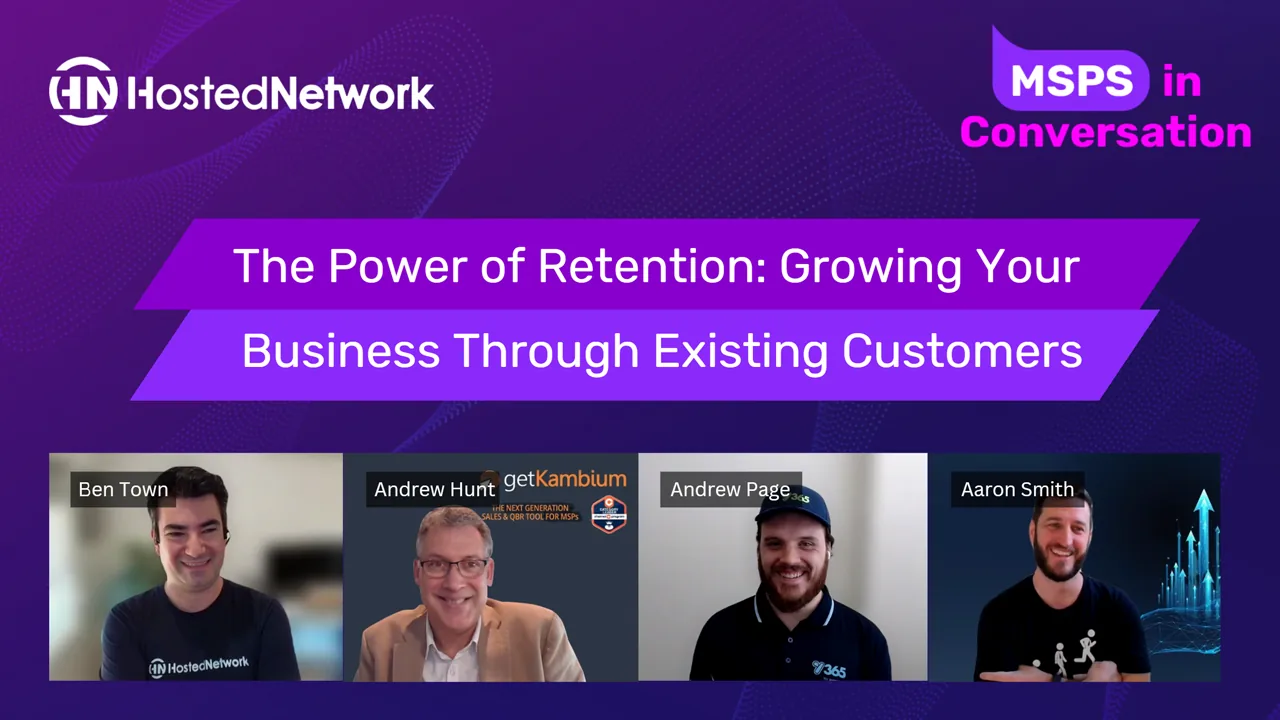
Alrighty guys, welcome to this month's MSPs in Conversation. We're going to be talking around the power of customer retention and growing your business through your existing customer base today, and the importance of it. So as always, this session is recorded, so we cut this up into a podcast. It is available on YouTube, Vimeo, and a whole bunch of things. If you have any questions, please feel free to drop them in the chat and we will answer them as we go. And a big thank you to our guests — I will get our guest panelists to introduce themselves in just a moment.
Very quickly, we're not here to talk about Hosted Network, but a free plug while I can: Hosted Network, if you don't know, we are a wholesale cloud and Telco provider for Australian MSPs. We started off as a managed service provider a long, long time ago, and for the last 12 years we have been 100% wholesale, dedicated solely to managed service providers. Our value prop to you guys is that we help you be an MSP, not a Telco, and quite frankly we like to get it done. As an organization we are entirely feedback driven — everything that we've done, our portal, all of our processes, the people that we hire, are basically feedback driven. So if you'd like to learn more, or if you'd like to talk, please feel free to reach out after the webinar or the recording. Anyway, that's enough about us.
Panelists, welcome. So we have the Triple A's today — there you go, I had to make that joke, we'll hear that a few times I'm sure. Two Andrews, Mr Hunt and Mr Page, and Mr Smith. There's a bit of a matrix, I'll make that enough, I'm sure you hear it all the time. Welcome and thank you for joining us and sharing your insights today. Could I get you guys to do a quick introduction of each of yourselves? Mr Hunt, I will start with you.
Hey, thanks Ben, it's absolutely fantastic to be here. I'm Andrew, one of the Andrews on the call obviously. I run an MSP in Auckland called Kinetics. I've been doing that for almost 30 years, and out of the back of that MSP business we realized we needed to know our customers better so that we could do exactly what this webinar is all about, which is to build our retention and make sure that we were doing the best job for our clients, to build a value prop. And so we built a tool to do that, which is called Get Kambium. And it's entirely Aaron's fault, because he heard we were doing it internally and he said, "Hey, that's fantastic, could you share that with the MSP market?" And so we did, and here we are today, and I blame Aaron.
We blame Aaron for a lot of things, so that's okay. It's fair to do so. And Mr Page, welcome.
Excellent. Good day. So I'm the other Andrew, yes. Thank you Ben, it's great to be back, I really enjoy these things. So yeah, I'm CEO of Y365, and we're a small MSP based in Melbourne that specializes in building bespoke solutions on top of the Microsoft 365 platform. So our solutions are all about our customers and how they do business, and we build really bespoke solutions. So it fits really nicely with the topic today, because you can't build a bespoke solution for a customer unless you really understand what they do and how they operate.
Awesome, thank you. And finally Mr Smith.
Hi. I thought I'd get away from all the stock-standard titles and call myself something fancy, so I Googled and came up with "Creator of Opportunities," which is effectively a creative way of saying I find opportunities for the people I work with, and away we go. I started Morphability out of an MSP. I worked for a company called Correct Solutions for the better part of almost 10 years. We got acquired on the way through that journey, and most of my focus has been on the growth of internal accounts. We did a number of acquisitions, and if you are not engaging with the accounts that you bring on and making sure that they bed down, and you start to get to know those businesses intimately and understand how they tick, how they work, ultimately you lose them. So for me this topic is near and dear to heart, it's one of the first things that I talk about when we walk into brand new clients and start engaging with them. But yeah, in a nutshell, Morphability goes in and builds sales teams inside managed services that are trying to get out of that owner-led piece, and that's where I come in and I start putting out structure, process, client engagement, and away we go.
Cool, well thank you guys, I look forward to all of your insights today. I've got my trusty reMarkable digital pen and paper in front of me, so I'm going to be taking lots of notes. And like I said guys, to the audience, feel free to drop in as many questions as you'd like, we will try and answer them as we go. But with that, let us kick off, so I will stop sharing and let's jump into it.
So my first question, and Mr Hunt, I'm going to direct this to you first of all. I know this is going to be a bit trying by the end of it, but anyway, bear with me. What, in your mind as an MSP but also someone that has built a product to drive customer retention, what does good customer retention look like in your mind?
I think it's really hard to win new clients and really easy to lose clients. And we know how expensive it is winning a new customer, so you've got to really value the ones you've got and make sure that you're doing something for them they really appreciate. And one of the things we know — and particularly we know this when we start selling, in our case our software, up to MSPs — is you sit on the internet and you have a look at various MSPs' websites, and you realize that most MSPs kind of have websites that say roughly the same thing. You know: fixed fee, look after your cyber security, come on site, do these things, give you reports, and so forth. And it's wildly commoditized. But a customer's experience is a customer's experience as they see it, and we've got to make sure they have an experience that's absolutely fantastic and that reflects that we really understand the customer. We've got to build trust with our client. They can rely on us to do the job that they need so that they use us more. So good customer retention, really to my mind, is customers that trust their MSP to understand them, to do the right thing, and to build value for both the customer and the MSP.
Brilliant. Mr Page, as an MSP that goes for a boutique approach, what is good with your customers?
Look, I think good comes down to it all being about building relationships. Ultimately everything that we do in business is about relationships, whether it be relationships with our suppliers, or relationships with our customers, or relationships internally with our own staff and our own team. So everything comes back to building that relationship, and I think that's what good looks like from our perspective, and making sure that we're fostering those relationships and really getting in deep and understanding what a customer does, how they do it, and what their pain points are. And to sort of step back into the boutique solutions dev space, what we specialize in is making solutions that fit the customer's specific needs. I think there's a whole lot of off-the-shelf products now that can manage particular processes in particular ways, but not every business owner wants to operate in the same way. And quite often business owners, or decision makers within businesses, want to operate in a specific way for some very specific reason. And the only way to really build a solution appropriate or specific to them is to get in and understand the whys and the hows and where the areas for improvement are, all of that kind of stuff. And ultimately all that comes back to that relationship. If you've got a great relationship you can leverage that to develop that understanding and really get in deep with that business.
Cool. Aaron, Mr Smith — I love that, I just want to call you Mr Smith now — from your sales perspective, what does good customer retention look like?
I think there's an understanding when you're engaging with customers, and part of one of the first things I do is understanding where to focus your attention more so than anything else. Because not all customers are good customers, and not all customers want you to engage with them in the way that you want to engage with them. And taking the time to actually make sure that you are digging initially to make sure that, A, you're the right fit for each other — that's the start of that thread pull in terms of building that initial relationship, and taking more time at the start to really understand what makes them tick, make sure you're aligned, make sure that your services and offerings — and contrary a little bit to what Mr Page is talking about, in the sense that the opportunity for Mr Page's business is to go and create, the opportunity for most MSPs is to standardize to what they've already got. And it's phenomenal differentiation, mate, I'm supportive of it. But for me it's talking to those people and actually understanding what makes them tick, find out the cadence with which they want to be engaged with, and then your job is to remain in touch enough, provide them with enough smart ideas, enough tree-shaking of things they can think about, that they then start to work with you. When they come up with their own hare-brained ideas you are the first person they think about rather than someone else.
Okay, so no one's mentioned pipeline at the moment, and that's a word I was expecting out of you, so that's good. So what we're talking about is going deeper with your customers so that you can be more aligned to them. Can you do that with all of your customers?
I think the challenge being — and you put a challenge out there to use the word pipeline, so I'm going to rise to the challenge — but it shouldn't be where you start. The challenge firstly, and I really agree with the comments, you've got to understand the client. It's easier to sell something to somebody who wants to buy it. And so if you are understanding what your customer's needs are, then you can position your solution in a way that relates to them. Now they might use the wrong word, so use it from their point of view. And if you can go in there and talk to them about their business and you can understand what they need, they're going to tell you the problems that they've got, they're going to tell you their opportunities to grow their business, the costs they're trying to control, the risks they're trying to mitigate. And each one of those is an opportunity for the MSP to go back to that customer and add value. And that might be through a 365 solution, it might be through something in Xero, might be through Forms or Power Automate or some other tools that Andrew is talking about. But you can't offer that until you understand them. And each one of those opportunities is an opportunity that goes into your pipeline that you can sell to them.
The idea is to understand the customer: this is the problem you've got, you want to solve it, here's where it sits on your priorities, is it Q1, Q2, Q3 of this year? And let's go and put those opportunities in against the customer time frame to solve the customer's needs. And the challenge is, as MSPs — and I've been around this industry for almost 30 years now — is I've noticed that most of us, and I started off this way myself, be technical. We see a thing and we go, "You know what, that's the old model, there's a newer model which has got better this, that or the other," and we want to go and help them have the best IT they can have. The problem is the customer doesn't want the best IT, they want the right IT for their needs. They actually don't like spending money on IT. The only time somebody wants to spend money on IT is if it's the latest Apple thing and they've got to have it, and that's really kind of a fashion sale. Most of our customers don't like spending money on IT, they'd rather spend it on other things that they've got to do. So our opportunity is to understand the business problem that they've got, and then to present our solutions to them in a way that makes sense to them.
And we've got to help technical folk, our sales team, that want to sell stuff in a box, stuff that they understand, to not look at it from our technical point of view but to look at it from the customer's perspective, and to ask the customer the right questions, uncover their needs, and streamline your proposal against their business priorities. That's going to generate your pipeline, and you're going to say to the customer, "Because you've got this pain, I've got this painkiller. When you want to solve it? Great, September? Fantastic. In September here's the proposal, let's do this together, let's add value." And that creates trust with your client. That's what reduces churn, and that's what helps your customer to refer you to their friends and their network, because they know that you've taken the time to understand them. And as I say, the challenge for MSPs is that tends to not be a natural thing, to have that conversation. We're not wired that way. We need help, we need coaching, and we need tools to help us have a human business conversation rather than a conversation about technology.
Sounds like you're talking about Get Kambium, Andrew.
Well, I'm actually talking about my business — well, as it happens, yes, but I'm actually also talking about my business. And it came from an epiphany. I was out talking to a client, I don't know, maybe 10, 12 years ago, had this epiphany. They said to me, "We've just lost a sales rep and they've taken all of our precedent library with us, what are you going to do about it?" And I sat there thinking, why is this my problem? You never told me that you needed that. I never realized you had stuff that you — I sound so naive now, but I'd never asked them the right question to understand their IP that they wanted to protect. And so it was my fault that they didn't have a tool to protect them from that, because I'd never asked. And at that point we had the realization that we had a duty as their trusted IT advisor to ask them the questions, to uncover what they valued and present that solution. And so that's how we started to build out our process that became Get Kambium. And we wanted to ask that consistently across all of our clients, all of our sales team asking those questions, so that we could do it to the most clients we could and add that value.
I think I'm going to pick that one up if I can.
Please.
I think there's an assumption that gets made that salespeople all know what they're doing and should just be able to sit in front of people — and that goes for business owners, because unfortunately they walk in front of relationships and go, "I'm the smartest guy in the room, you need to listen to me." But in terms of actually taking that time — yes, tactical speeds and feeds, by all means, you can sell a server till the cows come home. But as we're seeing now, servers have disappeared, the hardware sales that used to be there in the past don't exist to the same volume. So you've got to be able to have a different conversation with people, and this is where I sit there and I go, there's got to be a system by which you can follow and have a consistent conversation with a person at a personal level. And to Andrew's point, if I sit there and I build a relationship with people, I open doors — I understand that they have a couple of kids who play soccer and football and do all the things, and I take those notes in and I have that data there, I build a personal relationship with people over the course of time, the trust builds. And if I ask the right questions that shake the right trees, I don't have to build a pipeline, it'll build for me, because there'll be trust along the way. If you ask the right questions they all tie in to an offer that we have, but those questions all relate to something that we can use to help them out. And the most important thing is, if you stop selling your own services and start helping people, you will sell far more of your own services as a result of that, because your job as the position of power you're in is to connect the right people to the right people.
It's also more satisfying, Aaron. You're dead right, it's also actually just professionally more satisfying to help somebody. And I bet that's what Andrew Page finds as well, I suspect. You get quite a buzz, don't you, when you go into a customer and you see a problem that you've solved for them, and your work's making a difference, helping them be more profitable, to process a transaction faster. It's a very rewarding, self-fulfilling piece of it, isn't it, when you're actually solving a problem?
So I'm going to throw you another challenge. We talked pipeline from a sales perspective, and I think that's a really good foundational piece of it. But we've got a wide range of audience on the call, right? We've talked about sales teams already. What happens if you're an owner-led organization and you're in firefighting mode? And this is where my question earlier was, should you be going deep with all of your customers? So I'm going to go back to that question, and then for the owner-led, the smaller organizations on the call, how do we actually go in there? So Mr Page, I'm going to throw that one to you. I mean, you run a boutique organization, so maybe you've got a different perspective, but would you recommend that you go deep with all of your customers?
Look, I think like anything it's a matter of context, and it's a matter of, like Aaron said, identifying what does that customer actually want and need from your business. So when you're selling to a particular customer you've got to make sure that you're able to meet their needs and their requirements. And some customers are quite hands-off and all they want to do is tick a box and say, "Yes, I've got XYZ technology implemented, we don't really need to talk too much further than that, I don't want to spend money." And in some cases that's okay. It's often not the recommended path, but if that's what the customer wants, it's going to be a little bit difficult to change their mind sometimes. But I think where possible, yes, absolutely, you should try and understand and build a relationship.
I think to sort of pivot a little bit to the owner-led discussion, because it ties in nicely: I think building those relationships often can be a matter of personality as well. So there's obviously the tech side of things that we're selling, and we've got all this technical skill, but being able to communicate that technology with different people sometimes requires different communication styles, different communication skill sets. And so from an owner-led perspective, I know my team — one thing that I like to encourage is for specific members of staff to have specific interactions with compatible customers, let's say, and have the team build their own relationships with those customers. It's so important for scalability, and it's also really important for the customer, because I know that my communication style may not work for every single customer, and certain members of my team may not work for every single customer, but there are really nice synergies between different members of the team and different customers within that customer base. So yes, I think you should absolutely try and build relationships with every customer where you can. It's not always going to be possible. And again, to come back to Aaron's point, I think asking the right questions is just so critical, and that's going to really streamline that process, because you should be able to work out fairly quickly whether or not a customer really wants that constant proactive outreach, lots of handholding, lots of contact, or they just want you to sit in the background and wait for them to reach out to you for assistance.
We used to ask the question, how often do you actually want to hear from us? And then we built an account management program around that, and that was centered more around ensuring that there was — I mean, for me it's three different types of touch. I use Get Kambium for the annual big planning pieces that give us a road map to work towards. But then you've got strategic business reviews, which are either quarterly, half-yearly, or annually, depending on the frequency with which people want to engage. And then you've got your more tactical, which is speeds and feeds, because people still want to know that the work is getting done and that they are ticking boxes, and account management's ultimately responsible for that. And you need a good balance of all three of those consistently, and consistently looks different for different clients, and the engagement piece is there as a result. The bit that I think most people realize, answering your question more directly Ben, is if you look at most MSPs, 80% of the revenue comes from the top 20% of the clients.
I think it's quite nuanced, and it's tempting with these things to ask a yes-no question, "Should I put myself here or there?" And there's a question that's come up in the Q&A as well, which is what's the right balance. So the short answer is that most of your customers come to you through referral. We market and we sell and we cold call, but ultimately most of our business comes through referral, and referral is a measure of trust — you're not going to refer somebody unless you trust them. So you've got to have that trust. I like what Andrew said, that you want to try and have that connection with as many customers as you can. It's not that — you know, Aaron's right, the top 10% or 20% of your customers are 80% of your revenue — but what you want to have is a strong, in-depth conversation with as many clients as you possibly can, because your referrals come from across your client base.
And then in terms of your connectivity with your clients, there are some regular formal touch points like the annual budgeting process and the QBR, but actually customers' speed of wanting to engage varies depending upon what's going on in their lives, their business, and their projects. If they've got some big things going on, they're going to want to see more of you. If it's business as usual, they're going to want to see less of you. And if you're having some of those meetings, have different folk in them as well, and there are different tiered connections to have. If you go in to see a customer and you meet the CEO and you talk about tickets and the age of machines that are coming out of warranty and how well the backups went last month, you're not going to get another meeting with that CEO. They literally do what Aaron just did, fall over and fall slightly asleep — they don't want to know. But if you go into that customer and you say, "I understand that you're trying to open up a new factory, new warehouse, and we need to get in there and get these things done for you — what's the time frame, have you got the planning permission, whatever," if you're going to talk about their business, if you're going to talk about the things they care about, then they're going to happily meet with you. If they're going to say, "You know, the board's told me I've got to get cyber insurance and I'm really concerned that we've got these gaps," you can then say, "Well, we're promoting cyber security to you actually not just to protect your business — it's going to do that, but also specifically because you've got to meet a regulatory requirement or compliance requirement of that cyber insurer, and we're going to help you tick that box because that's going to help you reduce your cost of insurance or do these other things." Then you're talking the customer's language. So you don't know what the customer wants until you've unpacked it.
And as an owner, some of those conversations come naturally. The minute you try and get some of your team to do it, they struggle with it, because again they're not wired that way, they don't have that authority of ownership to be able to have that conversation naturally. So again, as MSPs, the good news is we love tools, so we can get tools to help us do that.
To cement home Andrew's point, also, your customer is actually multiple relationships. One of the biggest benefits of being in an MSP business is that you have multiple touch points. Ben, as a Hosted Network, as an example, is actually the opposite. Coming out of a Telco background myself 12 to 15 years ago, I had one contact inside that business, and that was generally the lead tech, IT manager, whoever it happened to be for that sort of a service. And so our ability as MSPs to know the head of the office, the office manager, the CEO, the CFO, because all of our people touch all of the people — we've got a way better touch. And the customer is not just the decision maker. The customer is putting the right people in at the right levels for the right relationships, who know how to have the right conversations with the right people. CEO-level conversations, to Andrew's point, are markedly different to an IT manager conversation, which is they're much more interested in the speeds and feeds, they want the tactical stuff. The CEO's already asleep in the back garden because he's already gone back, he's put himself in a hammock. But that for me is just knowing where you have to focus your attention on those customers, and away you go from there.
Alistair, your question just in the Q&A, I'll answer it a little bit more directly. When you are in a growth phase, your natural focus is on acquisition. But at some point in time you run out of capacity, and at that point the balancing act between net new business and growth and retention shifts. Because in this industry, if you go and land four or five new customers in a month, your service desk, they are going to drown, and the projects team on the way through. So there's a balancing act there between new business generation and hunting out of — you know, the best line I've heard is hunting on the game preserve, because if you go hunting on the game preserve you'll probably bag something if you've got the right attention. And Nate Austin, you can take that one, there you go, you're welcome. That's realistically the balance shift that does happen all the time. When you are overstretching one side of the business, you need to make sure you've got both done in the right balance, because you cannot drown your service desk, because you'll lose people out the back door.
To amplify Aaron's point as well, I think if you're talking to a customer, you're only meeting some of their needs because you haven't seen through what they need. You're meeting some of the need, then they're going to ring somebody else up. So to the point Ben made earlier on, years ago we were installing Novell networks, Microsoft Small Business Server — today all of that's gone. We used to replace servers for customers, everything 3 to 5 years, when the warranty ran out you'd want a new one — all of that business is gone. Today we're helping customers to implement much more complex cloud-based solutions. Our customers are more reliant on IT today than they've been at any point in history, but they have less physical IT. They have solutions like the ones that Andrew Page is talking about in 365, they're building solutions using Copilot or other AI tools, they're using RPA kind of solutions. They're more reliant on technology to work more regularly, more reliably, from wherever they happen to be, on a wider range of devices than ever before. And as the trusted IT advisor, our job is to make sure we understand what they need to make it work. And what the Get Kambium customers are telling us is that when they understand that information, when they've understood what they want, they're going to get more recommendations from clients to go and work with their colleagues. That's their experience of it. I know it's one of your clients, Aaron, in Palmerston North, or up in Brisbane at Grassroots, so we're helping them to understand what their customers need, how they're using technology, so they can win more business from their current customers.
Okay, so guys, I'm going to pivot a little bit. Let's put ourselves in the shoes of an owner-led organization. I want to go back to those, because I know that we've got a few of those on the call today. Let's talk a little bit about tactics. Aaron, you touched earlier on how often you should meet the customer. We've got this term of QBR, and I'm surprised no one's mentioned it yet, and I want one of you to destroy it, please feel free. In terms of — the industry sort of talks around, "Cool, you do QBRs," and I know a lot of MSPs just try and work towards that as like their standard. I assume you feel otherwise. Mr Page, how often do you think is a good baseline for your customers?
I think, much like Aaron sort of highlighted earlier, it really depends on that customer, you know, how often do they want to hear from us. For some customers with lots of complex infrastructure needs that are looking for a little bit more handholding, it could be weekly, even bi-weekly, where you're doing those regular catch-ups and those touch points, and then punctuated with the QBRs or an annual or a half-yearly, more strategic catch-up and review. Those touch points really vary depending on the customer. And then on the flip side of the fence, you might just have an annual meeting to discuss the next year's trajectory, and that's all they want, and then they want you to go back into your corner and we deal with just the IT guys from within the customer, moving forward to deliver those projects. So it really does depend on the specific customer's needs.
I also liked Aaron's response to the question in the chat around those growth phases, and it's important to remember that for the different business phases — sorry, it's important to remember that the customers' businesses are also going through those similar phases. So there might be a phase where they are just focusing on stability, they want to maintain their current customer base, and they want to prepare for growth, and they want to really bed down all of their systems. And so in that case they might be wanting to just look at shoring up most of their systems, and they're wanting less large projects, more just check-ins to make sure everything is going smoothly, and "let's find our weak points." And then you might go through a growth phase and realize that we need to change all of our systems, we need to make sure we're up to date with all of these things, we need to improve efficiency, all of those kinds of things. So the customers' businesses are going through those phases, and being cognizant and aware of where they are at within those phases is really important, and that may change the cadence of when you're touching base with your customers and how often.
Okay, so again, someone feel free to take a flamethrower to the term QBR. Is QBR black and white? QBR is not enough, typically?
It depends on the customer, so I want to give everyone in the audience permission to meet with the customer as often as needed, in that sense. I know there's a lot of MSPs that sort of feel like it could be annual, it could be — and I think that's a really valid point.
We renamed it. We renamed it to SBRs, Strategic Business Reviews, where you're connecting the dots between that planning, the bigger picture, the road map view, and the tactical pieces, and those three must link together. The only reason we remove the word "quarterly" is because some of those happen half-yearly, some of those might happen bi-monthly, some of those might happen — it really does depend on the body of work that needs to go on with that particular client and what their engagement desires are with you. But you still need to be having — this is a bit that I hate, and I'm going to gently publicly shame it, but there is another model, a mob who I'm not even going to talk about, but there's another model there that prescribes far more tactical operational focus where you go speeds and feeds on a quarterly basis, and that's really where you center everything. And holy — stop it. The first 45 minutes of my Strategic Business Review are: how's your business going, what's working, what's changing, what's adjusting? I'm not talking about speeds and feeds at all. Do you know where the speeds and feeds are? At the bottom of the thing, in what's called "bedtime reading," because I've had the wider conversation with you, I know where your business is at, I'm bringing and highlighting for you the bits that I need you to be aware of and telling you what's happening in the world around us, because we're generally connected to it better than you are. And I want to be having a bidirectional conversation that is about your business, our business, and how that all hangs together.
Just to amplify that point, the customers' businesses are changing and their staff are changing, and so it's really important — you should have your standard, and I would argue your standard is to do an annual business review with a customer to lay out their budget. And your budget's probably going to be over a space of 24 or 36 months, because the company says, "Roughly these are my plans," but every year that comes by they review that, and the stuff they thought they were going to do in the year 2025 will change a bit because their needs and circumstances have changed. They're being agile and responding to circumstance. So we start off as a default, my MSP, I want to have an annual review with the clients. Now, it might not happen annually, it might be that the customer defers this — they very rarely bring it earlier, they quite often defer — but let's start somewhere and say let's try and get it done in the year, let's try and get those QBRs done every quarter. Now it might stretch out, it might be you only get three of them done or two of them done, but let's have our standard and try and do it. What tends to happen is you go, "I won't make the call this week, I'll make it next week," and next week comes along, you go, "I won't make the call this week, I'll make it next week," and all of a sudden a month, two months, three months has gone by and you haven't done it. So have your standard and try and get them done, because if you're not talking to your customer, somebody else is, and if you're not talking about the stuff they care about, somebody else is, and that's not going to go terribly well for you, and you're not going to build that trust.
So you've got to have a conversation, but the clue to QBR is in the name: Quarterly Business Review. It's not Quarterly Technology Review. If you're going in and, to Aaron's point, talking about speeds and feeds and tickets and backups and updates and patching and so forth, the customer assumes you do that. When I turn on the light switch at home, the light goes on or off. Every three months the power company doesn't come around and go, "Look, aren't we good, every time you turn on and off the light switch it works." That's not a conversation that occurs, and if it did I would lose the will to live. When I'm talking to a customer at their business, they care about: how did I make them more successful, how do I solve their pain, did I understand their problems, and did I bring a solution to meet them. I've got to ask the questions they need, I've got to make recommendations that address those needs, in their language, in their terms, in their time frame, to their budget. Back in the day we used to call that qualification, sales qualification. Because essentially what we're doing — and then I'm going to focus my effort on the things that they want, that they need. If I do that, I will sell trust, I will build a stronger relationship. When the people at that customer move to new roles, they will take me with them. When they ask, "Who's good at IT, who can I rely on," they're going to refer me to them. If I've got documentation in that customer, if I have got streamlined reports and proposals based around what they've asked, when a new person comes into that business and says, "Why haven't you done these things," we can go, "Yes, actually we have recommended those to you, and you chose to do them or not do them, but we empowered you to make those choices."
And the good news is that none of this is new, we've been doing this in our MSP for almost 30 years. And what we did with Get Kambium — I'm going to keep pitching my solution, because actually I'm in sales, and I know MSPs have a problem that they really struggle to have business conversations, so we stuck our business conversations in the pack, so you don't even have to make them up. If you're not sure what to do, then you can use our library. If you want to add your own, go for gold and do that, but you can be doing sales out of the box, having business conversations, even if it's something that you as an owner, as a technical person, find uncomfortable or struggle with. We can give you a tool to make that business conversation easy. So now you know why you need that 365 solution, now you know why you need to have a more robust TCO solution that you can buy obviously from Ben, now you know why you need to go and buy a Microsoft Defender license or whatever else, because you've explained it to the customer in their words, in their reference point, so they want to buy it.
The other benefit, I think, to Andrew's point there, is that if you are having — and I will suggest this: stop reinventing the wheel, stop reinventing the wheel, stop reinventing the wheel. There's enough tools and systems out there that have already got there — stop reinventing the wheel. The final piece that I'll offer is the one benefit of asking the questions of your clients and hearing what they're actually saying to you: you have an opportunity to ask, how important is this to you? And when they go, "Well, my world is burning down because of it not being done" — amazing, that is a must-do item, we have to do that this quarter, I'm putting it on the top of the priority list. If they're like, "Whatever, we'll get there," then deprioritize that thing. But make sure that list of stuff you've uncovered is presented to them at every strategic review you have with them, because "what of this list are we doing next? You tell me which are the top three priorities and I'll put them on the focus list." This is the big list, this is the focus list, this is where we're going next.
That's dead right, Aaron, and it's really cool when the business management changes, as new people come through, or someone asks all of the questions for you, to be able to go back and say, "This is the stuff that you chose to prioritize, that's why we put our effort there." But the key thing you're doing when you do that is you're not opening the door for your competitor to come in.
I was recently talking to one of our MSP partners, and they had a long-term client who they thought they were great with, right? And they were foundational, from what I understand, but Dell knocked on their door for free and said to the board, "We'll do a technology review," and the MSP owner's face went white, basically. And so you've got these larger organizations just going around, you know, and in the end that MSP didn't even realize that that was something that they would be open to. So I often say there's two types of conversations you're having with an end customer: you're going to have a board-led conversation versus a smaller business where — and I take this back to where I was sort of trying to direct the conversation earlier — if we look at our customer list, there's only so many hours in a day, who do we prioritize to have these conversations? Because these are big conversations, we've got to start somewhere, we've got to put a stake in the ground. What are the types of customers that we should be having these initial conversations with? Because I want the people on the call today to be able to go, "Well, I know that customer, this is where I'm going to start," otherwise it's just, you know, we've just given them another year's worth of work.
I like what you said there. We had a customer up in Queensland using Get Kambium who said before they had it, they thought they knew the customer really well. They went in there and went through these questions — Aaron, you know who I'm talking about, I'm going to name and shame — they used these questions and soon they realized there was a whole bunch more of that customer that they didn't know, and they were able to reinforce and build that relationship. I do like the point Ben makes, which is, which of these clients? What's the stake in the ground? And I'm sort of curious to know where Aaron and Andrew start with that.
Yeah, Mr Page, go ahead.
Yeah, the other two have been hogging the microphone, so I'm going to throw it at you.
That's all right. Yes, so I think in terms of where to start, I suppose at a business level it all comes back down to who is your ideal customer, who is the customer that you're really targeting in your business, and which of your current customer base best fits that profile. And I think that's the starting point. And it's not necessarily always the customer with the most revenue, or the customer with the most staff, or the most licenses, or anything like that. It's the customer that — particularly if you're starting these types of conversations — which customer is going to respond best to that, and which one do you have the relationship with where it's conducive to that kind of discussion, higher-level discussion around what are their strategic objectives, what are they looking to do over the course of the next whatever period, those kinds of things. I think that's your starting point, and then work backwards from there down the customer list, based on that ideal customer profile.
I think, to support that a little bit, 100%. We used to wash people with three lenses. One was a pain-to-profit lens, because ultimately we're talking existing customers: if you are a tax, if the upwards or outwards customers are high-pain but you're making us good money, well, we'll take the pain, and we scored you on that lens. We also scored you on your propensity to work with us across our stack. And then the final piece was your actual operational maturity itself. There's a couple of different lenses to that. But to Andrew's point, if you've got 80% of your revenue coming out of your top 20%, you need to defend them first, and only a handful of those will be ready for the conversation you're having. So you've got to check the maturity on the way through. And all I would suggest out of this is, if all you do is pick the top five and you start there, just do that. Get your systems right with your top five that are going to work with you, the ones that will give you good feedback and the ones that will give you the ability to fine-tune what a good process looks like in yours and their lens, so that you can then rinse and repeat across the rest in appropriate priority.
You don't have enough time in the day, I get that. We used to joke about Fuzzy — my old boss had 48 hours in every 24, I don't get how most of your MSP owners manage to make it work, it's not a skill I possess — but you've only got so much time, and at some point in time, if you can get those revenues up, you can find support structures and staff to take over those conversations so that they do the run-rate work and you just get rolled out for the smart conversations. You can roll in for the Strategic Business Reviews and do the whole rockstar thing, and they take all your notes, they do the running around, they do the chasing up, they do the ticket creating, and you get back in your Porsche and you keep on driving. That's the idea, is it not? That at some point in time you can free yourself up as you grow that business, as you then become the leader that you want to be — unless you're on the tools and you like being on the tools, in which case go and hide in a corner cupboard, don't care, wherever that role is for you. Find the support structures, and you've got to find the revenue to enable you to achieve that.
That sounds like a good, sound starting point.
So I want to now jump back to a question that we had in the chat earlier, I think it was from Alistair, thank you, around the customer acquisition versus customer retention. We're giving a lot of advice today — there's only so many hours in the day, unless you're Fuzzy when you've got 48 hours. What sort of balance, how do you balance that, what sort of split do you make between them? Because a lot of the messaging in market for MSPs is like sales, it's all around new customers, how to close, how to close, how to close. So, and I'm not directing that to you at all Aaron, by the way —
No, I'm the opposite, mate. I actually believe that until you've taken care of your own backyard, until you've got the systems and structures in play, you can go land all the business you like, you're just going to lose it out the back, because you're not ready for the growth.
Cool. So if you don't have a sales engine, would you start with customer retention and focusing on existing customers first?
I think you need to know what you want to look like in a couple of years' time. And so if you sit there and you say, "Look, actually I want to have a whole ton of clients that I just do a little bit of work for," then that's one answer. If you say, "I want to have a smaller number of customers that I understand deeply," then that's a different one. And if you look at your client base, particularly when you're starting out and before you have a sales engine, you tend to sort of have anyone, anyone who will come to you as a client, and as you get bigger you get a bit fussier. In my MSP one of our criteria is that we want a customer that values IT. If they just see it as a cost, doesn't matter how big they are, if they just see it as a cost, then everything's going to be a price decision, we can't add much value. So if we unpack that conversation and we can't see a way that we can add value, then actually we're going to lose that client eventually to somebody else who just comes and offers a cheaper price. It's not worth our while to invest effort in that relationship. If we find a customer — doesn't matter how big they are — but a customer says, "Actually I really value IT, I understand this can make a difference to my business, I can automate that process, I can make that activity happen quicker, I can reduce the risk in processing these things over here, or I can expand my market over there, and I can use technology to do those," then that's a place where as an MSP you're going to thrive and succeed, and you don't need that many of those customers to keep yourself busy.
So I think really the answer to the question is really a point of you saying, what do I want my business to look like in 12 or 24 months' time, where am I now, and what are the changes I need to make. And so what I'd be tending to do is figure out which of my client base were ones that I just don't see taking that journey with us, which are the ones where I think I can do more for, and I would look at the ones I can do more for, because it's easier to work with a customer you've already got a relationship with. So again, ask the right questions, find out why they need to do those things that we've got on the screen behind me, and then for the gap — you've got the gap and you say, "I'm not going to get to where I want to go with those customers" — now you know how much customer acquisition that you need to do. But the same thing applies to customer acquisition: when you go and see a customer, you're one of three or five or heaven knows how many other IT providers that have knocked on the door. To make that a good use of your time, how are you going to differentiate yourself from the person who was last year, or the one that comes in after you for the next meeting? And again, the question is, a customer is going to do business just as we do — we do business with people that we trust, with people that we like, with people that understand us, with people that we understand. And so we've got to build that trust relationship by talking their business, unpacking what they want, uncovering these things, and saying, "I can show you how we can help you to do that," and map your solutions to their requirements.
I think, to that point, the acquisition piece that you need to be aware of is that everything needs to be done in balance — that is critical. The marketing journey that you start today bears fruit in about 18 months. So you need to be having an initial conversation out into the market and putting something out into the market fairly consistently. I love it and hate it, but every damn week I get an email from this man with the background, just telling me something about the market and the industry, because he's consistent, and he writes something, and he's in my inbox every single week. And so from that side of the fence, he's present, he's there, and if I want to go and look for something I know it's there. But then you need to have some sort of engine, some sort of engagement, some sort of event, some sort of whatever, and that all builds up in parallel. That takes time and effort, and that requires investment, as well as the investment in your existing backyard. You need to be talking to your customers and asking for referrals often, not just once. One MSP in Sydney was incredibly successful by literally having the eight people in the business, four of whom were directors, banging out phone calls to their entire list going, "Have you got any referrals for me this month?" And they did it monthly, to the point where every single person knew the phone call was coming and started preparing a referral so they could get them off their back. But it was also so that they grew to being a giant MSP as a result of it. But it's engagement that gets you there, it's consistent engagement that gets you there faster.
I think consistency — the word consistency is, I certainly put a lot of weight on it, and it actually comes from Fuzzy. I remember when I was sponsoring an industry event, he said, "You know what most vendors do wrong is they sponsor something and they don't show up." That consistency of actually being part of it and actually being front of mind is important. And I think that goes both for the acquisition and the customer retention.
But to summarize the response that I'm taking away — and if I get it wrong please feel free to throw something at me — but start with five, your top five initial customers, focus on that over new customer acquisition, and then once you get it right make sure you balance it. Is that kind of what you're saying, to summarize?
You'll still have to scale up your service desks and other things in parallel. So you still — it is a different conversation, but that's where the balancing act comes into it. You will find more business. We're juggling more than three balls, though. If you're the owner, I'll guarantee you have not had the time to go wide on your clients, let alone deep. You will have sold an initial service probably, and that's where you've gone, "Call the service desk and handle the rest." But all the other stuff that you've got — and Hosted Network's a perfect example of a parallel service that you could offer to those clients — you haven't had the time. And so the ability to dig into that and engage with that on a consistent basis means you get the parallel recurring revenue services, which means you can then afford to go and hire more service people.
I will segue it a little bit and just bring it back with a new business piece. There's two sayings that I've heard that I really like. One is: sales' job is not to have mercy on operations, it's to bury them. And the second one is: the sales car has one pedal, it's the skinny one on the right-hand side, and that's it. So there's always got to be go, you cannot stop, because if you stop you lose momentum and you lose everything else on the way. But all of the sales activity needs to fund the rest of the business growth, and you have to be doing it all at the same time, and you cannot do that alone.
Well, to Aaron's point, I don't think there are too many MSPs — I wouldn't get too hung up on the service desk, because it's a problem, and if you're so busy winning new clients that you can't service them, you'll lose some at the bottom, you'll know where to prioritize. But ultimately sales is a team game, yes, and you can't hold it all within your head. You've got to understand your customer, and if you want to do a really great job and win trust and win referrals, you've got to understand your customer — and not just you, but all of the people that engage with that client. It's a team effort. And the opportunity is to have a platform that allows you to unpack the customer's needs, to share that with your colleagues, and to go deep on a client. If you haven't got enough work to do that, you'll soon find that your client base shapes up for it. But all MSPs want to grow, all MSPs want to be liked by their customers, trusted by their customers, to build a new market. The way to do that is to understand them and talk to them in their language. If they use the wrong words for stuff, that's fine, use their words. Talk about their people, talk about the impact on their business, talk about how you're helping your customer to do a better job. If you do that, you'll be fine.
I'll give you one real-world example. I worked with a customer for 18 months. They were doing — call it whatever value per month of revenue — they were doing, I think, about $250,000 a month in revenue, in recurring revenue only. We got rid of 25 non-fit customers but increased the recurring revenue by $100,000 in an 18-month period. So by the time I finished working with them they were billing $350,000 a month, and lost — not lost, deliberately exited — 25 of their customers, and they were the wrong-fit customers. That's all by engagement. Now, we used Get Kambium to go and shake that tree, but engagement, and consistent engagement, and making sure that we had the right pricing, packaging, billing, all of those things all together, meant that the revenues went up while the customer load and the service load went down.
Guys, we are nearly at time today. I would like, if you could each give us some final tips for our audience today. So one or two: what do you think are the key tactics that you believe an MSP should be doing on a day-to-day basis to ensure customer retention? Mr Page, I'll start with you.
All right. Yeah, look, I think, as I said at the start, really focus on the relationships. I think building relationships is the most important thing in any business. So that's probably number one: get out there and really get to know your customers, build those relationships with the individuals that you have access to within the business. I think in terms of a second point, I suppose, consistency is a really key word. I think we've heard that a couple of times. I really like how you characterized that, Aaron: you can't take your foot off the gas, you've really got to keep building those consistent communication pipelines, consistent pathways. And again, it all comes back down to building a relationship. If you're there in the inbox you're building a relationship in one way or another, if you're catching up with them regularly on the phone, it's all about that relationship building. So I think consistency, 100% consistency, multiple touch points, build relationships, get out there and get to know your customers.
Beautiful. Mr Hunt, final takeaways you'd like to impart?
Simple, easy: build trust, consistently build trust. And as MSPs, we like tools and platforms, so grab a tool, do it repeatedly every day. Build trust, understand your customers, develop the relationship.
Mr Smith, final words on customer retention, what do you think are the two key things in your opinion?
I'd probably give you a "what do you do next" sort of thing as an answer to that question. One, go and ask your customer two questions. The first question is: what do you like about doing business with us? And the second question is: what makes it difficult to do business with us? And then shut up and listen. And the second one is: do not underestimate the value of working from your customers' sites. Grab a desk, sit amongst them, be present. Say, "I'm in the area" — I wasn't, but I will be — "I'll be in your office and I'll work there while we have our meeting, I'll hang around for the half day, I'll take a desk if that's okay." Seek permission, but do not underestimate the value of being present in their office for longer than you need to, and being present. And that goes at all levels of the team, whether they're sales, technical, owners, or otherwise. That is engagement.
That's great. And face to face is always king.
So yeah, and like Andrew, Mr Page, said earlier, having relationships at each of those different layers, whether it be your techs or whatnot, is very, very important.
Well guys, that is all the time we have today. I'd like to thank each of you and our audience. I'll just pop up the screen — we do have our next MSPs in Conversation coming up, hopefully you can all see that. So we are talking "Empowering Your Team: Developing Great Leaders for Your MSP" — how does the business owner step back a little bit and let other people shine? We've got some great panelists: we've got James Bergl, Paul from Mango IT, and Zorb from Leap Consulting. So that is happening on the 9th of October. And we actually have a dedicated website for MSPs in Conversation now, so you don't have to go to the Hosted Network — we're kind of splitting it off a little bit into its own little thing, so check that out. If you see any bugs, let us know. But as always, thank you for joining us today, to our panelists Andrew, Andrew, and Aaron, all the A's, I appreciate your time and thank you for your insights. Thanks guys, we'll see you next time.
Awesome, thank you.
Thank you.