20 October 2026
Getting Sales Out of the Owner's Head: What to Build First, and in What Order
Sales & Marketing
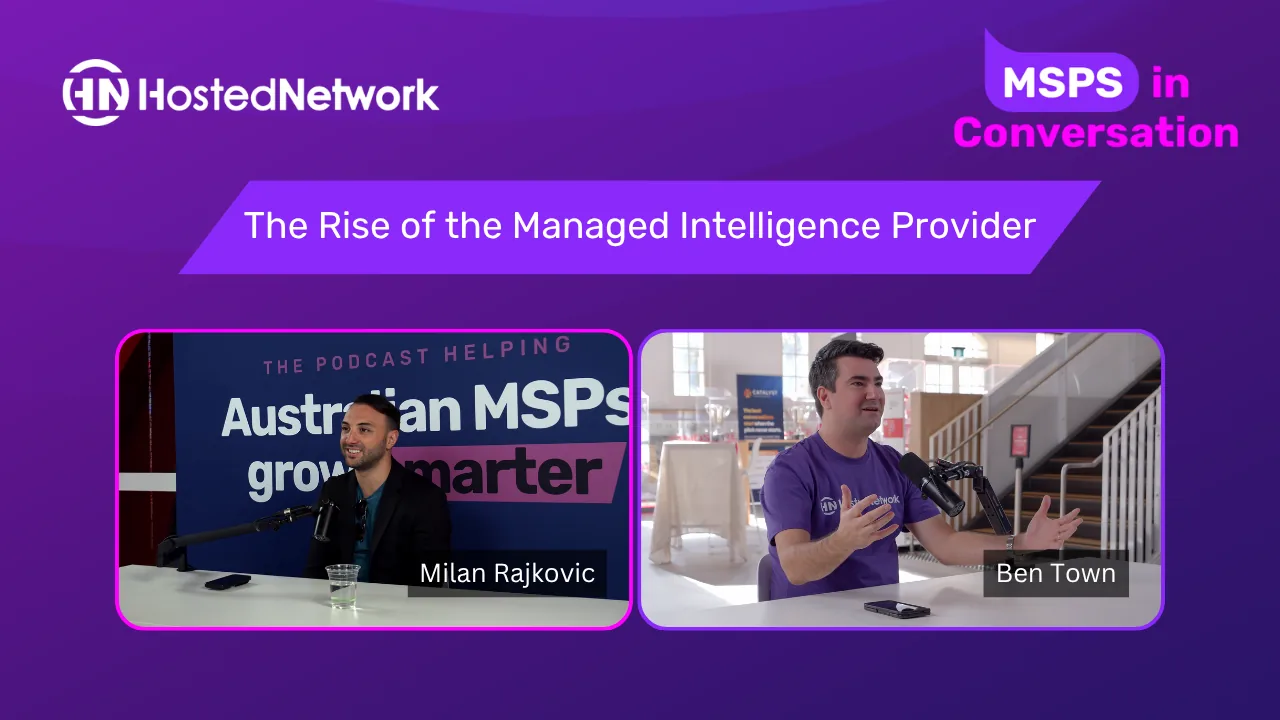
In this episode, recorded live at the Catalyst conference in Sydney, the founder of Otto IT traces his path from hacking his high school network at 14 to building a security-led managed service provider, then lays out where he thinks the industry goes from here. He makes the case for the Managed Intelligence Provider, explains why security stays the one constant no matter what the label becomes, and gets into the business acumen and judgement that AI still cannot replicate. A candid, fast-moving conversation for any MSP owner trying to work out what comes next.
The industry has moved from box pusher to break-fix to MSP to security-led, and the gap between each shift keeps shrinking. Milan's bet on what comes next is the Managed Intelligence Provider, or MIP.
No matter what the industry rebrands itself as, protecting a client's data, intellectual property and governance does not go away. Milan argues that everything an MSP does still wraps back to security.
AI can help almost anyone stand up a near enterprise-grade business quickly, but the years of judgement and practical experience behind it are far harder to copy. His food manufacturing example shows exactly where that line sits.
Early ChatGPT handing back personal details was Milan's wake-up call. As client adoption grows, custom use-case solutions and tight IT governance matter more, not less.
A $500 credit card at 17 and reselling web hosting taught Milan the value of recurring revenue long before "MSP" was even a term. The lesson still holds: predictable revenue is what makes the model work.
Edited for readability from the episode audio — may contain minor errors.
Thank you for being here. I wanted to get you to tell me a little bit about your story. You've just done this on stage. Can you give me the quick who are you? Who is Otto? Because you haven't always been known as Otto.
No, we haven't. And you and I have known each other for, oh, 15 something years. There's a lot of time. A long time. It's a long time. And you would have met me when I was running the company Milan Industries.
A backup company. Was it backup? No, it was originally a web hosting company. A web hosting. Okay. Yeah, that's how I first started.
Well, look, the origin story is a couple of things, right? So I started out of high school, hacked the high school network, because you know that's what you do when you're 14 years old and you find the admin password sort of thing and have a bit of fun. The actual way I did that is not by finding out the password, no easy feat, I'll tell you right now. But yeah, hacking the high school network, locking out people, getting suspended, it's all like the start of a good story, right? But people don't really know people that actually go through that, and I'm one of those people.
So how did we start? I started off as a contractor and I was actually contracted by my school. Really? Yeah. Our high school at the time hired me and I was writing software for my high school. Right. Yeah, that was the very first thing that we did.
Off the back of that, I started consulting for an IT contracting company and I was doing contracting work for other high schools. So I'd go after school, I'd go to another school and I'd do their IT, which is weird. It wasn't weird at the time. Now, when you reflect on it, you go, hindsight, right? That's a really weird thing. You got this year 10 guy going to another school and running the IT for the other year. Wow. Yeah. So that was how I kind of started off in IT through that.
I got my first credit card at the age of like 17. Is that a bit dangerous? It was a $500 credit card. Oh, okay. Safety first. Not going to break the bank. No, my dad helped me get it and it was the first credit card I got, and I started reselling web hosting, right? That was the first thing that I did to build out this form of recurring revenue. And talking about that kind of before MSPs were a thing.
Before MSPs, we leaned in pretty hard to being a break-fix company at the time. I ended up going to uni and I studied a bachelor of commerce. It was a triple major in accounting, marketing, and commercial law. I finished all my accounting and all my commercial law units. I didn't finish all my marketing ones. I had six months more to go before I left uni. So I never actually finished that degree.
Hey, I never even went to uni. So yeah, you're two steps up on me. Something about this whole entrepreneur thing that people don't end up finishing university. And I'm like, you know, I'm the stereotype. Just get amongst it, you know, get into it, embrace it.
And yeah, so during uni, Milan Industries at the time was a break-fix IT company that did web hosting, and we also ran a bookkeeping company. Did you really? Bookkeeping. Bookkeeping. I did not know that. Oh, well, there you go. Learn something new. Yep.
So we had, at our highest point, we had four full-time bookkeepers. They would be placed at client sites for a body of hours per week. So MSP for bookkeeping, managed bookkeeping services. Well, there's bookkeeping still today. Yeah, I know. But today, right? Like everyone needs an accountant. Everyone needs a bookkeeper. True. And we had a bookkeeping business. And we would go in, we'd do your BAS, we'd do your lodgements, we'd do your payroll. So we had a managed payroll service where we would do your payroll once a week and we would charge X amount per staff member. We had this service where we would go out, spend a day a week, you just pay per hour for that placement, and they would do all the paperwork for you, data entry, etc. And that was the way it happened back then.
At 21, I think I was like 21 or 22 on the cusp, I sold the bookkeeping business, and from that I really leaned into the whole IT concept and we started building that team up. I had three people and I was like, you know, there's this concept coming out of the US which is a managed service provider, and I kind of learned a lot about that through ConnectWise at the time. So we signed on for PSA from ConnectWise and then we learned about this concept of MSP, and we're like, what's an MSP? And then we signed our first client onto a contract and we're like, wow, this works. So that's when we really went hard on that, and we basically took off from there. Yeah. Cool.
And I guess, you know, a big question, it's probably later in my question set, but where do you think the industry is headed? You know, where are you headed?
So that's a great question, because depending on the week my theory is changing with the rate that things are going at the moment. That's not surprising. Yeah. And like I was saying before on stage, that six months ago I was going through this strange level of anxiety going, it's changing so fast. Are we going to exist? And that's something that you have this come to Jesus moment in your life, and everyone goes through multiple. I was going to say, we have a few. I think I've gone through a multitude of those, right?
But what happened was, over the Christmas break I took three weeks off and I really sat hard and reflected, and I'm like, okay, if this is the way the industry is going, it's going this fast, then realistically we're not really going to be going anywhere. We're going to be evolving. This is the same as the evolution of going from the box pusher to break-fix, which is then another leap to MSP, which then went to the leap of cyber security. We're now in that next leap. However, if you look at every block of time between those leaps, the time's shrunk. It has, it's getting shorter and shorter. 100%. Yeah. So like from going from break-fix to MSP was a few years. Yeah. Now this leap from managed security provider to, I like the term of the managed intelligence provider. That's a good one. I like that. Have you heard that one? No, I haven't heard that one. MIP. Yeah, I think we can really give thanks to the guys at Pax8, the exec team there, for coining the term the MIP.
But I really think that that's where we're going, and never have I felt stronger about it. I think that what we're going to be doing as businesses is going to evolve dramatically. And if we look at what we're doing today, we weren't doing what we're doing today eight months ago. No. And it certainly feels like it's going faster and faster. I remember when the sort of, I guess, chat kind of came out as AI, right? And it was for the first time that I couldn't comprehend how or where we were going. And then since then, you know, yes, businesses adopted it, but in weird and wonderful ways. And I think, you know, as with any change, it's a bit of an opportunity, right? At least we hope. Cool. Okay.
So you guys lead with security at Otto. Yeah. So how does that tie into where you think the industry is going? I mean, you just said that cyber security was kind of the last big leap, you know, and it's still very prevalent today. You know, AI is potentially going to make that worse. How do you do that?
So I think the biggest gap is security, and it still is security, and it's always going to be security, because at the end of the day, a business cares about their intellectual property. The business cares about what they're doing internally and how do they keep their property secure. You could start a business today and you could be almost at the same level of any other enterprise right now in a very small fraction of time, and you can do that all with AI. However, are you going to maintain, or are you going to have the insight and knowledge and the experience that the others are going to have? Yeah. The business acumen. The business acumen right now. That's where the security comes into it.
So a great example is like food manufacturing. I love food manufacturing because that's one of our verticals that we manage quite a bit. Food manufacturing is not about having the right information on paper. It's about practical application. Okay? Right? So if I was to sit down, I reckon I could build out the recipes of very large company products and I could get to everything that they've got. But how do I apply it? Yeah, they've got the years of manufacturing and processing. That's where internal security around intellectual rights and all that information is privileged, right? However, that then becomes another problem, which is how do you safeguard that information so it doesn't go to a competitor.
And all this comes back to is security, right? We're looking at financial services, contact information, personally identifiable information, that still needs to be secure. Can't have that ending up in the GPT of whichever model. That would be terrible. There was a point at the start when I think it was ChatGPT first came out, and you could go in there and go, hey, tell me about Milan Rajkovic from Melbourne. And if someone else had entered information about you in there, it would show up. It'd spew it back out. Yeah. And that was the largest security insight I ever had on where we were going. Terrifying, but at the same time, yeah.
And then you can look at other industries like law, security around maintaining your contracts that you've got, your standards, your templates, and then maintaining that information around previous case data. We need to avoid the whole concept of hallucinations. So I think that's where security comes into it as well. Like, we need to build custom solutions ingrained down to that specific use case. It all wraps up to security. Everything wraps into security. The IT governance is the most important part. Okay.
So I'm being told, you know, where do you think MSPs are going to go in general? Do you think we're going to exist? We're not going to exist in the same form, but do you think we'll exist as an industry? Yes. Yeah. Well, if you really think about it, the concept of an MSP didn't exist a few years ago. Well, not a few, but 10 years ago. So what were we known as before? IT companies, the IT guy. We as people will exist. What are we going to be called? We're going to be rebranded. We may not be an MSP. We may be. All right, well, I'm going to update the banner behind you. I better get that sorted. Yeah, probably. Well, I'm definitely an MSP right now and I'm in conversation with you, but good. Good. But is that what it's going to be called in the future? I don't know.
And who's going to know that? I think that MSP was kind of a term, I don't think anyone basically came out and said, all right, we're going to name the industry the MSP industry. Did anyone come out over time, right? Yeah. It was an evolution, right? So what's going to happen next? It's going to be another evolution. Someone's going to obviously coin a term, and it all comes down to how well does that term stick. Yeah. The most unique one that I've heard which has stuck with me a lot is MIP. MIP. And is that going to stick? If you hear it enough and the marketing is good enough, it's going to stick, right? It's going to stick, right? And that's what we're going to be rebadged. Okay.
So, final question. If you know, we've got a range of different size MSPs here at Catalyst today. Yep. You know, when I ran my MSP years and years ago, nothing like this existed. And you know, one thing I love about our industry is our willingness to share. So what is your, if you had to choose one piece of advice that you've been given over the years, what would that be that you'd be prepared to share? Something that you've been told that you'd like to pass on.
That's a great question. Don't be afraid to fail, and be curious. Be curious. I love it. Well, mate, thank you. This has been great. Thank you. Bit of fun. Anytime. And I've learned something new about you. There you go. Didn't know you ran a bookkeeping service. I did. Yeah. Well, there you go. All right. Cool. Awesome. Thanks, mate. We'll wrap it up.