20 October 2026
Getting Sales Out of the Owner's Head: What to Build First, and in What Order
Sales & Marketing
From automating repetitive tasks to delivering AI-powered services, MSPs that embrace AI can reduce costs, improve efficiency, and differentiate themselves in an increasingly competitive market. But how can Australian MSPs practically implement AI today to drive measurable business growth?
Join us as we cut through the hype and explore real-world AI strategies that increase margins, improve service delivery, and unlock new business opportunities. Our expert panel will share insights on AI-driven automation, cybersecurity, predictive analytics, and customer experience enhancements, giving you the actionable knowledge needed to stay ahead and scale smarter.
Agenda: • Unlocking New Revenue Streams with AI – Go beyond reselling AI tools by productising AI-driven services like performance optimisation, security automation, and advanced reporting. • AI for Business Growth & Customer Retention – Use AI insights to refine strategy, pricing, and service innovation, while enhancing customer engagement through personalised, data-driven experiences. • AI-Driven Efficiency & Profitability – Automate tasks, optimise resources, and increase margins without adding overhead. • The Future of AI in MSPs – Key trends and innovations shaping AI’s role in scaling MSP businesses and staying competitive.
MSPs don’t need to build their own AI models or infrastructure to succeed. The real value lies in helping customers adopt, integrate, and support AI capabilities already embedded in vendor platforms like Microsoft, Salesforce, ServiceNow, and Xero.
Most MSPs and end customers know they should be doing something with AI but lack clarity, skills, and confidence. This “AI inertia” creates a gap that MSPs can fill by guiding practical, low-risk first steps.
AI success starts with education and enablement — not just for technical teams, but for sales, marketing, finance, and operations. When people understand what’s possible, real use cases and revenue opportunities naturally follow.
AI delivers value when it solves real business problems like sales efficiency, marketing personalisation, invoice processing, or ticket triage. MSPs who frame AI around business impact — rather than tools like Copilot alone — become trusted advisors.
AI is non-deterministic and can hallucinate. Regulations are coming, and transparency, privacy, and “human-in-the-loop” processes are essential. MSPs should enable AI responsibly while avoiding taking on unnecessary liability.
Edited for readability from the episode audio — may contain minor errors.
Hi guys, thank you for joining us today for this month's MSPs in Conversation. Today we are talking about AI. It's a big topic. We're talking around how to unlock growth and drive revenue within your business using AI, so I'm very excited. We've had a great registration for this, as always. This is recorded, so if you do need to drop off, we understand. Feel free to share it around afterwards. We cut this up into a podcast. It's on Vimeo, YouTube, Spotify, all the usual places afterwards. Any resources that we talk about during the webinar we'll aim to send out afterwards as well.
We always like to keep these webinars nice and interactive, so if you want, feel free to jump into the chat. If you want to ask our panelists any questions, please feel free to do so.
Very quickly, as always, an introduction to Hosted Network if you don't know about us already. Hosted Network is a wholesale cloud and telco provider for Australian managed service providers. We serve over 50 MSPs. We were an MSP, so we understand the pain, but today we are 100% wholesale. We do not have any retail customers at all. Because we are only dealing with MSPs, we talk the same language, and we like to think that we get stuff done fundamentally. So where you've got other telcos that you're fighting against issues to get things done, we like to make things happen. Anyway, that is enough about us, but if you're not already a partner, or you'd like to have a conversation, please feel free to reach out after the webinar.
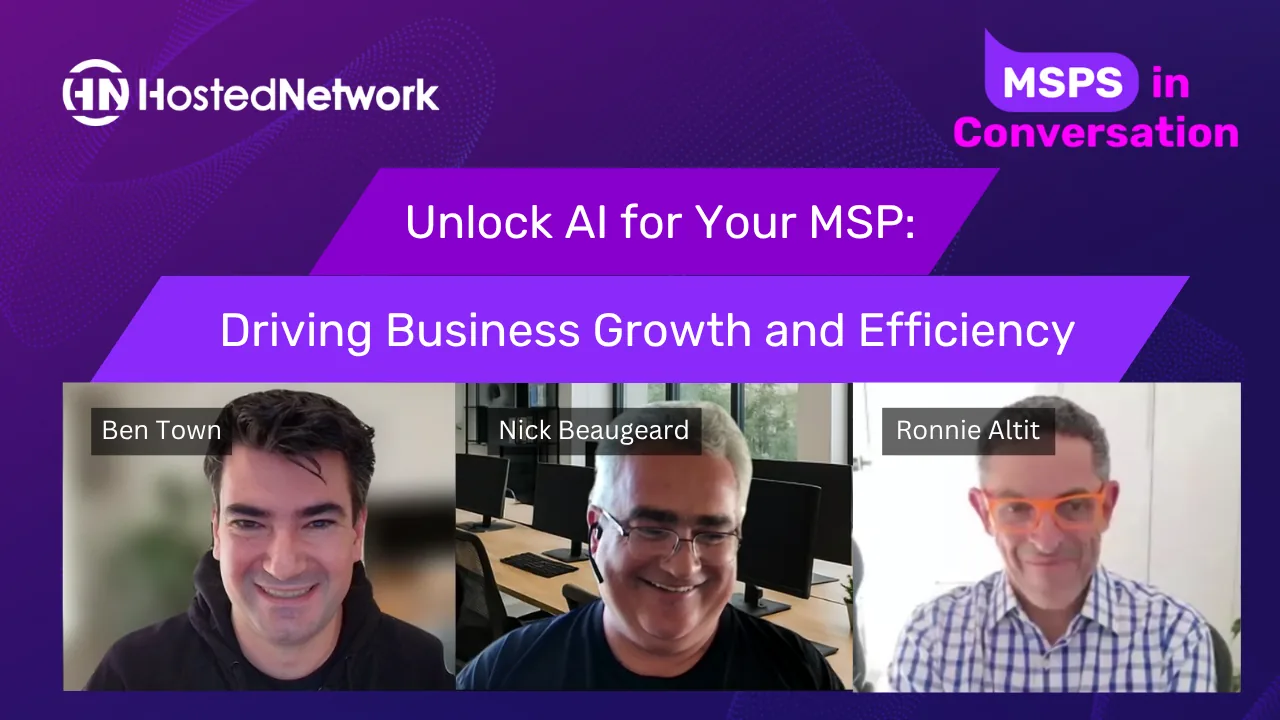
But we're not here to hear about Hosted Network, we're here to hear from our amazing panelists, both of whom I have known for more years than I can count, it feels, back from when I even first started Hosted Network. I've known Ronnie and Nick. So guys, thank you for joining us today. I'm very, very excited about today's conversation. Ronnie, would you mind introducing yourself, and then we'll jump to Nick?
Yeah, hi everyone, thanks very much for taking your time out today to come and listen to Nick and my dulcet tones. The intention is that you can walk out of here with at least one piece of valuable information that we might share with you. So the race is on, Nick, to see who can share the most valuable information, my friend. Just a little bit about Insentra: I'm the CEO at Insentra and co-founder. Much in the same way as Hosted Network, in fact, we are a wholesale business, if you like. We are a 100% channel-focused organization. We do not, will not, have not ever transacted direct with an end user organization. In short, the whole essence of our business is to help partners say yes more often. So that's where we can either become or augment the capability of the partners that we work with. We just had our 15th birthday yesterday, so we've been around 15 years. We're a global organization with about 120 people around the world, in the US, the UK, Manila, and here in Oz. Again, if we're not partnered with you and you don't know us, we'd love to have a conversation. Feel free to reach out to me on LinkedIn and I can take you through what we do and how we help partners grow and build mutually successful businesses with one another. And Ben, thanks very much for having us.
No worries, thanks for being here. Nick, welcome back.
Thanks, thanks Ben, game on Ronnie. So Ronnie and I have known each other for — I was just working out in my head — over 20 years, which is really rather too long to know each other, but anyway. You can see from the gray hair, my name's Nick Beaugeard. I've been in the tech industry for over 30 years, and I keep having to up that each year as it goes along. What I do at the moment is a mixture of things. One, I help a bunch of startups build and get products to market, so I'm CEO and co-founder of a product called Wolf Workflows. In my world at Released, I help MSPs and organizations not only build and deliver product, but get involved in the latest and greatest technology. People who know me well will know I've always been kind of at the leading edge of tech, letting people like Ronnie come up behind and actually make money out of it, so it's an interesting spot to be.
I've been speaking worldwide now on AI since before OpenAI released ChatGPT. A little statistic on that: ChatGPT was the fastest ever growing technology when it launched, and they were adding a million users a week. Sam Altman went out yesterday — they're currently adding a million users an hour, to give you an idea of how fast that's growing. So it's a super exciting space. Everybody wants to do something, nobody quite knows what to do and how to implement it, and you're hearing, I'm sure, a million mixed messages out there. So I think our job is to try and clear through some of that rubbish and try and give you a clear path as to what to do or what not to do as an MSP or an organization out there trying to help the customer do things. And on the side, I'm a councillor at the Northern Beaches Council as well, so I do lots of stuff.
Do you sleep, Nick, at all?
Oh yeah, yeah, Wednesday nights.
You find time, no? Good, good. Well, thank you for being here. I'm going to drop off my slide deck now and we will jump into it, so that way the audience gets our pretty faces to fill their screens.
Gentlemen, Nick, I'm going to throw this one to you. Our audience is predominantly MSPs. What do you see within the MSP space as the current opportunity for AI? Big question. And then Ronnie, feel free to jump right in as well.
I've been sitting on stage quite recently being really controversial about this, especially in MSP land. I think there's a lot of conversation out there about organizations building their own large language models, building their own big infrastructure in places like NEXTDC, and I'm sure with you, Hosted Network, lots of conversations about that end of the world. But I don't think that's where the money maker is for MSPs. I think the money maker for MSPs is vendors building and integrating AI into their own products, and whether that's something like Copilot, or something like Azure OpenAI integrated with Power Apps, or whether it's our stuff with Wolf Workflows, or whether it's someone like Xero or Salesforce or SAP or ServiceNow integrating AI into their products — I think that's the market.
Lots of people have said they made lots of money consulting on building new machine learning models and all sorts of stuff, and that's nice, but that's really big end of town enterprise stuff. I think when you're talking SME — so small and medium enterprise — I think it's how do we best adapt AI that's been built for us by vendors, not necessarily let's go build something new. So don't be wowed, or even confused, or even concerned by the amount of technical effort it takes to do some of the things in AI — you know, talking about downloading models and running them locally and doing Hugging Face and all sorts of funky things like that. I don't think that's the market. I think the market is, as it's always been, finding great products to solve the needs of your customer, implementing them well, and then supporting them well.
It's interesting you say that. I think it actually starts a little bit before that, insofar as I'm kind of coining this term "AI inertia," and it's really what I'm seeing that's happening in the MSP reseller world as well as in the client world. So if you kind of look at the... is that feedback coming back? Because I'm getting a bit of feedback, I can hear echo coming from you, Ronnie.
Yeah, not sure why. There we go, that's a bit better, might have been coming out of Ben's speakers.
So what we've sort of seen — I mean, Pax8 did the study last year — 80% of MSPs are being asked by their customers about AI, or 100% of MSPs are being asked by their customers about AI, and 80% of them are like, "Man, we don't really have the skills or capability." We started — I started with Copilot back in, I think it was September '23, right in the early Copilot jumpstart partner with Microsoft. I'm probably a great use case for what happened at the time, which is, as I looked at it, "Yeah, this is interesting but not overly exciting. It's great for Teams meeting summaries," but I really couldn't see the value in it. Indeed, that's what Microsoft has experienced, and they're really pushing hard on ROI and use cases and trying to do all of that sort of stuff.
But I think the problem starts, as I say, way earlier than that, and that is that a lot of MSPs kind of know you have to be doing something in AI, because if you're not doing something in AI, your competitors are and you'll rapidly get left behind. But it's really about, well, how do I skill people up, where do I skill people up, what do I do with them? And the next point around using third-party things that already exist, whether it's ServiceNow or Salesforce or all of their agents that they're building — they're great, and there's certainly some money that will no doubt be made in and around that, probably predominantly for Salesforce and ServiceNow more than the channel.
And then if I look at the customer side, same again, ignoring the big end of town which are being vomited on by all of the vendors — they get all sorts of love and they've got deep enough pockets to create R&D funds and teams, etc. in that space. From even five seats to say two and a half, 3,000 seats, there's a broad spectrum of what's going on in the customers and what we're seeing is that a lot of customers know they need to do something in AI but they don't really know what AI can do for them to then know what it is that they should do with AI. In the meantime, they've got partners coming and saying, "Let's find some use cases for you with AI," and really what their partners are finding most of the time are RPA use cases. They're not generative AI. They're not able to sit down with a customer and sort of say, "Hey, did you know that you could do this with marketing, and you can create avatars, and you can create voice chatbots really quickly, and did you know how you can actually prompt properly?"
If I just took a quick survey — if you're near your keyboard and you can get into even just the webinar chat — if you were to rate yourselves as MSPs, and this is kind of a little bit Chatham House rules, and when the video comes out I don't think anybody sees these responses, so it'd be great if you could just be a little bit honest. Insofar as, on a maturity curve, if you like, of a scale of one to five, where five is "Yeah, we're going, we're helpful, we've got a lot of things going on, we've got plenty of active projects," through to one, "We're kind of still navel-gazing a little bit and working out kind of where do we play, and we just don't know what to do and where to play," where would you guys put yourselves? The reason why I ask that question is so that for the balance of this session, Nick and I can sort of target it accordingly and not feel like we're going to waste any of your time in what we're sharing, and it makes it easier for Nick and I to riff off each other and provide some value.
We've got two, three and a half. Looks like we're getting a few coming through. Yeah, one, three and a half.
I do love when you give an integer scale maturity model, most people are putting 0.5 somewhere. I think that just sums up the audience really, doesn't it? It's a psychological thing, right? Clearly I'm not a coder. Josh, not you, I didn't kind of work that line of code out.
Well, all right, so I'm going to sort of work on the basis that it's early stage maturity for the most part. We're going to work on the basis of early stage maturity. So that, I think, is where the gap needs to be plugged. What we've seen out there is AI has done a fantastic job of making AI a household term, right? Between Microsoft and OpenAI, and then recently DeepSeek, everybody's talking about AI now. Everyone's talking about agents, and how many people recognize that there's like three different levels of agents? Which agents are going to be relevant, and who's going to write the agent, who's going to build the agent in Copilot Studio? Do I build it using Make or Zapier? All of these sorts of things. And that's before we even worry about data governance, people's concerns around information that's going out, hallucinations and how to manage them, all of those sorts of things.
So we're seeing really interesting things in market: the channel that's kind of wanting to play but not really ready, end users who want to play but don't know where or how, and then on top of that, that stops them from even going. Some of the smaller ones: "I'm not going to do the data governance because right now we've blocked all of it." So that's kind of what we're seeing out there in the market at the moment from both sides, hence why I call it inertia. It's kind of like the want to go but not quite.
I might add on that if I can. The first time I ever talked about chatbots, I was sitting in front of a fantastically awesome event called the Accountant Big Day Out — you can imagine how exciting that was — and I was the after-dinner speaker. For my after-dinner speech, I sat down with some early Microsoft natural language technology. I sat down with LUIS and QnA Maker, which are two early Azure tools around AI. What LUIS was able to do was listen to questions people asked and determine, basically break it down and send it down different paths, and what QnA Maker was able to do is take a bunch of frequently asked questions and very quickly build a chatbot — really quite simple AI things. We took them live on stage. We built this chatbot from nothing. We took the FAQ from H&R Block and put it into the chatbot and we built it, and everyone's looking and eating their dinner, and one of the accountants, I said, "Right, go for it, I'll get a question," and one of the accountants asked a question that they thought would be really difficult, and the bot instantly got the correct answer back to them. I've never heard a room go so silent in my entire life. The fear in the room, because this is the first time they've seen any of this, the fear was palpable.
I wonder if, you know, MSPs are primarily set up by people who've got a bit of a technical bent, who end up running a company almost by accident, because actually what they're good at is helping people solve technical problems. I think there's a fear in a lot of industries, especially if you're doing break-fix or you're doing help desk, that these tools are going to come along, if they're done right, and they're going to take your job away, and they're going to make it more streamlined. I know people in accounting are scared about it, lawyers are scared about it, software developers are scared about it, people doing data analysis are scared about it, lots of people are frightened. I wonder if that's one of the things, apart from the fact the federal election's coming, so no one's buying anything till May the third, I wonder if that's one of the things that's kind of holding people back — not the people with the 4.5s, the people with the ones or twos. Is that one of the things that's impacting those decisions?
I think you're right. Yeah, I think you're absolutely right. And I think part of the challenge as well is that, as MSPs, generally the go-to people are the technologists in organizations, certainly in smaller businesses where there's no technology professionals within the company that's being serviced. Then there are business-level relationships, but I think part of the challenge is that the IT people in organizations, when you get to those larger ones, they have a bit of a sting about them. They kind of know little bits and pieces, but they're not the ones who are going to actually help to transform. They're going to try and guide the business. But part of that fear is, and part of the challenge is, how do you get the workforce in an organization to be enabled and educated such that they can then go from that point to identifying their own use cases to then have it come and the value that it can bring?
So I think you're right, you've got to get over that sort of fear hurdle first, then you've got to go over the enablement hurdle to let people know what's in the art of the possible, to get their creative juices going, and then I think as well enabling people to do their own stuff. There's a lot of stuff that people can do if they know how to do it. So even take prompting as a basic example. Most people prompt a GPT like they prompt Google. Well, if we're environmentally friendly, you're better off using Google, because that's like eight times less the processing power that it takes in GPT to do a query. On that basis alone, we probably should just use Google. But people not even knowing how to prompt, and people not knowing how to multi-prompt, and how to go deeper with a prompt, and how to get it to ask you questions, and all sorts of things.
And to your point about job replacement, I read something that Bill Gates said recently — and it is but one person's thoughts, but clearly he's had some good ones over the years — and Bill Gates basically said there are only three types of jobs that are going to be protected in the world of AI. One is coders, because you're still going to need coders to do stuff and you don't need that human interaction. The next one is biologists, and the third one was energy people, because you don't want AI running the energy grid. And so you start to get some of this fearmongering talk, and whilst there might be some validity in it, I think the thing that's missing as well is that we don't know today what jobs are going to be created in the future. We've been here before many times. Like the Industrial Revolution — a lot of people lost their jobs, a lot of new jobs were created. Same when the internet came through: people like, "Oh my God, bricks and water shops are going to be gone," but they're still around, there's just a different flavor of how they go to market. Then we had the cloud: "No one's moving to the cloud," and then all of a sudden the cloud's here, and "How are we going to make money?" All the people who host infrastructure, data centers — data center guys are getting sold for billions of dollars. So I think we just don't know what's going to come in the future.
And I think having those kinds of dialogues with people where the fear, uncertainty and doubt is one thing, but here and now, how do you capitalize, what can you do right now, how can you make yourself more efficient so that you don't lose your job and you can go and add more value to other stuff?
So let me be controversial as well, Ronnie, because I think what a lot of people are saying — and certainly vendor land is telling us this — is everything's wonderful, there's a billion business cases out there, and AI is going to really save your organization money. I bumped into, a couple of times, a fantastic guy by the name of Dr. Tom Gal, and Tom's the head of technology at City of Sydney Council. I was on a panel with him a year ago and they'd stopped their Copilot rollout. The reason they stopped their Copilot rollout is, when they rolled it out, they realized, A, it was making their staff more efficient, but B, that wasn't showing an overall efficiency gain for the business — people were just taking more time off. So still getting their job done, still doing everything they needed to, but it was taking them less effort.
So there's a concept there, and this rings true for me, of a whole bunch of execs I speak to who sit up in the C-suite with the better carpet than anyone else, who think AI is ChatGPT, because that's really all they know. They think rolling out chatbots is the solution to all their ills, HR and below, and when you actually roll it out, you're not going to get any benefit. So when we talk about the Gartner hype cycle, I think AI — and lots of people think this now — is crashing headlong towards the trough of disillusionment before we end up at the plateau of productivity. I love these Gartner words, but anyway.
So I think, well, there's lots of — with anything, when cloud first started, Ronnie, I set up a business and capitalized on that in the early days, and then grown-ups like you came along and actually made real money out of it. I think with AI there's a lot of that early-stage, risky money to be made, but I think as it comes out of that, it's going to be far more structured than it was before. Notwithstanding that, if I was an MSP today, I'd be in learning mode rather than necessarily delivery mode — seeing how it can improve my organization and the cost of me delivering my services to my clients, so that when it actually comes to the point where it's relevant for my customer base... Because the way I see an MSP is you're a fulfillment engine. It's up to vendors to create demand in the customer base and you guys go fulfill it. I don't necessarily see all MSPs as great sales vehicles; they're more on the fulfilling-an-existing-need point of view. When that need comes up, if you're in a position to solve it, then I think that's a good place to be.
I kind of agree with you. I certainly agree with you as it relates to the trough of disillusionment, and I think Microsoft Copilot has been a big reason for that, by the way, because again, when people rolled out Copilot, they did what they did with me and they gave it to execs, and the execs weren't enabled, and the execs didn't know what it could do for them, and they kind of looked at it: "Yeah, Teams meeting summaries is cool and everything else is whatever." So I think that's part of the challenge, that's why now Microsoft is Copilot for everyone — it's kind of a little bit over-winery, right, what Microsoft's trying to do to get a bit of activity and get people using it. There's a whole lot of activity around ROI and how do you do proofs of value, etc.
And where I agree with you, Nick, is that the MSPs need to get in, absolutely, but I think in parallel those MSPs can be enabling their clients. I just stuck a little QR code up there, if it's relevant to anybody they can have a look and see what we're doing to help MSPs get enabled through this sort of complimentary Sprint that we do. Just to show, our view is that we need to get the MSPs to know what's in the art of the possible and get them starting to be productive and proactive with it, so that they can confidently talk to the customers about what to do. And it's not the first time that an MSP will be talking to a customer about how they can solve a problem without having the capability to solve it themselves. That's, you know — and ultimately I think it's the MSP's role to stay relevant, because in all the MSPs I'm talking to at the moment, when I say "How do you get new business?", there's very little net new MSP business. It's grow within the customer you've got, or go and take a customer off someone else because you can do it cheaper, better, faster, and the customers... the other MSP has done such a great job that the customer thinks they're not adding any value, but they are, because they've done it. So I'm seeing a lot of drive-bys going on in the MSP world where they're taking customers.
I think that's why right now, even as we get into the trough of disillusionment, being the early stage and being able to help customers to get to that point, you will then be the one that they're going to consider and come to when they understand more and want to then go and do more. So I think there's a couple of different sides to that. As I say, midway, I don't think that the customers aren't doing stuff — they all are. We're working with customers through our partners daily, with different use cases that are coming up, and agent requirements, and all sorts of different funky stuff that people are coming up with that they couldn't do before. But I'm hell bent on the partners need to get themselves to a point where they can confidently get customers to a point, and that's a big gap that we saw six months ago and started the Sprint series to help the partners do that.
So let's unpack that a little bit, Ronnie — it's interesting that you say that. Sorry, you carry on, sorry Nick.
So I actually hosted an executive lunch yesterday, and of course it always ends in AI, it's the hot topic, that's why we're here. One of the pieces of feedback that a lot of the execs at the table were saying was that they're not even using the basics themselves. So it's interesting to see, and it was about a 50-50 split, so I think the survey that you did earlier was quite valid. But thinking about the guys that are maybe on that earlier stage, you've got to start somewhere. So, Nick, you mentioned that you're in learning mode — what do you think that should look like for an MSP? And then Ronnie, maybe you can throw some sort of bits in around what you think an MSP should be doing in-house.
Good guidance there, Ben. I might just turn the conversation just a little to a side, because Ronnie hit on a really important nugget and I think it's something lots of people miss. The cloud, because the cloud creates environments where there's very little downtime for customers anymore, there's far less of an impetus for organizations to move from an MSP and go hunting for a new one. Ronnie absolutely nailed that, and so it's a lot harder for MSPs to find new customers, because existing customers end up being a lot more satisfied than they were 10 years ago with their MSP. Because 10 years ago you had a mob coming in and taking your servers offline for a week and all the dissatisfaction from that, and now stuff just sits in the cloud, and apart from the odd outage now and then, which is really rare, the whole thing just runs. So you don't have to be a very good MSP to have very satisfied customers.
So, parking that there: what can you do to get new customers? Well, you have to have a differentiator, and there's kind of a couple of ways you can differentiate. You can either differentiate by finding a niche vertical — go after accountants or lawyers or doctors or dentists or education, or whatever that is, and have key knowledge in that space that's helpful — or you can have a horizontal technology that you excel at that everybody wants. Those mega trends don't happen very often. I think they happen about once a decade. We had the movement to distributed computing that Ronnie and I would remember — so that was mainframe or mid-range to distributed computing, that was great — the movement from distributed computing to the cloud, that's also been pretty great, and now potentially the next one's AI, which is a different thing, because it's directly driving business benefits.
So where should you educate yourself? You should understand the business case for AI, where AI can actually go in and impact your customer's business, because every business shares a number of the same things. You've got accounts payable, accounts receivable, you do a budget every year, you have to pay tax, you have employees, you have HR, you invoice your customers, you do marketing — you know, we all do exactly those things. So I think a great way to learn is take your organization as an example and go, "Right, Ronnie's out there, Nick's out there, there's all these people talking about hyper-personalization in marketing, how can I do that for my business?" Or there's all these people saying, "I can have an AI bot at the front end of my help desk, well, how do I do that?" Or there's all these people saying AI will help me understand contracts and improve them, how do I do that? And people saying AI will read my incoming invoices and automatically put them into my accounting system — that's cool, how will I do that? Understanding those for your business means when you're sitting with another director or business owner or CFO, you've got direct relevance of the business problem you're solving, rather than "I can put in another shiny widget." I think there's the magic, there's the differentiator. And I think MSPs that do that won't just be closer to your customers, you'll be absolutely embedded with them, working lockstep into improving their business. It's not really anything new, it's just a new tech around it.
Yeah, I would agree. To answer the direct question from Ben, insofar as what can an MSP be doing now: the first thing I'll be saying is get yourselves educated, and don't make it Copilot. Copilot's great, and that's what most MSPs are talking about is Copilot, because that's kind of something in your kit bag and it's easy to talk about. But a lot of MSPs I talk to aren't getting much in the way of traction and they're not monetizing. Like, "How do we make money out of this bloody Copilot thing?" They're really struggling with that. And I agree with Nick that doing it for yourself is important, but some of the use cases that you spoke to, I think they're going to rapidly get taken up by the software services, as you said. Like Xero will have an AI invoice import engine, so will Dynamics, etc. A lot of those things are going to come through. It's being able to identify those use cases that — whilst there's a generic approach, there's always nuances, there are things that are different in every organization. So sometimes, just because you've got a hammer, everything's a nail.
So what we're about doing at the moment is enabling the partner, for the partners to know what's in the art of the possible, like I said. And not just how do you use Copilot, but how do you prompt, how do you do deep-level prompting, how can you create your own GPTs, how can you create agents, how can you leverage it to go and generate leads, how can you leverage it to automatically send emails, how can you automate workflows with AI in the background actually providing some intelligence, and how do you do multi-level agents? All those sorts of things.
I can tell you from an enablement perspective, I have a task that ChatGPT Tasks does for me every day, and it summarizes the news overnight, and by the time I go through the summary of what's changed in AI overnight, it's about half an hour to 45 minutes a day, and it's getting to a point where it's — and that's just the summary — it's getting to a point where it's kind of overwhelming. So the other piece of advice I would have is pick something that you want to go in and do, because you can get lost in a multitude of different areas. You know, one of the things we show people — we had a presentation from a vendor recently that we recorded in Teams, and then three minutes later we had a podcast done around that particular vendor value proposition, that was just immediately generated by NotebookLM. And even the ability now to do that with NotebookLM, and then sit in NotebookLM and interrupt the podcast and ask a question, and have the podcast talkers answer your question live in real time — you start showing people things like that, their creative juices start to flow.
So I think it's picking where you want to go. Do you want to take people down initial learning? Do you want to take people down the RPA? Do you want to be creating agents? If you do, who's got the capability to create the agents? Who's got the skills? Which platform do I create agents on? There's so many platforms, and if you haven't seen the website — I think it's "There's an AI For That" — there's so many different AIs that are out there right now. And again, I've looked at a bunch of them, and a bunch of them don't do crap. They're very specific use cases and they're just people trying to get stuff out there. But I would start from enablement and understand what you don't understand, understand what's possible, then work out a strategy of how you're going to take that to your customers, because your customers are behind where you are today as technologists. Getting them to a point where they understand, they're going to drive the use cases.
Generally, no fantastic ideas come out of IT as to how people can build their businesses. Most of the ideas come from the business. The knowledge workers know what they do every day, they know how they do it. Yes, it's generic ones that Nick speaks to, but it's about those edge use cases — that's where the secret sauce is, and quite honestly, I think that's where the money is. Because when you're solving a big problem that a client wants to solve, which you don't necessarily know, once you know it for that client and you've built it, now you can take it to all of your clients that are doing the same thing, and you've already built it, now you're starting to make some money.
It's interesting that you say that, Ronnie. We've talked quite often in this webinar series around the importance of understanding your client. It's not just about providing support. The MSP leaders these days are not IT guys anymore — Nick made a comment that a lot of our MSPs started as a tech because they wanted to help, but these days it's a business function, you're having a business conversation. Like what we've touched on in previous episodes, going deeper within your client actually opens up the world of potential. You can build out that roadmap of opportunities for your own sales pipeline, but at the same time you can have a greater impact for that client's business as well.
Nick, from your side — we've only got about 20 minutes, so I'm conscious of time — one of the questions that I had for you, because I've heard you speak about this before, is around the regulatory changes. What do we have to worry about that's coming up, and what should we be concerned about at the moment when we're recommending or even using AI solutions within our own businesses?
So governments around the world are working on regulatory frameworks, and they're all pretty consistent. I'm going to shy away from saying anything happening in the US is consistent with anything at the moment, so I might ignore that. But if I focus on what's happening in our government, New Zealand and Europe, there's several places of focus that you're going to see regulation around. One is going to be privacy: how do you use data with AI, where is it living, where is it being processed, is it training models, etc.? You're going to see regulation appear around transparency. You're going to be required, I think fairly soon, to tell anybody when you've used AI to do something. So for me, every time I send a document out that I've had AI anywhere near, I'll have something at the bottom saying "This is produced with the assistance of," and sometimes expand on that. That transparency is really critical to maintain trust. If you look at the profession, so accounting or legal, the person — there's an individual human responsible for the output, whether or not it came out of an AI, it's irrelevant. So being transparent about which bits come from AI and which bits don't actually will engender trust.
The next thing's coming around a human must review everything that comes out of an AI. We're going to see lots of that. There was a case just last week that the Law Society of New South Wales got upset about, when somebody once again went in front of a court with a bunch of precedents that were made up, hallucinated by an AI, and the legal team had spent no time looking at it, and the defense and the judge had to go and actually unpick what they'd said to not find the cases which had been made up by AI. It cost a bunch of court costs and cost people lots of money, that one. So that's important to watch.
The other thing to watch — so you've got the human in the loop, you've got transparency that you're using it, you've got the bias that's coming that you've got to manage as well. We're going to see a lot more, I think, localized specific AI models which are less of a black box and we more understand. So while there's going to be lots of space for ChatGPT and all those big models, there's going to be little models that you'll be able to dig into and use in a similar way, which are more specific around certain areas, have less bias, etc., and I think we're starting to see that kind of happen. So regulation — obviously there's an ISO standard right now. I think last week you were able to be properly certified for it. I know KPMG said they were in December, but BSI, who did that, said, "Well, we probably shouldn't," but now there's a couple of companies on the planet who will be able to certify you for the ISO standards around AI. But we'll see lots of regulation coming out of our government towards the end of this year.
Yeah, I think you're absolutely right, Nick. There's a few really interesting things. I mean, there's now an ISO standard for that — so not just "there's an AI for that," there's an ISO standard for that: 42001:2023, I think it is.
That's the one I meant, Ronnie.
So you can actually now get certified for that, you couldn't for a little while. But here's the interesting thing: under GDPR, people have the right to get their data rectified. I don't know if you guys had heard about the situation with — I can't pronounce his name, Holmen or something — he went into GPT and said "Who is this person?" and it came back with the most nightmarish hallucination about him that basically said that he killed his children in a pond near their home, and it certainly was nothing at all like that. But here's the problem: whilst the GDPR legislation, for example, says that personal information has to be accurate, people have a right to change it, OpenAI are like, "Sorry, we're just going to put a blanket statement in saying everything we say may not be true." So you kind of look at it from that standpoint where they're trying to get themselves around that, insofar as, "What we just said, it's okay." And then you've got this — Max Schrems is a big data protection lawyer — and his statement was, you know, you can't spread false information and just end it with a little disclaimer saying that may not be true. Imagine if you said to a customer, "Yes, it's going to work when we put it there," but it doesn't, and they have no recourse. So I think that's a big issue.
And I think somebody's put in here as well, "The biggest concern is ensuring that everything you want to remain private does remain private." I can tell you that is arguably — anytime we run our Sprint series with end users on the line, where our partners market it out to their user base and we run the Sprint One series, and we've now delivered it to like over 2,300 people around the world, every time we're getting the question about "Is my data secure, is it going to be okay, am I sharing data with models, etc.?" And the good news is yes, that can be taken care of, and there are multiple different tiers of ways that that can be taken care of. Microsoft's got a big thing around that obviously in themselves, but so too do the other ones, and then of course there's the local hosting of AI, there's all sorts of different things people can do.
Initially, by the way, when this whole thing came out, we thought as a business our data governance practice was going to go through the roof. We thought we were going to do loads of data governance strategies for people, we were going to do loads of sensitivity labeling, and Purview was going to go nuts, and DLP and all of that sort of stuff was going to go crazy. The reality is it didn't, because people in this inertia state are like, "Not so sure I need to do that now," and "Oh, that looks like it's a whole stack of work, so I really don't know how I'm going to do that, so maybe all of this stuff goes around." Whereas the reality is the problem's not as big as the FUD would have people believe, and it's something that we spend a lot of time talking to partners and clients about: you've still got to be wary, you've still got to be mindful, you've still got to be careful — that's the nature of protecting anything — but there are certainly guardrails and things that can be done that will satisfy most.
It's interesting that you say that, Ronnie. The last episode that we ran was around security, and obviously in security the end user is the weakest link, and training and that enablement piece is so important. But we talked about then that that was actually a revenue opportunity. So it sounds like... it doesn't work, it's been proven, training about the right use...
Yeah, look, 76 and a half percent of statistics are made up on the spot. But there is a statistic out there that basically says, whilst you have to get people skilled and trained, and you need to do ongoing training enablement from a security standpoint — if it was that bloody good, breaches wouldn't be going up as our security expenditure's going up. And that's a really interesting stat: we're spending more on security right now and breaches are increasing. They've sort of proven that whilst training is good in terms of doing so, it doesn't stop the "id10t" issue, right? Like, "Oh well, that looks real, I'll just click on that." And I think when you're talking about security — and that's where everyone's worried about North-South traffic, they've got to start thinking about East-West, and that's traditionally been the hard one to solve for, is the East-West traffic. Someone's going to get in, you just got to stop them getting across. That's another area we're working on.
But yeah, that's interesting on the training stuff as it relates to security. A lot of it — and we saw it in our organization, we run KnowBe4, we deliver KnowBe4 as a service for a bunch of partners and their clients as well, and we noticed in our organization over time, we trend what the alerting is that comes in, phishing alerts, etc. — it's been a mission for us, with a bunch of technology people in our business, to get ourselves to a KnowBe4 score that's really right down, closer to zero, where people are reporting all the things they need to do.
Interesting question coming. I've got to read it now: "Can we discuss the implications and liabilities to an MSP if AI hallucinates as part of an outcome, agent, or a data breach?" Nick, do you want to jump into that?
Yeah, I'll jump into that one. First of all, unless you're a software provider, a native software provider, a software company — as an MSP, I wouldn't have thought you'd want to be the one on the hook for delivering these outcomes. I think you'd want to be the one on the hook for maybe consulting on putting them together, or reselling the product, but certainly being the throat to choke on this one — I'm not sure there's many MSPs in this country big enough to actually take on that liability. I think it's working in partnership with your customer to achieve an outcome that they want, and enabling that, not getting yourself on the hook for what comes out of the AI. I think therein lies madness. But it would be the same as if you put in Office 365, and you put in data leakage prevention, and you put in antivirus in front of my email, and a virus got through — so it's the MSP's fault. And if you get your contracts wrong, it can be.
So I think we know AI is going to hallucinate, we know AI is non-deterministic, we know AI is going to get things wrong, we know without human oversight AI is going to send out bad emails to your client at some stage. You just don't think you can protect from that — you can't. So that's where the training needs to be, to teach people the difference between putting data into a spreadsheet and getting something out of an AI. If I put number five into a spreadsheet, I should get number five out. If I ask a question of an AI three times, I should get three different answers. So that non-deterministic nature of AI means you need to be very careful about what you do. Sure, build outcomes, build agents, integrate it into their business, but do it in partnership with the customer, not — unless you want to get into that game, and that's a whole different level of insurance and stuff — not necessarily as the software provider at that point would be my advice to an MSP.
Yeah, I would echo that, and I'd add a couple of — workflow Sean, he's giving you a plug there, exactly, Sean. Southern, Wolf Workflows, that's — they've done... What I would add to that is one of the things that we talk a lot about internally with our partners and our partners' clients is the human in the loop. There is always that thing with the human in the loop. So if you're thinking about leveraging AI models and GPT models, etc., where we're talking about the hallucinations coming out, where it's an open environment rather than a closed environment that's purpose-built, purpose data sets, etc. where there still may be challenges — it's no different to a crappy bit of code, where someone's written some bad code and it's returned something wrong from the database. It actually is no different, and MSPs and integrators have protected ourselves against those sorts of things for many, many years.
But the human in the loop is really key. One of the messages I've communicated internally to my team is: you are no longer needed to be a creator of content, you absolutely need to be an editor of content. And for those of you who follow me on LinkedIn, you will have seen my poll that I did around whether people get annoyed if they read something that just looks and smells and smacks like AI, and by and large it was like, "Yeah, I don't really mind if there's value in it," and some, you know, more than 50% of people were like, "No, I just think that it's useless." At which point it's like, yeah, it is useless, because there's no human in the loop, there is no personal experience. An AI is not going to do that for you until you train the model well enough.
So I think in anything that you do, A, you protect yourself, because it's third-party risk that you're protecting against here, it's not your own risk. What you've put in is what's going to come out. And you work, to Nick's point, in concert with your customer, where they understand the risks that they are taking on. And the truth of the matter as well is that if you're doing stuff with gen AI, you absolutely have to let your customers know and understand it's an iterative process. For any of you who have done serious prompt engineering, you will understand how the iterative process makes a massive difference in the outcome that you get.
We're gone, we're well past that you are an expert in phase — that stuff's like 101 now. Once you start to learn how to do prompting well, and then you show the comparison between an average prompt and a really solid prompt — and it's even funnier when you get AI to help you build a better prompt too, that's a lot of fun. But if you run through that principle with the customers, and they understand that this is iterative building, for all of the reasons Nick said, then I think there's a degree of protection. Outside of that, there's a contract for that, and that's where you need to contract the liability and work out what risk you're prepared to take on. Again, pick the lane you want to swim in, and then work out how to swim in it really well.
I'll just add to Ronnie's: if you're an MSP dealing with smaller customers, be very careful about the legalities, just because if you're doing a small monthly bill to your customer, they could be protected under consumer legislation rather than business legislation. So if your invoice is less than $20,000, consumer rules apply. That means if your contract is considered to be too tough for a consumer to consume, then you could be found liable for impacts, and the customer can go to the consumer affairs tribunal, which is like a court and can be enforceable, but is free, and make a complaint. So just, you know, as with everything, get proper advice, get legal advice, get financial advice. And I'm not a lawyer, and nothing I say takes into account circumstances, my advice is general in nature.
Sorry, right guys, that's part of the recording now, that's noted.
So guys, we're nearly at time. I wanted to sort of tie back to the commercial opportunity. Ronnie, I'm going to throw this one at you. Knowing what you're currently doing at Insentra around AI, what are some of the immediate AI-driven efficiency gains that you would recommend MSPs can implement to either reduce costs, or improve their profitability, or hey, increase revenue?
Yeah, so again, I'm so hell bent on start with enablement and get your team knowing what can be done. There are enormous things that you can do. From providing your salespeople — once your salespeople have an understanding of how they can leverage AI for meeting preparation, for objection handling, for proposals, for all manners of different things — your sales team becomes enormously more efficient. So I would absolutely be enabling sales teams. I'm not talking even here about what agents you put in, etc. I would be making sure that you have trained a model on you and your organization and your ethos and your values — not just what you do, but how you operate, and the way in which you would do things, so that you can have people go and say, "What would we normally do in this?" And then again, human in the loop — sorry, my 94-year-old mother keeps ringing me, I'm really sorry, as soon as I finish talking I'm just going to call her back. The human in the loop is still really critical, so I would say that's an area of focus.
Think about where you can leverage it within marketing — there's a whole stack of great stuff you can do in marketing, and you can differentiate your marketing as a result of that too, not going about spamming people, but how can you actually differentiate in that? And then I would be, like, obviously in your help desk there's a bunch of stuff that can be done there with automated ticket responses, but that, again, I think that is the vendor challenge to help you solve. I don't think you need to build your own tools for that.
There's one great use case that we've worked on with a partner around CVEs, for example, and being able to process CVEs and then go through their CMDB and decide which customer that CVE is appropriate to, and automatically send that customer an email. That's pretty damn good. And if you get that wrong and you miss a customer, not great — again, human in the loop, they were doing it manually before, let's check it. If you get it wrong and you get it to a customer who doesn't need to do it, so what, not a problem. But there's those little things where it's about what are the kinds of things that we do day to day that we might be able to take and do more efficiently.
And I don't believe it's about AI taking people's jobs. I do believe — and it's not my statement, it's a well-known statement, we're running a whole marketing campaign around it — it's people who know how to use AI that will take people's jobs. So that's what I would be saying: get your team to know what they can do, because then they will be your biggest raving fans, and they'll be talking to the customer saying, "Check out what we did, we've just done this, and this is really cool, and this is really great, we should do this for you, we should show you what is possible." But again, I'm all the way back that most MSPs, AI is Copilot. It might be Copilot and ChatGPT. It's seldom Claude, it's seldom Llama, it's seldom Replit, it's seldom any of the other things, it's seldom Zapier. It's really Copilot, ChatGPT, maybe one or two of the others, maybe Posit Security. People don't really know. So that's what I would say, and that's the way we've been monetizing it with partners, is enabling partners and enabling their clients, and the use cases just stream out of it as soon as we're doing that. So if a partner's struggling to work out how they can get the customers to come up with proper gen AI use cases, that's a path to goal that we've proven, and it works.
Yeah, it's interesting you say that. I'll give you some examples of what we're doing within Hosted, in fact. When we're actually providing you details through Project Guardian, we loop those through multiple elements to give you more context. Same thing with the NBN diagnostics — NBN spews out a lot of technical details, and so we use that to pass through and actually simplify that down into a human-readable form. A lot of these tools are internal tools, but it means that we're providing you with a faster resolution or a faster turnaround time.
Nick, you've seen a bunch, and Wolf Workflows is one of them, but what are you seeing — have you got any great, I mean feel free to give it a plug, go nuts — are you seeing any other good use cases yourself, any good practical examples?
I've got a couple of favorites, so I'll just call out a couple of favorites, thanks for the opportunity, Ben. So look, the first one we came across — we all know that ChatGPT is actually really good at reading images and telling you what's in them. We had a customer who used one of those traditional OCR tools to do incoming invoice processing, and it was one of those very expensive ones, you know, they're all out there, and we just decided to throw something together with Wolf Workflows to take their incoming invoices, process them with a function, and squirt them into Xero. We got better accuracy, faster delivery, and we went from a dollar an invoice down to 3 cents an invoice, which is just crazy. And it's a problem they'd actually almost had solved, to be honest with you, but it was way cheaper and it happened faster.
But the key ones for us — and this is one we do for a lot of our partners when they sign up, because they get free copy — is actually do some hyper-personalization around marketing. A lot of customers we work for — accountants and lawyers and those sorts of guys — do a monthly newsletter, and it's always the same three articles, blah blah blah. We've just got them to fill in some details on their customers, we take the articles, we squirt them through an LLM which has effectively been prompt-engineered around them and taught a bunch of things, and it does a targeted newsletter to each individual customer. We've seen such an increase in the engagement, because instead of getting "Hi, I'm Bob's MSP, and this is what we do, and there's been these things happen in the industry," it's gone to "Because you work in steel manufacturing, you'd be really interested in this, and this applies to your business here, and there's an opportunity there." Those things are actually really driving an increased, demonstrable increased share of wallet across the customer base, and it's a one-hour workflow to start getting up and running. So it's those couple of things, just little tiny things which make people go, as Ronnie said, the creative juices start flowing. They've got all these other things they can now apply this to, because somebody's actually shown them one working. And I think that's super exciting.
Very exciting, yeah. I mean, I know we're playing with it constantly internally, and our COO — we actually have a special initiative internally that starts with a lot of training — but yeah, you're right, you can do some very cool things. I like that example of the OCR, I've made a note down that our cost of invoice getting it into Xero needs to definitely be decreased, so our finance team is going to have some work after this.
You're a partner, Ben, so you get Wolf Workflows for free, so you could implement this for almost nothing.
Oh, amazing, amazing. All right, we'll have to speak after this.
Guys, in the next couple of minutes that we've got left, final tips for our audience. What would you recommend? Ronnie, you go first.
Thanks, Nick, give yourself time to think about it, huh? One tip that I haven't already given — I just don't want to repeat myself.
Feel free to reinforce.
Yeah, enable. Get your business enabled, not just your tech team enabled, and what I mean by that is sellers, marketers, finance, admin — have those people enabled, particularly the sellers. And if you would like to take the enablement program that we have and take it to your customers and get your customers enabled, because that's when you're going to start to see the opportunities come through, rather than try and force them down a path of "You really should get Copilot, and look at all these wonderful things Copilot can do for you," or "You really should start using ChatGPT." It's more around "These are all the sorts of things we could be doing, where do you think it's going to make a difference in your organization?" So right now there is a big opportunity to enable organizations, both in the channel and in the end user community.
So if you're the one enabling it — I mean, companies like DDLS were built on training. I'm not calling it training, I'm calling it enablement, because we're not about just giving people information, they can go find that now, it's really easy, ChatGPT your training. We're about enabling them to actually be able to do it themselves, and be able to understand it at least at a micro level, so that then the more complex things is where they're going to come and ask for more assistance. And if you're the one leading the charge — if you're not saying anything, someone else is. And it's not hard to take the customers there once they know what they can do, and most of them just know about GPT, and they don't even know how to do that.
Yeah, I'd add on top of Ronnie: it's very easy to pick up a tool, have a play with it, go "It doesn't do what I want," and never ever go back. We're bombarded with so many things, and I know people have done it with Copilot. I do a bunch of webinars at the moment refreshing people on what ChatGPT can do now versus what it could do two years ago, and it's chalk and cheese. It's not like the days of Windows XP where you were getting a release every year — sometimes you're getting a release a day. These things are really moving fast. So I say keep engaged, keep up to date with the art of the possible, and that will help you become that trusted advisor to your client, because you know what you're talking about and you're all across it, and it will help your business at the same time.
Guys, amazing. I have a whole page of notes, so you've taught me a few things, so I appreciate that. Thank you very much for your time. We will be sending out a follow-up email, so we'll drop some links to some of those resources that we've talked about today, and if anyone has any questions for Nick or Ronnie, feel free to connect with them on LinkedIn as well — we might drop your profiles in there as well, if that's okay guys.
We have our next MSPs in Conversation — just share my screen quickly — coming up on the 21st of May. We've done separate sessions on sales and marketing multiple times, but we are going to have a bit of a showdown, and we're going to have sales and marketing working together, which as it should. So we're going to be talking about two sides of the same coin, so I'm very excited about that one. So make sure that you register. Check out our MSPs in Conversation website, mspsinconversation.com, for all of our past episodes as well.
Ronnie, Nick, thank you so much. And for everyone that attended today, hopefully you can walk away with a light bulb moment. Thanks again, guys.
Thanks, Ben.