20 October 2026
Getting Sales Out of the Owner's Head: What to Build First, and in What Order
Sales & Marketing
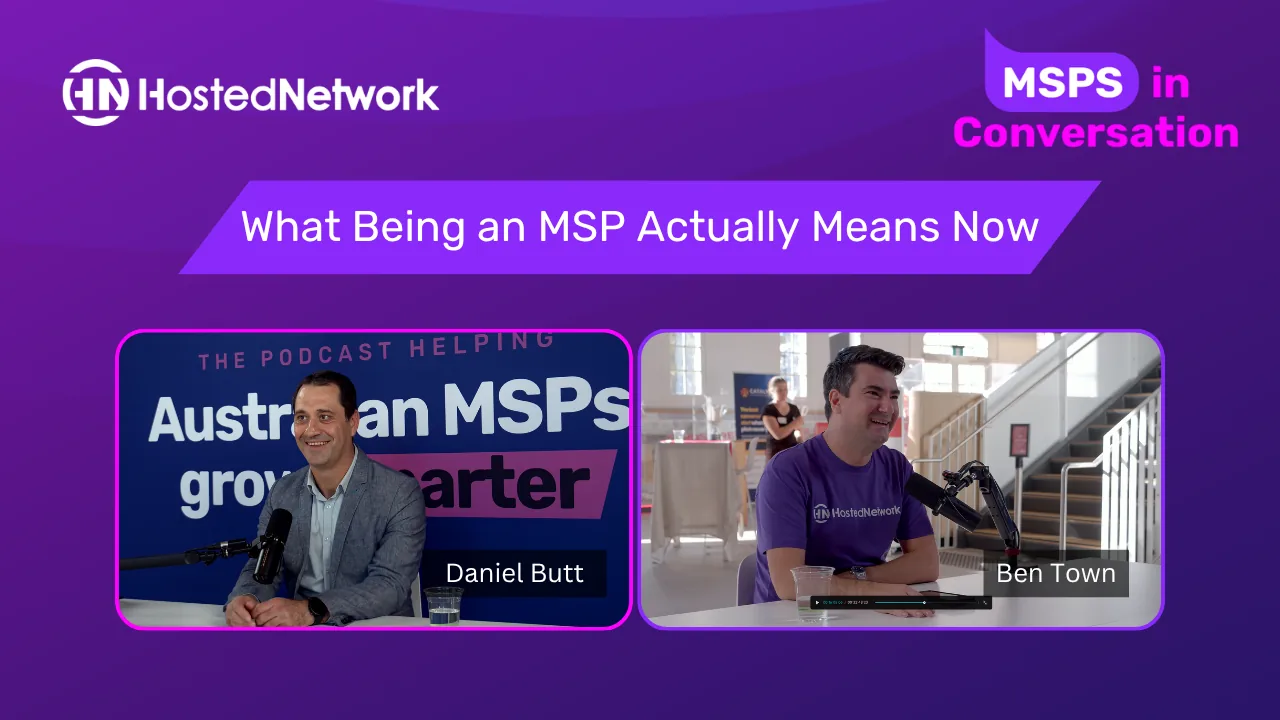
In this episode, recorded live at the Catalyst conference in Sydney, Daniel Butt, Director of Danet Technology, shares what it really takes to stay relevant as a managed service provider in 2026. From using AI to go deeper with clients, to escaping the race to the bottom on MSP pricing, to making the shift from IT support to strategic technology partner, this is a conversation every Australian MSP owner needs to hear.
AI isn't just a productivity tool. It's raising the bar on what clients expect from their MSP. If you're not using it to understand your clients' businesses more deeply, someone else will.
Technology is more stable, the cloud solved a lot of the old problems, and younger clients are more self-sufficient. The traditional MSP service model is shrinking. The question is what you're building in its place.
Clients who see you as just the IT company will cut you when budgets tighten. Clients who see you as a strategic partner will fight to keep you. That distinction starts with how you show up, not just what you deliver.
Unsustainable pricing doesn't just damage your business. When an underpriced MSP folds, their clients wear the consequences. Charging what you're worth is a responsibility, not just a commercial decision.
Jumping vendors for a slightly better rate is a false economy. Loyalty, consistency, and genuine partnership with your vendors builds the kind of support that shows up when you actually need it.
Edited for readability from the episode audio — may contain minor errors.
You were talking today about what does it look like to be an MSP in 2026. Give us the highlight. What does that look like for you?
Sure. I think it's both exciting and frightening at the same time. I don't think you can put it into one bucket. So what's frightening is AI and the pace of change, and the big thing that I sort of spoke about is that I feel like we're learning the new technology and new ways to do things at the same pace that our clients are. And traditionally, we're known as subject matter experts. They come to us to solve problems. But when clients are now coming to us and solving problems at the same rate, or learning things at the same rate that we're learning, that is quite frightening.
But what's exciting as well is the opportunity. There is a huge opportunity. For my business, we're not known as a development business. We're not a development business. We've never had that side of things, but we're able to develop things at the moment thanks to AI that's giving us opportunities that we never had before. And it's been particularly good in terms of our engagement with clients and the way that the data that we have at our disposal, the pace that we can actually not only solve problems but get to the root cause of a particular problem, which we just weren't able to do beforehand. So, yeah.
Would you say that AI is allowing you to go deeper with your clients, understanding their business better than what we've traditionally been able to do as MSPs?
That's a good question. I think AI has definitely enabled us to go deeper, but it's also forced us to go deeper. I think that's an important distinguishing factor, because if we don't, we're being left behind. Now, the reason I say that is that we're seeing all these AI companies that are suddenly springing up, bucket loads, right? It's unbelievable. And I've had the opportunity to speak to some of them and I kind of realize they're actually no different to us. They're just putting the word AI, and they have a similar level of experience.
The new buzzword.
It's the new buzzword. And that's made me realize that if they can do it, then we can do it. And so we're really focusing on sort of educating ourselves, skilling up, getting that consultancy piece right, making sure that we have the right people so that we can actually solve the problem. So I think not only is it enabling us to go deeper, it's requiring us to go deeper, because if we don't, we're going to be left behind.
Yeah, 100%. And it's funny, we talk about this in MSPs in Conversation a lot. A lot of different people say the better you understand your client's business, the better your sales pipeline is. The better your engagement is going to be as a business, they're going to grow, you're going to be able to grow, because you're going to be able to help them more. Because all of a sudden you're not just understanding their IT problems, you're understanding what makes them profitable. So I think AI is an opportunity for that.
But I agree. And I will say, I think, as an MSP owner, and I think we're all pretty similar, if you work on a particular vertical, and we do a lot in financial services, we are able to walk into a meeting and use vocab and words that we know are their pain points, and it's just based on experience, right? So that helps the sales process, because you understand they're going to have this problem, they've got these particular requirements, how you solved it in other cases.
Exactly.
And now we're having to leap into how we can use AI to accelerate your growth or make you more efficient, or open new opportunities or markets for you. That's the kind of change that I'm seeing.
Cool. So for MSP owners, listeners of this podcast that want to stay ahead, what are two things, or a couple of things, that MSPs really need to be focusing on at the moment in your mind?
So I think the consultancy piece, right? And really understanding that the days of us being an organization that goes along and solves just the technology problems, or fixes your mundane type of issues, I mean that's so far gone now. It's no good. So we need to go on a deeper level, on a business analysis level, and really understand on a really deep level their business, and then explaining to them how the technology that we supply to them can drive efficiency and change, and being a real partner for their growth. So we need to be looked at as a strategic partner for their business success, not as the IT company that's there to support them when they have a technology problem.
It sounds like we want customers to think of us differently, no longer as the IT guy or an MSP. What do you think we should be thought of as?
I think we should be a strategic partner. I think that's the two words that we need to hear all the time, that we come in and we're their strategic partner for success. I think if you're not that, and if we're not doing that, then I think our days are numbered.
Yeah. And you know what? I'd agree. I think that if you're just the IT guy, IT company, then someone else is going to come along.
Totally. Someone's going to come along and they're going to be able to solve the problems. And the truth is, the requirement, what has traditionally been the service that we provide, is dying. It's not going to be required anymore. For a number of reasons. Technology is inherently more stable. The cloud that came in many, many years ago solved a lot of the problems that used to exist. We no longer have to worry about RAID arrays and things like that on-prem, right?
That's right.
People that are coming through school, they're kind of born into the technology environment, right? Very different skills.
Yeah. I didn't have that skill. I had to learn those skills.
But these people are essentially born with it. So they just don't need it anymore. So it's why we as an owner have to sort of leapfrog to a new evolution of what we do.
Yeah. Cool. Okay. So if you could fix one thing in the industry, I'm shifting gears a little bit here. If you could fix one thing in the industry, or change something, what would that be?
I love that question. It might not, it can be more than one, I guess.
No, no. There's one pain point for me that it's almost infuriating, and that is that I am seeing too many people, like essentially competitors, where it's a race to the bottom. So they're doing things like onboarding for nothing. They're lowering their fee to a level which is unsustainable, which I know that they're selling services at a rate that they cannot possibly make money, right? One thing that I say to opportunities all the time, and to my clients, is: how important is it for you that we are a profitable partner? We're a profitable IT company. And it's very interesting, the responses. Some will say we don't care if you make money or not. That's not my problem. That's your problem. It's your business. But the good ones, who really understand the value and the strategic partnership that we are, will go, well, it's really important to us.
Now, from my point of view, it should be obvious that that's a really important thing, because at the end of the day, we hold the keys to the kingdom, and the level of access and control that we have is absolutely unparalleled. There isn't a single business out there that doesn't use technology in some way that really they can't do their business without it. I remember having a dentist that made it very clear to me that if her system went down, she couldn't see a patient. I'm thinking, but you're not touching, you know, you're touching teeth. And she said, I know, but I need to be able to look up the historical records and what have you.
So I would love our competitors to really understand the value of what we do and not make it a race to the bottom, because I think all we're actually doing is a disservice to our customers. We're hurting everyone. We are hurting everyone, including our customers, because as soon as you go out of business, then that's just going to cause a problem for that particular customer of yours who then has to move, which is expensive, and it's painful, and it's risky, and all that stuff.
I 100% agree, and I hear that. I've spoken to a lot of MSPs over the years where you hear the charges or the rates that they set, and you cringe, right? To your point about onboarding fees and things like that, or project stuff, they just kind of give things away for free, and that diminishes the value, right, of what they do.
So yeah, and it's a constant battle as well. It is hard sometimes to convince customers the value of what we do. Where we are sort of in the business of insurance, right? So a lot of what we do is making sure that they don't have a problem, and that's a difficult business to be in, because everyone understands when you've got a problem. Like, we all come across opportunities where a customer got breached, like a potential customer got breached, or they had a massive problem, and then they want to change, right? And they're the worst, like it almost feels like ambulance chasing. It's the worst type of business to pick up.
The good ones are the ones that understand that if they never call us because they never have a problem, that is the best investment they've made in their technology partner ever, because we're charging them all this money, whatever. We're doing a good job. We're being proactive in everything that we do. We're dealing with alerts before they become a problem, before they're noticeable to the customer. And that's the value of what we do. And that's, I find, the hardest thing to sell and to convince our potential customers, and sometimes our existing customers, the value of what we do.
And I think, when times go hard, when times are difficult, and customers are looking to cut costs, unfortunately sometimes we're one of the first people that they knock on the door, and you go, well, do you understand that if we turn something off you might be fine, there's an 80% chance you'll be fine, but that 20% that could set you broke.
Could set you broke. Yeah. It only takes one problem sometimes to put you out of business completely.
So yeah, it's a difficult situation.
It is. It is.
So we're here at Catalyst, and this whole piece of it is about sharing pieces of wisdom. You've just gotten off stage and shared some of your own wisdom. Can I ask you, what's the best piece of advice that you've either been given, or that you love to share to other MSPs? It could be any business in general.
So I think there's two things, which I did say when I was on stage. So the customer relationship obviously is really important, and everybody knows that, but the vendor relationship also is equally as important. I think in our industry, the IT industry, the vendor relationship is more important than anything, because without the services and the tools of the vendors that we use, we're nothing. We don't exist, at the end of the day. We can't do anything. We can't support systems without having tools and vendors supporting us along the way.
So it is really unfortunate that I often see sort of vendor jumping, or vendor jumps. I'm just trying to get my words out correctly. Where I see an MSP jump from vendor to vendor because they might get a slightly better rate here or there, but they don't actually understand that there is a significant cost to that. There's risk to that. It doesn't buy loyalty.
Yeah.
If you want your back scratched, you need to scratch someone else's back. So it's really important, I think, as an industry, that we look after each other and we understand that value.
I'm hearing Stu Applegate behind you.
Well, look, he's definitely someone that I would consider a mentor, and he's been around obviously for a long time. He's my facilitator, been almost the whole time since I've been involved. But I think that's a natural, I think it's a maturity thing. I think it's a natural progression that as you've been in business for longer. And it's interesting, because I think about this a lot. I get many calls from people trying to spruik their services every single week. And I think when I first started in business I'd pretty much hang up the phone, because I'm thinking it's a waste of my time. But I kind of realized it's a really ridiculous way to be, because we're calling up potential customers and we want to get their time. And so if that's what I'm expecting of other people, I should treat them in the same way.
So in terms of people calling up, I always give any vendor who calls me the time of day. I'm genuinely interested in the services that they sell. And for me, I'm always focused on what is the problem. The question I will ask them every time is: what is the problem that I have that you are solving? And then if they could do a good job of explaining to me how they're going to do that, then they often become a partner. The other thing that's important to understand, and I say this to opportunities all the time, I'll spend a million dollars with you if you make me $2 million. It's a no-brainer. So you kind of really have to be able to explain that. It is a true partnership.
Yeah. When that happens, amazing.
Well, I think that's all we've got time for, but I wanted to say a huge thank you. This has been great. This is our first time running Catalyst, so thank you again for speaking and sitting down with me today. So yeah, thank you.
I'm very honored to be invited to present. I kind of, I don't always feel like I have a lot of value to add, but I think, based on the conversations I hear afterwards, that people, it definitely resonated with some of the other people in the room, which is great.
I always say to people, particularly to panelists on MSPs in Conversation, if we can give one nugget of information, or a light bulb moment that they can walk away from, then we've done our job.
Yeah, totally. And that's how we grow.
Totally. And I think you've done an amazing job putting this together. I wish you much success, and I hope this is a continued thing that happens, at least.
We'll see how we go. Yeah. Awesome. Too easy. Thanks, mate.
Thank you. Cheers.