20 October 2026
Getting Sales Out of the Owner's Head: What to Build First, and in What Order
Sales & Marketing
The problem is most MSPs are either not prepared to acquire or not prepared to be acquired. They haven’t thought seriously about valuation, they haven’t done the operational work that makes a business attractive, and they haven’t mapped out what integration actually looks like after the deal closes. When the conversation comes, they’re not ready for it.
In this episode, we’re talking to MSP leaders who have been on both sides of the table. They’ve bought businesses, sold businesses, and in some cases done both. They’ll walk through what actually drives deal activity, what buyers are looking for, and what you need to do now if you want to be in a position to act when the opportunity arrives.
MSP M&A rewards owners who've already built a process-driven business. Get your operations, finances and team solid first, acquisitions amplify what's there, they don't fix what isn't.
Australian and New Zealand MSPs rarely command US multiples, most land between 2x and 5x. Anchor on a realistic number and get fast agreement on price before emotion takes over.
Smart buyers don't pay everything up front. Tie part of the price to your biggest risk, like customer churn, so the seller's risk doesn't quietly become yours once the deal closes.
There's no broker shortcut to buying an MSP. The owners who acquire treat it like sales, working their network and being openly, shamelessly vocal that they're looking.
Winning the deal is the easy part. MSP integration succeeds on focus, clear client communication and strong middle management, not on the spare capacity you think you have.
Edited for readability from the episode audio — may contain minor errors.
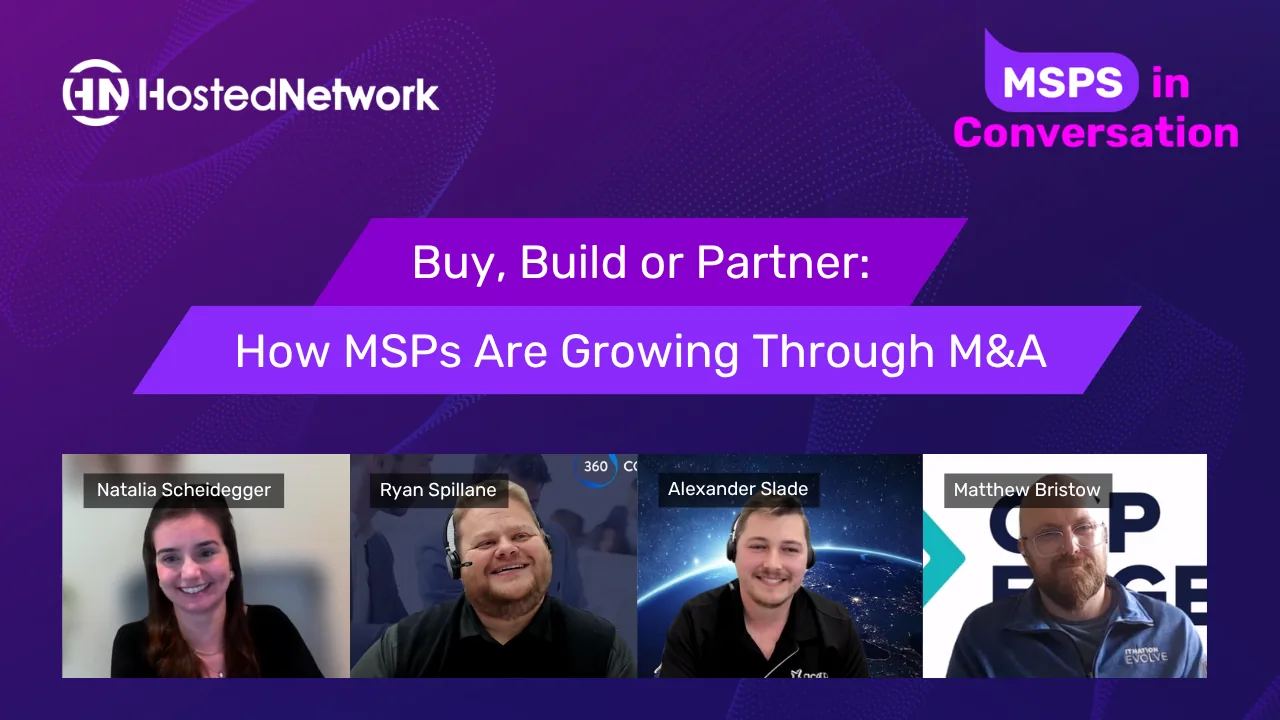
Good afternoon everybody, and welcome to this month's MSPs in Conversation. So, I am not Ben Town. I am your host today. Ben decided to be overseas when this was on, so I'm the ringing moderator for today. We've got some great panelists which we'll talk through in a second.
Today's topic is buy, build or partner: how MSPs are growing through M&A, and not just M&A, how are they naturally growing as well. We're excited to be joined by Alex, Matthew and Natalia. Just some housekeeping before we dive in: this session is going to be recorded. Zoom would have told you that to start with. You will be able to see this on Spotify podcast, Apple, YouTube, on the MSPs in Conversation website, etc. There's plenty of places you will see this content afterwards. I'm even told it's on Vimeo, so I can't forget that one.
This is going to be an interactive session, as most of the MSPs in Conversation have been over the years. So please throw any questions down into the webinar chat. We'll answer those as we can. There'll be a stop a few times where we can answer those questions, or if the panelists keep an eye on that like I do, and if you can answer any of those questions as we naturally go along, more than happy to do that. So if any of you have had a bit of an M&A story or question, drop it in the chat and we'll try and cover that off as well. Without further ado, let's get started.
Let's welcome our panelists today. Can I get each of you, for about 30 seconds, to give us a little bit of background on you and your experience? Alex, you've got the A start, so you can go first, and you're probably the youngest and the baby, so yep.
I'm feeling you already. I was waiting for that. Thank you. Alex, CEO at A. Corp Computers. Your pretty standard MSP, office in Sydney, Muswellbrook in the Hunter Valley, and now Newcastle. It's a very recent acquisition. 16 staff, playing in that small to medium business space. So yeah.
Cool, wonderful. Matthew, you've got a little bit of a different role now, but if you want to cover off on your past and where you are now.
Yeah, that's right. So in a past life, obviously, you know, tech by trade, worked at a distributor at Dicker for a couple of years. But then for the last four and a half, almost five years, working at OGC and going along that journey, that huge journey of growth, you know, a sale event and beyond. And then I ventured out on my own late last year and started CSP Edge, helping MSPs really focus on getting the most out of their Microsoft partnership in terms of rebates and solutions partner designations, specializations and everything in between. It's a bit of a dark art. I shouldn't have to exist, but through that complexity, that's where I bring the calm. So, thanks.
And I don't know how you keep the calm with how slow the Microsoft partner puddle is.
Good call. Yeah, it's a tough one. A lot of coffee, a lot of volume.
Yeah. And Natalia, please introduce yourself.
Yes, hello. I'm Natalia. I'm CEO at 3rdmill. The business itself has been going for almost 30 years. We turn 30 next year. But I myself have been in this seat for about 12 years now. We are roughly a 30-man team, 25 onshore, five offshore, specializing in particularly Microsoft and financial services as our kind of niche. Two acquisitions in, and some organic growth in between. I have certainly cut my chops on all the things you shouldn't do to grow.
That's going to be fun to listen to shortly. Wonderful. Well, thanks all for sharing a little bit about yourselves.
A little bit about our sponsor for the show. So Hosted Network is a wholesale cloud and telco provider for MSPs. They started as an MSP back then, way back when, and today they're 100% wholesale. So they only go through the channel and only go through MSPs. They don't deal with any customers or any of your customers directly. They understand the challenges you're facing because, again, they're entirely a feedback-driven organization. Everything they've been shaped by is over 300 partners they work with. So they also like to get stuff done. That is one of their core values. Delivering cloud and telco services the way it should be for MSPs: simple, easy, no margin burn.
And with that, I'm going to stop sharing and we're going to get into the conversation. So let me see, hopefully stop share, and I'm doing this right. Okay, cool. All righty.
So, some of the topics today are going to be around building and buying MSPs and getting ready for sale, any of those types of pieces, as a lot of people are here for. But I actually want to start off with a little bit slightly different question, and throwing all the panelists on the fire just as we do. So I want to talk about: how have you built your MSP? We know that at least two of you have done acquisitions. Matt, I think you may have had a little bit, but you've gone through a sale. We'll talk about those shortly, but I want to understand how you've actually built your MSP over the years to where you've come from now. So Natalia, let's start with you if you can. What are the key things you've learned? How have you done it? What's worked? What hasn't worked?
Yep. Rather than give outright advice, I will share my experience with this, and do what you will. So obviously, early years was very much just getting my feet under the desk. I didn't come from a technical background, and so growing an MSP, it was very much wading in the dark. I call those the middle ages, the dark ages. Not much growth, and you could tell why, because I was really just trying to keep the ship steady and turn us back to profitability after I inherited the business.
But then the next wave was very much organic growth driven by cloud and then cyber. So I think understanding the market shifts and gearing the business towards that. I inherited a break-fix shop, and so there was a lot of just natural sales to happen in shifting our customers to the cloud and transitioning everyone into recurring services, and honestly it was just the fuel that took us through what I would loosely call the 2 and a half to 3 and a half mil range. So slow grinding growth, it was a grind, but following the market trends allowed us to accelerate through those years.
The next wave was fueled by more networking with peer groups within the industry, and actually understanding and accelerating that growth through learning much faster what other people had done rather than trying it yourself. I found those years where we went on that cloud journey, it was very much me working it out as I went along. Once I got involved in the peer networks, that growth accelerated because I wasn't reinventing the wheel, basically.
But I was ambitious. I saw that a lot of the MSPs that were growing really fast were doing the naughty M word or the A word, the merger or acquisition, and I went, I want to do that. And so this last few years has been fueled by that. But I did the grind, I did the slightly more accelerated organic growth through learning from peers, and then felt like I had enough knowledge and enough of a stable business underneath me to attempt the M&A journey, and that's certainly what's fueled us up until this point. So hence almost three or four distinct stages there, from the dark ages through to the shaky revolution I've got going now.
There's going to be a good story in that a little bit later. Matthew, give us a bit of history around, again, from your days at OGC and how you helped build that.
Yeah, absolutely. Look, it was a massive team effort over, we'll say, the four-year journey from when we started. We focused on organic growth year on year. We were roughly around 30 to 35% growth year on year. We invested heavily into a strong sales team. But I think what was the rocket fuel was having Steve Dawson at the head as the CEO. He has an incredible work ethic that kind of bred throughout the business, but also having a framework. So we chose EOS, and when I started we had just implemented that. We were also part of a peer group, so I'll mention Evolve as well, and I think being able to learn from others' mistakes, and Natalie so well put, you learn so much from them, right? So being able to learn from 10 or so other businesses' mistakes and avoiding those pitfalls yourself kind of enabled us to have, I guess, the courage to just put it out there, have these big hairy audacious goals and have that growth.
It didn't come without its battle scars, and there's probably things, looking back, would I have done things differently? Absolutely. Probably would have been to a different outcome. But I think it's probably underestimated the amount of effort and years and time away from your family and friends and stuff that you have to put in to get that kind of growth. And I'm not saying 30% year on year is amazing. For us it was. We were incredibly grateful and happy of that achievement. But it definitely meant burning the candle at both ends quite a lot.
And was a lot of that growth coming through marketing, or was it growth of the existing customer base? How were you actually getting that growth?
Yeah, that's a great question. We invested pretty heavily into marketing as well, not only external to net new, but also nurturing our existing customers and exploring that white space. We were so regimented and focused on filling that white space gap within our customer base, and that helped a lot of that growth. And I think that helped when it came to the endgame too, when someone comes in and has a look at your business and you can see that coverage across your customer base, they're eating the full meal deal, so to speak. It's quite attractive.
Brilliant, thank you. Alex, how have you grown A. Corp?
Look, I think we've grown in a similar way to most MSPs. We started out, it was just me, it was an owner-operator business. 18 years this year, we figured out. So I was still at school. The first probably 10 years of that was just myself, going from backyard IT fix-it stuff through to this MSP evolution and having business clients, and suddenly figuring out how to bill things monthly and have things recurring. 2016, 2017 was probably our pivot. We had one person come on board, then we had two, and then we had three or four staff. We were three or four for quite a while.
COVID obviously happened, and it was actually a great time of growth for most IT providers, I think, realistically. I just looked back to confirm: we did 102% growth in 2022, and we spent the next year and a half literally playing catch-up because it was just so unbelievably unsustainable. It wasn't funny. And I think the interesting part about that is we didn't really have a plan. From when I was 12, 13 years old through to building a business as a 22-year-old, there was little plan in those initial years. It was, again, like a lot of MSPs and IT guys do, it's just helping out the customers, whatever comes your way. Anything with a heartbeat and a wallet was pretty good. So it was a huge effort.
And look, the last 6 to 8 years has been a bit more focused and a bit more process-driven, now that we've got the people to do that. I'm not a process person, that's not me. So now we've got the team to help with that. So the last few years, stable, anywhere from 15 to 25% growth year on year for the last few years has been pretty stable for us as we've grown slowly.
Nice. Okay, well thank you, and that's good to get an idea of how you've grown from a natural perspective, through marketing, etc. And then obviously we're going to talk a little bit about the buying and the other sides of this today, merging if needed.
So, if you think about it, the market's never been more active at the moment, from the private equity guys rolling things up. There's been strategic acquirers hunting for specialist capabilities, and a lot of MSP owners are having serious conversations about exits for the first time. We had a budget change last week or whatnot, which I'm sure a few people are thinking about, whether they should get out before June 30 next year. That's probably a slightly different conversation than this one, but I think a lot of MSPs aren't ready for either side of the table. So let's get a little bit more into that.
Natalia, let's throw a question over to you. The M&A's been heating up. You've now done a couple. What do you think's driving that acceleration? Is it succession? Is it private equity money? Is it something else entirely?
I think private equity money is creating competition for sure. But I don't necessarily think it's the source of it. I think at that end of town a lot of people are recognizing the value in IT services businesses because of the underlying recurring revenue. There's less love for that kind of SaaS revenue multiplier angel-darling "maybe there'll be profit, maybe there won't be" model, and now a lot more love for stable recurring revenue businesses. People have gone, actually, holy crap, here's an industry that's kind of been largely underserved by private equity and now is ripe for the taking. And so I think we're certainly riding that wave and it's creating a lot of noise in the market.
But I still have seen a lot of transactions not involving private equity, as people like myself look for growth, and recognize that there's a really long sales cycle right at the moment to acquire customers, particularly in that mid-market, but all up and down the chain. And that cycle is only getting longer as the needs of our customers are evolving so much. If you've got the infrastructure to be able to just bolt on customers and you've got a great process around it, acquiring makes a lot of sense in our industry because you really just are bringing on and accelerating your customers without having to go through that painful, long sales cycle to wine and dine and nurture a customer and beg them to come over and all the things we've suffered, right? So I think there's a natural fit for our industry to be able to bolt on. It's not like it's, depending on the nature of course of the acquisition, but that's where you kind of have got to do your due diligence in advance.
And then I think separately there is this recognition, in the liquidity in the markets, that we are a valuable target, and the two forces are at play, but you often don't see MSP buying MSP necessarily competing with private equity. You're kind of either going for one or the other, depending on the nature of the seller and the buyer.
And fundamentally, I'll never forget, I think it was Josh Goodman that told me, that M&A is a lot just like BD. It's a lot about relationships, and that's true in terms of finding people you want to buy and sell to, and in terms of how the deal closes and how it ultimately ends up. It's really a transaction, a relationship, and it is from the beginning. And so if you treat it like that, then it becomes a lot more people-centric rather than numbers-driven.
There was a little idea that floated around the industry a few years ago, and that was Tinder for MSPs. Matchmaking.
Seriously, because, yeah. And you've got to, what is it, eat a lot of frogs before you, you know. And then that's where the emotions get into play and all that. But to answer your question, I think there's a lot of forces going on at the moment that's driving it. Are some MSPs looking to get out because of how quickly everything's accelerating with AI? Possibly. I think we're probably only seeing the beginning of that, though. I think a lot of MSPs are having a crack at this new world, and the ones that maybe don't succeed will be ripe for the picking. But who knows? Maybe that's just the pirate in me.
I love that. I think that's a perfect little sound bite for later, the pirate in Natalia. You've got a new nickname now.
So on that note, Matt, I've got to come across to you for a second. You've got a slightly different viewpoint of this, coming and working with MSPs from the CSP Edge perspective, and you speak to a lot of MSPs, go to a lot of events and things like that. So that's kind of the framing for this question. When you talk about the buyers in this market, you've got PE firms, you've got strategic acquirers, you've got MSPs looking to grow. Who are the most active buyers that you're hearing about, and what are they looking for?
Oh, that's a great question. So it's funny, if we turn that back to say five or six years ago, in my position when I was at Dicker, I looked after a lot of the larger customers in Queensland, and I would say every week I was speaking to a partner. They would say, "If you know anyone wanting to sell, you tell me right now." People had the checkbooks ready to go to acquire. And it was a lot of those, let's call them small to medium sizes, wanting to buy up a lot of the smaller ones, because it's a lot cheaper to acquire that kind of business in volume than to go out and sell. So to reflect on our time at OGC as well, we would be spending probably close to a million bucks a year on sales and marketing. If you look at headcount, actual investment into marketing, agencies and whatnot, that's super duper expensive.
To address the question, though, what am I seeing in activity in buyers? Look, we've seen some massive plays even just this year. I mean, the elephant in the room with Evergreen, we're seeing international investment, foreign investment coming in. We're seeing the merger with Integra and Focus just only a couple of weeks ago. That sends ripples to the market too for everyone else who's in a position where they might be thinking of selling, or even thinking of buying, because they're going to be saying, "Well, who's going to be left on the dance floor?" The last thing you want to do is get to the end of the night and the ugly lights come on and you've got to take your pick of a bad bunch, right? So you want to make your moves clever and quick and decisive. So yeah, I think I'm seeing the same level of, I want to say tension, but intent of wanting to buy up a really good deal. It hasn't really changed.
No, cool, good to hear. Alex, are you seeing MSPs being approached unsolicited? Are people knocking on your door all the time? And, again, not just you, this is going to be all of you. Are owners proactively going to market? And does it matter which way it happens?
Unsolicited? No. And I think it's in its importance. Obviously, I'm in a peer group and talk with people in the industry quite a lot, and back to what Matt was saying before, I was talking to a vendor yesterday and they literally said, "Oh, congrats on your acquisition, by the way. Oh, do you want to get another one, because I just had a partner tell us they're looking to sell. This is how big they are." And I was like, "Whoa, whoa, whoa, hold on." So everyone's talking about it in every sort of space, and that's just an unrelated vendor. They just heard of this, and that MSP has reached out to them saying, "Look, you've got other MSP partners, start talking to people and just start planting those seeds, and if you find someone that's interested, let us know and connect us." So it really is talk of the town.
But on the same note, I know several MSPs we've been chatting to recently that aren't interested in selling at all. And mainly because their view on that is most MSPs are not going to get the money they're wanting at their current scale and size. Then it may very well be more profitable short and long term to just keep the business running efficiently, and then even look at the potential around putting in managers or an executive. And that's a different kettle of fish, but it's interesting, conversations are being had, because I think everyone's just talking about buying and selling and buying and selling, and it's all everyone's talking about, to be honest. Not a lot of people are talking about the growth and the keeping things running. Yeah, that's what we're seeing at the moment.
Well, I think people talking a lot about acquisitions is because it can be an easier form of growth. If, again, Natalia, you said a little earlier about how long it's taking, the sales cycle now, and, again, Matt, you talked about having a million-dollar sales and marketing budget including team, external advisors, external agencies, that's a hell of a lot of money you'd spend every single year. And then if you look at the cost of acquisition, that's why in some instances people say, "Well, just go and acquire," as long as they've got the target customers.
So, Natalia, quick one back for you. There's a discussion around rollups. A bunch of people have probably tried rollups. The PEs are trying to do some rollups and things like that, right? Is it actually happening in Australia, or is it really just MSP-to-MSP activity?
It's still being talked about for sure. I think it's still the shiny light that a lot of MSPs are looking for. I'm seeing it now shift from multiple MSPs coming together to more of a potentially a lead MSP, and multiple kind of coming in at once sort of thing, but really fundamentally having a single entity at the top, rather than more of a sort of partnership roll-up, which is probably what was talked about in the past. I think, interestingly, I'm seeing evidence of it being PE-backed as well, potentially looking at the Evergreen model and trying to compete against that in a way that's a bit more accelerated.
Is it, in terms of the actual activity? I've only seen MSP-to-MSP, and the private equity for buying out. I haven't seen much success in the rollup space. But is it still being talked about? Certainly. Lots of talk. Whether how successful is another discussion, and you probably could have asked me that question five years ago and it would have been the same answer, right? So I think the proof is in what really ends up commercializing. And fundamentally, the straight M&A, one-to-one, or PE coming in and purchasing, still seems to be the one that executes. That seems to be the one that executes.
So we've got a potential little question out to the audience now. The question that I have here is, drop a one in the chat if you've ever seriously considered selling. Drop a two in the chat if you've thought about acquiring another business, or three if you've never really explored either. Now, I know in these things very few people are ever going to say they're considering selling, because then everyone else jumps on them. So we know that's often not the case, but if you want to throw it in the chat window if you'd consider doing any of those.
While we do that, I'll segue across into positioning your MSP for sale. It's both buy-side, sell-side. So what are some of the things that we need to do to prepare? If you were, again, probably Alex, I'll throw this to you because it's going to be interesting from the other side. If you're advising an MSP owner who wants to be acquisition-ready, say in 12 to 18 months' time, what's the first thing you tell them to fix?
Documentation. Make sure everything is, like, your processes are ready, I guess. So, look, I'll just put this question into my perspective actually, because we're not looking at selling at the moment, but we're constantly working on ensuring our processes are 100% where they should be for our client base. And I think if they are repeatable, easy to follow from both a sales and a service perspective, that's going to make your business really palatable for anyone looking to either PE or another MSP or even a rollup. Because maybe in a rollup, for example, if you've got the best processes, they could be very easily put across multiple MSPs as they're rolled up, right?
I think it's one of the most important things. It's something, to be honest, that our processes and procedures aren't the best. I don't think anyone's ever are the best, 100%. It's a constant evolution, and constantly working on them. But if you're seriously considering selling, that's going to be one of the key parts right there. Finances are always important, make sure you've got your dollars right. But if you're making good EBITDA, and just sort of everything's inside the owner's head, or in a key person, creating some risk in the organization, it's going to be a little more difficult to integrate that business.
Good answer, thank you. Matt, I'm going to throw across to you. What are some of the basic things MSP owners should have in order before they even start seriously thinking about selling or even merging?
Please have a clean balance sheet. Get the finances. Having that in order makes it so much easier when it comes time for potential due diligence. Any acquirer worth their salt, they're going to put their best resources on just making sure there's not a fire under the hood. So making sure your P&L is really well presented and clean for at least three or four years. But yeah, just having a clean balance sheet as well is super duper important. Coming from experience of, you know, it can happen, things you just need to tidy up, it just draws out the whole experience of due diligence, which you'd want to avoid.
No, definitely. Nat, I'm going to come across to you. Valuation is where a lot of deals fall apart. MSP owners down here in Australia, New Zealand hear US multiples and think that's what their business is worth. What's a realistic valuation framework for an Australian MSP, or Australian, New Zealand MSP?
Yeah, great question. And there's definitely a conversation around what the buyer thinks it's worth versus what the seller thinks it's worth. I think there are so many factors at play, and honestly, it's funny you asking me that question, because you're asking all the questions and not having to answer them.
This is so cool. The master exceeds the student.
No. But the short answer is like, it can be anywhere between two and five, right, in that sort of 2 to 10 mil range. Right now, if you're at that lower one-mil range, the multiple goes down. As you climb up the curve, the multiple gets higher, all those obvious pieces. And there's lots of things that go into it. I think, aside from the obvious that you can get from any presentation that the wonderful Ryan here does, which is phenomenal, I think the question that people don't ask themselves is: what are you willing to pay for it, and what's the risk of not achieving, you know, how many years payback do you want?
I bootstrapped my two acquisitions, and so I had to just go, what am I willing to pay, and how long am I willing to wait to get that money back? And fundamentally, when that number got small enough that I was comfortable with the risk, even modeling out churn and all that sort of stuff, I went, this is a good outcome. But there's risk to that ROI, that return on investment. So then, what are the things that you can do to reduce that risk and carve out a portion of it associated with that risk factor? For me, in my instances, customer churn was a big one. So I pulled out a large number of what I was willing to pay and tied it to that risk, and ultimately I didn't pay that amount at all. I only paid the smaller amount, which was acceptable for my risk appetite.
So I think that, multiples aside, there is an aspect of gut here, particularly as the buyer, that you need to trust, and understand what your willingness to pay is before you see a dollar of that money back, and what the risk factors are to that payout so that you can hedge your bets as much as possible. That would be the one thing I would say that's hopefully slightly different to what maybe everyone else has heard before.
No, that's cool. And if you put a gut feel on it, how many deals do you think would fall apart because the buyer and seller are just too far apart? Or do you think eventually most of them come to a common ground?
No, not even close to most. I would say for every 10 conversations, one or two actually end up anywhere near the right price. And then even then, maybe only one of those actually then ends up being sold, because a bunch of other stuff happens along the way. We closed in on price pretty quickly. I'd had eight painful conversations and had learned my lesson the hard way, that getting that number on the table and getting alignment quickly was really important, a fast no. And I've learned that in sales as well.
So I think getting alignment on that number, I'd almost do that before anything else, because then you're saving yourself a lot of heartache along the way. Once there's alignment on that number, yeah, a host of other things can go wrong, but they're a lot more in your control and a lot more negotiable, particularly with assistance from lawyers. Whereas the number, no lawyer is going to sit there and give you guidance, legal guidance around it. They can help you draft clauses against those risks I spoke about, but they're not going to help you close that gap. So I would say be prepared to have lots of conversations. Be prepared for most of them to end in failure. Don't get emotionally attached to any one, and get a fast no or a fast yes on that gap really quickly, and you'll save yourself a lot of heartache.
I love the emotional attachment there. That's a lot of times, and the false economy in some of those.
Yes. Learned the hard way.
Yeah. Okay. I've got to throw a question to all of you on this one. So I'd like each of you to answer it, and it's going to be funny, again, the different versions of the answers. So how important are well-written and signed customer contracts, terms, even supplier agreements? Matt, start with you.
Yeah, thanks. Honestly, it was one of the things that we were so lucky we had in order when we did go through that sale event. It is critical that you have decently written, very clear contracts with your customers, because if they're not worth the paper they're written on, then who's going to pay a multiple on that, right? There's no guarantee of an ROI if they're trying to pay four times multiple, if they're not contracted for multiple years, or they can just get out of it at any moment. Then there's a huge amount of risk tied to that. And then same with your vendors as well. Making sure you've got clear terms around lines of credit, they're in good standing, just shows you've got good robust commercial agreements with all your vendors. It is super important, probably more so than the contracts you have with your customers. But it is also good to have, on an MSP's value at the moment. I think everyone's looking for confirmed revenue and that sort of thing.
But, funny enough, thanks Peter for the thing in the chat, that's where I was going. I don't think a customer's not going to stick with you because your contract says they've got to stick with you. We've got contracts in place, but I'm pretty open that if we are not doing a good job, good luck me sticking to a contract to stick with us through another two years or one year, whatever that is. So on a business sale or selling side, it's probably important to have those in place, but running the business, it might not be the be-all and end-all, to be honest.
Yeah, fine line between contractual stuff and what you're doing. Alex, any different thoughts than that?
Happy. I agree. But also my good friend Peter on the call has commented that if you do a good job, you don't lose the customer. And I'm a big proponent of that. Full disclosure, my recent acquisition was all month-to-month contracts, and I didn't bat an eyelid, because I feel, and I think, contracts are important to some people. They live in that world. They want to sign a 12, 24 months with blood. And I get it, and for some buyers that's important. And so if you're on the sell side, what Matthew said is absolutely important. You want to open yourself to as many buyers as possible. Some buyers will care about contracts. Don't close the doors to those by having shitty contracts, right? Sorry, I knew I was going to be the first one to swear.
But on the flip side, you, in terms of the way that you operate your business, also need to come to terms with, and if you're looking to buy, what you're willing to accept. And this is just another risk factor that I went, I feel confident that I can continue to hold and deliver a good service to these customers such that I'll minimize churn. And that has largely been true. And hence the month-to-month contract was not relevant. But I think it just depends. It also depends very much on the share versus the asset sale kind of things. And I don't want to get technical about it, but that does also change a lot vendor-side. Like, I just had to resign all the vendor contracts because it was a business sale, I wasn't acquiring the business, like the actual shares itself. And so the vendor contracts didn't matter much, to be honest, because it all had to get resigned when it jumped over the fence anyway. So a lot of things come into play, but do some people care about contracts? Absolutely. Is that perhaps going to get less and less over time? Probably.
I'll also challenge, and I'll throw this back just for a second to Matt or to anyone on the panel here, is: the higher the multiple, though, do you think people would actually care more about the contracts? So if you're down at a two or a three on the actual multiple, versus a five or a six on the multiple, I think there might be a difference in opinion on the value of the contracts then.
Yeah. Look, let's just pretend it's your money. You're coming in, you want to spend $10 million, and then you come across an MSP and 80% of their revenue comes from 20% of the customers that aren't on a contract. And look, we've lost plenty of good customers that we were doing a great service to, because they got acquired. And guess what? The company that acquired them had an IT department or they had another MSP that they wanted to use. And it was heartbreaking that they didn't want to go, but it's not their call. So I think protecting, you know, it's your asset when you're going to sell it. You've got to show the buyer that they're going to get a return on that investment. And we're talking big money here.
And look, I totally agree with what Peter's saying and Alex as well. If you're doing a good job, your NPS scores come back, everyone's happy, and it's more likely you're going to have those conversations with those buyers that have a lower appetite for that sort of risk. But yeah, when you're talking with a lot of money, you definitely want to see there's no emotion in it. There's no amount of smiley-face customer scores that are going to get you across the line when you're looking at those kind of millions.
I'd also challenge, I think there's a hell of a lot of emotion in it that people don't want to talk about.
You just drink that away. It's fine.
Yeah, it's all right. Someone's got to tell someone that the baby's ugly, and that is just part of the job. And that's where the carve-out arrangements work, though, right? Like, if 80% of the revenue is coming from 20% of the customers, that's not a contract risk. That's a customer risk. And there, you then have to get creative in terms of the way that you structure the deal as well. And I think most risks, you can create a mitigating factor on the other side by structuring the deal in a certain way where you're making that risk clear and associating part of the purchase price with it. The challenge is then that, yeah, if the risk then gets carved out equally between both parties, or falls back on the seller, right? And so if you don't want to carry that risk going forward as the seller, absolutely get your contracts in order. You're not going to have to table that as a risk.
Yeah. Okay. A quick question to the attendees and to the chat. If a buyer is looking at your business tomorrow, what is the one thing that you know you'd need to clean up first? Be honest, because anyone can make something up, but yes, what was the first thing you'd need to clean up in your business? Drop that in the chat.
So let's segue again into the next topic, and that's acquiring as a growth strategy. Most of you have done this on this call. So, Natalia, I'm going to start with you. For MSPs thinking about acquiring rather than being acquired, how do you actually find targets? Are you cold-approaching? Are you working within your peer network or other peer networks, or using brokers? What's worked?
This is for me, right? Yes. Yeah. So, back to that comment I made earlier about it's business development: it is business development. And if you're not in that seat in your business, get ready to get really uncomfortable, because that's fundamentally how you get targets. It is canvassing LinkedIn. It is canvassing your networks. It's being shameless about it. I used to love that people used to be really coy about the fact that they want to acquire. It is literally counterproductive to what you're actually trying to achieve, which is just tell as many people as possible.
I think it got to the point where people were sick and tired of hearing me say I want to acquire, and I got called things, right? Ambitious, hungry, pirate, you name it. And it felt uncomfortable, and it felt, particularly for me, and this is maybe where I can get a little bit honest about it, uncomfortable to be seen as that ambitious and hungry and a little bit against the grain, because I was pushing, and I was pushing hard. But did everyone eventually work out that I was trying to buy? Yes. Did one of those people eventually introduce me to the business I eventually bought, or one of them? Yes. And in fact, the other one came through a staff member, because I actually shared with the team, hey guys, this is the strategy and this is what I want to do.
And so shout it from the rooftops, and get really uncomfortable about it, and get ready to. And for me, the other thing was also getting serious about the events that I attended and where I was at. I ended up, I stopped going to the fancy, great junkets and conferences that the industry is famous for, because that wasn't where my targets were. I had to start to go to the events where I knew my targets were, and it was a different room. And so those sacrifices, that discomfort and that vulnerability about being honest with what you were, were the things that ultimately changed the game for me, not some magic strategy or some magic handshake deal. So I couldn't be more vocal about this, and more than happy to chat to anyone else struggling with this, but it was an uncomfortable process for me.
No, good. Well, it's valid. It is so true, and that's kind of what it is. Alex, I'm actually going to let you answer the same question.
Well, yeah, tell people, obviously, as from my phone conversation yesterday with a vendor. This is what I'm saying, everyone's talking about it. Look, interestingly enough, we weren't really looking when our opportunity came across recently for an acquisition. It's one of those things where we, again, like a lot of MSPs, probably thought about it. You do the pros and cons, you weigh it up, and you come back to it later sort of thing. And then obviously Ryan brought us an opportunity, right? So, importance of your network is probably one of the most key things.
So, yeah, there's people that are going to be out there telling you there are MSPs for sale. If you're interested, start listening. Start listening. We were interested, so we listened, and we went through a process. And that's where we are today, right? So, definitely, your network is really key. Much like what Natalia said around business development and doing the same thing you're doing with sales in your own business. Talk to people, understand if they're looking to sell, why they're looking to sell, what's their business like, is it a good fit for you? Just start asking those questions, and I think everything does kind of fall naturally if you're actively looking.
Totally agree.
Matt, I'm going to come over to you. Everyone talks, but the hard part is what happens after. So what's the number one integration mistake you think first-time buyers might hit or might make?
First-time buyers. Oh, I mean, I can say from a seller. The biggest thing is, what are you going to do as a leader, as an equity holder in the business, what is your role post-sale? You might have an earnout, so you've got to commit to a certain amount of time to actually produce an ROI on a certain part of the sale. But ultimately, you really should have a game plan or an idea of what you want to do and be after that as well. That was something I had to face myself. I'm fairly young, I only just turned 40. So it's not like I could retire on the amount of money I made, nor would I want to, I'd still have a few years left.
But I remember sitting at my desk after a certain amount of time and thinking, you know what, it kind of feels like I've got the end of the movie, the credits are rolling, and I'm still sitting in the cinema, and I'm like, what am I doing here? Like, I've watched the movie, I watched it to the end, but I'm sitting here just reading the names as they scroll up. I should get up out of this seat and let someone else have a go now. And that's really what led to the decision of actually going, you know what, I've finished my karmic cycle with OGC and it's time for me to depart. And I think it's better to make that choice on your terms early than get to the whole, you know, you either die the hero or live long enough to become the villain. So go out the hero.
Something was a bit different. I'm actually going to throw Alex and Natalia both under the bus on this one. What is the thing that you both learned, possibly the hard way, or what are some of the mistakes you're willing to admit on the webinar of when you did your first acquisitions? And to be specific, what's the biggest integration mistake so far?
I was going to say, yeah, it's always afterwards, right? Probably not pre-planning well, and making it clear or carving out. I thought I had a lot of capacity in my team to absorb what needed to be absorbed, but I probably underestimated the effort. Not just time-wise. It didn't actually end up being a time thing, it was a lack of focus and a distraction thing. And while I am well-versed at chasing shiny objects and juggling multiple balls, the reality was my team did not have that skill set. And so once I threw more balls in, and they started juggling, they were less equipped. And so I was hearing words like overwhelm and lack of focus and distraction and too many things going on. And it took a while for me to realize what was going on.
And it's, you can have all the capacity in the team that you want going into the acquisition, it doesn't change the fact that these things are a distraction. They do rattle. And you can see in our scorecard, the numbers took a hit for a couple of months while the key people in key seats got distracted, and it took us a while to get them back on track. There's literally a red block in our EOS scorecard when the peak of the acquisition happened. So I think it's just, be prepared for the flow-on impacts even outside of the acquisition, and that lack of focus and distraction. Train the team and get them ready for it. Get them trained, have a strong middle management that can really look after and step up while the key people are off doing what they need to do in the acquisition. That would be the one I would call out.
Thanks, Nat. Alex, are you willing to admit anything?
Oh, yeah. Look, lots of things. And full transparency, we are at week eight, right, of our first acquisition. So everything's pretty fresh at the moment. And look, again, what Natalia said, processes and having things in place and a proper plan is really important. We had a plan, so many things that would change now. What I am doing is keeping a list of all the things to remember if we do it again. Because, you know, in anything, you don't want to make the same mistakes twice. Well, you might, but maybe not a third time or a fourth time. So, keeping a list of everything we're doing now.
I think the biggest thing is it's going to depend on where your business is at in terms of what your current challenges are, because there's always going to be challenges. No matter how good the business is, how big it is, how it's firing, there's always going to be a challenge that you're facing. And it can depend on where your business is on what an acquisition then does to either exacerbate those issues or maybe even fix them. So for us, look, similar to what Natalia said, actually, we thought we had lots of extra capacity, and everything keeps firing, and then you add on a business that's also firing, yeah, it takes a toll. It takes a toll. And if anyone knows there's actually 24 and a half hours in a day, it's not about the time, you're right. It is about having that focus and a team around you that can execute on what you need to do. So, yeah, planning is going to be really important. Speaking to someone that can help you with those plans is probably really important before executing on those sort of things, which we obviously have been doing. There's so many things. I can happily share a list with anyone when they want to ask. It's extensive.
Thanks, Alex.
Matt, I'll throw kind of the reverse question here that I think you should be able to answer. Client retention is a big risk in any acquisition. So let's reverse this: when you were selling, what was your playbook to make sure the clients didn't churn within the first 12 months? And that's an open question to Alex and Natalia as well.
Yeah, that's a fantastic one. And even your own staff. Because it's actually amazing listening to Natalia and Alex talk about the acquiring side, the buyers, and the capacity and whatnot, because as the seller, we don't get to tell the leadership team for the initial part of it usually. That was our choice, I guess, but a lot of those hours were spent, and it was just this kind of, what do you call it, the fortress of solitude of just the three owners in the business. That's all we had. They were our support group. We were each other's therapists. And yeah, just watching the rest of the team trying to slowly figure it out, because they're smart people, that was hard.
Your clients are the same, because if you're distracted in that kind of making sure your ducks are in a row, negotiating with the buyer and whatnot, what if you slip on some of those QBRs, or maybe you're not paying enough attention to your seat scores, or contract renewals and things like that, and fires happen? Yeah, you've got to, really well put, Alex, that whole 24 and a half hours a day, right? If you're working all of those hours and you're fully consumed, and then all of a sudden you've got a P1 with your top customer or something and you've got to spend all that focus on that, maybe you're not at your best. That's a huge risk.
So I don't really have an answer as to how to fix the retention of your customers. I think you just got to do a good job, and you got to trust your team at doing a good job. And before you go into that sale event, it's really important that you've got really good service delivery, you've got good processes. I mean, you should have that anyway, right? Your processes, they're standardized, documented, and followed by all. And just rely that that's going to happen. Yeah, hopefully that answers that.
Alex, Natalia, do you want to throw anything there? How have you, on the buyer side, how have you made sure clients don't churn in that first 12 months? And, again, obviously Alex, you're only eight weeks in, but contextually you can give some answers.
Well, yeah, contextually, I think one of the first things we've been doing is meeting with all the key clients again. Similar, you're going to have a mix of clients, and so you've got to go through and prioritize which ones you are going to meet with and, I guess, handhold a bit more than others. And that's going to be dependent on advice from the seller. So in our instance, we're working very closely with the seller to actually work through and understand their clients first of all, and then which ones are key, which ones can be met with at a later date, that sort of thing.
We've already lost a customer that was sort of already halfway at the door as part of the acquisition, but, again, not a concern for us based on where they were on our list of clients, and in the priority matrix they were near bottom. So because there's going to be some churn, I think that's something you've got to come to terms with as well overall. But just getting in front of the customers, working with them. The other key thing was the communication from the seller as part of the acquisition, and the messaging you send out, either prior or the day of acquisition, is really key to make sure the customers aren't just getting a cold email saying, "Oh, by the way, this is your new people." That's not going to go down well. Especially, again, depending on sort of what market you're in. If you're acquiring a very large organization, that might go down better than acquiring a two or four or six person business that they've worked with the same people for 20-plus years.
Yeah. All right. I'm mindful of time, and there's a pile of questions. I think we had probably four hours' worth of questions to get into an hour, but there's one key question that's a pile of questions down the page from where I am. And that is: culture is the thing that everyone says matters and nobody knows how to assess. How do you actually evaluate cultural fit before you commit to a merger or to an acquisition?
I think I go back to the commentary I made around so much of this is built on relationships and people rather than numbers and dollars. And I think you can model the hell out of whatever it is that you like, and no plan will survive first contact with the enemy, because you kind of end up with people involved. And so I've got a couple of interesting stories around this one.
I think first of all, at the buyer and seller level, you tend to have certain conversations in a certain relationship, and that needs to work. You kind of need to be able to have conflicts and resolve it and work through things together. And so you need to be able to have some level of ability to work with them, and if that falls over during negotiation, first of all you're unlikely to complete, but second of all, that's usually a massive red flag, because stuff will come up afterwards and during that transition period. I had a four-month transition window that I've now just finished, and it came up a lot, and we had to navigate through some pieces during that.
I think the thing that I missed was that beyond that next level, there is a team underneath you that is not having the conversations that you're having, and are going to have to work together. And so there was this next level that perhaps didn't have as much of that cultural fit, and it was less relevant because the parties at play weren't going to have to work together for long, but it certainly reared its ugly head and made transition really challenging for a bunch of different reasons.
And then I think there's the next level down, which is the team itself and the culture, what you would ostensibly call the culture of the business, which then has to fit, because that is a longer-term marriage, right? And that is something that does need to last. I don't think it matters so much if the culture is different, I think the cultures need to be compatible, which is different. And I think particularly where you're inheriting staff and their managers, or their direct reports are going away, the people you're replacing them with need to match culturally.
And so in our instance, we bought a largely offshore team, and it was a very different culture for us, right? Like, there was a lot of emojis that we were not used to. We just weren't used to communicating in emojis, and as it turns out, this offshore team, and in fact offshore in general, love a good emoji. And we had serious transition meetings where we were talking about the use of emojis, and that became one of, like, a critical recurring factor in these transition planning meetings that I didn't think were going to be tabled as these significant things. And so, not underestimating that as a key piece. In the end, it made sense that that team's direct reporting manager then became an offshore person that was a better cultural fit than anyone we had to offer, because we were not as versed in their nuances, and that person has now become the translator between that team and our team.
So that was just how it fit for us, because we kept it quite separate. So I don't always aim for exact cultural fit, but I think people have to fit, and so the relationships, and where people work together, you have to understand how to keep people motivated and engaged, and sometimes that does mean different managers or a different structure or a different reporting line, even temporarily, so that people feel comfortable and feel like the change isn't as stark. Because if you replace a manager that's big on emojis with someone that's a little more stoic, it doesn't work, believe it or not. And these are the things.
Find someone fluent in emojis.
Yeah. Matt, from your side, on the sell side, how was the culture managed? Again, probably 30 seconds at most.
Look, if we could use a movie reference, it was definitely, what is it, Django, Leonardo DiCaprio, who says, you know, if you've got a good number, say this, the bio number. A good number, yeah, you've got my interest, but a cultural alignment, that's when you've got my attention. Because you get offers all the time, and they're throwing numbers. I'm not trying to say good all the time, but the interest is there. But I think when we found our buyer that aligns so closely with our culture and how we like to actually hold ourselves, we're like, oh, no, we can actually have a discussion now. We can talk about what next steps look like. I think that's, for us at least, our own lived experience was a huge gate for the next step in that process.
All right, final question. Sorry, Alex, I will start with you with the final question. If there's one thing every MSP owner should do in the next 12 months, or in this year, to be better prepared for M&A, whether it's buying, selling, and we didn't even get to the topic of merging, what is it? Let's start with Alex.
Oh jeez, I don't know. Just do what you're doing. Just do what you're doing really well. I think just make sure you've got the team, the people, and the processes around you as good as they can be. They're never going to be perfect, but if you can get them as good as you see fit, I think that's the best thing you can do.
Natalia.
I think if you're trying to buy, the founder or the CEO has to be out of the business. I think you cannot have an operational seat and try and tackle an acquisition or an M&A. And I think if you're selling, work out who you want to sell to, on what they value, right? And build your business around that.
Any last comment, Matt?
Yeah, I think, echoing exactly what Alex was saying, is just keep doing what you're doing and do it well. Make sure that you're living your values, you're serving your customers. At the end of the day, it's a customer service business. It just so happens to be in technology, right? And speaking to Natalia's point as well, it is a BDM role. Like, your CEO should be out there selling the business, like, full-time. And you could have the best product in the world, if no one knows about it, you're not going to be able to sell or even have the opportunity to talk to the right people. So I think the experience in the room here between Alex and Natalia is amazing. I feel honored to even be in the same room with these guys. So, yeah, that's the best advice.
Brilliant. And I'm going to bring us back to here. So, guys, we're at time. It's been fantastic. So thank you for that. Again, as I said, we've got piles of questions we didn't even get to. Just so everyone's aware, this will be recorded, it was recorded, it's going to be shared around. It'll be on the MSPs in Conversation website, on the YouTube channel, etc. There'll also be, I'm sure, Hosted Network will send out a notice about a link to those recordings.
A quick plug for those that are around. Hosted Network's going in person. So a bunch of really good vendors have come together and are running their own first conference. It's called Catalyst. It's a one-day single track. There's no vendor talk. It's all MSPs talking to MSPs. So the conference, again, it's called Catalyst, it's on the 3rd of June at Sydney Swans headquarters in Sydney. So if you've got something you'd like to talk about, they're still looking for some speakers or people that are willing to talk, have a chat with the Hosted Network team. Otherwise, look at getting a ticket. There is a small fee for it, but that actually all goes to charity. So I believe actually some of the people on here are definitely going to be there. I'm actually going to be landing in San Diego when this is on, so unfortunately I will not be there.
So just with that in mind, thank you to everyone, and thank you for coming along. A huge thanks to Alex, Matthew, and Natalia for your time. Again, have a great afternoon, and look out for the recording. Thanks, guys.
Thank you.