20 October 2026
Getting Sales Out of the Owner's Head: What to Build First, and in What Order
Sales & Marketing
The reasons are surprisingly consistent: a reactive sales culture, laser focus on new clients, and years of single-stack thinking that assumes existing clients already have everything they need. Meanwhile their clients are writing cheques to other vendors every month for solutions their MSP could and should be providing.
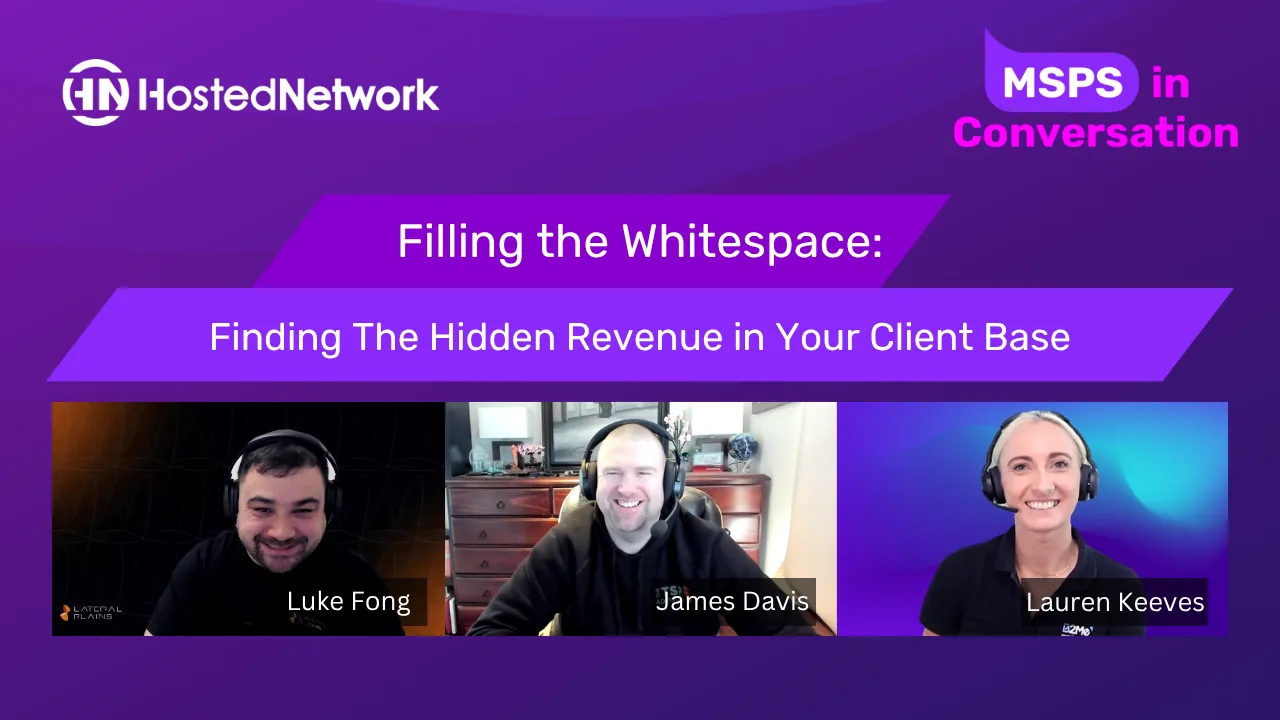
In this episode, we’re talking to MSP leaders who have audited their client base, identified the gaps, expanded their solutions portfolio and unlocked significant revenue from clients they already have.
Consultants auditing MSP client books are consistently finding 40–60% revenue upside sitting untouched — enough in many cases to double the business. The budget already exists within the client base; it's simply being spent with other vendors.
MSPs are culturally wired to chase new clients because it delivers an adrenaline hit that upselling existing clients doesn't. This "break-fix" and order-taker mentality keeps them stuck in reactive mode, while the more profitable, lower-effort revenue opportunity sits quietly in their existing accounts.
The shift from reactive to proactive doesn't require expensive tools or complex campaigns. It means going to clients and talking about their business outcomes, not just their IT problems. MSPs that make this shift position themselves as strategic partners rather than support vendors, making themselves far harder to replace.
Clients are becoming more tech-savvy and scrutinising their technology spend for ROI. MSPs that stay in the support-and-infrastructure box are increasingly vulnerable — to commoditisation, to AI, and to competitors who will have those broader business conversations if they won't.
Edited for readability from the episode audio — may contain minor errors.
Welcome everyone. Welcome to this month's MSPs in Conversation. Today we are talking about the whitespace, so finding the hidden revenue within your client base. I'm very excited to be joined by, we've got James, welcome back. Lauren, welcome, first time. And Luke, welcome, first time. I'm going to get you guys to introduce yourself, but before we do, a little bit of housekeeping. As always, this is recorded. It will be cut up into a podcast on Spotify, all those sort of places. It'll go into a video around Vimeo, YouTube. And it is available on our MSPs in Conversation website, so make sure to check that out. If you do have to drop off, please feel free to share the recording.
And this is a bit of an interactive session, right? So if you've got a whitespace story, a question, maybe a scenario that you're wrestling with, drop it in the chat and we'll try and address it. The panelists will give you feedback as we go.
So with that, James, welcome back. Would you mind doing the honor of introducing yourself?
Surprised you let me come back. For those that haven't had to put up with my face on LinkedIn or anything, I'm James. I run The TSP Advisory and I've been helping partners for, this is year nine. I'm enabling partners, so hopefully I can share some wisdom today from all the mistakes I've made in the past.
And the mistakes you've seen many of us make as well, I expect. Lauren, welcome.
We're here. So yeah, I'm the managing director of B2Me Marketing. We've been around since 2018. We're a full-service digital marketing agency and help MSPs across Australia grow, scale, and stand out.
Welcome. And Luke, welcome, first time in MSPs in Conversation. Thanks for dragging you on.
Yeah, dragged me kicking and screaming, that's for sure.
Kicking and screaming.
Hey guys. Yeah, I'm Luke, the chief executive officer of a little country town MSP called Lateral Plains. I've been with our business since 2013, and I've made every mistake possible and then some. And James will probably even slap me around the face when he hears more of them today.
Well, thank you guys. A little bit about, I guess, the sponsor of the show, Hosted Network. So Hosted Network, very quickly, is a wholesale cloud and telco provider for MSPs. We started as an MSP way back when, but today we are 100% wholesale. And because we only deal with MSPs, we understand the challenges that you're facing. We're an entirely feedback-driven organization. Everything that we've built has been shaped by over 300-odd partners. And we like to help you get stuff done, right? So delivering cloud and telco services the way it should be for MSPs. Simple, easy, no margin burn.
And with that, I will stop sharing, and we will jump into it if I can find the stop sharing button. There we go. I only ever use Zoom for this, so I always have to relearn it every single time I do. Anyway, painter that paints his house that never knows how to do IT.
We're not here to hear about my IT problems. We're here to talk about whitespace.
So I'm going to start with you if that's okay, Lauren. In your experience, why do MSPs spend so much time chasing new clients when the revenue that they could potentially have is sitting right there in their existing client base?
So I think I'll just call it straight out. And especially being a business owner myself, we are all very much addicted to the chase and the adrenaline of winning new business. That's what I've seen in my experience. When you are looking at whitespace and expanding existing clients, it's a lot more quiet, and you don't get that same rush. And many don't even celebrate those wins effectively. So I think they're quite hungry. They see that as growth and misinterpret the revenue that they can achieve within their existing base.
Cool. Okay. James, now I'm going to throw it to you, and there's a reason I didn't throw the first one at you, because I wanted to give you this question. So when you walk into an MSP, you're a consultant, and you look into their client book, how much whitespace are you actually finding on average? Can you give us a sense of the scale? Is it 10% potential upside, or are we talking a lot more?
Usually 40 to 60% at least. The amount of partners I've helped, especially on the smaller side, the two to four million range, one to four million range, I guess, you can often double your business from just upselling to your existing clients and raising your prices. I've done that so many times. But I like what Lauren said, it's not as exciting. It doesn't boost the ego of getting all these sort of new logos and new things. So I think there is a bit of that adrenaline to it, but I also think it's the way that a lot of the partners started their businesses in terms of the break-fix mentality. A lot of people have a transactional mentality when it comes to sales. And I know sales is a dirty word, which we'll rip into later, but I think it's just they're used to it being more transactional. And because they're order takers, they get excited by people coming and asking for them. But to actually drive that growth, you need to be proactive. You need to do something. And that amount that's there can double your business.
So you reckon if you're in the one to four million space, there's a 40 to 60% upside, and you could double your business. That's huge and terrifying.
All right. Luke, so most MSPs say they're too busy. I think this is typical business owner, particularly in the SMB space, right? To go after new revenue. We're fighting fires, things like that. But the opportunity is already there, right? What have you struggled with? And I guess a second follow-up question, what data did you find in your business when you did address your whitespace that you originally weren't using?
Okay. So I mean, the things that we struggled with, I'm not a sales guy, right? I'm a tech guy. So for me, the chase was more about fixing a problem than actually chasing revenue. The revenue that came after it was somewhat great. But the thing that we, I came back to the business in 2013 from a corporate background. So I would work for Big Blue and some other bigger name corporations, and I tried to bring a corporation mentality back to the SMB. Okay, A, that didn't work. Actually sunk us a little bit even further than what we were.
We went from, I think it was in 2013, we were a $200,000 business as a family business to now, I think somewhere roughly we're on track to do four to four-and-a-half millionish this year, right? The thing that stood out the most when we struggled between sort of 2018 and 2022, realistically, was the fact that we weren't charging enough, and we didn't know how to go to our customers and say it. We're a family business, right? We don't like charging people the correct amount of money for their services and things like that. And again, I can already see James shaking his head at me because he's going to slap me for the way that we run it. But again, I'd never run an MSP until Dad threw me in the driver's seat in 2017 and said, "Luke, you got to do this thing, and we're going to make it work."
The one thing that we did, I think it was the end of 2023, and I think you guys might have been at DattoCon that year as well. We were on the brink, and I just turned around and said, "We got to do something here." So we went and analyzed all of our customer space. And the way that we went to our customers was basically, "Hey, look, this isn't working for us. We need to do it this way." And we effectively tripled our prices probably within a month. And I saw a 55% customer decrease, but I saw a 55% revenue increase.
And more profitable.
So we analyzed and did the whitespace on those particular customers that weren't necessarily profitable, but they came along with the journey because of the relationship. So that's what we found anyway.
Cool. Okay. James, does that align to what you normally see in the space?
Yeah, all the time. Time and time again, we're undercharging so much. Everyone's so afraid to raise their prices. I know we've spoken about this in many years on this, in these sessions. They raise it. Often we don't even lose as much as what Luke did. That's sort of an extreme. It's also probably a bigger extreme of price rise, but it always works out like that. And that's a key part of growth, and then it's the whitespace that drives that additional growth in the clients. And it's not even about revenue, it's about the profit. This is what a lot of partners miss when they're thinking about this as well. They're stuck on the revenue, and that's going back to Lauren's point of like they can see if I add X client externally, I can add a grand worth of MRR. That's exciting revenue, where whitespace is a bunch of small margin plays that you have that adds up significantly over time, and it's all intertwined. And it's more strategic when you look at it compared to that transactional, let's just add a new logo, let's just white tool. Our clients ask for something and we can reactively order-take. It actually takes focus and action to effect.
And I can probably talk to a bit of the whitespace stuff there too, James, right? So we looked across our customer base over sort of 2024-2025, and towards the middle of last year, we, you know, we sell our full managed service contract with everything or nothing, basically. But there were sections that were bolted in with, whether it be BCDR or backups or whatever it may be. And we're like, well, the pricing has moved for them from a supplier perspective, but we haven't moved our customer base. What are we doing about it? So we then did some math and said, "All right, cool. We can ramp this over the next part of the contract period." And all of a sudden our profitability that was there in 2024 had disappeared in 2025. And we're like, "Okay, cool. We can ramp this back up." So we did. We had the conversations.
And the hardest part about the whitespace analysis is not necessarily the analysis itself, it's the conversation with the customer. I think a lot of MSPs like myself who get nervous talking to customers, it's because, all right, cool, hey, we need to do something about this pricing. You're afraid to get smacked down about it, right? Taking that proactive approach of, okay, cool, we have to have this conversation regardless of what the outcome is, we need to get on and have that chat. So I think that's where a lot of whitespace analysis in most MSPs falls down, is because they're not willing to have the conversation because they're afraid of the outcome. Whereas we need to have the outcome.
I think to add to that, there's two parts. There's obviously services that they need that they don't appreciate and you need to push forward, like with cyber and other things, but there's definitely other areas and other whitespace that they don't see that initial need, and so everyone's journey is also very different. And so if you go, "Hey, I'm just going to do a campaign to fill this particular whitespace and dive in there," they can smell a sales pitch a mile away. MSPs, as I know and like you, they don't feel comfortable with having those conversations. They also don't want to be that sleazy used-car-salesman guy. So it's about just setting yourself up so that you have the right tools and the right information, so when they're aware that you offer those different things, then you can meet them when it does become a need. So there's also that part to it as well.
It's interesting. One of the things I see, when we did this back in the day, we were an MSP ourselves, right? And whitespace, I guess it's not even just an MSP piece. It really is, if you're talking B2B and you've got a service portfolio, I can only imagine retailers would do it as well, and it'd be across the spectrum. But where do you start, right? So James, what are the tooling and the data that MSPs have got that they can look to identify the opportunity? Because you've mentioned 40 to 60%, right? Where would they start to quantify what that would look like themselves?
Yeah, they've got all the data in their PSA. So it's not like we don't already know what our clients ultimately have at a high level. It's actually stopping and doing it. And people get sucked into, "Oh, we need all these tools to do it." It's a simple spreadsheet exercise of, here's our clients, here's our main offering lines, what do they have? That's the first step. Put a cross in a box or not. That's how whitespace got its name. You fill the box, it's not white anymore. And people overthink this a bit. Just to get started, you get to the next step, actually quantifying their spends and stuff and the profitability. You can go to the next level in that. And again, that's not too hard if we've got data in our PSAs, which the great majority do. How accurate that is, it's 50 to 100% accurate. If you're starting from low accuracy, just assume it's a bit low accuracy and move on.
The problem I keep seeing along with time is people get caught up on the analysis part and it needs to be perfect. We need to have all the data. We need to have all the data to go talk to the client. Don't. All the ones that sell a lot more don't think about that stuff. They just go talk to the client. "But we don't think they have this, or we've got gray information." Well, we can go and be honest and go, "We've got gray information. Let's start from a point of, can you help us so we can help you?" kind of thing. But that data analysis becomes an excuse not to talk to our clients. Like what Luke was being open about, most owners aren't comfortable talking to their clients anymore. Especially not proactively. Everyone's fearful. Even take away the price rise things, people are fearful because they don't have the answers. And we only don't have the answers because we're not asking the questions. We don't know our clients well enough. And that's getting more and more dangerous.
And keeping it to this whitespace thing, our whitespace is actually getting broader and broader. There's more opportunities to sell different things. And a lot of partners are restricting what they're actually looking at to that old sort of rigid stack approach of, we only sell our managed service and there's a couple of add-ons and that's it. Actually, like I rattled off in an article the other day, I could think of like 68 different things that we could sell off the top of my head when I just went bang, bang, bang, bang, bang. That's a lot of whitespace and a lot of revenue and a lot of things. But I think it's the owners getting in their own way. They don't actually want to do this.
Sorry, you go, Luke.
No, I was going to say, at an owner's level, right? A lot of us struggle to understand a lot of the time that the ability to talk to our customers is actually key to the whitespace, right? So we went through this the last three or four months. We've had an uptake in some of our non-recurring revenue, which is some professional services stuff that we didn't think we could deliver internally. And then we realized all of a sudden, yes, we actually can. And our customer base is going to be better for it, right? Let's take a SharePoint project for example. There's a lot of customers out there that need SharePoint an intranet or just a basic type of collaboration tool, right? We were just delivering it as part of our managed services. Actually, no, this is a project here. And all of a sudden, we could see our NR numbers going like that, right? And you don't need to do whitespace to realize that you can sell a project. But a lot of owners don't understand that, right?
I speak with, you know, I'm part of a peer group and a lot of peer groups around the country. And I consistently hear people saying, "Oh, yeah, no, we just sell it as part of our service." I'm like, "Why? Why are you selling it as part of your service? This is a project." And I was talking to a partner yesterday. Four hours, and I say four hours is one of my partners that said that anything over four hours moves to a project. It's then got to be quoted, right? And they've just got like a workflow rule to go, "Hey, we can't spend any more time on this. We need to have a conversation."
I mean, it's ballsy, but yeah. Four hours. It works, all right? Because you're right. So many partners do that.
Yeah. Exactly.
Sorry, Lauren, to cut you off.
That's all right. I was just going to piggyback off something James said about looking at whitespace, analyzing it. It's exactly right. There are many tools out there. I've even got a client that's built their own Power BI dashboard to look at the data. But I agree, it's not actually a visibility problem and they don't need to overcook it. It then comes down to an accountability piece. I don't think it's actually really clear who owns the whitespace and filling it. And that's then whether it's the owner, whether it's the account managers, I think it's really blurry. So even when they have that clarity, they have the information even at a very top level from their PSA, it's just not clear on who owns it, and then no one's actually filling it. They're not thinking the way that you were thinking, Luke, about shifting it to a project. And so it's actually about changing that mindset, mentality, and getting them to see it differently, and someone making it clear who's actually accountable for fulfilling the whitespace.
It's a great call out because a lot of us have account managers, but a lot of us don't want account managers to be selling for whatever strange reason. They don't see it as a sales function. And so they turn it into a service delivery manager function. And service delivery managers don't drive whitespace. I promise you, I've got a technical alignment manager, which is, you know, in the commas, an account manager as well, right? The amount of conversations that he's been able to have just by sitting in their office and asking and understanding the problems, our whitespace gaps have gone from like here to like up here, knowing that we can deliver. It's wild. And even, you know, I don't like to call him an account manager, but I want him to go and sell what he can do best and what our team can deliver. That's the whole idea of technical alignment, right? So for us to be able to take those three steps, ask the questions, make sure we understand the problem, and then have a project to deliver the solution. It's wild how people don't want people to sell. At the end of the day, our team is our best selling point. They have the ability for gap analysis there. They're already there living it and breathing it. When the guys are there on site, when they're actually talking to the customers, the whitespace gap analysis does itself. We just got to be able to go and deliver and actually pick it apart.
And the only reason things can become blurry and people can overthink it as well is when you do have account managers and they're out there, or whoever it is that's out there with the client, are they actually picking up on the right signals? Although your PSA can give you that top line or what agreements they're currently on and you can find that, if the team are also using a different CRM like a HubSpot or whatnot for collecting all the information that they went out on site, or if they've got it in their documentation, there's probably lack of clarity there and the ability to identify, okay, you've got all this whitespace with a client, that audit, that matrix, your PSA's told you that, but knowing what trigger and which whitespace to jump on, that's where the missing gap is. And that's a gap not just in the small partners, but it's in the big partners that I work with as well, that have like I'd call them gun account managers. Because things are getting broader, our verticalized stack that we once had, all of a sudden it's gone from maybe those 10 items at most that we have in our whitespace covered to 68-plus. It's getting harder and harder for them to be across all of that enough to be able to identify those opportunities, and probably more importantly, be confident in bringing those topics up and actually having a conversation about it. Like even the experienced people not wanting to be idiots in the room. And it's holding a lot back. So it's not just the small MSP owners that are anti-sales and they don't want to do any of that for multiple different reasons. Even actual salespeople on my end are struggling to be across enough things to be able to direct a client. It's a big challenge in the industry.
So we've identified it's a bit scary having those conversations sometimes. For those tech-led owner organizations, it's a bit more challenging. But let's talk a little bit about the risk of not having the conversation, right? We see this in telco from a Hosted Network side quite often. Telco is a whitespace play. But what we see is that there are retail telcos coming along, right? And all of a sudden they're having other conversations. Everyone's an MSP these days. What can that look like, in your experience, Luke? Have you got any experience where you've faced that sort of thing?
Yep. Absolutely, I have. The risk of not having the conversation is that you lose a relationship, right? At the end of the day, we kind of neglected a couple of customers, not through fault of our own or them, and they went to a telco for their MSP. And quite literally within six weeks, they were begging on the door coming to come back. And I said, "Sorry, we've ended that relationship," and I was too embarrassed to go back to it. The reality is that the risk of not having that conversation is that it's not just the revenue loss, it's the reputation loss. People forget that people talk. The world is a globally connected village right now, right? I can get photos from an airport in Las Vegas from a dude that lives in Ballarat hanging out with someone I met in Atlanta. The risk of not talking to your customers, someone talks to this person, someone talked to that person, "Hey, we never had any comms from these guys, so probably best not to go talk to them." It's a reputation hit that happens, right? So that's risk number one.
Risk number two is that when you lose that customer, it also has a flow-on effect to your team. And that's big for my team at the moment. When we lose a customer, they actually take it personally, when realistically, business is business. But I understand where they're coming from because they've nurtured the relationship, they've tried their hardest, etc. So yeah, that's the real risk. For me, anyway.
James, what are some of the risks that you see from not doing whitespace in that sense?
You've got multiple different angles. Luke's touched on some good ones. A lot of the risks that I'm seeing at the moment, we all keep talking about the cybersecurity risk if we don't educate our clients and they get hit. It's an obvious one, a fairly legitimate one, that I don't think enough partners take seriously enough. They think they've had conversations with their clients about cyber, but they've tried to flog some tools. They haven't actually spoken around the real business impacts and outcomes and what's going to happen. The other risks are that the clients are actually outgrowing the average MSPs. They're becoming more savvy than the MSPs themselves. And I know a lot of MSPs will sit there and scoff at that. They won't know as much about how to configure M365 or networks, but they definitely know how to leverage business technology better than you guys do for their own business. And so if you're not involved in those conversations, that's the big risk, isn't it, Luke?
Yeah, it's a massive risk. And I'm going to bang on about this at some point, right? And there's going to be a lot of shade thrown at me for this, but people keep shoving AI down our throats, right? And this is where the biggest risk to us in a whitespace mentality is. Everyone's going to go, "Oh, we can do this with AI. We can do this with AI. We can do this with AI." At some point, someone's just going to turn around and then AI their MSP out of their business. For the ones that are having the conversations, sensational, because you know that you're not going to be AI'd out of the conversation. The amount of slop that I'm seeing on the internet at the moment, especially on LinkedIn and a lot of social media, is that, "Oh, we can automate half of our workflows this way or all of our workflows that way." You've got to have a human behind it, right? And nine times out of ten, it has to be from the IT team or your MSP. I've got a couple of customers that are dabbling with Claude and Copilot and trying to vibe code their own CRMs and things like that. Like, can you please stop? Just don't. The risk for us is that they're going to try and figure out that we're not actually needed. That risk is huge. Not because it's going to demolish us as an industry, because I don't think it will. The thing that's going to demolish our reputation as an industry is that, "Oh, we can do it better and cheaper," when margins are already super thin at the moment for what we're having to do on top of all of that.
It's the risk of relevance, one way or the other. If you're hanging your hat on the value of supporting infrastructure management, clients genuinely need less support than what they ever have. I don't care what people say. And half of it can be automated away legitimately as well. Infrastructure management's a huge commodity that can be done a lot better. So there are going to be players that come into the market and can do it better, faster, cheaper than an average MSP. So you do then start competing on price legitimately, not like the old days, and you become irrelevant on that side. But if you're not elevating yourself and actually talking to the clients and understanding their business, and then this comes back to our solutions portfolio and whitespace, if you're not bringing them solutions to their business problems, you're irrelevant as well. And that's the biggest risk, is relevance. A lot of partners have just coasted on by because we were sort of like a given, we needed to be there to keep everything running, and the clients begrudgingly signed us up in the first place. They saw the benefits. We kept them going and they were happy enough just to be there. We're like an actual service-based business. But that relevance is shifting, and that's where a lot of the partners are struggling.
So with the partners that you've seen be successful, they've attempted the shift, right? They've gone from that reactive to proactive approach. What separates them from someone that talks about it versus actually delivers it?
So there's probably two sides to proactive. When we hear proactive as an industry, we think of all the back-end management stuff. Proactive whitespace filling, yeah, it's an important distinguishing factor, because it is that. It's the difference between when the technology, the proactiveness is actually going out and having a conversation with your client about something that could help them. And that something could just be an awareness-level activity that highlights something that they didn't know and they needed some education and seeding. Could be a direct thing about their ICT environment to go, you need to do XYZ to mitigate business risks. Or it's going out and discovering and bringing them solutions to their business problems. It's as simple as that. Everyone makes this a bigger thing. We've got all the vendors that are trying to flog all these tools for things. But it's as simple as just actually talking to our clients.
Yeah, and James, you touched on a really good point there. So one of the things that, if I am selling to a new client, regardless of the whitespace, I actually tell them, "Hey, part of the reason why you're paying Lateral Plains is because I do a bucket load of travel to conferences, to technology meetups, to all of these kind of things to learn more about what's happening in the world so I can bring that back and share that with you. Because if I can improve your business, I improve the whitespace that we can find a gap for and then fix the problems that are within the business." And people look at me strangely and go, "Oh, but we're paying you for support." I said, "No, you're not. You're not just paying me to support your infrastructure and your business. You're paying for me to be able to help your business outcomes and be more efficient. I can bring you better solutions if I'm out there learning."
That's Elliot from the chat just echoed that, and he's said that the question we need to be asking clients is, how do we assist you growing your business and better utilize the technology that you already have? And I think that is, James is right, the business conversation is not an IT conversation. That has been echoed in many of these sessions for the last few years. So definitely make sure that one sinks home.
Lauren, I want to shift a little bit over to your skill set if that's okay. In terms of marketing, myself included when I say this, so no one take offense, but most of us are fairly introverted when it comes to these conversations. How can marketing help us generate conversations? So the marketing is doing the proactive piece of it for us to generate those, and then we're kind of just following the bouncing ball, if you will. What does it look like for a campaign in your mind?
Yeah, so once you understand what whitespace you want to focus on, and again to my point earlier, it is about making sure you're creating a strategy for all of the different whitespace areas that you have, so that you can trigger the right one depending on where the clients are and being across all of those different areas. One most commonly that we support businesses with is nurture campaigns, and that isn't just your typical email nurture where you're feeding clients in. Although that is a nice starting point, building out that journey so that you can plant those seeds, educate them along the way. You're seen as, I'm not trying to sell you anything, I'm just trying to broaden your knowledge on this particular topic or offering, and letting that sit with them. But off the back of that, even as a standalone or to be fed into the nurtures, it's things like case studies that are focused on problems rather than service-focused. It's also being more active on LinkedIn. Now, putting aside the fact that a lot don't actually focus on building their LinkedIn connections and portfolio, let's say they do that and they're connected to all their clients, that is that passive way that you can be in front of these topics and they're aware that you offer that or have an opinion.
So they shift their understanding from, at the minute, their clients have been so trained to only come to you when they have self-identified a problem inside their business. They'll come to you and go, "Hey, this is the problem. Give me a solution." And MSPs will do a quote and then they'll sell it in. So with this approach, either through nurturing or through LinkedIn posting, it can be as simple as that, you then start shifting their mindset, and instead of coming to you with the decision that's already been made and all their problem, they're actually coming to you to help and get you as part of the decision-making process. So it can be as simple as those things. There are other things like, again, helping them feel like they've come to that understanding or identified the need. There are things like interactive quizzes where they can do those self-evaluations. So again, putting as much in the clients' hands because no one wants to be sold to, but just helping them come to that realization. And that you are the natural choice and that you offer it, because a lot of the time they're not aware. As much as I talk to MSPs and they'll say, "Hey, my clients are aware of what we offer," like, I've seen it, I've seen MSPs lose business that they thought they never would, with even services that they offer, but the client had no idea. They're not looking at your website every five minutes and double-checking again, because they're not used to that. They've put you in a box. So it's trying to break down those walls and get them to bring you into that conversation a lot sooner. But yeah, there are many different ways to do that. It just comes back down to having a strategy and what you need to focus on.
And when you find that strategy's successfully executed, is that a single whitespace area or is that a bit more of a broader approach?
Yeah, it's across the board. So taking that audit, you've worked out where you've got your whitespace and how you ideally want to fill it here and there. Let's put cyber to one side, but let's talk more broadly about connectivity or comms. And it might not be at the front of all clients' minds. You do a campaign and go, "Hey, this quarter we're going to focus on getting internet into everyone." That might not be the most pressing issue that they want to handle right now. It's something that by all means you should start planting seeds so they're aware and whatnot, but you do need to have whitespace campaigns across all the different areas so that you can pull the trigger depending on which one they're after, pull the necessary ones. So as an example, with the clients that we work with, we'll build multiple whitespace nurture campaigns, and it'll be a matter of then the account managers, after they have a QBR or they just have a general catch-up with their client, picking up on those signals and then being able to go, "All right, okay, I think it's necessary, let's start putting that client on that path because I see in the next three to six months that's going to be something that they need or we should talk to them more heavily about." Let the nurtures do all the heavy lifting. Start getting that information in front of them early. But yeah, go across all the whitespace.
Okay. James, what do you see? Do you find the same? Do you go broad or is there, do we focus on 100 things or do we focus on four? How broad do we go in your opinion?
The ideal and the most successful is when you've got focus per client. You need to be strategic about this. It goes back to there's no one line of transaction that's going to work every time, and every client's on this different part of the journey. You need to actually understand your clients again. So as an account manager, even I did this back in the day, you know what you've got to sell, what your clients have, and you're always looking for what's the opportunity to get one of those over the line in one of your clients. And if you know your clients well, you'll know there's two or three things that you'll be talking to that client about and one of them will be accepted. Even if you oversimplify this and go, basically you have three talk tracks for that one particular client, one of those things is going to land in that quarter. And then you multiply that by all the clients inside your portfolio. It's probably unlikely that out of 20 clients, even 25% of them are all going to end up with the same thing. And that's where the complexity starts coming in if you don't want to focus on this. You choose to be busier. Like if you're an owner-led sales and you're the account manager, if you're choosing to be busy and focus on other things, you're never going to do this. You're never going to succeed at this, because it goes back to that transactional approach.
You can seed it a bit better with marketing, and this is where a lot of partners fail to think about marketing in the right way. Everyone defaults to, I'll chuck some money at it, it's a brochure on the web, and randomly new logos are just going to fall out of the sky and then they're going to sign up with me. But actually the best way to utilize marketing in the first place is to wrap around your whitespace activity, because while you're focusing on your existing warm client base, it lets you hone your messaging. But it's all projected digitally. So you're treating external like they're already sort of clients, and you're trying to educate them, and it pushes your feel and your culture and your identity out, rather than it being this sort of brochure approach. So the broader you go, the more strategic you have to get, and that's the challenge for partners, is well, probably 99 out of 100 have no strategy, have no plan, have no focus. Plus add on the fear and/or the I don't actually want to be a salesperson. So it's no wonder no one does this.
Big opportunity, right?
Huge.
Speaking of that opportunity, what, and I hope you say that it's telco and services, I'm just seeding an answer there by the way, but what are the key whitespace services that most MSPs are asleep at the wheel with? Where is the opportunity that you see? And Luke, Lauren, feel free to chime in as well.
Communications, voice, data, mobility is a key. And it's probably not what Ben's going to want to hear, but apart from the fact we need to start controlling that because then we start to get more grasp of the client's budget. So it's not even about us making more margins. It's actually us getting more visibility on our clients and starting to step into areas that we haven't traditionally done, but we should. And the clients actually want us to as well. That's the important part. What everyone forgets in this whitespace conversation is the clients want us to be their technology partner and own everything. They already assume we do, and the more that we say no, the more that we don't do, the crumbling of that relationship, like Luke pointed out, happens more and more, and it's eroding very fast. But that voice, data, mobility conversation, there's actually quite a big opportunity that a lot of organizations are overspending, and you can get better rates for what they need, or better solutions for the same price. And so you can look like a hero very quickly to say I've saved people money so they can reinvest in other things, or get them a better solution for the same price and they're in a better spot. Ben knows well, as everyone you pointed out before, voice, data, mobility is a commodity space. So we need to treat it like that, but do it with some smarts wrapped around it.
The next bit better as well, just quietly. There's a lot of people that are doing that voice, mobility, and data really, really poorly, right? And we end up getting the backlash for it.
Especially if you're letting the customer buy that voice from someone else, it's always going to be your problem, right?
Yeah. You know. I'll just throw a focus on a word that you said, James, that is budget as well. Going back to it, and it doesn't actually get thrown around in these sessions as much. We focus on the business conversation, but if you understand what they're budgeting, what they're spending, and where, you can have a totally different conversation. When your customer comes to you for that, then you're on a good trajectory. And they're not going to unless you elevate above and go to them and talk about budget. And show them solutions in different ways. And that's where everything starts opening up.
What's happening in most of the market on the client side, whether you're seeing it or not, and probably the average partner actually isn't being told this because they don't have the relationship, I think, every client is looking at their technology budgets because it's number two or three spend line on the P&Ls these days. And clients are looking at what's the ROI they're actually getting from the technology spend. And the signal that most MSPs get back to them is, oh, the client's concerned with one of the biggest line items on their business, they want to cut me. Most clients aren't looking to actually cut costs. They're looking at better ROI and leverage. And the only time they're looking to cut you most of the time is when you're a commodity and you're hanging your hat on that support, because they don't believe they're getting the actual return on investment of spending $100 a seat to pay you to fix nothing. They want to leverage part of that $100 that they're already spending per user to leverage for AI, to shift that to cybersecurity, to increase their communications because they're opening a new office and they've got more or a warehouse and they need to spend on more IoT. That's the challenge. And what Lauren said before is like most MSPs have put themselves in a box. They've set up the client expectation. Everyone keeps thinking, oh, the clients don't respect us, they don't come to talk to us. Well, they only don't do that because we've never set them up to expect anything different.
And the application layer is the perfect example. You just think about 10, 15 years ago when everyone was on prem. We didn't want to hear a bar of what the application problems and stuff were. We wouldn't touch it. We'd sell them a new server and network and make sure it was all up and running, the vendor can put on their software, and we'll, you call us when there's a problem, we'll escalate to the vendor. That's all we cared about. And that behavior has set up that expectation of, oh, we only talk to them about our support, like what Luke was saying, and a little bit of hardware. Why would I talk to you about my AI? Why would I talk to you about my cybersecurity? The amount of conversations that we get to have now is not around support. My main driver now is not support at all.
Yeah, cool. We approach some discussions with support, even some of the new logos that we're talking to. But how do we make the business more efficient? How do we scale your operation? I've got one that's on the hook at the moment. They need to open three new offices in the next six months. They've got a technology partner that can't scale with them. I've got hands and feet everywhere. Like I said to them, if you want to scale, I can help you really, really quickly. It's not hard. Thanks to the guys at Hosted Network, I might be able to do that even faster, but you never know. But the reality is that we're not having the right conversations and the expectation has not changed for 15 years, you're right. Watching some of my compatriots around town, I wouldn't necessarily call them competitors because we're doing things very, very differently to them, but they've still got the mentality from 15 years ago that you've got what you've got, we're going to support that and that's it. Whatever happens, happens. We're starting to pick up some of those customers now because they're actually understanding that they needed a better outcome for their business, whether that be efficiency, leveraging AI to do whatever it may be within their business. Having those conversations now, it's way easier to have them because we're already starting with those conversations. We're not approaching them with the, does that make sense? Because we've been in their businesses for so long.
Yeah. And to answer your question, Ben, I'll just finish the whitespace.
Go.
I didn't actually answer your question. What's the hot whitespace? It really depends on who your clients are and what industry verticals they are, what size they are, what part of their life cycle they're on. That's what dictates what's hot for each individual.
Not the answer that I was after, but I'll respect it nonetheless.
I kind of got a comment from Rob in the chat. A question that he's had more often is, why should I buy from you? Can you give Rob some advice? How would you recommend approaching that comment from a customer?
I have a question for Rob first of all. Do you know why they would buy it from you first? Because if you can't answer that question, then we need to understand. People will buy from you for three reasons. A is always budget. B is trust, and C is that you're knowledgeable. B and C absolutely trump budget, right? I've gone to customers before where I have absolutely blown their budget out of the water because of the solution that we provided, and B and C, with trust and the relationship, got us there. I guess the question is, do you have that relationship with the customer to say, "Hey, the reason why you would buy it from me is because I have that relationship and trust and knowledge with that customer." I have had to ask myself that at so many different levels. And in fact, I had this discussion with James at SMB IT last year. We were sitting there over a beer like, "I've just had this one that's come to me saying, 'Why would I buy it from me?'" And then James just looked at me going, "You know better than this, Luke." If they've got trust in you, you've got a good relationship with them, and you know the solution that you're providing is going to better their business, that's why they would buy it from you.
Cool. I think that's pretty concise. And it goes back to that business conversation, right? We're having a business conversation, you're understanding the budget, all of those sort of pieces of it.
All right. So for the smaller MSPs, and we're kind of getting towards the tail end here, for the smaller MSPs, is whitespace something that they should be focusing on? That can be a yes or no, but try to elaborate just for the recording at least.
I am the smaller MSP, all right? So let's not beat around the bush. I am the smaller MSP.
But you've got the smaller guys that are lifestyle businesses that are, you know, two or three hundred thousand dollars a year, and they do focus on that support piece of it fairly heavily, which you guys have just said is potentially at risk. So what do you think on that side?
I think the thing for me at the moment is there's a lot of private equity coming around bashing on the doors, right? The thing that scares me about people not doing that whitespace analysis first is that if PE comes and knocks on those lifestyle businesses and says, "Hey, we want to buy you for X amount," PE then buys them and then under-services them because they haven't had the conversation to start with. So we're actually under-serving ourselves as an industry. I think the whitespace analysis for the smaller MSPs is even more important, because if they don't grow to a point where they can exit and then hand that customer base over at a professional level. I would like to say, you know, us, James and Hosted Network and the guys being industry leaders, we want our industry to be held to a particular standard, right? And what you're saying is that you're only just getting these little guys that are only just doing support. So in my humble opinion, and please, whoever is listening to this, beat me up around what I'm saying here, but the reality is that if we don't get better as an industry, we're not going to get better at all. So it's very important to do it.
Yeah?
Yeah, I agree. It creates that stickiness, especially when they will have others that are delivering everything and are more vocal and they're doing their marketing. If you haven't at least evaluated your whitespace and tried to go broader and offer more services, you're not as sticky as when some big gun comes in. If that is when that client has got to a point and then they feel that they've outgrown you. Whereas if you've been that consistent and that piece, super sticky, then yeah, they're less likely to move off. And I guess I think that's probably scary when you think as a smaller business, for anyone listening, "Oh, crap, I now need to start offering all these services." And they instantly potentially default to bringing it in-house, and that's where probably they forget about they can still offer that through partnership, as long as they get the right partner, that they can still lead the conversation, be the one driving that, and they just have the partner doing the execution, then that's how they can achieve that.
Yeah. Can I just add to that, Lauren? So LP traditionally, we've had our singular stack. I've had many conversations about what we do and how we do it. One thing that we learned at the end of 2023 was that if we couldn't deliver it, we needed to find someone that could. They would wear our shirt, they would go and execute for us, they would wear the Lateral Plains brand through the whole project, whatever it may be. It is one of the most rewarding things to be able to deliver through partnership. There is a lot of other vendors out there that will do that as well. Your distribution partners will help you. You know, guys, not going to say Hosted Network again, but they will help you go to these customers and deliver these end-to-end telco services for you, right? Don't be afraid to ask for help. One of the things that I see a lot of people struggle with is that they have so much pride in that we can do it ourselves, we can just do it ourselves. I had a major project that I absolutely had to deliver last year. Couldn't do it on my own. I made three phone calls, and my executive director, my father, said, "Why are you going to partner? We can deliver this." And basically ran me down. And I said, "I just don't have bandwidth. I can't do it." But we also delivered it on time with margin to spare, and the customer was happy. Don't be afraid to ask for help.
I like it. I like it.
Guys, we're nearly at time. And Cindy's thrown a quick one in there. It needs to be quick because we're running out of time. AI is blowing up everywhere at the moment. Have you seen or used any tool that actually helps identify whitespace opportunities in your customer base using AI? Is anyone doing that? Is it low-hanging fruit? Are you for or against it?
I'm actually all for it, all right? So here's a trick that a lot of people don't know. For those of you who have PSAs and you have the ability to access an API, and you have the ability to have some form of Copilot or Claude or whatever it may be, talk to it in natural language, and it will query the absolute jibbers out of your database for what you're looking for, right? I actually did this last week. I hooked it up to an API, and I'm like, "Right, cool. What are these customers doing with XYZ contract, and where can we uplift?" And it came back with the services that we're providing them, and then compared that to another similar type of customer, and went, "Oh, look at that. There's this particular service that I'm not selling that particular customer that we should already be selling that customer." So we went back to that customer and tickety-boo, more revenue.
Cool. I'm going to hand it over to James to finish up.
Go for it. If I can just add, it can also help with finding patterns as well. To go back to my point about, "Hey, you need to go broad," that is true, because again, you need to make sure that you have the right area covered depending on where the customer's at. You can't just be laser-focused on one. But yeah, it can help you identify, you know, with patterns, all right, okay, actually we've got the biggest opportunity here, and also, based on other information, other data, we think that they would be prime for it. Out of everything, because you can't instantly go and create all the talk tracks or all of your whitespace campaigns in one hit, whilst you want to build those engines over time, it can help you prioritize which one to build first. So by all means, yeah.
Lauren, that sounds like a challenge.
Oh, I'll say it.
James, you've got to be the last. We've got to wrap up.
I'll be quick. Before you get me in trouble. I'll rant on two things. The small business thing. Doesn't matter what size you are, you need to be specific about what you do. If you're small and you're focused on support, how about you become a field services specialist and focus on that rather than trying to do what you can't do? Because if you're not an MSP already, you're way behind the boat, because the industry is shifting to the other generation already. You're like two, three generations behind. But there's still a need for field services because that's a very necessary thing. Or become a fractional CTO or a technology barrier. You don't need to become an MSP to service your clients, and with all the specialists, like what Luke said.
And I think, going to wrap up, to do all of this, you don't need to have tools. That enhances your work. Don't stop and over-engineer and get paralyzed by all this analysis. Go talk to your clients. Pick a couple of things that you need to sell. Pick an easy thing like voice, mobility, data, that's well-defined, and go through your client base and find all the opportunities. Bang, done. There's no tool. There's no need to do much else other than go talk to your client and just take action. Because once you start building momentum, momentum builds off momentum. The problem is most partners never start, so there's never any momentum.
You want to know why partners don't start? Because we always start the sentence with, "The problem is." And not, "The outcome is." All right? It's the mindset shift that I've had to do so many times with staff in my office. They always come to me and say, "Hey, this is the problem." Okay, cool. But what's the outcome that we need to achieve, and how do we get there? If you can even get to the point of asking yourself, "What's the outcome and how are we going to get there?" the problem becomes irrelevant.
Guys, we are at time, but that was fantastic. That wrapped up really, really well. My marketing team is yelling at me to wrap up. So very quickly, just so everyone's aware, this will be recorded and shared around. It will be available on our MSPs in Conversation website. But for a very quick plug, we are going in person. We and a bunch of other vendors are organizing our first conference. It is a one-day track. There is no vendor talk. It is all MSPs talking. And the idea of this conference is Catalyst. It is on the 3rd of June at the Sydney Swans HQ in Moore Park. Same idea as MSPs in Conversation, right? MSPs and operators talking. No vendors. We're talking around scaling, M&A, leadership. We've got Drew Arthur, the COO of Sydney Swans, who used to be the head of enterprise at Apple Australia, and he's doing our keynote as well. But the big exciting thing for me is that we're doing MSPs in Conversation in person. So we'll be interviewing and asking various industry leaders about what they're struggling with, what they think we need to focus on. So if you've got something that you'd like to talk about in person on camera, please reach out to me. I'd love to have a chat.
So with that, thank you, guys. That's been really, really good. And I appreciate all the comments, the chats. And yeah, we'll leave it there. We'll see you next time.